The Lukewarm Reviews Are In

AP's Chris Duncan reports that the Rees Jones-David Toms course at Redstone didn't exactly remind them of Riviera.

The Shell Houston Open will move to the weekend before The Masters next year, a change organizers hope will lure a more star-studded field.

It's not the date, but the course that could keep many away.

The Tournament Course at Redstone, where Stuart Appleby shot 19 under last weekend to win the event, got a lukewarm response from the players, most of whom were seeing it for the first time.

Vijay Singh won the previous two Houston Opens at the adjacent Jacobsen/Hardy course at Redstone. The event moved to the 7,457-yard Rees Jones layout this year.

Singh said too many of the holes look the same.

"The golf course did not grow on me," said Singh, the 2000 Masters winner. "Normally, the more you play, the more it grows on you. I just hope they go back to the old golf course next year. I think that's the consensus of most of the players."

Bob Estes, who finished second to Appleby, didn't like the distance between holes. The second tee was more than a quarter mile from the first green and though players had carts waiting to shuttle them, Estes said the process backed up play.

"It's just so spread out, the rounds were really long, and that's the downside of it," Estes said.

I'm shocked.  Jim Nantz said it was getting rave reviews!

The Signature Hole Has Not Been Established

Garry Smits reports on Tom Fazio's latest masterwork, Florida's Amelia National (aren't we about to run out of names you can put next to National?).

You'll be shocked to learn that the course is going to be tough from the back tees, but still playable from the member tees.

"Tom did a very nice job," said 2005 Players Championship winner Fred Funk, who conducted a clinic and participated in an opening-day tournament, along with Fazio. "It's a very good test from the back tees, but it's also going to be a very good member's course."
According to Smits, the only thing left is a decision on the signature hole.
Although a "signature hole" hasn't been established, it might be the 460-yard, par-4 18th, with a series of fairway bunkers down the right side. But the par-5 ninth hole, reachable in two shots for good players, is a twisting, winding beauty, and the parallel par-4 fourth (424 from the back tees) and par-4 fifth (405) form a picturesque pairing.
 The American Society of Signature Hole Comittees (ASSHCom) will have a tough decision on their hands. I say give 'em two signatures, the front nine and the back nine signature holes.

Work for you all?


Campbell on New Redstone Course

golf2.jpgSteve Campbell looks at the new Houston Open design by Rees Jones and David Toms that is debuting this week.

If the Tournament Course lives up to the reputation of its designer, then the SHO should be a breakout hit. Rees Jones has established himself as major-championship course doctor of sorts, the man the United States Golf Association and PGA of America turn to when they want to upgrade a classic layout. The son of renowned course architect Robert Trent Jones, Rees Jones has performed major undertakings at the likes of Congressional, the Country Club, Bethpage Black, Pinehurst, Torrey Pines, Medinah, Hazeltine, Baltusrol, East Lake, Sahalee and Atlanta Athletic Club.

"I've been very fortunate in my life to have done a lot of these championship venues," said Jones, whose body of work includes Redstone collaborations at Shadow Hawk and The Houstonian. "The more I do, the more I understand what you must do to challenge the best."

Nothing like learning on the job!

To that end, Jones designed a course that plays longer from the back tees than any on tour so far this season. The Tournament Course is also 51 yards shorter than the adjacent Peter Jacobsen/Jim Hardy Redstone Member Course, which served as SHO's halfway home the previous three years. Jones describes the Tournament Course as a "neo-classic" design that favors strategy and shot-making over raw power.

Longest on the Tour so far, but it favors strategy and shotmaking over raw power. Makes sense.

One of the distinctly Toms touches was No. 12. The 338-yard par-4 is, depending on the wind, drivable. With the reward of a possible eagle comes the risk of hitting the tee shot in the lateral water hazard right of the green.

"I'm hoping they set up the golf course to let guys use that risk-reward strategy," Toms said. "We don't get that very often. There's always thousands of people around those holes, trying to see what the pros can do, seeing if they can make an eagle or a double (bogey). They're well-received with the spectators, and the pros like them as well."

Wishful thinking based on this year's course setups.

"The golfer has a choice," Jones said. "I think that's great for a championship. We're making them strategize. The winner will be under par. But we're making him manage his game by the green contours and the angles of the greens. He knows the easy route may lead to a three-putt or the harder route could lead to disaster but has a greater reward."

It all sounds so good.

Huggan On Musselburgh

John Huggan offers an update on the Musselburgh Links situation where a public inquiry has been ordered.
And therein lies the crux of the debate: is the links in its present configuration and condition worth preserving? Or has the damage already been done? One of the few areas on which both sides are agreed is that the course is a long way from the one on which those five far-off Open champions learned the game.

So is it too late to save what is left of the Musselburgh links? And is it worth saving? While any number of mistakes have been made over the years - the short fifth, for example, had two nonsensical and wholly inappropriate bunkers added behind the green as recently as the past decade - and the course itself is best described as shabby, it is difficult for any golfer not to hope instinctively for its salvation.

As to what may or may not still happen, both sides are already preparing for the on-going battle.

"I'm still confident the golf course will regain its pride and that the interests of the club will be looked after," says MacGregor, at the same time acknowledging that the public inquiry came as "a bit of a surprise".

On the other hand, Colville is delighted at the latest development. "I'm still not sure of ultimate victory; far from it," he adds. "But I think we have a far better chance of winning in a public forum than we did when it was up to the Executive. We have support across the town from all sorts of people, and that has to count for something."

Rain Delay Flashback: 1937 and Perry Maxwell

Courtesy of reader Michael... 

AUGUSTA COURSE TO HAVE FACE LIFTED FOR MASTERS' TOURNEY

By Charles Bartlett, Chicago Tribune, Sunday, January 23, 1938

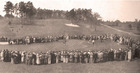
Major league golfers who have been swinging clubs for the last four years in the annual Masters' tournament at Augusta, Ga., which brings a man named Bobby Jones back for his single yearly appearance as a competitor, are going to do a bit of eyebrow raising and glove flexing when they step upon the first tee for the fifth all-star show there, beginning March 31 and ending April 2.
230136-246885-thumbnail.jpg
(click to enlarge)
The reason for their concern may now be called work in progress. It consists of transforming the course from its original Scotch motif to one more adapted to the American topography upon which it was constructed. No official announcement of the revisions has been made, but the presence of a sharp eyed little Oklahoman named Perry Maxwell on the Augusta National course these last few months would indicate that the lads will find a new layout when they set forth in quest of the $1,500 first prize.

Mr. Maxwell is a livestock farmer who, in his spare moments, has become one of the nation's leading golf architects. He has been assigned the chore of making the Augusta National acreage an American course rather than the overseas composite layout it was intended to be when the late Dr. McAllister McKenzie, and Jones himself collaborated on making it a replica of the more famed seaside links.

Principal changes in the National course will be in the vicinity of the greens. It was around these that the original sketches aimed to reproduce the foreign touch of St. Andrews, Muirfield, and other noted courses. Four years of competition have proved that while the experiment may have been a worthwhile effort as such, the lovely Georgia countryside is not adapted to it. The quarter mile arch of century old magnolias, leading to the antebellum clubhouse, are only a preface to the wistaria and dogwood with which the course abounds. Attempting to duplicate the austere Scottish coast line, where the early morning mist makes it difficult to distinguish the rolling sand dunes from the gray of the North Sea, is a feat not in tune with the terrain at Augusta. The abruptness of the dunes contours, which frequently caused well-hit approach shots to kick awry, has been done away with. So also have the peculiar undulations in the ground adjacent to the greens been reduced, although at no sacrifice to testing a shot.230136-309828-thumbnail.jpg
(click to enlarge)

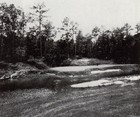
The greens at the fifth, seventh and seventeenth holes have been rebult, and an entirely new tenth green has been cut into the hillside behind and at the left of the original green, on high ground. The hole has been lengthened to 449 yards, and is a fine two-shot test for the experts. P.J.A. Berchman, the horticulturist who was born on the site of the course and who has been resonsible for its general beautification, has removed seventy-five pine trees to make way for the new tenth. The change has been made not to eliminate any peculiarity in land formation, calling for what was at best a freakish second shot, but to try a player's ability to hit a long ball to a well built-up modern green. The green proper is the largest on the lot, and will call for precise approach putting.

Not all of the old country features have been eliminated. The "schoolmaster's nose" bunker in the middle of the eleventh fairway, built to duplicate one of old St. Andrews' most notorious sand pits, is still there. It remains the same as it was on that day when Col. Bob Jones (father of Bobby) hit a good drive into it, and was moved to inquire, "What jackass dug that in the middle of the pretty?"


Boswell: US Open On Magnolia Lane

Thomas Boswell in the Washington Post column (thanks reader Tim):

Welcome to the U.S. Open on Magnolia Lane. Gentlemen, check your charisma at the gate. Hit it straight, but not too far. Aim away from the flags. Think pure thoughts. Don't make the Masters galleries cheer too loudly. And win a green jacket.

They've finally done it. They're taken the "Ahhhhh" out of Amen Corner. They've Tiger-and-Phil-proofed the Masters. They've transformed Augusta National, the home of imagination, channeled recklessness and swashbuckling recoveries, into a golf penal colony. Think bad thoughts -- like "make eagle" -- and end up in jail. It's April in Georgia. Get ready to yawn?

For the past five years, Augusta National has been messing with Bobby Jones's masterwork, trying to adapt it to a new golf world where every ambulatory male crushes his tee shot half a football field farther thanks to a trampoline-faced driver and a ball designed for space travel. No additional talent required. Just buy that extra 50 yards at the pro shop. Credit cards accepted.

The Masters has found itself precisely at the center of this battle between golf equipment commerce and classic golf course architecture. So, to defend its layout from strategic obsolescence, the Masters has added almost 500 yards of length, narrowed fairways, added forests of magically mature pines, put its sand traps on steroids and built mountainous mounds.

Rubenstein On Augusta's 3rd

Lorne Rubenstein looks at one of the only holes not lengthened at Augusta, and includes this classic line from Nick Faldo:

Three-time Masters winner Nick Faldo was dead on when he said, "All the great holes in the world are the twitchy ones."

He also writes:

"There are three or four options on the hole," Stephen Ames said yesterday before going out to play the par-three contest. "It all depends on where the pin is." His brother and caddy, Robert, said: "It would be nice if we had three or four of these types of holes on every course. All the classic courses have that kind of hole."

Meanwhile, told that Augusta National could find 40 yards behind the third hole to lengthen it, Ames, the recent Players Championship winner, said with his characteristic, and appealing, bluntness, "I'm surprised they haven't done that yet."

Let's hope they never do.

Crenshaw On Augusta's Architecture

From Jerry Potter's course redesign feature in the USA Today:

Ben Crenshaw, a two-time Masters champion, says the Augusta National that Jones built after winning the Grand Slam in 1930 was "revolutionary in American golf course design at that time."

"It was completely different architecture," says Crenshaw, a golf historian when he isn't designing courses or playing senior golf. "The course Jones wanted had as many options to play a hole as was necessary to keep any golfer's fascination."

Jones wanted a course that was a pleasure for a recreational player and a challenge for a skilled player. It wasn't too long, it wasn't too narrow and it had no rough. It did have undulating greens that placed a premium on the second shot at each hole.

"There was a safe way and a dangerous way to play each hole," Crenshaw says. "It set itself apart from other courses."


Kroichik On Distance, Masters Ball Possibility

Ron Kroichik looks at the possiblity of a ball rollback, a "Masters ball" and offers all sorts of interesting tidbits about a distance rollback:

Sandy Tatum barely hesitates before answering in the affirmative. Tatum, the former United States Golf Association president and patriarch of Harding Park's renovation, joins Jack Nicklaus in suggesting the USGA "roll back" the distance the ball can travel. Woods and his big-hitting colleagues on the PGA Tour routinely smack drives more than 300 yards, taking golf into once-unimaginable frontiers.

It's either a thrilling joyride (many fans), a fundamental affront to the game (traditionalists such as Tatum) or an unwelcome threat to booming business (elite players and golf-ball manufacturers).

Tatum begins his sermon with this premise: The ball goes too far. The faster a player swings, the greater the benefit from technology. Drivers with club heads triple the size they were 15 years ago collide with balls specifically designed to soar into the stratosphere.

"It puts the game seriously out of balance," Tatum recently said. "You get more emphasis on power and less on shot-making. The stats will tell you, accuracy is no longer anywhere near as important as distance."

And...
These kind of numbers help explain why Chairman Hootie Johnson felt compelled to try to keep Augusta National "current with the times." He lengthened the course for the second time in five years, but only after hinting club officials might force players to use a "uniform ball" in the Masters, one unlikely to travel such prodigious distances.

That option still exists for Johnson and his colleagues in Augusta, but even then it would apply only to the Masters. The USGA and Royal & Ancient Golf Club, the game's governing bodies and rules makers, do not favor the idea of a uniform ball.

"That's not in the cards, for the same reason a baseball player doesn't have the same bat as any other player," said Dick Rugge, the USGA's senior technical director. "It's personal equipment suited to each player."

Rugge nonetheless elevated this long-simmering debate into another realm in April 2005, on the day after Woods won the Masters. Rugge sent an e-mail to manufacturers, inviting them to participate in a research project by making balls that travel 15 and 25 yards shorter than current models.

This would not be a uniform ball, because players still could arrange their own specifications (launch angle, spin rate, etc.). But the ball would not fly as far, exactly the kind of rollback Nicklaus and Tatum are advocating.

Rugge, in a phone interview last week, said the USGA expects to receive prototype, reduced-distance balls from manufacturers "very soon." Rugge and his staff -- 18 people in all, including six engineers -- will then embark on extensive research to determine how those balls would affect the game.

"To some people, it's as simple as a shorter ball," Rugge said. "I can tell you from our research, it's a much more complex issue than that."

 And...

Top players, not surprisingly, are cool to the idea of limits on technology. Woods, asked earlier this year about the ongoing chatter about a uniform ball, practically scoffed, saying, "I don't think it's realistic at all. Do you realize what that would do to the golf-ball industry?"

Gee, think he has a lucrative endorsement contract?

Mickelson similarly downplayed the possibility of a uniform ball. As for rolling back the ball, he said, "I don't think we'll ever get to that point," though the USGA's impending research project suggests it's possible. Woods, interestingly, seems open to rolling back the ball.

For now, technology rolls forward on several fronts. The USGA recently proposed a "liberal limit" on so-called moment of inertia, to address the modern drivers that create good shots even with imperfect contact. Rugge said a final decision will be made in the coming months.

In the coming days, all eyes will turn to Augusta and the stretched-out course awaiting Woods, Mickelson and their brethren. They will arrive armed with the finest equipment available, ready to tackle the beast. There will be much talk about those 4-plus miles of Georgia landscape -- and not as much talk about the little white balls at the center of the action.

The Donald Comes To Aberdeenshire

It reads like an April Fool's Day joke (£14 million pounds to build 36 holes on dunes!?), but here are the gory details on The Donald's plans for his Scottish development:

The development, which will be known as Trump International Golf Links, Scotland, will be comprised of two championship golf courses, a five-star hotel with associated facilities, a state-of-the-art golf academy and a turf grass research centre. The development will also include a mixed use residential element.

The courses will be Donald J. Trump Signature Designs, in association with Tom Fazio, nephew of the legendary American golf course architect Tom Fazio, and his firm, Tom Fazio II, LLC. The land, which is set among towering dunes beside the North Sea, has been acquired. Planning and permitting is underway and work is scheduled to commence by September 2006, with a course opening scheduled for spring 2008.

"Mr Trump was committed to identify a world-class traditional links site in the Home of Golf and Menie Estate was chosen because it satisfies all of the strict project criteria set out by The Trump Organization," said Ashley Cooper, executive vice president, Acquisitions and Development for The Trump Organization. "Our goal is to create the greatest links golf courses in Scotland as part of a golf development that will become the finest in Europe, if not the world."

And this, courtesy of reader Steven T.:

The final cost of the project is estimated to be more than £287million, although that will depend on the outcome of a planning application to be submitted to Aberdeenshire Council in May.

The company said last night that the Menie Estate had been chosen ahead of 200 other sites in Europe, reviewed by the billionaire property mogul himself over the course of five years.

Mr Trump is said to have been "overwhelmed" by the sand dunes and coastline, which he hopes to turn into "the greatest golf course in the world".

Senior figures in the golf and leisure industries, as well as Aberdeenshire Council and other economic organisations, called it a major coup and an "unbelievable" opportunity for the north-east.

Scottish Enterprise Grampian said the project would contribute an estimated £157 million to the economy over the next 10 years and create up to 400 jobs.

But Scottish Natural Heritage, which was consulted about the site late last year, has already expressed concerns because it is a protected area of special scientific interest.

The Trump Organisation promised the finished article would "set new standards in the home of golf".

And...

Geoff Runcie, chief executive of Aberdeen and Grampian Chamber of Commerce, described the news as "fantastic", adding that it would boost visitor numbers, raise the region's profile and rectify the absence of a trophy golf course.

"This will put the region in line to host high-profile championships in the future - having a course that could secure the British Open would be excellent," he said.

The Peper Files

Another gem from the "When Good Editors Move To St. Andrews and Don't Care Anymore" Files, has Links Magazine columnist George Peper dismantling the claim that Jones and MacKenzie would approve of recent Augusta National changes.

This appears to be another sign that the club's pre-tournament media offensive has backfired.

Let’s face it. If Jones and Mackenzie had been cryogenically preserved and brought back to life, they’d take one look at what has happened to their course and head straight back to the freezer. Augusta National is no longer a Jones/Mackenzie course—it’s a Jones/Mackenzie/Clifford Roberts/Perry Maxwell/ Robert Trent Jones/George Cobb/John LaFoy/George Fazio/Joe Finger/Byron Nelson/Jay Morrish/Bob Cupp/Jack Nicklaus/Tom Fazio course—and in the process of all that revision the guys at the wheel have, to borrow a Scot’s expression, lost the plot.

Hootie, if you think your founding architects would approve of what you and your predecessor chairmen have wrought, it’s time you started reading something other than putts. Pick up a copy of Mackenzie’s The Spirit of St. Andrews, written in 1932, the year he completed Augusta National.

Peper goes on to look at various holes, contrasting the changes that have taken place with MacKenzie's own writings.