
Let The Oakmont Previews Begin...

oakmont2.jpgI rolled my eyes through E.M. Swift's excellent Golf Digest piece on the Oakmont members and their obsession with humiliating guests via greens stimping at 15 and other nonsense.  There really is more to the game than inflicting misery, isn't there?

Meanwhile Gerry Dulac looks at the club's tree removal for Golf World, building on his original Post-Gazette piece, and offering some fresh insights into the politics:

The decision to get rid of all the trees created one of the most contentious periods in club history, pitting members who liked shaded, tree-lined fairways against those who sought to restore Oakmont to its original design (and, by doing so, improve turf conditions). It didn't help that some of the trees were secretly removed without the consent of the membership. But with the U.S. Open returning for the first time in 13 years, most of the members have apparently embraced the new look, even if some are reluctant to say so publicly. Trees have been replaced with high fescue grass that sways in the wind, creating the Scottish look Fownes desired.

"If [the support is] not 100 percent, I don't know who is on the other side," says Ford, Oakmont's pro since 1979. "There is no grumbling at all. Everybody is very upbeat about it."

To be sure, the new-look Oakmont has received rave reviews from just about everyone in golf. What's more, the restoration, which began shortly after the club hosted the 1992 U.S. Women's Open, has helped restore some luster to the Oakmont tradition. Because of the changes, Oakmont has moved up to No. 5 on Golf Digest's America's 100 Greatest Courses, behind only Pine Valley, Shinnecock Hills, Augusta National and Cypress Point. Even the USGA is pleased with the new look, advising other clubs seeking to undergo similar restoration to form a committee and visit Oakmont.

Fast forward... 
Oakmont's decision to remove trees was not widely embraced, even outside the membership. Environmentalists wrote letters and e-mails, protesting the wide-ranging elimination and citing the ecological problems created by their loss. A local church even offered prayers, asking for the trees' survival. Internally, some club members threatened lawsuits, claiming trees were removed without their knowledge.

"There are now 85 bunkers on the Ailsa and this plodder seemed to splash out of most of them."

The Scotsman's Mike Aitken hunkers down in full resort-newsletter mode and swoons breathlessly over the R&A's distance deregulation driven changes to Turnberry, artfully running through the cringe-worthy checklist of what a major championship "test" is to provide.

In terms of heightening the difficulty of the Ailsa - both Tom Watson and Nick Price won at Turnberry with 72 hole totals of 268, the lowest winning scores for an Open in Scotland - the most significant changes have taken place at the 16th, 17th and 18th holes. The 16th, once pretty but toothless, has been transformed. By moving the fairway left, the re-modelled par 4 has become a 458-yard dogleg which approaches the same green from a far trickier angle.
Key word, trickier. That usually means rigged to combat the distance jumps that we failed to understand and regulate.
This alteration enabled Martin Ebert from MacKenzie Ebert course designers, with input from the Royal and Ancient,

 His name's Peter Dawson...sorry, continue... 

to create a new back tee for the 17th which stretches a previously soft par 5 to 558 yards. Throw in a new 18th tee built to the left of the 17th fairway and it's little wonder George Brown, Turnberry's golf course manager, believes the alterations to the last three holes have added a stroke-and-a-half of difficulty to the finish.
And now you know why they haven't turned out a decent architect since MacKenzie, and he wasn't really even Scottish. 
Where previously the aspiring champion standing on the 16th tee thought about making a couple of birdies, matching par is now no disgrace.
Well, and you know Turnberry has produced such dogs for winners. Watson, Norman, Price and that horrible duel in '77! It had to go!
According to Michael Tait, director of the R&A, the changes to the Ailsa are sure to enhance the reputation of a links which hasn't staged an Open since Nick Price clutched the Claret Jug in 1994. "It's important at any Open venue to have closing holes which will test the best players in the world and we believe the changes at 16, 17 and 18 will give Turnberry a very strong finish," said Tait. "The burn in front of the 16th green didn't really come into play for the top players before. By re-routing the hole, and changing the angle, we feel the second shot there is much more challenging.
Yawn... 
"The Ailsa has always been renowned as the most scenically beautiful links on the championship rota and we were fortunate to be able to build new tees on the seventh and the tenth holes which add to the visual appeal as well as toughening the golf course. The new tee on the seventh has been built on reclaimed land from the sea, while the new tenth tee, with a shot over a rocky promontory, is quite spectacular."

As well as adding 227 yards of length - the par-70 Ailsa measures 7,224 yards compared to 6,967 in 1994 - 21 new bunkers have also been built. Having played the course last week with Stewart Selbie, Turnberry's manager, it is clear how shrewdly these hazards have been deployed. There are now 85 bunkers on the Ailsa and this plodder seemed to splash out of most of them.

Okay everyone on three, one, two, three, "oy vey!"

Golf.com's Ten Most Overrated Courses

may30_overrated06_600x600.jpgNo byline on this one, and it's hard to argue with a list of overrated courses including Sahallee (left...I know, looking a tad tired) and topped by Medinah No. 3. But this seemed way harsh Joe, err, I mean, whoever wrote this:

Admittedly, nice guys Bill Coore and Ben Crenshaw had a tough act to follow in doing the third course at Bandon Dunes Resort, and on an inland plot at that. But those early raves have turned to furrowed brows for those who properly contemplate its back nine flaws, chiefly the ridiculous 14th hole and the inexplicably left-tilting landing area on 16.

Perfection Is Boring

Thanks to reader Rob for noting Lorne Rubenstein's column pondering the perfection of Muirfield Village's conditioning and role that such pristine conditions play in the game.

The problem is that golfers, and not only tour professionals, expect perfect conditions in modern golf. They want to know that a ball hit into a spot in the fairway will stay there and not careen madly off a firm slope into a bunker. When they do find sand, they expect a perfect lie. They also expect the sand to be the same in every bunker on the course.

Nicklaus took some action in this regard. He furrowed the bunkers last year so that not every ball that settles into the sand will sit up. Some players whined. The furrows aren't as deep this year, but they're still furrowed. "Bunkers are meant to be a hazard," Nicklaus said. "Why have them otherwise?"

That's a good point. Nevertheless, Muirfield Village and most every PGA Tour course still offers ideal conditions. But golf was never meant to be played on courses so produced and contrived that they might as well be domed. Barring wild weather or stupidly narrow fairways and rough so high that there's no shot to play but a hard thwack out, today's courses are mostly the same and mostly boring.


Avenel Redo Update

Leonard Shapiro reports in the Washington Post that the TPC Avenel redo is still going to be pricey:

At the moment, the course is getting permits approved. The next step is a meeting before the planning board on July 12.

The PGA Tour, Sullivan said, has set the money aside. They'll pour $8 million into the clubhouse, including expansions to dining areas, upgrading locker rooms and new fixtures and furniture. Another $12 million will go into the course, with what Sullivan described as "significant changes in design of tee boxes, bunkers and green complexes, as well as all new bentgrass on the fairways and greens."

$12 million for an existing course! Amazing. 

"If they want to learn the business, they've got to pay their dues and go and work under some other people."

Thanks to reader Tom for this Lewine Mair piece on Jack Nicklaus criticizing player architects for mailing in designs. Oy vey...Jack. You can't have your son-in-law designing courses under your name and go on rants like this!

The ball, fine. But come on, this?

Mair writes:

Jack Nicklaus has let the cat out of the bag. In an interview for CNN, to appear on Saturday, Nicklaus confirms that there are top golfers who have lent their names to courses which they have never clapped eyes on.

Nicklaus does not include Tiger Woods, whose first design project is under way in Dubai. Though he begins by saying: "Tiger doesn't know anything about designing golf courses at the moment", he makes it clear that when Woods lends his name to a project, "you know it's going to be good".

It is more the general trend of tour players assuming the role of designers with which Nicklaus is so uncomfortable. "There's a lot of fellas out here who know how to play the game, but they don't really understand a golf course," he says. "If they want to learn the business, they've got to pay their dues and go and work under some other people. That way, they'll not only be able to use their name to produce a facility, but they'll produce a facility they're proud of.

"What you don't want," he continues, "is to have people saying, 'This is a Joe Jones' course' when Joe Jones was probably never there."

Nicklaus is interviewed on CNN International's Living Golf on Saturday at 6:30pm.


McCabe On TPC Boston

The Boston Globe's Jim McCabe files the first review of Gil Hanse and Brad Faxon's TPC Boston redo. Unfortunately, no photos with the story online or at the club's web site.

Dramatic new bunkering with grass that falls back into the sand caught the group's attention at many holes, starting at the first, and a series of "chocolate drops," which are mounds of grass-covered dirt, now lend character to holes. Aesthetically, TPC Boston looks so much better than before that Hanse should be considered a miracle-worker. He has done what any great designer strives to do -- players will not only have to think their way around , they'll have to hit a variety of shots.

Of course, fickle PGA Tour players surely will critique the changes. Those involved are especially eager to hear the reaction to the par-4 fourth, changed from a goofy, dogleg right of 425 yards to a fairly straight and drivable par-4 of 299 yards -- but one that features a green that can't be more than 3,300 square feet and provides demanding shots from just off the green. So, fire away, laddies.

Dramatic, too, are the changes to the par-5 seventh, which now features a cross bunker roughly 140 yards from the green and creative greenside mounding, and to the par-5 18th, to which Hanse has added a strip of rough stretching out from a bunker. The par-3 16th? It is shorter, but now the green sits closer to the pond, so it's a more daunting shot. The par-4 17th? It might just be the best hole on the back nine, a brilliant piece of work that features one large grassy mound on each side of the fairway, but just enough room for those players who feel they can thread a draw between them.

Will some players moan? Sure. It's usually the second order of business at tournaments, after hopping into the courtesy car.

That's one part of the equation that isn't new.

''I wish the USGA was talking to us, but they're not.''

Len Ziehm details some of the changes Rees Jones plans to make at Cog Hill.  Naturally the latest pricey toy designed to please the USGA is part of the package: a SubAir system under the greens. And guess who will pay for it?

This was buried deep in the story...
Jones' involvement is no guarantee, though, that Cog Hill will get its coveted U.S. Open.

''I wish the USGA was talking to us,'' Jemsek said, ''but they're not.''

“We are at or beyond any other Open in terms of general inventory sales"

Tod Leonard reports on the cash cow that the Torrey Pines U.S. Open is becoming and boy just in the knick of time to help pay those pesky USGA employees who expect things like...health benefits! Damn people!

“It has gone extremely well,” Griffin said. “We are at or beyond any other Open in terms of general inventory sales and gross dollar sales. People were really starved for something like this, and they have really embraced the opportunity.”

We're moving inventory! That's what happens when you have good product. Just ask Tony Montana.

“It has been terrific, as good as it gets,” said Pete Bevacqua, the USGA's managing director for all U.S. Opens.

The Open by which all other Opens will be judged – at least before Torrey Pines – is the 2002 event at Bethpage Black on Long Island that generated enormous interest because it was the first Open to be staged on a state-operated facility where everyday golfers regularly played.

Bethpage smashed attendance records, drawing 297,500 fans for the week, and Golfweek magazine reported the gross earnings likely exceeded $100 million for the nonprofit USGA, which uses the money to stage all of its other championships and support its golf programs.

There was an enormous city of 78 hospitality tents at Bethpage that cost as much as $175,000 apiece.

At Torrey Pines, the first municipal course to host an Open, there will be about 60 tents in three villages on the North Course (many of them going for $210,000 each for the week), but there are 11 other hospitality areas, mostly situated in the Lodge, that well exceed $175,000.

"That 77,000-square foot testament to conspicuously conspicuous consumption."

They won't be framing this John Steinbreder column on the TPC Sawgrass monstrocity. As he did in the wonderful Club Life, Steinbreder puts the new structure's excess into perspective.

For one thing, a clubhouse should never draw more scrutiny than the course, or courses, it is designed to serve. It should be, at most, a compliment to the track on which the rounds are played, and only a secondary point of interest.
And more importantly...
My fear is that its vast size and scope might inspire others to go to similar extremes when building or modernizing the places where they don their Eccos before a round, much in the way Green Chairmen have for years responded to the impeccable look and lushness of Augusta National by attempting similar feats on their own tracks, often with disastrous results. The temptation to follow in those footsteps can indeed be great, and only the most sensible and steadfast club leaders will be able to ward off fellow members who decide they must have at least some of what the folks at Sawgrass have, no matter how inane or incongruous those desires may be.


“I think that would be a fantastic eighth hole, but not as the 71st hole of a tournament, or 17th hole of your round.’’

Thanks for all of the memory-jogging nominations for great greens in the game. The chapter got a whole lot easier to write.

Though I noticed no one really got too excited about my 17th at TPC Sawgrass nomination, and now I read in Doug Ferguson's piece that Tiger the architect thinks the 17th is poorly placed in the sequence of the course. Kinda spooky I know, but when you are going with the whole Fazio thing in your design business, the overriding theme is bound to be dull design.

“I’ve always thought that hole is too gimmicky for the 17th hole of a championship,’’ Woods said. “I think that would be a fantastic eighth hole, but not as the 71st hole of a tournament, or 17th hole of your round.’’

Thankfully Geoff Ogilvy was around to lend some more rational and thoughful perspective:

“If that was just a bunker around it and not water, you’d probably find more people would hit it on the grass,’’ Geoff Ogilvy said. “There’s something about water that does it to people. It’s a fun hole. I’m glad it’s here. You wouldn’t design an island hole on every course in the world, but it seems to work here. It’s cool.’’  

And because this is my clipping archive, here's the lowdown on Tiger's Dubai design partner associate, again from Doug Ferguson's notes:

Among those watching Tiger Woods at the Wachovia Championship last week was Beau Welling, who used to be the top designer for Tom Fazio and played a big role in the redesign of Quail Hollow.

But his presence had more to do with the future.

Woods has hired Welling to do the work on Al Ruwaya in Dubai, the first golf course for Tiger Woods Design. The golf course is supposed to be done by September 2009.

Woods said Bryon Bell, whom he hired as president of Tiger Woods Design, found Welling after looking at the philosophies of various design companies.

"Beau fit what we wanted to have happen," Woods said.

Dubai is the only course in which Woods is involved, and he did not say whether he would continue to use Welling for other projects.

Welling now has his own company, and golf course design is not his only interest. He recently was appointed president of the U.S. Curling Association.

Great Greens In Golf

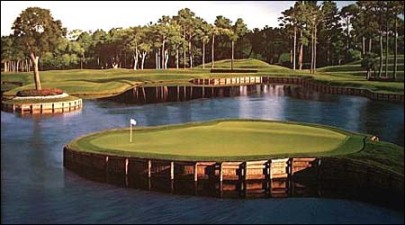
TPC Sawgrass No. 17.jpgI'm in the midst of writing something and need your help. (Hey just remember, no pop-up ads, no animation junk...I'm allowed to take advantage of the brilliant minds who check in here).

So, I'm trying to write this chapter on my ideal greens and in thinking about it today, the 17th at TPC Sawgrass is one of my favorites. The green contours here are as much a part of the drama as the water.

Most of all I love the "compartments" that make what appears to be a one-dimensional hole so different from day to day.  And I love how the key features of the green are memorable, a trait that encourages creativity and shotmaking. Because memorability of features on a green makes it more likely that players will be suckered into playing at tempting hole locations, moreso than they might otherwise try if a green before them were simply a sea of meaningless bumps.

Therefore, I'd love to know what you think are some of the best greens in golf?

Or to put it another, name a green (or a few) where the design supremacy of the hole is mostly dependent on the contours, size, shape and angle of the putting surface.

Don't be shy. There are no right or wrong answers. Just help for a lowly writer. 

"It appeared the boys were stinking up the gym. That speaks of one thing..."

I only watched a few minutes of the sixth major (love the blue jacket for the winner...how original!).

However I noticed on the Golfweek.com Tour blog that the real genius of Quail Hollow was picked up by Jeff Rude:

The top two Wachovia Championship finishers both made double bogeys coming in. And high finisher Vijay Singh made two bogeys and a triple coming in. It appeared the boys were stinking up the gym.

That speaks of one thing: Quail Hollow is one of the best courses on the Tour. You might say it deserves the strong field and favorable date it received.

It's one thing for a newcomer to the game evaluating a course based on its difficulty, but after all of the great stuff Dr. Klein has penned in Golfweek about what actually merits architectural legitimacy, you'd like to think we could something a tad more nuanced than the course's ability to churn out doubles and triples. Right?