Tiger Unveils Sneak Peak of al Ruwaya For Those Of Us Who Hope To Never Get There

Here's a link to the printer friendly version, which is minus an interesting look sketch that I was unable to zoom in on or copy over (Tiger has a shrewd website builder!).

A couple of weeks ago, we broke ground on my first golf course design project, Al Ruwaya, at The Tiger Woods Dubai. Although I couldn't be there, I was thrilled. I can't wait to see my designs take shape in the Dubai desert.
There's something you don't hear everyday. A player architect admitting he was not there for the groundbreaking and expressing eagerness to see a design take shape in the Dubai desert.

Fast forward...
We used length, width, topography, wind direction, hazard placement, and greens contouring to create unique, individual holes that test not only the physical but the mental game as well. We're getting close to completing the final designs, but in the meantime, I wanted to share holes 12, 17 and 18 since they showcase the unique, strategic experience I've designed for Al Ruwaya.

Hole 12 is our shortest par 3 at 181 yards, but it is very interesting. Visually it's very dramatic due to the elevations and vegetation, but it's also very strategic. It plays over a 30-foot depression of native grasslands and shrubbery to a somewhat crowned green. 
I'm sorry, did I miss something? Is it already built? They are amazingly fast over there! 
At 341 yards, hole 17 is a short par 4 that will have a big impact on the finish of the round. It plays slightly uphill but downwind, and presents several strategic choices off the tee.  A longer hitter can challenge the fairway bunker and possibly drive the left side of the green. Long drives drifting right, however, could find the deep greenside bunkers or the large depression short right of the green. Shorter hitters may choose to lay-up off the tee but will want to favor the left side of the short landing area to preserve the best angle into the left-to-right green. This is a great drivable risk/reward hole that provides an opportunity for birdie or eagle heading into 18.  Smart decisions and proper execution will be rewarded, but it will be hard to save par if you make an error.

You know, I hate to be skeptical but uh, how does he know all of this already if they haven't built it yet?

Reason 7,812 PGA Tour Pros Should Not Be Architects

Congressionalhole18.jpgGiven the choice between TiVoing the old geezers playing one of the twelve majors over a colorful, textured, rich, eccentric and slightly nutty design or an elite field playing a "classic" "U.S. Open style" "test," you can imagine what I picked.

Honestly, told I have six months to live, it's a toss up what I want to watch to make time stand still. Medinah or Congressional?

Now that Congressional's old 18th has been bulldozed by Rees Jones and replaced by a hole only he could design (click here for Tim Taylor's photos on GCA...but view with caution, it's not pretty), the final stroke of quirk has been stripped from the place. Therefore, as much as it pains me to not single out Medinah's relentless mediocrity, I think Congressional gets the nod for not taking better advantage of interesting terrain.

Ah, but the players love it! Why, I have no idea other than to merely confirm that they have no architectural sense whatsoever.

Billy Mayfair said:

"You put Tiger Woods as host and a great course like Congressional and you've got something people want to be involved with. What happened here this weekend was amazing. You put it down the street [at Avenel], and you're probably not going to have the same kind of field. Guys will come here, to Congressional. Guys want to play old-fashioned, U.S. Open-style courses, and that's what this is."

And Robert Allenby...

"This is a great golf course," Allenby said. "It's easy to run a good golf tournament here. You've got a great venue. It's pretty awesome."

It may be what you want to play fellas, but in terms of viewing it's deadly.

whistling_straits_straits_course_7.jpgSure, Whistling Straits goes over the top and the fairway widths looked absurd (exposed for their lack of room as soon as the wind came up Saturday). I also don't know what the USGA was trying to prove playing the 17th so far back Saturday, making it a 250 yardish shot when the hole is plenty brutal at 160 yards in benign conditions.  

But wasn't it fun to see all sort of different shots, including a few played on the ground?  And recovery shots. And most of all, a colorful, lively example of architecture's most inspired possibilities.

At Least Two Players Might Be Open To Returning To Avenel After It Is Completely Demolished

Leonard Shapiro writes that Phil Mickelson and Fred Funk are the two who found something to like, though Funk's comments are a tad frightening:

"I've been somewhat involved with the redo at Avenel," Funk said yesterday of a $20 million renovation of the course and clubhouse scheduled to begin next month. "And if they do a really good job, as far as making it look like it's a finished product, I think it will be well-received. When you go to Muirfield Village [site of the PGA Tour's Memorial in Dublin, Ohio], you see the streams that are through the golf course. It looks like it's well-manicured and not overgrown.
Those darn creeks and wetlands that capture all that storm runoff and provide wildlife with sanctuary have no business being all messy! Man can do sooooo much better with flower beds and chemicals!
"There's a lot of attention to detail, and Avenel never quite had that look. You have to make it look good and really present the best product, even off the areas where you don't play, where you hope the ball doesn't go. I think it could be a really good golf course, but it still is not ever going to be a Congressional."

Hmmm...let's hope it's not that boring. 

Golf Architecture, Issue 11

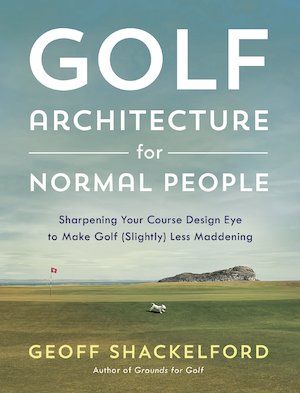
GA10_Mag.jpgNow I know I say this every year, but Neil Crafter and Paul Mogford have outdone themselves with "Golf Architecture" Issue 11, they Society of Australian Golf Course Architect's glossy annual. Each of these volumes will age beautifully and prove someday to stand as some of the most important publications ever published on this peculiar art form that some of us love.

Just some of the highlights:

-James Spence reviews Bandon Trails

-Paul Mogford interviews Greg Norman

-Michael Hurdzan looks at golf architecture memorabilia and shares some of his prized purchases

-Mike Clayton reviews Port Fairy

-Jeff Mingay on Dick Wilson

-George Waters on disturbance by design

-Tom MacWood on Bernard Darwin's great hole descriptions

-Noel Freeman on Eastward Ho!

-Wayne Morrisson on William Flynn

-George Bahto on The Eden at St. Andrews

-Neil Crafter reviewing the latest books

-Brilliant illustrations and photography from Gary Lisbon, David Scalletti, Wood Sabold and many more

Yours truly also contributed an essay on the design tandem of George Thomas and Billy Bell, with a look at their revolutionary design concept for the future.

You can subscribe here for the current issue or for any of the sensational back issues, and there's also a subscription form with more past issue details in Issue 10.

Oakland Hills Finisher Remains...There

Carlos Monarrez reports that the R&A setup of Oakland Hills teetered on the edge of absurdity for Monday's Open Championship qualifier. But this that stood out about Rees Jones's rees-toration of his father's bludgeoning of Donald Ross's masterpiece:

Sean O'Hair, who recovered from a triple bogey on the first hole to shoot 68, wasn't a big fan of the 238-yard uphill par-three 17th or the 498-yard uphill par-four 18th. Both holes require an approach shot with a long iron or lofted wood to a narrow green.

"The last two holes are ridiculous," O'Hair said. "I hit five-wood into 17, the par three. And 18, it's like where do you hit it? If you're a little bit right, you're screwed. If you hit it down the left side, it's going to release through the fairway and you've got nothing."

So nice to know some things haven't changed. Steve Jones will be pleased. The lamest finishing hole in major championship golf remains intact.

Seriously, how is it that this hole was not addressed? Didn't RTJ II add the fairway bunker down the left that caught Lehman in the 1996 Open?

Anyway... 

The South was lengthened about 350 yards under the recent update, and Monday it played its new full length of 7,445 yards. The Royal and Ancient Golf Club, which conducted the qualifier, chose the pin placements.

"These are very, very tricky greens," said R&A director Michael Tate. "We have not put them in the most difficult places. Some greens it's very difficult to find anything less. I think also this is a qualifier event for a major championship. It's not a regular tour event. This goes directly into a major, so you might reasonably expect that things are a little tougher."

"‘What we’re trying to do, like all other championship courses, is modernize it and fit it to today’s golfers"

Chay Rao looks at TPC Avenel's pending renovation and featured this from course superintendent Chad Adcock.

‘‘It will be a much better layout,” Adcock said. ‘‘I know that Tiger said that he would like to stay at Congressional, but if they can’t host the [AT&T National] in ’09 and ’11, and they look for another venue, we would like to be that venue.

‘‘I know that the membership here was proud of their Tour stop, and was disappointed to lose it,” he said. ‘‘They want it back.”

One of the major changes to the course will be to its ability to handle extreme weather.

‘‘We are going to restore Rock Run Stream [which runs through the course] to the size and status that it had a few hundred years ago,” Adcock said. ‘‘We are also going to add about 12 to 14 acres of wetlands, so that the course can handle the once-in-a-generation storm, like the one we had last year.”

The PGA Tour has set aside $20 million to make extensive changes to a course that has received poor reviews from several PGA Tour players since it opened in 1987. The Booz Allen Classic — once known as the Kemper Open and FBR Capital Classic for a year — was held at Avenel annually from 1987 to 2006 with the exception of 2005.

Due to the lack of enthusiasm, Avenel’s signature event, the Booz Allen Classic, failed each year to draw many of the top players in golf. That lack of star power was one of the contributing factors to the tournament’s demise.

‘‘The game changed considerably over the last 20 years,” Dennis Ingram, the former superintendent at Avenel told The Gazette last year. ‘‘The landing areas, as they were designed to be, are basically obsolete. ... It becomes an unfair advantage for longer players versus the normal players.

‘‘What we’re trying to do, like all other championship courses, is modernize it and fit it to today’s golfers,” he said.

$20 million in part because these guys had to go and be better athletes! Glad that steroid testing will be starting soon.

Klein on Chambers Bay, Municipal Golf

bizmuni.jpgGolfweek's Bradley Klein looks at the evolution of municipal golf in the context of $20 million Chambers Bay and also reviews the new RTJ Jr./Bruce Charlton/Jay Blasi design in Tacoma, writing:

Chambers Bay is the most carefully crafted and well-designed municipal golf course to open since Bethpage State Park’s Black Course in 1936. The big difference is that Chambers Bay, perched on the windy shoreline of Washington’s lower Puget Sound, has a better natural setting and makes for a more exciting walk.


"Standing around in a towel is a great way to enjoy the view."

OB-AM042_golfcl_20070622160444.jpgJohn Paul Newport visits The Bridge and chats with founder Robert Rubin about his club and what he sees as the future of clubhouse design.

Easily the most dramatic expression of the club's idiosyncratic nature is the clubhouse, which opened just this month and occupies the highest point of land on the eastern end of Long Island. It has four angular glass-and-steel "blades" that swirl outward from a central hub and feels more like a postmodern museum perched in the hills above Los Angeles than it does anything traditionally associated with golf.

According to the architect, Roger Ferris, the blade-like design picks up on both the "dynamic tempo" of a golf swing and on the impeller assembly of a turbo-charged racing engine.
OB-AM043_golfcl_20070622160623.jpgGosh I love the Hamptons.
In any case, the 280-degree views of the Rees Jones-designed golf course, which has been open for several years, and Peconic Bay beyond are spectacular.
"The world has enough shingle-style, McMansion clubhouses," says Mr. Rubin, who effectively controls all but 25% of the shares in the club. (The rest are held by his acquiescent business partner, Gary Davis.) "What we're creating here, we think, is a model for the 21st-century golf club."

The basis for that model is Mr. Rubin's interpretation of how people actually use golf clubs these days.

"The clubhouse at Shinnecock Hills perfectly reflected its time and place," Mr. Rubin observes, referring to the famed 116-year-old golf club only seven miles away and its classic Stanford White structure. Messrs. Rubin and Ferris consciously imitated the way the Shinnecock clubhouse dominates its landscape and is grandly visible from many locations on the course. But functionally, Mr. Rubin contends, the old clubhouses are no longer relevant, even though a lot of new clubhouses still reflexively ape them.

And...
Another thing that Mr. Rubin noticed is that modern golf-club members like to sit around in their locker rooms after a round and schmooze, so he decreed that the locker rooms should have the nicest views. As a result, the entire front walls of both the men's and women's versions are floor-to-ceiling glass, 24 feet tall in places, and they open out directly onto the club's wraparound stone terrace. Standing around in a towel is a great way to enjoy the view.
And just think of the clubhouse view for golfers.


But none of this has kept him from finding members, even at $750,000 a pop (the earliest memberships went for a mere $500,000). Mostly they are self-made men (and a handful of women) in finance, hedge funds and real estate, with a couple of doctors and lawyers thrown in (he calls them his "scholarship guys," although they get no discount) and a few in entertainment (including hip-hop mogul Lyor Cohen and artist Richard Prince).

"It can sound like a ridiculous amount of money, but a lot of members justify the cost by thinking of the club as the extra room they don't have to add onto their house," Mr. Rubin says.

OB-AM044_golfcl_20070622160719.jpgYou know it's funny, but I just budgeted an add-on to my second home in Malibu. Low and behold, $750,000 for that extra room. Which is why I could see where Newport was going with this:

In an area where houses routinely cost $5 million, and the really good ones near the ocean go for $10 million or more, this argument holds some logic, especially since membership will cap, at least for the time being, at 150. Currently the count is 129. He describes the club, with its cool, minimalist architecture, and its astounding views, as a place to appreciate the more meditative aspects of golf, which too much traffic would spoil.

Traffic? In the Hamptons? No! 

"The winner of the last hole picks where to hit from"

Thanks to reader John for this Stu Pospisil story on Ballyneal.

Love this little local touch...

 A caddy at Ballyneal is a golfer's best friend. One reason is the caddy discreetly carries a GPS device in the pocket of his bib, giving precise yardages to the flagstick every time. The caddy will take you on the short walks from the green to the next tee. Better follow closely, or beware of the yucca and the occasional cactus or lizard.

 Each hole on the 6,995-yard, par-71 course, routed through an area of chop hills by course architect Tom Doak, has at least three teeing grounds. Downwind holes, head to the Tiger tips. Wind gusting in the face, consider moving up one or two tees.

"How we play is that the winner of the last hole picks where to hit from," Ballyneal owner and developer Rupert O'Neal said.

The tees at Ballyneal are truly works of art. Great to hear they take full advantage of their versatility.

“We’ve got to get back to basics, back to A.W. Tillinghast, to Donald Ross-type courses"

Lee Trevino tells the Boston Herald's Joe Gordon:

“I’m real concerned about golf because we’re losing golfers every day,” Trevino said. “Golf has declined since 2000. The PGA, the USGA - no one is doing a damned thing about it. And I’ll tell you what the (problem) is: It’s too expensive to play and the reason is that these courses they’re building are too difficult and the maintenance is too high. People can’t play them, they lose too many balls. It takes too long to play.”
And...
“We’ve got to get back to basics, back to A.W. Tillinghast, to Donald Ross-type courses,” he said. “They’re 7,000 yards long and tight, but without a lot of water or hazards, so people can get around. I want to get into it full time because I’m 67 and I don’t play much any more. I’ve got nothing but time.”

Bandon, Subsidies and The Reservoir

subsidy_slide3.jpgDavid Cay Johnson pens a pair of New York Times Business section stories, one looking at government subsidies for real estate projects, private jet use and Bandon's airport expansion.

A second story considers the plight of Scott Cook, who will be impacted by a reservoir project that will provide more water for the town and future Bandon courses.


A Few More Tuesday Clippings

2007usopen_50.gifThe John and Sherrie Daly matter is getting downright ugly.

In lighter news, Steve Elling looks at Oakmont's 8th and wonders if the USGA's 288-yard setup is within reason.

At 7,230 yards, the course isn't punitively long by modern standards, but the crazy eighth should generate a cacophony of complaints. From the back tee, the 288-yard par 3 is the longest in U.S. Open history -- funny how that general theme is repeated each June in some respect -- and stands an attention-getting round-wrecker.

Moreover, if the USGA set-up sadists put the flagstick on the back of the green, the hole can measure an intimidating 300 yards. Mind you, technology gains or not, the average driving distance on the PGA Tour is 285.1 yards.

In other words, this hole, as they used to say in the mills hereabouts, will separate the steel from the slag. Pittsburgh has morphed into Titanium Town.

And this from Phil Mickelson...

 "I love the hole because, in architecture -- and I've been slowly getting into architecture -- the longest par 3 you ever see is about 240 or 250 yards, and the shortest par 4 is about 330," Phil Mickelson said. "There's 80 or 90 yards there, where you don't know what to call them." 

Scott Michaux weighs in on the tree removal with this.

Ford says that the greatest irony of it all is the fact that the same course architect who oversaw the conclusion of Oakmont's deforestation project is the same one resembling Johnny Appleseed with mature trees cropping up all over Augusta National Golf Club.

"It's very coincidental that Tom Fazio is our architect who help cut them all down and he's the architect at Augusta National and they're planting trees," Ford said. "It's pretty wild, isn't it?"

It's quite a lark considering that Augusta National played the defining role in Oakmont's shaded canopy era to begin with.

"If it weren't for Augusta, we never would have planted the trees in the first place," said Ford.

Mike Dudurich explores some of the wild and weird occurrences on the wonderful short 17th. He also has this interesting playing strategy from Phil Mickelson, who you may recall, bungled Riviera's 10th earlier this year with a similarly peculiar approach.

It looks like the majority will play aggressively on the 17th. At least that's what the No. 2 player in the world, Phil Mickelson, is thinking.

"You drive it up the left of the 17th fairway and then we'll see how thick that rough is," Mickelson said. "I had a tough time hitting the green with a wedge out of there. But it's still the play, hitting it over there because it takes bogey out of play. If you don't hit a driver, you're risking a five. I'll be trying to hit it in the left rough if the pin's in the back right or in the "Big Mouth" bunker if it's front left." 

Rory Sabbatini's philosophy is even more confusing:

"Take out the driver and go for the green," the South African said without hesitation. "The rough front left of the green is the thickest on the golf course. I think you only make things more difficult on yourself if you lay up in the fairway."

Ok! Whatever floats your boat.