
A Few More Panelist Summit Comments

I sat through two enjoyable Powerpoint presentations by John Fought and Rees Jones here at the Carolina. Two points by Jones were of most interest.

Encouraging was his message to Golf Digest and the panel: categories like Aesthetics, Ambiance and Conditioning threaten to make the rankings "into a rich man's list." Losing those categories while emphasizing how much "continuing interest" (repeat playing fun) of a course would make, in Jones's view, for a better ranking that serves the game better. Naturally I wholeheartedly agree.

Another comment of interest was his disdain for the Golf Magazine panels' love of "collapsing" bunkers and how courses featuring this "fad" were overtaking their list and threatening to ruin it. Collapsing would be your Coore/Crenshaw/Bradley/Doak/Urbina/Hanse/Wagner/Devries etc. style that Rees has always hated, but unfortunately which many golfers are finding more appealing looking compared to cleaner, rounder hazards.

I got a giggle out of his remarks, yet on a similar theme, the panelists who had just played Pinehurst No. 2 were saying privately at the evening dinner (after Jaime Diaz gave a great talk on Tiger entering the design business) were consistently underwhelmed by the course. And in large part, their lack of enthusiasm stems from the course's lack of visual interest, and in particular, the bunkering as well as the mundane wall-to-wall Bermuda look eliminating much of the sandy scrub that once gave the course such a distinctive flavor. I have to say I strongly agree that Pinehurst has lost much of it's unique character and other than its distinctive greens, looks like way too ordinary.

So the morale of this story is simple: visual stuff does matter in making you want to play a course. I think those rugged, wild, inspiring and seemingly natural "collapsing" bunkers are here to stay.

More importantly, Rees posed for a photo with his favorite golf blogger (I've cropped the others in the shot to protect the innocent from any potential photo caption fun!).
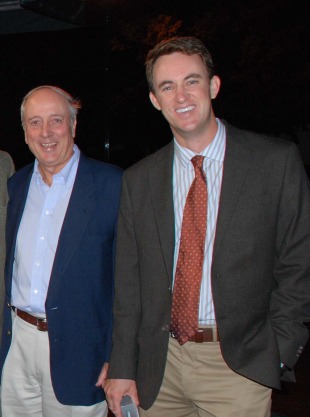
GeoffandRees.jpg

More On Tiger's First U.S. Design

asset_upload_file452_3651.jpgLinks editor Hunki Yun pens the most extensive feature I've read to date on Tiger Woods's first U.S. course design at The Cliffs. The spread also features easily the best lit staged architect-developer photo of all time (left). Nice use of reflectors boys! Though way too much Dockers ad for my taste.

Anyway...

Anthony contacted Woods in February, and a major factor in Woods’ decision was the Cliffs’—and Anthony’s—emphasis on health and wellness, which mirrors Woods’ values. In the spirit of fitness, Anthony and Woods originally announced that High Carolina would be walking only. But in the only misstep of the day, they later clarified that walking will be encouraged but not required.

Oh well.

There remains the considerable task of building a course worthy of the hype, not to mention Woods’ fee, estimated to be more than $20 million including real estate sales incentives—nearly 10 times the highest previous going rate. The Cliffs is still working on the permitting for the site, which sits at about 4,000 feet and features 50-mile views of the Blue Ridge Mountains. Meanwhile Woods’ design team, led by Beau Welling, formerly Fazio’s top man, has yet to finalize a routing—construction is not likely to begin until mid-2008 and the course won’t open for at least two years after that.

I'm sure we won't hear a thing about it between now and then.

"Then I've done what should be done."

The architect press release quotes are getting more torturous every day.

Jack Nicklaus, on the Tucson course he's started that will reportedly land the WGC Match Play when it's done, assuming the design proves worthy...well, and that site licensing fee check clears in Ponte Vedra...

 "Golf course design has been a blessing for me," said Nicklaus. "It has allowed me to take what I learned playing the game of golf and apply it to a piece of ground to create a legacy that will live well beyond what I accomplished as a golfer. If I can design The Ritz-Carlton Golf Club, Dove Mountain to take advantage of its spectacular high desert setting and beautiful vistas, while integrating solid strategy and good, fair golf shots, then I've done what should be done."

"A yellow school bus idles in its parking lot; the driver collects ten dollars from those who board."

img10412091.jpgT&L Golf's Thomas Dunne covers the one day a year you can get in the gates to walk Pine Valley.
Clementon Amusement Park in South Jersey is not exactly a place brimming over with good cheer. Although it is celebrating its hundredth anniversary this year, Clementon carries a distinct aura of hard luck—all faded paint and sharp edges and arcane dangers.

But once a year, usually on the last Sunday afternoon in September, the park becomes a portal to another world. A yellow school bus idles in its parking lot; the driver collects ten dollars from those who board. The bus heads down a nondescript lane and then, minutes later, pulls up at the end of a gravel road, where local kids sell burgers and hot dogs off a grill and soft drinks from a cooler. Nearby, a small green-and-white building serves as both town hall and police station and hints that the territory beyond is a separate and sovereign place, far removed from the strip-mall tedium of the surrounding burbs.

A man in a blazer waits near a guardhouse and hands the visitor a scorecard. "Have a nice time," he says. And just like that, one steps, blinking in disbelief, inside the sylvan fold and onto the grounds of what's commonly regarded as the greatest golf course in the world: Pine Valley.

In a strange coincidence, a Links profile by the late, great Pam Emory was posted over at CBSSports.com.

Trouble At St. Andrews Beach

...in Australia. Martin Blake reports the unfortunate news that the course closed temporarily because it's not paying its bills. You have to love Clayton's quote:

One source said the course's co-designer, US golf course architect Tom Doak, was owed at least $250,000.

Mike Clayton, Melbourne golf professional, course architect and Age columnist, was the other designer. Mr Clayton said he was disappointed to see the concept struggling. "It's clearly one of the best courses in the country and it needs to work," he said. "We can't afford to lose great courses. We've got too many bad courses around without losing something like this."


"Architects like Robert Trent Jones and his regrettably prolific scions dotted the American landscape..."

Thanks to reader Mark for Dean Barnett's wonderful look at the rise of the minimalist movement in architecture, highlighted by his look at Sand Hills, Bandon Dunes and Ballyneal. But it's the setup and conclusion that prove just as  entertaining:

But there followed several decades of golf architecture dreck. Architects like Robert Trent Jones and his regrettably prolific scions dotted the American landscape with courses that were difficult and unpleasant to play--largely because they deviated from the tradition born in St. Andrews. Instead of letting each player figure out his own route from hole to hole, they funnelled all into a single narrow path.

Rees Jones, Robert Trent Jones's son, is still one of golf's most prominent architects. He describes his theory of golf architecture as follows: "My style emphasizes definition. I work hard at giving the golfer a concept as he stands over the ball. I want him to see the intended target and be able to visualize the shot." What Rees Jones omits from his reckoning is that some golfers, indeed most golfers, may be incapable of pulling off the shot that he compels them to see. Golfers have enjoyed finding their own way around St. Andrews for over 500 years. Speaking on behalf of the modern golf architecture establishment, Rees Jones in essence insists that he has discovered a better way: He will officiously preside over each and every golfer's each and every shot.

Jones family members haven't been the only architects guilty of committing affronts to golf history and ignoring the imperative that the game be fun. Perhaps the most serious offender has been Jack Nicklaus, arguably the greatest golfer ever. Nicklaus has had a hand in designing 207 courses. While some of his courses are picturesque, few are fun unless you're able to play golf as well as Jack Nicklaus. On many of his courses, the average player will lose half a dozen balls a round, many of them having found a watery grave in one of the man-made water-hazards of which Nicklaus is so fond. As a player, Nicklaus probably wouldn't even notice many of the water hazards that litter his courses. But the typical golfer does.
And the conclusion to the piece...
There remains the pressing question of what long-term impact places like Sand Hills, Bandon Dunes, and Ballyneal will have on golf architecture and the game itself. The early attempts at golf-course design by Jack Nicklaus's successor as king of golf, Tiger Woods, may offer a clue.

For his first project, announced in 2006, Woods took a commission to build a course on a piece of flat desert in Dubai. It was a move right out of the Nicklaus school: Put a golf course where nature didn't intend there to be one, substituting one man's limited imagination for nature's infinite variety. The "Tiger Woods, Dubai," its website says, "will feature 20 palaces, 75 mansions and 190 luxury villas that offer the perfect blend of exclusivity and luxurious community living"--about as far as conceivable from the austere fun to be had at a place like Sand Hills.

For his second commission, Woods undertook to build a golf course on a piece of rolling terrain outside of Asheville called the Carolina Preserve. When the project was announced a few months back, Woods insisted that the land is perfect for golf, and that no man-made lakes or waterfalls will blight his first American design. The course will be walking only.

So has Tiger undergone a conversion? Only the finished product will tell. But this much we know: When someone asked him to describe his design philosophy, Tiger Woods used the magic word: "I'm more of a minimalist," he said.


"Consistent with last year, several trees were removed."

Who says Tom Fazio can't do a little restoration?

Why, he's taking out trees at Augusta! 

Granted, he planted them, but still...progress toward total de-Hootification:

October 2, 2007
FOR IMMEDIATE RELEASE

Billy Payne, Chairman of Augusta National Golf Club and the Masters Tournament, announced today changes to four holes, Nos. 1, 7, 9 and 11, for the 2008 Masters. In addition, other modifications were made on the grounds.

"Refinements to the golf course and grounds have been made almost every year since the Tournament's inception and this year was no exception," Payne said. "Overall, we are happy with the golf course. We think last year's exceptionally high scores were an anomaly due to the frigid, windy weather."

The changes for the 2008 Masters are:

Hole No. 1: Ten yards were added to the front of the Masters tee providing more flexibility in the event of a strong northwest wind. Back of the tee was reduced to ease patron movement. Masters scorecard remains 455 yards.

Hole No. 7: Green was changed for agronomic reasons and approximately six feet added to the left of the green allowing the possibility of 2-3 additional pin placements.

Didn't they just do No. 7 recently? Refresh my memory.

Hole No. 9: Green was changed for agronomic reasons and right pin placement softened on first and middle plateaus.

Hole No. 11: Consistent with last year, several trees were removed.

Whoa Nellie. It's because you recognize how ridiculous they look right?

The result allows for enhanced patron viewing.

Hey, whatever floats your boat. Just get 'em outta there!

Additional work throughout the course included construction of a new patron viewing area on the hillside at No. 16, further work on the new practice facility that will open in 2010, adding and extending azalea beds to increase course color and replacing grass with pine straw between Nos. 15 and 17 (pine straw was also added to the left of No. 15).

Well, 11 is a start but it sure would be nice if a tornado blew through 15/17 too.

The hillside seating area is located to the left of the pond at No. 16 and will provide viewing for over 2,000 patrons. Holes that can be viewed from this location include No. 6 green, the second shot and every putt at No. 15, the green complex at No. 16 and the tee shot and second shot at No. 17.

Easy access can be gained to this area from a newly renovated back entrance. From there, patrons can travel to No. 16 hillside, No. 5 fairway or to holes Nos. 13, 14 and Amen Corner. "We are very excited about these significant improvements for our patrons, and hope that we have made an already special experience even better," said Payne.

Now, about that slippery-when-it's-wet second cut? I think it needs to go for patron safety? Not yet?


Yet Another Senior Major

Don Markus writes about yet another Champions Tour major--the Constellation Energy Senior Players Championship--kicking off this week at the venerable Baltimore Country Club, profiling Keith Foster and his work to bring the course up-to-date for today's old geezers. Thanks to reader John for this.

On restoration:

"You're really riding the edge," Foster said of restoring a golf course. "If you do too much, everyone knows, and if you don't do enough, everyone still talks about it."

Club general manager Michael Stott said the principal idea behind the multimillion-dollar restoration, the cost of which was shared by the club and the PGA Tour, was to make the Five Farms course "relevant again" in terms of modern technology. It appears that Foster accomplished that goal.

While most of the players have yet to test their skills on the course, which has a major golf history dating to the 1928 PGA Championship, the early reviews have applauded Foster's work. It has been ranked as highly as the No. 1 course in Maryland by Golfweek, and No. 83 in the country by Golf Magazine.

"Any golf course where you automatically pull out a driver ... that's a weakness in my book"

bildeRobert Bell takes a peak at Kris Spence's restoration of Donald Ross's Sedgefield Country Club design. You may recall the course has been eyed recently as a new site for the Greensboro event and Bell seems to confirm that progress is being made on that front.
Sedgefield's $3 million renovation, which includes rebuilt greens, tees and fairways, as well as repositioned bunkers, began in November and was expected to be completed by August. But heavy spring rains followed by a hot, dry summer delayed the reopening by about a month.

Monday, three days after the course reopened, members said the wait was worth it. The gorgeous fairways with beautiful rolling contours and the smooth greens have members gushing over one of the area's most impressive golf course renovation projects.

"It's a new course, but it still has a Donald Ross feel to it," said member Mark Speckman, who played the course Monday. "Every shot makes you think, which I think is what Ross would want."

That's certainly what Greensboro golf architect Kris Spence was aiming for when he agreed to refurbish Sedgefield's aging course two years ago. Spence, whose specialty is renovating Ross-designed courses in North Carolina, spent the past 18 months bringing back many of the traits Ross created in 1926.

Greens have been expanded to their original size, allowing for pins to be tucked into corners. Rolling fairways slope from side to side, requiring every tee shot to be one of thought rather than mere brute strength.

And while the renovation was designed with club members in mind, Spence said the course would make a perfect venue for the PGA Tour's Wyndham Championship, which has been played in recent years at Forest Oaks Country Club.

Sources this week said Wyndham officials have begun discussing a buyout of their long-term contract at Forest Oaks with the intent of moving the tournament to Sedgefield. PGA Tour agronomy officials were at Sedgefield last week to look at the progress of the renovation.

Spence's renovation added another 400 yards to Sedgefield, bringing its length to 7,130 yards. Sedgefield's par is 71 for members. If the Wyndham were to move there, par would be 70, with the 505-yard, par-5 18th hole likely shaved to a par-4.

Sedgefield would be one of the shortest courses on the PGA Tour, but Spence, like Ross, is not concerned with length.

"Any golf course where you automatically pull out a driver ... that's a weakness in my book," Spence said. "The twists and turns and the natural topography here make this course very special. I really believe that over time this is going to be one of the top courses in the country."

"When we talked to Tom Fazio, he said that he would like to make this the Augusta of the North"

Chris Wagner of the Syracuse Post-Standard proves that there are still people who aspire to build the Augusta of their neighborhood, even if it's at a casino in the middle of nowhere.

Atunyote, on the other hand, came wired for the future. Made-for-TV fiber-optic cable was installed to every hole designed by Tom Fazio, considered by many to be the top golf course architect of this era. He also is the person responsible for this decade's facelift at Augusta National, home of the Masters.

The clean, classic, country-club look of Atunyote was a polar opposite of Shenendoah's and Kaluhyat's wild-nature, wild-fescue appeal. Even Atunyote's state-of-the-art practice range was better than Shenendoah's, which was lost when Kaluhyat's 18th hole was built over it.

None of it was by mistake.

"When we talked to Tom Fazio, he said that he would like to make this the Augusta of the North," Halbritter said. "And we liked that. We liked the sound of it. We liked the quality of it. We liked the history and the legacy of it. ... So, that was part of the whole process of thinking, for people to think of our Atunyote as the Augusta of the North."

You know what P.T. Barnum said...







