The Hardest Mile(s) In Golf?

In the post about Greg Norman's new Dubai course ripping off La Costa's unofficial distinction as the hardest mile in golf, I was wrong.

It seems the Shark is stealing from himself!

Just to remind those of you who haven't memorized it yet, here's what the press release for Jumeirah Golf Estates's "Earth" course says:

The last four holes will measure exactly a mile, 1760 yards.  I expect it will be considered one of the most challenging and exciting miles of golf, in terms of risk and reward."

golf_norman_course.jpgHowever reader Rich noticed this website claim for Lansdown Resort's Norman-designed course in Virginia:

The last four holes measure exactly 1,760 yards—equal to one mile—creating, according to Norman, “the hardest mile in golf.”

It's a wonderful world. 

"The most challenging and exciting mile in golf"

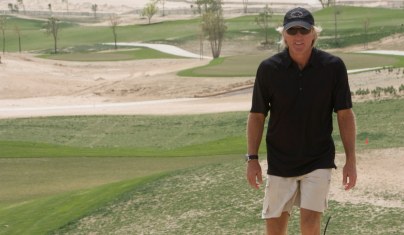
GregNormanDubaiPoor La Costa has Greg Norman and the folks in Dubai taking their claim to infamy when they announced that  Jumeirah Golf Estates's "Earth" course will be hosting the inaugural Dubai World Championship in November 2009. From the press release:

Greg Norman said:“As a golf course architect, it is both rewarding and challenging to know that this course will be hosting the Dubai World Championship.

“I’ve been fortunate to have a number of PGA Tour events played on courses I have designed.  Of course, Jumeirah Golf Estates will be showcased on a global basis and as the golf course designer, I’m proud to be a part of such a significant event.

“From my perspective I think that both the Earth and the Fire courses will be equally playable and I’m pleased with the progress that has been made on them.”

Norman was returning to Dubai for his ninth site visit and spent his time fine-tuning the course design for the Championship.  The final four holes of the Earth course will, he said, offer a spectacular finish:

“Of course, I think the entire course has a great balance, but the finish will really stand out.  The last four holes will measure exactly a mile, 1760 yards.  I expect it will be considered one of the most challenging and exciting miles of golf, in terms of risk and reward."

Meanwhile, let's get to the important stuff:

“There were some significant changes on 7 and on 9 but everything else has been more subtle, getting the greens ready for the speed that we need them and so on.  And we’ve had to allow for the infrastructure of a major tournament. That means laying cabling and getting prepared for the full hospitality suites, designing the right driving range facility, creating ease of access for parking and everything like that.”

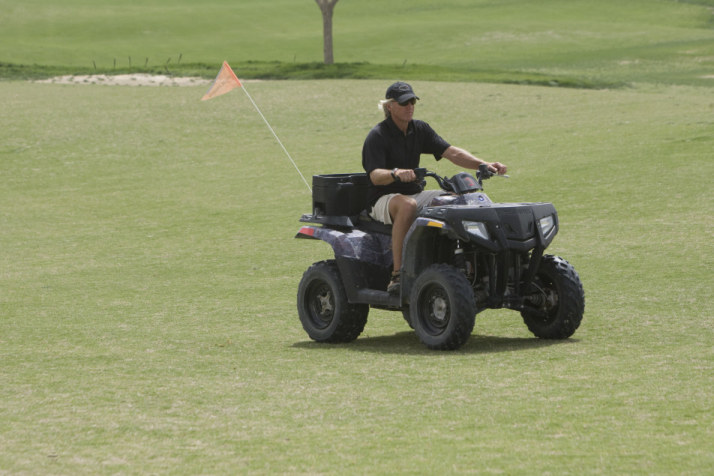
And with the release came this totally unstaged photo in need of a caption, don't you think:

GregNormanDubaibuggy 

It's What "Byron" Would Have Wanted...

This week marks the 83rd re-opening of the TPC Las Colinas after a renovation. Naturally, everyone is thrilled about the second coming of Deere Run, with talk of "traditional" features and fulfillment of Lord Byron's dreams.

Player consultant J.J. Henry:

"To see everything come full circle, I can't believe what kind of shape the golf course is in," Henry said Tuesday, when course officials showed off the renovations. "We always talked about what would Byron want. ... I think he is up there smiling today at what was accomplished."

Traditional square tee boxes and white-sand bunkers throughout the course and the cascading waterfalls next to the 18th green are among some of the changes.

Is there another form of waterfall besides cascading that I'm not familiar with?

Henry played with Tony Romo, Trip Kuehne and Harrison Frazar in a recent exhibition, and Jimmy Burch reports good news for Tiger: it's all right in front of you.
Trip Kuehne: "I've played here since 1986 and this is really the first time you could get on the tee box on every single hole and you knew exactly what you needed to do. D.A. has told you where you need to place the ball on every single tee shot and the challenge is to get out there and place it. It's a very playable golf course, and it's in great shape."


Thinking Of The Grandchildren: Jack Calls On Chinese Government To Invest In Golf

Because after all, they have the whole human rights thing all cleaned up! From John Ruwitch of Reuters:

"The government needs to be involved," Nicklaus said in an interview with journalists.

"The government subsidises track and field ... the government subsidises all those sports in this country," he said. "There's no reason why they shouldn't be" subsidising golf.

And who should they have design their courses? I think I know who Jack has in mind. 

"This tournament has become all about playing defensively and minimizing damage."

They're not throwing snowballs anymore. This is an avalanche.

From John Hawkins' Golf World game story on the 2008 Masters:

Those who have begun comparing the Masters to the U.S. Open in terms of punitive nature aren't thinking clearly,

We'll let you tell that to Tiger and Phil's face...

...since the outrageous homestretch produced by the top of the leader board in 2004, this tournament has become all about playing defensively and minimizing damage. The addition of the second cut (rough), a billion trees and 500-plus yards, all of which occurred during the tenure of former Masters chairman Hootie Johnson, has resulted in a conspicuous subtraction of charm and suspense.

It's easy to blame Hootie and the Blowtorch for the growing pile of late-Sunday snoozers, but the game's sharpest minds failed to foresee the most obvious effect of the changes.

Oh do tell us why you see what the rest of us only saw five years ago...

A competition once weighted heavily to favor power players and good putters has fallen into the hands of the control freaks. You have to hit fairways to even think about winning. Scoring angles have been reduced to direct lines. Certain sections of the course have gotten alarmingly tight, but it's the congestion framing those alleys that has nullified the shotmaking and recovery skills that helped brand the Masters from its inception.

The Seve Ballesteros of the early 1980s couldn't make a cut at Augusta National nowadays.

Okay, that's a bit silly, but we'll let it slide because the point is well-intentioned.

Immelman hit 48 of 56 fairways and won. Zach Johnson averaged 265 yards per measured drive but hit 45 fairways and won. Heck, those guys made a cottage industry out of laying up on par 5s once routinely attacked by anyone with a little pop in his bat and designs on a seat at the Champions Dinner.

Not to indict the last two green jacketeers -- they only did what they could and had to do -- but things have really changed. Good strategy is now conservative strategy at a place where all hell used to break loose on a regular basis. "It usually doesn't turn out too well if you try to be aggressive," said Geoff Ogilvy, who shot six over on the weekend and finished T-39. Not that he needed to finish the thought, but Ogilvy did: "Aggression doesn't work, but the guys four or five back have to be aggressive because you're not going to win parring every hole."

After years of dealing with disadvantages one could trace to his lack of supreme power, a top-tier control player such as Jim Furyk might figure to factor, but even he speaks in somewhat jaded tones. "It's a pretty good test of golf," Furyk said. "I mean, it used to be a lot of fun to play. It's not fun anymore, but it definitely got a lot more difficult." Addressing the notion that people don't hoot and holler over solid pars, Furyk added, "I don't think we have [heard roars] for the last few years. It's obviously a decision they [tournament officials] made. It's their event, a different golf course, and there's a different way to approach it now."

All over a silly little golf ball that no one wanted to roll back. Such a shame.

Meanwhile, even one of the old guard proudly declares its continued love for using course setup ploys to put the flatbellies in their place -- except at the Masters. 

John Hopkins writes of the course changes in The Times:

Some of the unique appeal of the Masters has gone as a result.

“Those trees were not there. He could not make the shot today."

Larry Dorman probably hasn't helped the healing process between ANGC and the New York Times with this assessment of the course changes and their impact on play.

There can be no doubt that the 1-inch fuzz on the face of Augusta has reduced the ability of long hitters to bomb drives into spots on the edges of holes that used to set up better angles into greens. The freedom that came from not worrying about the penalty the second cut exacted — reducing the spin on iron shots, thus reducing control — is gone.

I wonder if the club understands how important that sense of freedom was in making the players more aggressive and therefore, more likely to play freely? (And with that comes not only better play, but also big numbers when they get greedy.)

And the addition of trees to the left of the 17th hole has taken away the opening that led to the greatest charge in the past 25 years at Augusta. It has cut off the opening Nicklaus found during the final round in 1986, when he punched his ball onto the green and made the final birdie in his closing 65 to win his sixth and final green jacket.

Visiting the spot last Wednesday from which his father had made his great escape, Jack Nicklaus II pointed to some new pines and said: “Those trees were not there. He could not make the shot today. There’s no way.”

Come on, a Tom Kite win that year would have been just as memorable! 

"There's more scoring in soccer."

img10779302.jpgSteve Elling joins the chorus calling for Augusta National to turn back the clock. Several fine points:

It's irrelevant what the television ratings will say, because history has proven people will watch the Masters no matter the conditions or leaderboard. But has there ever been a more dreadful two-year period in modern history with regard to excitement and goosebumps?

Short answer: No.

And...

We watch the Masters for birdies and crazy rallies, like those managed over the past quarter-century by Jack Nicklaus and Phil Mickelson. Masters memories were not intended to be nightmarish, even for the winner.

And this quote, which I didn't see anywhere else from the former USGA President:

 "We've got them all in the honey holes," said Fred Ridley, chief of the ANGC competition committee, shortly before the leaders teed off Sunday.

Yeah, but the course itself was still a bear. Ridley, it has been sarcastically noted elsewhere, was once the president of the USGA, where extreme course set-ups that cross the line have become the stuff of legend over the years. But in fairness, the changes to Augusta pre-date Ridley's arrival.

But let's never forget just how closely tied the USGA and Augusta National have been in recent years. If it weren't Ridley, it'd be someone else protecting par.

As a final plea to the club for a return to moderation, consider the performance of arguably the greatest player in the history of the game over his past three-plus seasons at Augusta. Over his most recent 13 rounds, Woods has posted exactly one round in the 60s and broken par a total of five times.

Funny that the club has initiated a program last week to allow kids into the tournament for free. Had I watched Sunday's play as a teenager, I would have bought a soccer ball the very next day.

After all, there's more scoring in soccer.

Could Billy Payne's global initiative actually be opening the door for unprecedented criticism of the course? We'll see... 

"Seven is just terrible."

It's not unusual to read strong critcism of the course changes at this point, which in itself is fascinating since no one would have dared rip the place 10 years ago. And while Billy Payne brushes it off and says it's 50-50 on the subject of the second cut, he has to be taking notice of the almost relentless wave of criticism. Because we know players aren't saying this stuff at this point just to be controversial.

Anyway, Rex Hoggard talks to several players about the overall impact of the changes and manages to get some pretty blunt stuff about several things, particularly No. 7.

“Seven is terrible. I played with Raymond Floyd in the Par 3 (Contest) last year and he just ripped it,” Arron Oberholser said. “Every guy that’s ever won there I ask them and to a man they say it’s terrible. Seven is just terrible.

“It’s supposed to be a short par -4 where if you get up there and want to hit 2-iron you can hit 2-iron and lay back,” Oberholser said. “But if you got the courage you can stand up there and hit a driver and a little flip wedge into that green which is very severe.”

Even Crenshaw, as gentle as ever, struggles to understand the change to No. 7.

“It’s too long,” he said. “Seven is one of the greatest greens I’ve ever seen, but it just doesn’t have to be that long.”


"I first felt a little bit like Michelangelo felt when he worked in the quarry."

I'm sure you know better than I what this means, but here's Robert Trent Jones Jr., talking to Thomas Bonk about Chambers Bay:

"When I saw the land, I first felt a little bit like Michelangelo felt when he worked in the quarry. We can re-craft this, cut the piece of marble into a David or a Pieta.


"At this year’s Honda Classic the “Bear Trap” netted an astounding 356 over par, compared with last year’s 254 over par, proving the improvements enhanced not only the quality of the course, but also its difficulty."

I can't say that I can ever recall a press release going out celebrating the increased difficulty of a course, or in this case, the dreaded "Bear Trap." Until now... 

Much-Feared “Bear Trap” Ranks as Toughest Three-Hole Stretch in Professional Golf
 
Palm Beach Gardens, FL (March 14, 2008) –  South African Ernie Els and his fellow PGA tour players kicked off the Florida Swing at The Honda Classic,  recently taking the stage on “The Champ” course at PGA National Resort & Spa.  After two separate rounds of renovations in as many years, The Champ proved to be as formidable an opponent as the players themselves with the course’s daunting “Bear Trap” – a series of three holes, starting with No. 15 - continuing to test the game and spirit of the best players in modern golf.  At this year’s Honda Classic the “Bear Trap” netted an astounding 356 over par, compared with last year’s 254 over par, proving the improvements enhanced not only the quality of the course, but also its difficulty.
 
“We are thrilled with the extensive renovations by Nicklaus Design and Superior Golf Concepts,” said PGA National Resort & Spa managing director, Joel Paige.  “The combined scores from holes 15, 16 and 17 have shown that our “Bear Trap” offers professional golfers the toughest three-hole stretch anywhere in the world.”

 I'm booking my trip to Palm Beach Gardens as soon as possible.

TPC Las Colinas, Err...Four Seasons Set To Go

After rumors that it would not be ready after lousy weather hampered their turf grow-in, it seems the course formerly known as the TPC Las Colinas is not only ready to host the Byron Nelson, it's been rebranded! 

2008 EDS BYRON NELSON CHAMPIONSHIP TO BE PLAYED ON REDESIGNED TPC FOUR SEASONS

Irving, TX – The completely redesigned TPC Four Seasons Resort Las Colinas will host the 2008 EDS Byron Nelson Championship, April 23-27, according to officials from the PGA TOUR, Four Seasons Resort and Club and the Salesmanship Club Charitable Golf of Dallas, the Championship’s sponsor.

After a thorough review of all aspects of the golf course by PGA TOUR, BentleyForbes, Four Seasons, and Salesmanship Club of Dallas, the PGA TOUR is pleased to announce the TPC Four Seasons will host the 2008 EDS Byron Nelson Championship.

"So many parties have pulled together under challenging weather conditions to get the course ready and make this announcement possible,” said Henry Hughes, Executive Vice President and Chief of Operations for the PGA TOUR. “D.A. Weibring has been the driving force with tremendous support from both BentleyForbes and Four Seasons.  The Salesmanship Club will undoubtedly continue to produce record charity dollars to benefit the less fortunate in Dallas. The PGA TOUR is proud to congratulate all involved in this huge accomplishment."

Immediately following the 2007 EDS Byron Nelson Championship, D.A. Weibring/Golf Resources Group embarked on an $8 million redesign of the TPC Four Seasons.

“In redesigning the course, our goal was to honor the legacy of Byron Nelson,” said Weibring.  “To that end, we created a cleaner, more defined course that incorporates traditional tee, bunker and green elements
throughout.”

Cleaner, more defined. Translation: ugly.

“PGA TOUR players will be faced with more shot options from tee to green, creating additional drama for spectators and TV viewers.  At the same time, for resort guests and Sports Club members, we created a very playable layout for all skill levels,” he said.

Utilizing input from dozens of PGA TOUR players, Weibring and his partner, Steve Wolfard, redesigned every hole on the 76-acre course, including all tees, fairways, and green complexes.  The course is now distinguished by traditional square tee boxes, softer mounding, better sight lines and dramatic white faced bunkers framing the fairway and green complexes. PGA TOUR professionals Harrison Frazar and J.J. Henry served as player consultants on the project.

Bring your sunglasses boys!

“The changes didn’t require us to dramatically lengthen the course.  We added just 200 yards overall,” Weibring said. “Instead, PGA TOUR players will see the biggest impact in the realignment of tee shots and better contouring of bunkers and greens.”

The changes start at a redesigned 20,000 square foot putting and chipping green, designed to meet the exacting standards of PGA TOUR professionals. The course culminates on the beautiful and dramatic 18th hole, highlighted by a series of four lakes with cascading waterfalls and a challenging risk/reward decision by the player.

Not three lakes, but four lakes. Nothing but the best for Las Col...Four Seasons. 

If Old Tom Morris Were Here Today...

askernish_18773t.jpgThanks to reader Stan for this Mark Hughes story on the resurrected Old Tom Morris design at Askernish that's opening this summer, and the controversy surrounding it's rebirth.
It has already been described as the "jewel in the crown of world golf". But this isn't Carnoustie, Prestwick or any of the other famous Tom Morris courses. It is the tiny Askernish Golf Club – a one-time nine-hole pitch and putt course on South Uist, an Outer Hebridean island with a population of less than 2,000.

But, while the golfing world has been vocal in its appreciation of the resurrection of Old Tom's lost course, and many of the islanders say it is a chance to provide a much-needed boost to the island's flagging economy, not everyone on South Uist is pleased about the proposals to restore the links course of Askernish to its 18-hole glory.

A small band of local crofters has started legal proceedings against the golf club, claiming that the expansion of the course will leave them with less land on which to graze their animals. They say that their rights to the land on which the golf course is situated – known as Askernish machair – were enshrined in 1922.

The club claims that isn't correct and that the golfers have more rights to the land than the crofters. The argument over who has the better claim has divided the small island community and has now spilled into the courts.

Both sides are confident they will win, the golfers so confident that they have already set a date for the official club opening – 22 August – and have named an honorary president, the former Liverpool and Scotland footballer Kenny Dalglish.

The crofters, meanwhile, are vowing to go to the highest courts possible to stop the golf course going ahead on land they believe is rightfully theirs.

It's fair to say that the rugged but beautiful island of South Uist, a tiny, windy speck on the north-west corner of the UK map, has never seen such a bitter divide.