"This much-ballyhooed addition to the Home of Golf's portfolio is ultimately disappointing."

John Huggan pens the second Castle Course at St. Andrews review and it's not pretty...
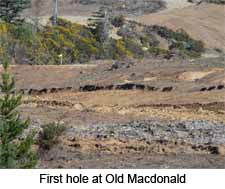
Quite apart from the air of mystery surrounding the final resting places of so many tee-shots, the most striking aspect of this picturesque layout high above the Auld Grey Toon becomes apparent once the golfer is lucky enough to have found his ball after driving into seeming oblivion. The architect, David McLay Kidd, calls them 'spill-offs'; my four-ball came up with a few other names – some of them printable – for the peculiar rough-covered mounds we discovered dotted indiscriminately about the fairways.

'Hairy mound' was the first, albeit rather prosaic offering. I myself favoured 'clumpy hillock'. Then there was 'Abe Lincoln chins'. But the most imaginative member of the group came up with 'enormous hoof-prints left by enormous horses'.

Whatever, these mysterious affectations – for they appear to have no immediately discernible architectural or strategic purpose – are intensely irritating. While golf, as someone once said, is a game never meant to be fair, searching for one's ball after striping one up the middle very quickly gets old. The always-tricky-to-locate line between luck and skill has been crossed here and crossed too often.

"Think of wacky bowls where the sculptor takes the wet clay mold and stretches it in different directions."

The first review is on the Castle Course at St. Andrews, making its debut this week.

Alistair Tait doesn't sound like he'll be invited back after this.

With the Castle Course, I felt as if I’d need a few rounds to get the lay of the land.

I’d certainly need more than a few rounds to get used to the greens. Kidd must have been in a funky mood when he designed these, for they might be the most undulating greens I’ve ever played.

The note I jotted on my course guide regarding the fifth green consists of  one word: “stupid.” The course guide describes this as a “bowl.” I’d agree if it read, “bowl that’s bent out of shape.” Think of wacky bowls where the sculptor takes the wet clay mold and stretches it in different directions.


"TPC Potomac At Avenel Farms" Update

PH2008052602274.jpgLeonard Shapiro pens an update on the rebranded, rebuilt and re-something'd TPC Potomac at Avenel Farms.

PGA Tour officials say they are putting no pressure on Woods to hold his tournament at their golf course, which is scheduled to reopen in November with a new look as well as a new name, TPC Potomac at Avenel Farms. But after investing so much in the renovation, the tour clearly has high-level tournament golf very much in mind.

According to sources granted anonymity because no plans have been set, the tour also is exploring the possibility of conducting the Senior Players Championship, one of four majors on the Champions Tour, at the newly configured course.

Hey, aren't there five senior majors? Or is it six?

That tournament, usually scheduled in the fall, has a contract to play at Baltimore Country Club/Five Farms in Timonium, Md., through 2010, about the same time TPC Potomac should have matured enough for tournament play. But the tour knows a senior major championship in the nation's capital likely would draw bigger crowds and more media coverage.
Massive crowds! 
David Pillsbury, president of PGA Tour Golf Properties, said that neither he nor the tour is focused on the possibility of Woods's tournament, or any other event, being played at the newly upgraded course.

"We know we're not the ones who will say this is now an 'A' facility," Pillsbury said. "It's not for us to say. It's the players who will tell us. We've tried to take this piece of land and make the best possible golf course we can build and let the golfers decide and tell us how we did. At the end of the day, we'll let the course speak for itself."

I'm disappointed David, I had my MBA bingo board ready to go.

The tour officially will announce the facility's name change this week, emphasizing a new beginning for a previously maligned venue.

Oh good, a press release explaining the rebranding of a once-hated TPC. That's a doublespeak special. I spoke too soon.

Royal North Devon Told To Cease Coastal Erosion Efforts

painting.jpgThanks to reader Chris for Robert Booth's Guardian piece detailing the bad news about England's oldest course.

As coastal erosion accelerates, the seventh and eighth holes at the 144-year-old Royal North Devon Golf Club near Westward Ho! could disappear as early as next year, according to senior club members.

But there is frustration that Natural England, a government agency, has ordered the club to stop "potwalloping", the practice of holding back coastal erosion by rounding up local people twice a year to replace by hand the stones which have been washed away.

The agency said the coast must be allowed to erode in a "managed realignment" because continued human intervention will alter the way the sea naturally interacts with the sand dunes in an area of special scientific interest.
There are also concerns that diverting the tidal flow could expose an old landfill site further along the coast, which is thought to contain tonnes of asbestos.
Until this year, the banks of the windswept links were disappearing at a rate of about a metre a year, with the pebble ridge which defends the course retreating 50 metres between 1947 and 2000. Fierce storms earlier this year tore a 27-metre chunk off the exposed tip of the course and the unstable land has since continued to crumble, leaving the eighth hole 18 metres from the edge.

"If something isn't done to stop it, we will lose a significant portion of the course in the next 12 months," said David Lloyd, a senior club member.

The club web site has more information and you can also read Ran Morrissett's excellent profile here, which includes one of my favorite Mike Miller paintings (linked above as well).

Nicklaus Admits He Used To Design For His Own Game; Has No Regrets

Jeff Shain in the Miami Herald examines the design operations of Arnold Palmer and Jack Nicklaus. Thanks to reader Nick for the link, which includes quotes from Brad Klein about the nature of the mass produced player-architect model.

First, a Palmer anecdote:

'This is certainly an ideal situation for me to stay in the business of golf,'' Palmer said during his visit to Deering Bay. ``We'd like to hope that [golfers] appreciate what we're trying to do.''
There's always hope.
Not that Palmer and Nicklaus have the capability to get intimately engaged in each design -- though it's available for developers willing to pay higher prices.

Both, though, leave a mark on nearly every blueprint that crosses their desk.
Well, better there than in the field where they could do real damage.
''He's real careful with not pushing his thoughts on us,'' said Erik Larson, Palmer Design's vice president and one of his lead designers. ``But there are certain design philosophical items that he embraces that he wants to make sure we incorporate.''

Hazards and greens should be visible. Subtly rolling greens, rather than severe humps and bumps. Make the round visually pleasing.

''Give the golfer something to look at,'' Palmer said, standing on the 13th tee of PGA National's Palmer course. The par-3 green slopes off to a collection area behind, but it all runs together.

Palmer suggests two bunkers instead.

''One on the left and one on the right,'' he said. ``That'll make a better target.''

Hey, how about a big highway stripe down the center of the fairway too?

As the caravan gets ready to move on, he adds: ``This is potentially the best hole on the course.''
He has a stronger suggestion for No. 18, where a fairway bunker melds into a larger waste area bordering water.

''We have a beautiful hazard here and it's not showcased,'' he said, all but ordering up sod and vegetation.

Palmer's suggestions will be incorporated this summer.

All in a hard day's work.

As for Nicklaus, he did reluctantly admit in his book that he favored the left-to-right approach shot in his green designs. Still, it's nice to read it in a newspaper. 

'[Nicklaus has] evolved dramatically,'' Klein said, ``both as a function of the market as well as changes in Jack's own game.''

Early Nicklaus creations frequently caught criticism for favoring a left-to-right ball flight -- matching Nicklaus' playing style. As time has evolved, though, so have the patterns.

''Pretty soon I found out,'' Nicklaus acknowledged. ``I learned from that and adjusted what I did.''

I think his work was more interesting when he was designing for himself. 

"They got me while I'm still upright, so that's pretty good, too."

may_dye_299x360.jpgBill Fields reports that Pete Dye is headed for the World Golf Hall of Fame.

"I can't believe it," Dye told Golf World of the honor. "I was totally surprised. They're putting me in there with a lot of people who have done a lot for the game of golf. They got me while I'm still upright, so that's pretty good, too."

Dye, 82, will become the fifth person enshrined for his work as a course architect, joining Robert Trent Jones, C.B. Macdonald, Alister Mackenzie and Donald Ross.

Meanwhile, Josh Sanburn at golf.com interviews Dye.
What's the biggest issue facing everyday golfers?

Cost. Fewer people are playing but they're paying more. If you add tees and length to a course, you have to escalate the cost. And they're not only lengthening courses, they're putting in new grasses and increasing the speed of the greens. "We're not as fast as Augusta!" — that's all superintendents talk about. And now you've got a $40,000 machine cutting them.

So what's the solution?

The escalating costs will stop that. The USGA and the Augustas — they haven't been listening. We have to cut back costs and make courses more environmentally sensitive. You don't have to have emerald green from one end of the course to the other.

Over at CBSSports.com, Steve Elling points out that the TPC Sawgrass is a democratic design.

In an era when PGA Tour courses often are amenable mostly to certain styles of play from week to week, favoring either ball-bashers or ball-trackers, Sawgrass discriminates based solely on talent, a masterstroke of design carved from a snake-choked swamp by a man who on Tuesday was announced as the first member of the World Golf Hall of Fame class for 2008.

Psssst. Truth be told, it's an accidental masterpiece on that front.

"It's a secret," Dye deadpanned when asked about the course's open-arms value. "If I tried to tell you, I'd just be lying, so what the heck? I haven't any idea, to tell you the truth."

"That's a pretty good record of identification."

John Huggan appears to be the only writer who saw through R&A secretary/in-house architect Peter Dawson's presentation earlier this week. You know, the one where he explained how he was renovating 16 of 18 holes at Birkdale to fit the game that has move on somewhat.
As Dawson trawled through the various changes made to 16 of Birkdale's 18 holes (16!) in the decade since the game's most important championship last made the trip to Southport, it was hard to suppress an ever-increasing level of incredulity. Justifying those alterations with the kiss-off line that "golf has moved on somewhat since then", Dawson was careful not to mention the real reason why Birkdale has joined an ever-lengthening list of classic courses that have been stretched to within an inch of their boundary fences.

Using carefully chosen phrases like "challenge to the modern-day player" and "increased player capability," Dawson, not for the first time, disguised the fact that the current "programme of significant change" that is well under way at every Open venue has virtually nothing whatsoever to do with the players themselves and virtually everything to do with the collective and joint abrogation of responsibility by the R&A and the United States Golf Association when it comes to their (lack of) legislation on the modern golf ball. Had today's equipment been properly regulated over the last decade and a half, it is a safe bet that the likes of Augusta National and the Old Course at St Andrews, to name but two classic courses that have been forced to endure unnecessary change, would not have had to be screwed up to the extent they have been.

This is juicy about 2009 host Turnberry:
It was reported last week that the Ailsa course that will host next year's Open Championship will be "narrower, longer and tougher." To which the obvious response is: "why?"

Correct me if I'm wrong, but on the three previous occasions in which the Ayrshire links has hosted the world's best golfers, the winner of the championship has been the world's best golfer at the time: Tom Watson in 1977, Greg Norman in 1986 and Nick Price in 1994. That's a pretty good record of identification.

Not only that, but every one of those Opens – in three very different weeks weather-wise – were events that have already lived long in the memories of those lucky enough to witness them. The first one, in fact, the so-called "Duel in the Sun" between Watson and Jack Nicklaus, was so good it transcended golf and became one of the great sporting occasions of the last 50 years.

So, tell me again, why is it that the course on which those great events were played is suddenly deemed inadequate, especially when the R&A, unlike their counterparts at the USGA, are forever claiming that the winning score is, to them, irrelevant?

"The last time the Open Championship was here at Birkdale was ten years ago in 1998, and as we know, the game has moved on somewhat since then"

Yesterday we learned that R&A chief spinster Peter Dawson was proud of the organization's revamping of 2009 Open host Turnberry. Tuesday the governing body of golf outside North American proudly announced  changes to 16 out of 18 holes at 2008 Open host Royal Birkdale, including a narrowing of many landing areas.

Hey, it never gets windy over there, you can tighten those babies all day long and no one will notice!

Tuesday Dawson sat down for two press conferences to further discuss the changes and other issues in the game. The only thing more astonishing than his answers was the lack of one decent follow up question asking why the R&A is going around to nearly all of its rota courses and making changes! So much for the demanding British press.

Here's Dawson's joint press conference with Michael Brown and David Hill, where you better get a cart because he's going through all 18 changes. Who knew the R&A was in the architecture business?

None of the alterations is apparently more offensive than Birkdale's new 17th green, which sounds like a disaster if even the lowly scribblers in attendance were astounded by its hideous nature.

Now, this green I quite understand has caused a little bit of controversy. Many of you made comments on it yesterday, and we do fully understand those comments. Let me say a few things about it. It is a par-5, so it's not as if we're expecting the green to be hit at with long irons. The type of green it is is a green that the pros are accustomed to on many golf courses they play at. If you look at Augusta a couple weeks ago, there's probably 18 more sporty greens there than this one. But we are aware that it's a green that could get away from us if we're not careful, and we will be using conservative pin positions and taking great care with the green speed. If we weren't aware of that, we could get into trouble, but we are and we won't. We will be monitoring how this green performs during the Championship to see if anything needs to be done to it in the future. So we're aware it's controversial. We'll have to see how it goes.

And we know how well that attitude worked for the USGA.

Clearly Dawson came prepared for the writers to ask how they can justify emasculating courses instead of doing something about equipment advances. And since questioning the disturbing nature of narrowing courses might require thought, Dawson was able to slip this in.

Overall we've increased the length of the golf course by only 155 yards, which is 2 per cent. Instead of hitting it 100 yards you've got to hit it 102, so the length addition is not that significant.

Now, you'd think that just maybe someone would say, hey, isn't narrowing, lengthening and tricking up courses going to make rounds take longer? Some questions almost got there:

Q. We had a situation at The Masters this year where Trevor Immelman and Brandt Snedeker took five hours to play in a two-ball in the final round. I believe that Adam Scott's group on Sunday was three hours for nine holes. Obviously slow play is the cancer on the game. How do we get players to move quicker around the golf course?

PETER DAWSON: I think we will certainly be aiming to do better than five hours and ten minutes. I think in recent times, particularly on the weekend, we've actually done quite well at the Open. Basic play has not really been an issue, and I'm quite confident that we can do an awful lot better than that.

Q. It's not an issue at the Open perhaps but it is an issue generally. It is getting abysmal. I'm wondering with the R & A as a governing body, how do we get them to get a move-on?

PETER DAWSON: We are concerned about this. We did see some very slow play at The Masters. That's not a criticism of the Augusta event, it just happened to happen.

 He acts like it's an isolated incident!

I wasn't aware of the Adam Scott group statistic. But we do have a meeting coming up in two or three weeks of the World Golf Foundation, where everyone around the table who runs professional golf will be there, and we have put the subject on the agenda, and we hope we will be able to get some meeting of the minds that it is a problem and start to work towards some improvement.

But as you say, it certainly needs something doing about it, not just for the running of these events but for the effect it has on grass-roots play. We do see people not unnaturally copying the stars, and I think it has had an effect on pace of play generally. We all know, don't we, that pace of play is one of the issues cited for participation, and the time that golf takes is an issue that's been cited for keeping participation levels down. It's clearly an issue right across the game, top to bottom, up and down the game, and I think it behooves all the governing bodies in golf to address it.

Yes, let's narrow, lengthen and toughen courses. That sets a wonderful example and really helps speed things up!

And after a few dull questions...

Q. When you say you're looking for a meeting of minds, what is the R & A's view on what can be done?

PETER DAWSON: I think at a professional level it's like drugs. It's a 52-week-a-year occupation, and I do think that ways need to be found to, one, educate players to encourage them, and as a last resort penalise them if they don't respond. We're not seeing any slow play penalties in the game, and that's the last thing we want to see is players being penalised, but unless there's a realistic threat of it, it's hard to see that this would improve.

Well he's right about that.

Here's the one question related to the remarkable number of changes to a course that most thought was already pretty darn good.

Q. The question I was going to ask, which I am going to ask, have you made as many changes to Open courses, to other Open courses, as you have to this one? You described 16 of the 18, which seems to me to be quite a lot.

PETER DAWSON: Well, it is, of course. Many of the changes, if you do it as a whole count, are quite minor. A number are more significant.

We've been going through a programme at all our Open venues by agreement with the clubs and the hosts of some quite significant changes. You're going to see a good deal at Turnberry next year, and you'll probably see quite a few at Livermore in 2012. Royal St. Georges we have, as well, but this is among the more significant in terms of quantum.

And why are these time test venues in need of so many "significant" changes?

I think I know why I don't get invited to their conference calls anymore.

Speaking of that, the conference call produced the killer quote of the day...

Q. My question has to deal with the course setup for the Open. As you know, there was a bit of consternation at The Masters as to how things played out the last couple years, and these questions always come up at the U.S. Open. I'm just curious your philosophy on how you like the course to play when the tournament begins in July.

PETER DAWSON: Well, the last time the Open Championship was here at Birkdale was ten years ago in 1998, and as we know, the game has moved on somewhat since then, and we have made a considerable number of course alterations here at Birkdale. Only two holes have had nothing done to them. The majority of holes, the alterations have been all about repositioning bunkers and run-off areas around the greens, but five holes have been significantly altered. And overall, the length of the golf course has gone up by 155 yards, which is only 2 percent of an increase. So the player length for this year's Championship will be 7,173 yards, but most of the changes have been designed to be strategic or requiring more accuracy from the players.

The game has moved on somewhat since then. Somewhat.

"And Jack said, 'Well, I think it's just awful'"

SCIOTO_TMD3_-_04_10_2008_-.jpg_04-29-08_C1_PDA29PO.jpgBob Baptist in the Columbus Dispatch lets Michael Hurdzan tell the story of Scioto Country Club's renovation where he had a little help from Jack Nicklaus.
The eighth hole at Scioto Country Club is the club's "postcard hole," a 500-yard par-5 on which a stream crosses the fairway, feeds into a lake left of the green and then feeds back out through a stone moat encircling the other three sides of the green.

"It's been a picturesque hole for us for many years," course superintendent Mark Yoder said.

Its beauty, though, was not in the eye of the beholder one day last spring as Jack Nicklaus walked toward a members committee on No. 8 and said, "Well, what do you guys think of this green?"

"The members said, 'We love it,' " said Mike Hurdzan, a local golf course architect who also was there that day. "They said, 'This is our favorite green. It doesn't get any better than this. This is our signature hole.'

"And Jack said, 'Well, I think it's just awful,' " Hurdzan said with a smile, "and I'm saying to myself, 'Oh, my God, this is really going to get fun.'

"Jack said, 'What makes you think this is such a good hole?' Now, all of a sudden, he's (challenging) these members to try to explain to Mr. Jack Nicklaus, winner of 18 majors, why this is such a good golf green? And all of a sudden people are looking at it and saying, 'Well, maybe it isn't so good.' "