H-O-R-S-E Golf
/My Golfdom column for February is up and while it may seem like a plug for The Prairie Club's Horse Course, it's actually a plea for more H-O-R-S-E type match play. Let me know what you think.
When you come to think of it that is the secret of most of the great holes all over the world. They all have some kind of a twist. C.B. MACDONALD
My Golfdom column for February is up and while it may seem like a plug for The Prairie Club's Horse Course, it's actually a plea for more H-O-R-S-E type match play. Let me know what you think.
I thought Geoff Ogilvy was kind (and insightful) on the subject of what appears to be another Jack Nicklaus design players don't care for. Geoff's typically original analysis:
Q. Tiger earlier in the week said these greens were quite severe. What's the difference between big curvaceous greens like these and big curvy greens like at Augusta National?
GEOFF OGILVY: The greens at Augusta look like they're supposed to -- they look like -- they look right. Most of them are built on the hill that they're on, their natural looking slopes, it doesn't look like people moved too much dirt to make those greens.
These ones look a little contrived. And they're a bit -- Augusta has the bigger sweeping kind of more natural looking hills. These ones have a few little steep things and such.
(Laughter.)
But it's probably almost genius greens. I mean, all the best golf courses in the world have really slopey greens. So you can see what he's trying to do. Greens are getting too flat probably because greens are getting too fast. You couldn't design Augusta right now, every player would walk off if we walked into Augusta the first time we had ever seen it, played a brand new golf course, we would all quit after nine holes. We would all say, "I can't play this, it's ridiculous."
So you feel for Jack a little bit because you're not allowed to do it any more. But they look -- I don't mind big slopes. I just don't -- they just don't look as natural as Oakmont or Saint Andrews or Augusta like the truly natural slopey ones.
So he's really saying that an architect can still pull off big, sloping greens if the contours are built properly.
Now, the three courses cited by Ogilvy all had one thing in common at the time of their creation: they were not constrained by USGA spec greens. Augusta has since gone to USGA greens and according to the people I trust who played them before and after, have lost a great deal of their character in the way of neat little bumps and rolls.
Not that this is a legitimate defense of poor green design, but it is something to keep in mind as the players pile on The Ritz Carlton Golf Club at Dove Mountain. (And if they were lukewarm while at the tournament, it only gets worse when they get off property! Playing PGA National this week won't help.)
 I was going to bellow on about the corporatization of the tournament and how that is subsequently draining life from a once well-attended event and suggest ways to breathe new life into the L.A./Northern Trust Open, but really why bother? When the PGA Tour takes over tournament operations next year they'll whip out the Championship Manual and do their clean, sterile, boring thing. Crowds will continue to dwindle, the event will look just like a WGC minus Tiger, and I'll still be begging for an 18th hole scoreboard because the folks in Ponte Vedra don't ever actually go to a golf tournament on their own dime to experience it like a fan.
Instead, I thought it would be more productive to post the final ShotLink data and a more manageable plea to the far more agreeable and savvy folks who operate this wonderful technology. Could we revisit the 10th hole's "Going for the Green" stat? I think 3% of the field taking a crack is just slightly off! 10th hole's four-round tee shot dispersion (click to enlarge)
For those of you shot dispersion junkies, here's this 2009's four round scoring from the location of the tee shot. (Right)
And finally, reader Steve emailed to ask how my prediction that the newly restored but poorly shaped short grass on No. 10 played out. You may recall that I noted how the poorly reshaped slope off the green, restored as short grass this after the brilliant idea to take one of the best features away, needed no help after surviving 81 years of play. Still, it was steepened and the Mickelson Mounds added to discourage drives near the 11th tee. However, the new area was collecting balls in the same small spots instead of a more diverse distribution that the gradual slope would have allowed.
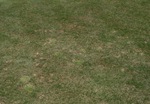 Nice work by the Riviera crew to mask lousy shaping (click to enlarge)I point this out not to belabor the minutiae of golf architecture, but for you to file it under the old "why can't they build 'em like they used to" slot in your memory bank.
Well I figured I had it wrong because the area looked splendid Sunday. Then I walked on it while trailing the leaders and noted that the stellar Riviera maintenance staff has been ably masking the modern architect's failed shaping with very discreet Kikuyu patches where divots were created. Yet again, the superintendent makes an architect look good.
Jim Furyk, killing any chance he had for the ASGCA's Donald Ross Award, talking Wednesday at the Loss-of-Trust Open about Riviera and classic architecture in general.
I always say if it was built before 1960, there's a good chance I'm going to like it. If it was built after 1990, there's probably a pretty good chance I won't. It doesn't always hold true, but it's a good rule of thumb.
 Matty G looks at the efforts to make Bandon Dunes more accessible via commercial aircraft and also quotes my cousin Tobin who has creating an innovative air service for those wanting to get around some of Oregon's better courses.
 Ron Whitten sort of buries the lede (in a copy and paste kind of way) when he repeats this story about the Jack Nicklaus-Tom Doak dream design pairing (why can't we have this on tape?).
Out in the dirt at Sebonack:
Jack: "Why leave that knob? The only criticism it'll get will be from good players who can't see the fairway."
Tom: "My thing is visual. All you see is green grass. The knob makes it visual. It pulls the green toward us. It plants the idea of going for it."
Jack: "In the mind of a scratch player or an 11-handicapper? You've said a bunch of stuff that a scratch player would never think."
Tom: "Well, a low-handicapper. If the green looks close to him, he'll overswing and get into trouble."
Jack: "All this stuff over one little pile of dirt. Look, it's my tee back here and if I want to get rid of it, I'll get rid of it."
They move down the fairway, where a plastic-lined, environmentally dictated retention pond was installed at the base of a hill below the proposed green. Both agree the pond looks too artificial.
Jack: "What if you built a waste bunker along the edge of the lake, break up that linear look?"
Tom: "I don't want to put a waste bunker against water. That looks like a hundred other modern golf courses. That's what I really don't want to do."
Jack: "You really don't like it?"
Tom: "I like to let human nature work against golfers sometimes. Why bunker right up to the water and dictate their shot? If they're silly enough to hug the lake on their second shot, then it's their fault if they go in."
Jack: "But we have to take up the elevation somehow. There had been a cliff between the pond and the fairway. Another option is to put that cliff back."
Tom thinks about it for a minute, then shakes his head.
Jack: "OK, let me throw out another idea for you to reject."
What a shame with this economic crisis, it's going to be so hard to get these two modest, humble men together for another collaboration.
 Ed Sherman profiles Dick Wilson in this week's Golf World, and naturally the tension between Wilson and Robert Trent Jones is the best part.
As the preeminent architects of the post-World War II period, Robert Trent Jones and Wilson were fierce competitors, often up for the same jobs. A 1962 story in Sports Illustrated was headlined, "Golf's Battling Architects." Critiquing Trent Jones' work, Wilson said: "I think he gives an impression of too many straight lines. Straight lines are something you want to get away from."
Von Hagge recalls Wilson once was told that a prerequisite for landing a job was joining the American Society of Golf Course Architects, which Trent Jones had formed in 1946. The request had Wilson fuming. "Dick was such a competitor," von Hagge says. "He used a lot of profanity and said, 'We're not joining that bleeping union.' The real underlying tiger there was Jones was asked to put it together, and Dick wasn't. He never joined."
 In Peter Dixon's look at the struggles of clubs in the UK, he that much of a club's standing still comes down to the quality of the course:
While there are still some high-end developments being planned, the future probably lies much farther down the scale. Williamson points to a development near Edinburgh where a farmer is adding a nine-hole course to an existing driving range and is encouraging families.
In 1997, the Henley Centre identified an emerging demand for what it called “fast golf, friendly golf, family golf”. This is just such a development. “I think traditional golf clubs have to move as far in that direction as they possibly can,” Williamson suggested. “Particularly in terms of relaxing dress code, welcoming families and so on.”
And as for the Royal Troons, Muirfields and Royal Birkdales of this world? They seem immune from the downturn, earning good income from visitors without having very many of them. The one thing missing from all their websites is an invitation to join the club. Now there's a surprise.
I'm shocked no one emailed to point out Tom Fazio's latest wisdom on why his generation (well, and really, him personally) is the best. I suppose you can only hear the same old broken record skip around so much. Nonetheless...
Lorne Rubenstein writes:
There's a tendency in course architecture circles to sanctify the past while discrediting the present. The top 10 courses in Golf Digest's most recent ranking of the top 100 U.S. courses were built before 1935. Can this be an accurate reflection of the truly "great" courses?
No, says Tom Fazio, probably golf's most successful architect in the past 30 years.
"That is fact," Fazio, 63, said the other day of modern rankings, "not that they are the best, but that that's the way people automatically think. Golf is a traditional game, and people like to go to Scotland and Ireland. They want to visit the home of golf. But imagine if somebody designed a course like St. Andrews today with blind shots. Golfers would wonder what's going on."
I know, can you imagine, blind shots? All that strategy too, minus framing and aiming bunkers? Frankly, it's just so wrong that they don't update the Old Course for today's discerning golfer.
Fazio was speaking in his headquarters here, in a house backing onto the Intracoastal Waterway. He'd flown in from Spain the night before, and had watched the film Casablanca on the plane. The famous film was made in 1942 and starred Humphrey Bogart and Ingrid Bergman. Many people think of it as the best film ever made. Fazio loves the movie.
"It's wonderful," he said. "But I was watching it and wondering what people would say today. You accept that it's the best. That's what people say. It's like when golfers talk about a Donald Ross course. But they never say just that they played a Donald Ross course. They played a 'great old' Donald Ross course."
And the point of this brilliant analogy, besides the fact that we shoud be grateful Tom Fazio isn't a film editor charged with restoring Casablanca?
None of Fazio's impressive body of work is in the Golf Digest's top 10 in the United States, of course.
Of course! Why would it be? Oh sorry, continue...
He breaks into the top 100 with Wade Hampton (1987) in Cashiers, N.C. at No. 15, and next is No. 22, his Victoria National (1998) in Newburgh, Ind. But he didn't seem concerned.
"I'm always telling clients that it's very hard to break into the Golf Digest list," Fazio said. "I hammer the people who run the magazines about the rankings, because it's such a controversial subject. I would have a top 100 for every decade. What's wrong with that? I happen to think the nineties were the best decade. Others say the twenties.
"The decade of the twenties was great," Fazio continued. "There was money around then, before the Depression."
Because after all, money=great design.
"Golf changes," Fazio said. "You wouldn't want to go back to the equipment that my uncle used, or to the way they built courses."
Nor will anyone want to go back and build courses the way Tom Fazio does!
Imagine today, the travesty of producing the graceful lines and gentle character like the old guys did. Or those green complexes that rest so nicely in the landscape and have all those cute little bumps and things that are lost with modern USGA green construction.
Here's a reminder that there is one architect who loves the equipment revolution. After all, it creates more chances to bulldoze the work of those pesky old and overrated guys!
"I've been listening to these discussions forever," Fazio said, "whether they're about equipment and how far the ball goes or about courses. I think the modern equipment is great for golf. It's kept us in the game longer. People in their sixties and seventies are hitting the ball as far as they ever did. They love that."
Not all players love it. Jack Nicklaus, for one, is adamant that the powers-that-be should roll back the distance a ball can go.
Fazio doesn't agree. He also pointed out that the best classic courses are always changing. Pine Valley, No. 1 on Golf Digest's most recent list, had seven new back tees and three rebuilt greens. Then there's Augusta National, No. 3, where Fazio is the design consultant."You go to Augusta National, and you might not notice the changes," Fazio said because the club works in alterations seamlessly. "But they're making changes all the time."
Nope, it is so hard to detect those changes at Augusta. Because they've been so discreetly carried out. And yet, so well received.
Great to read from Lorne Rubenstein that Mike Weir has joined design forces with Ian Andrew. And I loved this question from Lorne:
But what might happen should a city or town looking to do a public course, perhaps for kids, and unable to pay anywhere near that amount, approach Weir Design? Would Weir, Andrew and IMG entertain the idea?
"Absolutely," Pelletier said. "We talked about sending out an RFP [request for proposals] to municipalities saying, 'Here's an opportunity.' Mike wants to grow the game of golf in Canada."
Such a course could be Weir's and Andrew's first.
"There's the possibility of a public course," Weir said. "That's an idea Ian had, and I liked it. We'll see."
One of the points raised in my Obama-WPA piece for Golf World revolved the idea of taking turf out of play and in general, irrigating less (perhaps with government incentives, as pointed out in this example). I close the piece wondering if golfers can actually accept less green in the name of Green.
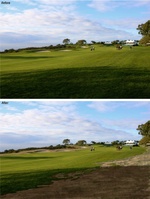
I asked Tom Naccarato, who does digital photo work for architects and clubs looking to simulate what something will look like, to work on a couple of Torrey Pines photos I took last year. Because I can't think of a course with more acreage that needs to be converted to non-irrigated native. (There was one choice spot right of the 7th fairway where irrigation has been turned off and Tom used that for the rough look you'll see in the photo below).
While I was walking around Torrey prior to the Open I met consultant Andy Slack, the irrigation guru brought in to try and right the troubled irrigation system at Torrey. When asked how many acres on the property could be converted to non-irrigated without impacting play, Slack said he felt that 50 acres was an easy target. I would agree. And the ensuing cost savings in irrigation, energy and man power of reducing 50 acres would be incredible.
Furthermore, does this really look so bad? I know the PGA Tour would have a coronary because there isn't full turf coverage and many golfers would wonder what's wrong, but this would seem to me where golf is going to have to if it wants to survive and reclaim some of its "native golf" roots. Click to enlarge Tom Naccarato's digital enhancement of No. 14 at Torrey Pines:
 Brian Lee in the Tucson Citizen takes a sneak peak at the Ritz Carlton Dove Mountain, new home to the WGC Match Play.
The signature Jack Nicklaus- built course, utilizing two of three finished 9-hole layouts, will be "typically" Nicklaus, said general manager Kenn DePew of The Ritz-Carlton, Dove Mountain resort. That means intriguing and multiple bunkers, tempting space and undulating greens with eight to 10 possible pin placements each.
"I'd like to know why Jack designed this," DePew said. "Not that I question it. I just want to know what the reasons are. There is going to be some good golf played here."
Well I'm sure he'll be happy to take your call anytime to answer questions about his thought process.
But a Ritz-Carlton designed for tournament play is not just about the worldwide pros. The change from the much narrower straight-out-and-in Gallery course of the first two years of Tucson WGC play, is a fans' delight or relief, depending on how you look at it.
"The Gallery was beautiful but was a lot of walking," DePew says. "It was a load of work. This is fan friendly."
And at just a few yards under 8,000, it's oh so quaint.
Geoff Shackelford is a Senior Writer for Golfweek magazine, a weekly contributor to Golf Channel's Morning




Copyright © 2022, Geoff Shackelford. All rights reserved.