"TIES BROKEN IN FAVOR OF COURSES WITH MORE EVALUATIONS"
/A reader spotted an interesting footnote in the latest Golf Digest ranking. Posted
Read More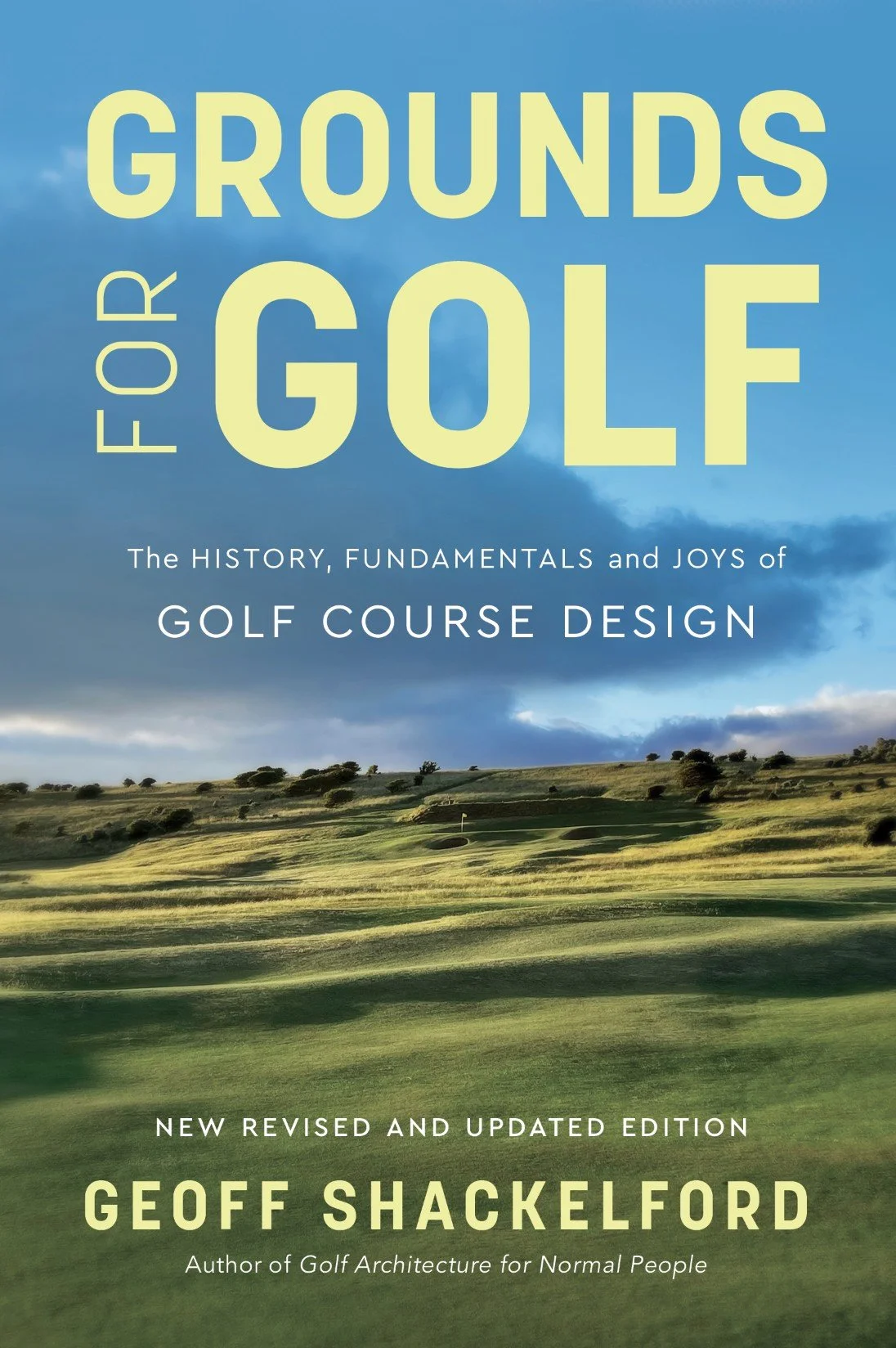
It’s back!
Twenty years later Tatra Press has kindly allowed me to bring back Grounds For Golf now that golf architecture is of more interest to the masses. A new Introduction looks at what’s driven the interest growth and two new chapters I had a blast adding (plus a few edits to keep things up-to-date).
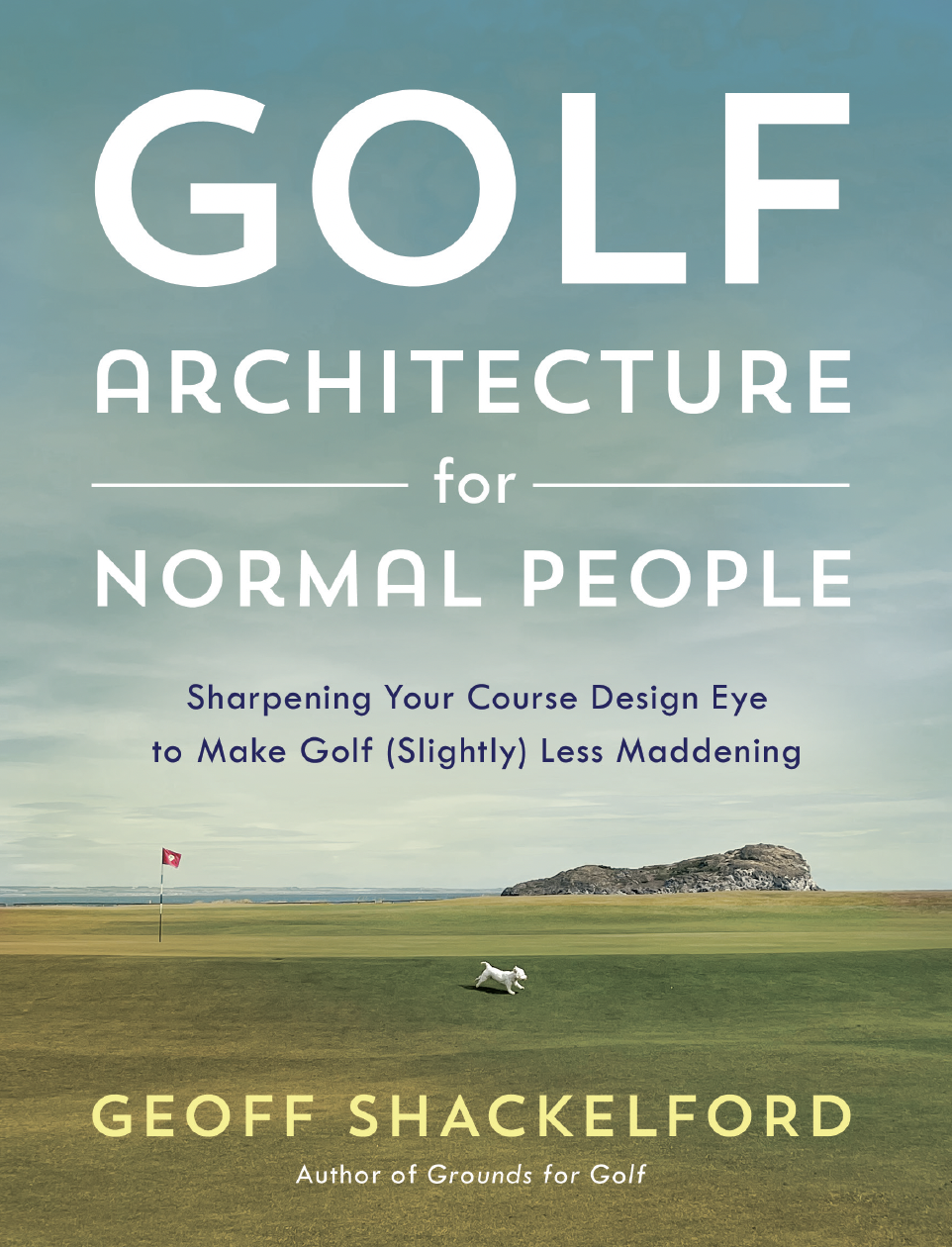
The Amazon purchase page for the book arriving June 15, 2026.
 In the April Golf Digest, Jaime Diaz writes about the lack of excitement at recent Masters and concludes that simple tweaks are all the place needs.
This is a significant story for a number of reasons, the most obvious being that it's a major shift from Diaz who penned a Golf World story just three years ago with the subtitle: "On Second Thought, Masters officials knew precisely what they were doing when they executed the most recent changes to Augusta National."
But as with that story, embedded you will find more telling details that speak to the impact of architectural changes at Augusta National. While he focuses on "tweaks," it's clear that Diaz talked to many figures and few feel the course has evolved in a positive way.
For the record, what I thought was a slightly misleading headline (just in case five years from now he writes something titled, "Cut the Rough And The Silly Trees Down Mr. Chairman Ridley, Please":
Adjusting the Volume: For all the fretting that the Masters is trading roars for bores, a few tweaks (and good weather) might be all that Augusta National needs
That's a bit misleading since Diaz proposes restoring two of the most famous tournament holes in golf, which seem like they were recklessly altered when you read some of the really interesting tidbits Diaz picked up from players.
In excusing the defensive nature of the event in recent years, Diaz writes:
The 10 yards that have been added to the front of the tee on the par-4 seventh were sorely needed. The hole was the redesign's worst effort in terms of strategy and aesthetics. Lengthened by 85 yards since 2001, to 450 yards, it was also counter-intuitively tightened with more trees. Even after a good drive, the super-shallow green--which was built in the '30s to receive an exacting short iron or wedge--is unreasonably small for a middle-iron approach. As Woods has said, "I don't have that shot." What used to be a tricky and tantalizing risk-reward has become a hard par where the mandated conservative play is a competitive buzz kill.
I don't see how 10 yards and no tree removal fixes No. 7? Television does not do justice to how absurdly narrow this hole has become (it wasn't exactly wide before!).
Alright, here's where Diaz gets to the main point in all of the ANGC change discussion. The once beautiful balance is gone, putting players in a constant state of defensiveness.
"The whole thought process of playing the golf course used to be, get through the first six holes around par, and you can birdie 7, 8 and 9 ... and you have a great round," Phil Mickelson said last year. "It changes when you can be aggressive--and the whole complexion and the mind-set of how to play the first six or seven holes."
Diaz focuses on the 13th and 15th as the keys to restoring Augusta National to its former self. He explains why players lay up more than ever, then writes:
It's a procession of almost laughably mundane short-iron lay ups to what essentially becomes two 100-yard par 3s, giving the Masters another wedge-fest. The 13th, in particular, used to be considered the best tournament hole in the world, but that reputation is being diminished.
It also contributes to boring golf to play. Without a payoff looming on 13 and 15, players, to use Faldo's term, get "switched off" to creative, aggressive shotmaking and go into a sort of play-for-par U.S. Open mode that has hurt the Masters.
His solutions, which all make sense:
So here's a simple stimulus package: Make the 13th and 15th worth going for in two again.
Augusta National has all the options. The club can move up some tees, soften greens, set less-dangerous hole locations, cut the fairway grass in the direction of the green instead of toward the tee, flatten some speed slot-killing fairway humps, trim some overhanging branches and take out a tree or six, grow the grass around the water hazards just a hair longer--or any combination of the above. The goal, as Jim Furyk succinctly states, should be to "put the gamble back in."
A first step has been taken, with the tee on 15 being moved forward about eight yards. Something similar should happen on 13. The landing area on 13 since the hole was lengthened is much more sidehill than the old one. The awkwardness of the lie, versus the more level former landing area, is a big inhibitor to players going for the green. Length isn't the issue as much as loss of control.
While those are great suggestions, it's hard to imagine 13 and 15 reclaiming their former glory without removing all of the recently planted trees. (Look how absurdly narrow 15 is in the photo accompanying the story. And remember, it plays narrower than that due to the tilt of the fairway.)
Losing the second cut would compensate for restored width by sending errant balls further into trouble. More importantly, the look of width might subliminally encourage more aggressive play.
Ultimately the entire sense of defensiveness established by the club and Tom Fazio has to be eliminated from the architecture in order for The Masters to regain its place as golf's greatest championship. This means losing the rough, having more tee placement options, removing the silly trees and restoring holes like 1, 2, 7, 9, 11, 13, 15, and 17 to resemble their riskier, more volatile selves.
 In this dust up over design credit for Hyde Park, I suppose I forget that it is Florida and a long way from Canada, but it's not like the design credit is going from a Donald Ross to a Leonard Thompson. Or even a Fred Thompson (same generation in his case).
Stanley Thompson was no slouch and considering how few of his courses south of the border--or even north of the border--Hyde Park still has premier architectural lineage.
 I figured this one was lost to the ocean for good, but Ron Green Jr. reports otherwise.
 Garry Smits' files an interesting piece on the architectural name dispute at Hyde Park, where a February Ron Whitten story in Golf World credits Stanley Thompson to the dismay of local Mark McCumber, who reasons that articles saying Thompson "built" the course differ from designing the course.
McCumber, who has designed eight courses on the First Coast, said there's a distinction that can be made from that sentence.
"It said the course was built by Thompson, who happens to be an architect," McCumber said. "Some architects also had golf-course construction companies and built courses based on the design of others. We've done that at McCumber Golf. That sentence, in and of itself, doesn't prove Stanley Thompson designed the course."
Points for the subtle plug but I have to go with Whitten's counterargument on this one:
Whitten counters: "That's a distinction without a difference," he said.
Considering that Ross's courses were so well documented and no plans exist, I'm leaning toward Whitten's take on this one.
Ed Sherman reports on the rather incredible salvation of Ravisloe Country Club and the course with Ross genes opening to public play April 1.
Thanks to reader Joe B. for this Marisa Lagos update on the possible future of Alister MacKenzie's Sharp Park. Doesn't sound so good.
My Golfdom column for February is up and while it may seem like a plug for The Prairie Club's Horse Course, it's actually a plea for more H-O-R-S-E type match play. Let me know what you think.
Geoff Shackelford is a Senior Writer for Golfweek magazine, a weekly contributor to Golf Channel's Morning



Copyright © 2022, Geoff Shackelford. All rights reserved.