in·ter·est·ing (in-t(ə-)rəs-tiŋ) : holding the attention : arousing interest

It's hard to interpret the early reviews of Liberty National, but it seems like most of the players are trying their best not to blast the design. Shoot, Norman Vincent Ogilvy is tweeting about how great it is that players are actually discussing design. Granted, it took a Cupp-Kite nightmare, but he's finding the positive in that. Impressive restraint!
Read More

New Rule...

Click to enlarge at your own risk...with apologies to Bill Maher--no course can host a major event or be eligible for a ranking if they have fake swans in their lakes.

Some of you may have noticed during Solheim Cup play that the lake swans at Rich Harvest Farms never moved.

Yes I know, they're more discreet than fountains, and I do appreciate a sense of humor sometimes, but if you have to put phony wildlife on your golf course to spruce things up, you are not a real golf course.

"No greens keepers here — just do-it-yourselfers."

Eric Olson files an enjoyable look at sand greens in the U.S. and in particular, Nebraska. Pictures would have been fun. I'm not so sure about this...

Irwin said he would like to see sand greens make a comeback.

"There are a number of places that sand greens might make a resurgence because of our water issues and challenges facing many of today's golf courses in trying to keep them up," he said. "Sand greens are unique, but they aren't impossible to play."

Sand greens of yesteryear were an environmentalist's nightmare. To create a faster putting surface and keep the sand from blowing away, motor oil was dumped on the greens once or twice a year.

PastureGolf.com has more including a listing of courses.

MacKenzie And Wikipedia

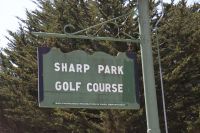
If you read my Sharp Park story in Golf World--I know many of you have studied it and already cut it out for your scrapbooks--you'll know that Brent Plater, the primary environmentalist and San Francisco State lecturer lobbying for its closure "for the good of the game" is suggesting that Alister MacKenzie created a faulty design and furthermore, there is none of it left, so the course should go.

(I know, don't even begin to ask things like, how would he know the design is faulty if he was not alive back then and none of it is left today to study.)

Mr. Plater has repeated this claim many times by citing Daniel Wexler's book, even appearing to repeat his claims under the name Arnold Palmer below Curt Sampson's story posted at golf.com (the misspelling of "McKenzie" is the same mistake in his early writings on Sharp Park and to me. Now, we architectural junkies bicker over MacKenzie's spelling, but the a in Mac is never an issue, it's that dreaded upper or lower case k).

Thanks to Mr. Plater's redundant message of MacKenzie's mistaken work at Sharp Park, I'm guessing that this hilarious modification to MacKenzie's Wikipedia page was the work of those hoping to see the course closed. Obviously the reference is totally out of context with the rest of the biographical sketch and will be edited out probably by the end of the week, so I'm offering a screen-capture and a copy-pasted version of the text for you to see just what kind of mudslinging the proponents of saving Sharp Park are dealing with.
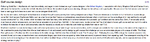
(click on image to enlarge)

Here's the text, unedited. Not exactly a graceful or appropriate or accurate transition.

MacKenzie worked in an era before large scale earth moving became a major factor in golf course construction, and his designs are notable for their sensitivity to the nature of the original site. He is admired for producing holes that offer an ideal balance of risk and reward, and for designing golf courses that challenge yet also accommodate players with a range of skills. The Sharp Park golf course in Pacifica has little resemblance to the initial design. Golf historian Daniel Wexler’s book “The Missing Links”: “Following the early 1930s deluge that washed several of (the course’s holes) out to sea, a massive berm was constructed (largely upon land once occupied by holes three and seven) to prevent history from repeating itself. The subsequent rerouting of the county road and reconfiguring of the lakeside holes has further muddled things so that today only a handful of holes run consistent with MacKenzie’s originals, and no appreciable trace of his strategy remains in play.”

"Yet another fable from the region immortalized by the brush strokes of Paul Cezanne, the Cannes Film Festival and the topless beaches of St. Tropez?"

Pretty much yes. Disappointingly, Bloomberg's A. Craig Copetas profiles Vidauban, the "world's coolest golf course" that "doesn’t have a name" but is called Vidauban throughout the piece. This supposed mystery course is supposedly impossible to get on and even harder to find, but it seems pretty easy to locate after a quick Google search. Thanks to all of the readers who sent this and I would agree with a couple of you who wondered what the real story is here.

Spike Bar To The Donald: Stop (Again!)

The Internet Sports Writer of the Year has now (twice) told The Donald to forget about his course planned for very environmentally sensitive land. I expect The Donald to be protesting that ISWOTY award any day now. You go Hoppy:

Though there is little sign of activity at the Donald Trump International Golf Links at Balmedie, near Aberdeen, that does not mean that work has stopped, according to Neil Hobday, the project manager. "When we got outline planning permission last November we were given 40 conditions that have to be purified before we could put a shovel in the ground" Hobday said. "That is what we are doing now - trying to purify these conditions.

"We are not behind schedule though we are not ahead of it either. We are going through a transparent process. We are optimistic that we will be in the dirt in April 2010 and the opening date will be 2012.

"We have not been affected at all by the current economic situation," Hobday continued. "Mr Trump is in a strong cash situation. Everything has been paid for in cash. There is no mortgage on this project. I assure you Mr Trump is in an acquisition mode."

Though a friend made the valid point that Trump's project would be good news economically for a depressed part of the country, it did little to reduce one's feelings of concern at this project. Golf did not need another course in 2008, one, furthermore, set in an area of outstanding natural beauty much enjoyed by everyone. And it does not need one now, however on schedule it is and even though one year down the line, it looks more of a reality than it did.

"Awkward" Tees At Congressional

I have to confess it's been a while since I looked at Congressional very closely but today's AT&T National first round was an eye-opener. The list of cringe-inducing sights is too long, so let's just hope they do some tree and bunker work before the 2011 U.S. Open. To call the bunkers there two-dimensional would be unfair to two-dimensional bunkers.

Rex Hoggard blogged about this change, which actually sounds like it fits with the rest of the course:

The Blue will close shortly after this week’s event and the greens rebuilt, but some new tee boxes that the U.S. Golf Association may use have already been installed, at Nos. 9 and 15 for example, giving players a glimpse at what may await in ’11.

“(Nos.) 15 and 9 seemed very awkward because they move away from the way the slope is,” said Jim Furyk, who has played in the last four Tour events played at Congressional (’97 U.S. Open, ’05 Booz Allen Classic and ’07 and ’08 AT&T Nationals). “They both slope left to right and the tee is going back to the left, which makes the tee shot a little bit more awkward.”

Speaking of awkward, that hill behind below the new 10th tee, old 18th green site. They will find a way to put people there in the U.S. Open, right? It looks a little strange right now with just a television tower. Actually, that's the least of Congressional's issues.