The release of David Owen's lastest book, Green Metropolis, coincides with a powerful look at golf's sustainability in the November, 2009 Golf Digest.
GS: Your November Golf Digest feature lays out a pretty strong case for changes in the way we view golf courses and how they interact with the environment. Your bold conclusion seemed to say that no matter what we do conservation wise, shrinking the golf landscape is the top priority and to do so we must reassess the chase for distance. Do you think there's any scenario where this could happen?
 It would take some courage from the game’s governing bodies—something they haven’t traditionally shown much of. The USGA, instead of tackling distance directly, has done things like spending millions on golf ball research. That’s like addressing climate change by creating a government department to build car engines. The easiest way to reduce golf’s environmental impact, as well as to hold down its rising cost per round, would be to reduce the amount of groomed acreage that the game requires, and the easiest way to begin doing that would be to dial back the golf ball. Doing that wouldn’t be sexy, but making unsexy decisions is what nonprofit governing bodies are for.
GS: Who would you like to see take the lead on this and how would you sell it to golfers that a distance rollback is the best thing for everyone involved?
DO: In the ideal scenario, the USGA, the R&A, the PGA Tour, the PGA of America, the European PGA Tour, the tournament committee of the Augusta National Golf Club, and anybody else with influence over the game would agree that it’s crazy for an expensive sport with shrinking participation to continue driving up its own costs. Longer clubs and balls lead to longer golf courses, which require more maintenance and consume more real estate, water, fertilizer, pesticide, and fuel, thereby driving up both maintenance budgets and greens fees, and driving away players. Manufacturers will probably scream—they have in the past—but they don’t need distance to compete. Making putters and wedges is usually more profitable than making irons, but nobody buys a putter or a wedge because it hits the ball farther. Let manufacturers compete on accuracy instead of yardage. Let them make their equipment so accurate that we can get by with smaller greens and half-width fairways, which would cost less to maintain.
GS: It seems as if the argument would be aided by numbers that say, if the Overall Distance Standard was dropped by X amount, X number of acres less would be needed for golf, and therefore, X amount of energy, water and money would be saved annually. How much of a rollback do you think would make a difference for existing courses?
DO: I have no idea what the numbers are. And, of course, making a long golf course shorter without ruining it or spending a fortune isn’t necessarily an easy thing to do. But the lousy economy is shrinking golf’s landscape right now. Between 1990 and 2008, according to the National Golf Foundation, the number of golf courses in the United States grew by almost 25 percent, from fewer than 13,000 to roughly 16,000, yet during much of that same period participation by golfers actually fell. In fact, Americans played 20 million fewer rounds in 2008 than they did in 2000—and the decline has presumably accelerated since then, as the economy has tanked. Those forces, right now, are driving marginal courses out of business, pushing us back toward where we were in 1990. The resulting contraction will be good for the survivors, because the golfers who remain won’t be spread so thin, but bankruptcy is a very blunt instrument of change. It would make more sense to try to wind golf back in a more orderly way.
GS: You write that the trick is to find a "sustainable balance." Do you think the economic collapse is actually making this a possible path for golf's future, or will it just be another example where the game's leaders are just saying what they think needs to be said to cover their rear ends?
DO: I have no idea what the game’s leaders are saying. Many, I would guess, figure that technology will save the day—that, for example, somebody will come up with a type of turf grass that doesn’t need to be watered, fertilized, or mowed, and everything will be fine. But technological breakthroughs are at least as likely to increase costs as to reduce them—and, besides, we already understand the technology of making things smaller. The problem is that low-tech solutions don’t seem very glamorous to most people. I know a married couple who are getting ready to build a new house. The wife read a book about the environment and got all excited, and suggested to her husband that they make the house green. He said, “Good idea. Let’s make it 2,000 square feet instead of 8,000,” and she said, “That’s not what I meant!”
GS: You get around a lot in your work for the New Yorker and you still play a fair amount. Do you hear a lot of negative feelings directed toward golf and if so, do you think much of it comes from the game's image as a resource waster? Has animosity toward the game gotten worse recently?
DO: I don’t know that animosity has increased. In fact, I think golf is still enjoying the image upgrade it got from the rise Tiger Woods. But golf’s leaders should worry less about the game’s image and more about its rising cost per round.
GS: On another subject, in the October 12 New Yorker you profile of Nell Minow, the influential independent researcher who co-founded The Corporate Library and who believes CEO compensation is "doing more to destroy capitalism than Marx." You write about the subscription database she runs which includes SEC filings, contracts and background information, including "in one case, overlapping golf-club memberships of corporate directors." Did you find out any more about this and what it might say for the role certain clubs play in the corporate world?
DO: That club was Augusta National, and the membership list was one that was made public back in the Martha Burke days. Lots of business gets done on golf courses, but I think golf-playing corporate hotshots are more likely to think about the effect that their business relationships might have on their golf club memberships than the other way around. Will serving on that board make me more likely to be invited to join Seminole?—that sort of thing.
GS: Back to golf and the environment. Do you think there's ever a day when golf courses could be viewed as environment beacons, or is mere survival and basic sustainability the real goal at this point?
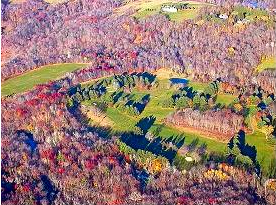 DO: Golf, like all human activities, will always exact an environmental cost. But it’s worth remembering that the first golf boom in the United States, back in the late 1800s, took place at a time when the equipment was primitive and playing conditions were extraordinarily crude—no four-piece balls, no watering systems, no fungicides, no greens mowers. Anybody who has ever played cross-country golf on a closed course in the middle of the winter knows that the game doesn’t have to be played on a 7,500-yard billiard table in order to be compelling.
My home course is a century old. It has just nine holes, and it fits on 40 acres—about half the size the USGA’s recommended minimum for a nine-hole course. To play 18 holes you play it twice, from different tees, and the whole thing, if you stretch it out to the absolute tips, measures barely 6,000 yards. Big-hitting members sometimes used to complain that it was outdated, and that we’d eventually have to either abandon it or find a way to make it a thousand yards longer, but it now seems serendipitously well-suited to the times, and to our likely environmental predicament in the years ahead. My club’s costs are low because we don’t have much acreage to maintain, and the course is short enough to allow four players on foot to play 18 holes in three hours. As a result, we’ve been able to keep our dues under control, and, although the stalled economy has hurt us, we haven’t suffered the sort of membership crisis that some other clubs in our area have. I think we represent one possible model for the future—and I’m sure there are others.