"My 10-year-old Griffin now plumb-bobs. I go, 'Dude, what are you doing?'"

Cameron Morfit conducts an entertaining Q&A with Steve Flesch, covering all sorts of good stuff.

Let's talk Tour policy. You've slammed course setups. What's your beef?

It's the same every week. Having every par-3 at 230 yards is boring, as is having the rough at five inches. The greens don't always have to be 12 on the Stimpmeter. They water the fairways and around the greens, forcing you to hit a high spinny shot in. We've gotten away from the fact that golf can be played more than one way.

But that's exactly how Tiger and Phil and most of the top players like to hit the ball. Maybe the rest of you guys should learn to live with it.

But let's not set up every course so it's like a major. The public wants to see us make birdies, so let's set up the courses so we can display our skills and show everybody how good we are.

Seems the boys really are in love with the Memorial these days.

Jack Nicklaus upset the pros when he toughened Muirfield Village for The Memorial and furrowed the bunkers. Who's going to call up Jack and say, "Enough!"?

It's hard. Jack should have his input, but is it really in the best interest to play the course like that? That was eight-inch rough that obviously hadn't been topped off the day before the tournament, as Jack indicated in the papers.

Are you calling Jack Nicklaus a liar?

No, I'm not, but it was eight inches on Monday and it wasn't touched the whole week. Whether it's the tournament director or whatever, don't tell us it's four-and-a-half-inch rough. I can put my foot in it and see it's over my shoes. It's the same at Arnold's event. That rye-grass rough is sticky and it's five inches long. Muirfield is one of my favorite courses, but from the first time I played it in '98 to 2008, it's gotten harder, not better. The greens are 14 on the Stimpmeter and they're not big; do you need ruts in the bunkers, too?

This may be the first time someone dared to note the issue for Phil Mickelson and his joint instructors Butch Harmon and Dave Pelz.

Your fellow lefty Mickelson had a quiet 2008. What's wrong with him?

Phil Mickelson is fantastic. I have learned so much from watching him play. He knows I respect his game, and I don't want to say anything that would upset him, but right now I think he's got two different kinds of coaches. I worked with Butch Harmon for five years, and his way of thinking about the game is a lot different than how Dave Pelz is. Dave's very analytical, very scientific, and everybody respects that. Phil is trying to find a balance between two methods that seem to pull him in different directions.

And of course, slow play...

What else is on the PAC's radar?

Pace of play. There are a dozen guys out here who are habitually slow. It's not that our fine structure isn't strong enough — it's that our officials should be more assertive. We all know who's slow and who's not, and while half of the slow guys say they want to get faster, the other half say, "I don't care if I'm slow or not." Well you know what? You've got 144 guys out there that week and most of them feel you're disrespecting them by taking that attitude. You have 40 seconds to hit the shot, and if you can't do it, you're not playing out here.

Is this why weekend golfers seem to think a glacial pace is okay?

My 10-year-old Griffin now plumb-bobs. I go, "Dude, what are you doing?" He goes, "I don't know, I see you guys doing it on TV." That's exactly why it's wrong for us to be playing that slowly. 

"Players don't get better in the long-term if they stand on the tee and are not required to exercise their imagination."

It's comforting to know that the shallow love for rough and narrowness at the expense of strategy is not relegated to PGA Tour course setup. Derek Lawrenson on the setup last week in Dubai:

The Emirates Course in Dubai is one of my favourites but I do think the way it was set up last week meant it lost some of its charm.

Architect Karl Litten cleverly designed it so players would have numerous options both from the tee and with their approach shots. Many of those options, however, were taken away by growing the rough.

Take the par 4 sixth, where Litten's idea was to hit your tee shot as far to the left as you dare to get the best line into the green. Not last week.

That would have left you in the thick rough, meaning the only option was to aim for a thin strip of fairway.

Those in charge could point to a high quality leaderboard for validation. But players don't get better in the long-term if they stand on the tee and are not required to exercise their imagination.

Tour Fairways Getting Tighter?!

Over the four days of the FBR Open at TPC Scottsdale, I heard several mentions of newly narrowed fairways. And the rough was cited as being particularly difficult this year due to a wet spring (and what sounded like an aggressive overseed).

I know of two other PGA Tour venues that are seeing narrowed fairways. This would not seem to jibe with what some players believe is going to be an end to the old school U.S. Open approach of the last few years at select venues. Nor does it really fit with the Commissioner's remarks about introducting more risk-reward (unless he thinks rough creates interesting risk-reward golf, which I doubt).

"The last few years we've got stuck in this narrow fairway, long rough kind of setup that's really quite similar every week we play, I think."

A highlight from Geoff Ogilvy's teleconference call today, answering a question about sameness on the PGA Tour:

GEOFF OGILVY: It wasn't really a comment about the architecture of the course we play; it was more about the setup we play. The last few years we've got stuck in this narrow fairway, long rough kind of setup that's really quite similar every week we play, I think. Kapalua is the exact opposite of that: wide fairways, rough is really not in play, big greens. Everything is just different about Kapalua than we play a lot of the year.

I just think a bit more variation in the setup. The TOUR, there was a big player meeting at Charlotte last year where the players and the TOUR got back on the same page about how we think we should set our golf courses up. Maybe we've got a bit off track trying to set them up as extremely narrow, as extremely hard as we can recently, kind of chasing the U.S. Open model, can we add a bit more interest back into our courses? Over the next few years, the TOUR is already taking about a bit more interest in the setup, maybe a little bit less rough. They've already done it at Sawgrass by cutting the rough down and changing the course. I think we're on the right track. I think for a while we got stuck in the narrow fairway, long rough kind of golf course. I think, to be honest with you, there's definitely a time and place for it, but every week it kind of gets boring. That was my point. It's more of a setup thing than an architecture thing.

"Augusta is now one of the purest majors we play."

SI Golf Plus's excellent year-end issue featured a roundtable with scribes Garrity, Van Sickle, Bamberger and Shipnuck joining the "anonymous tour pro" for a discussion about 2009.

It's all quite entertaining in an pared-down sort of way, but one comment from Mr. Anonymous made me hurl my magazine across the room.

ABOUT THE MAJORS

Bamberger: Augusta National sets up for some semiobscure guy — like Zach Johnson or Brandt Snedeker — to have a great driving and putting week. To me, they have taken the emotion out of the tournament by toughening the course so much.

Van Sickle: The course negates ability because now you make birdies only by accident. They pushed the course to the brink of difficulty, and weather conditions can push it over the edge.

Garrity: If they fix the course the way we want, they may be left, once again, with ridiculously fast greens as the course's only defense. I didn't like that, either. Ease back on the course, and a Masters-regulated ball may be the only solution.

Anonymous Pro: I hate to say this, but Augusta is now one of the purest majors we play. With the length, the rough and especially the trees, it's less of a bomber's paradise. The trees have changed the course. They have Tiger-proofed it. They've taken a lot of the risk out of the course. You have to plod along and play to point A and B and C.

So let me get this right. It's the purest major they play, yet it takes away risk and you have to plod along and play to committee-dictated points of interest?

That's what a pure major does? Yikes.

"You'll probably will see more of that type of presentation moving forward because we are trying to find more risk/reward..."

Commissioner Tim Finchem sat down Saturday with the assembled scribes at Sherwood (here, here to Doug Ferguson for suggesting we pull up chairs...it was a long 30 minutes). For a summary of the conversation, you can read Ferguson's focus on the PGA Tour cutting costs and not jobs, while Steve DiMeglio shares some of Finchem's most detailed remarks on the economic crisis's impact.  GolfChannel.com posted this short interview with Finchem that also serves as a healthier, more cost effective alternative to your daily Valium consumption.

The Commish talked about the demise of the Hope Classic and I used the opportunity to ask about a rumored shift in over course setup philosophy that we might see in 2009.

Q. You mentioned talking about the Hope, that one of the things that has possibly impacted the tournament was the shift in the way the golf courses played and presented, and now it's going back in the other direction. Do you see that as something that's a shift for that tournament or a shift in general for tour golf courses?

COMMISSIONER FINCHEM: To some extent I would say that it's really two different things, because the Hope, we are talking about a straight configuration of history and culture of the tournament, the atmosphere, what you want to try to accomplish in an environment where you play lots of golf courses during the week, and it's very difficult for a competitor to properly prepare, learning their way around one golf course let alone several.

Having said that, we are looking at ways to have a broader range and variety and set of conditions. We have, you have probably noticed in the last year, we have experimented a fair amount at certain tournaments.

For example, at Boston this year, we set up the 18th hole to where it's very conducive for players to reach the green and be in positions for eagle and birdie, just to see what reaction there was from players and the fans and television viewers.

You'll probably will see more of that type of presentation moving forward because we are trying to find more risk/reward and trying to find more things that create interest for the fans but still maintain the integrity of the competition.

Q. Was that a reaction at all to television ratings or player feedback?

COMMISSIONER FINCHEM: I don't think it's a reaction to television ratings, but it is the recognition that we should be on the weekend making the competition and the play of these golf courses more interesting to fans generally.

Sometimes you miss things and you realize you should be concentrating more -- not that we have necessarily missed anything, but we are putting out more interesting -- those kind of issues as we look at golf courses.

Uh, that's a yes, they are going to try and generate a little more excitement via setup in 2009. That should reassure Peter Kostis, who has expressed concern about some of the oddball setups of 2008 possibly carrying over into next year.

Finchem was also asked to confirm John Marvel's GolfDigest.com report that the Commish is entered in the AT&T Pro-Am at Pebble Beach.

COMMISSIONER FINCHEM: The chairman and CEO of AT&T asked me to play, and I do believe I said, "Yes, sir."

Q. Who is your partner?

COMMISSIONER FINCHEM: Davis Love. It has not been announced yet.

Q. What is your handicap?

COMMISSIONER FINCHEM: I think my index right now is 6.3.

Q. So if you have to play a few tournaments in the schedule, you're trying to lead by example?

COMMISSIONER FINCHEM: I'm going from zero to one.

Q. So who is in your foursome?

COMMISSIONER FINCHEM: Hunter Mahan and Randal Stephenson and myself. That's the plan, anyway.

"I enjoy playing where single-digits is a good winning score."

Carlos Monarrez wonders if the post-Buick Tiger will return to Warwick Hills (no!) and points out this comment from a few years ago:

After Woods' last Buick victory, he said he liked the traditional tree-lined layout at Warwick Hills and how it set up for his game. But Woods also admitted he was not a fan of the low-scoring nature of the event.


"As far as enjoying this type of golf tournament, no, it's not my favorite," Woods said then. "If you look at my tournament schedule, I usually don't play events that are like this. I enjoy playing where single-digits is a good winning score. ... Here, you will get run over with spike marks all over your back."

I wonder if such a remark about single-digits drove the PGA Tour to accentuate the higher-rough, old school U.S. Open course setup mentality?

Naw...not possible.

"But it felt like I was always just a foot into the deep stuff and a foot away from having a perfect lie, and it wore on me."

Steve Elling looks at the concept of PGA Tour players fleeing for the European Tour and includes this more detailed version of Robert Allenby's suggestion that course setup is influencing his decision.

Next week, while the Disney event will be mostly filled with journeymen seeking to retain their cards for next season, the HSBC field is expected to include Mickelson, Padraig Harrington, Adam Scott, Kim, Henrik Stenson, Sergio Garcia and Trevor Immelman. To be sure, the European Tour allows players to receive appearance fees, but the imbalance of power is pronounced.

Allenby said he's looking for variety, too, and took a thinly veiled shot at the PGA Tour's prevailing bomb-and-gouge mentality.

"I joined because I wanted to expand my golf, I wanted to play a different style of golf," said the Australian, who has lived in Florida for nearly a decade. "I thought I was getting a little bit stale. The golf courses (in the States) are set up the same way every week. I kept getting injuries over here, pretty much because the rough was so high, and I got sick of it.

"I got sick of playing out of six-inch rough every week. I'm not bitching or moaning about it. I know I am a great ball-striker, and I drive the ball very straight. But it felt like I was always just a foot into the deep stuff and a foot away from having a perfect lie, and it wore on me."

Fair enough. But like they say on the police shows, if you want to find the real reason behind the mystery du jour, follow the money.

"It also is likely that there will be less of a need for long, punitive rough."

There is a USGA.org Q&A with president Jim Vernon about the state of the USGA and his first year in office. I liked his answer on the groove rule change, which could be the first time I've seen someone from the USGA suggest that it could lead to less rough.

How do you expect the rules changes concerning grooves to impact how courses are set up for tour-level and championship competitions?

Vernon: For those setting up courses for players of this level, I think you’ll see a whole array of opportunities. If you look at the PGA Tour, the major championships, or the European Tour for that matter, you’ve seen a trend over the past 15 years showing hole locations have gotten closer and closer to the edge of the green each year, and that won’t need to be as much the case anymore. The rules changes may well reopen greens to some different hole locations that will still reward accuracy, but you won’t have to put it three or four paces from the edge of most of your greens. It also is likely that there will be less of a need for long, punitive rough. 

"[The rough] is five inches long. Why brush it back at us?"

Paul Mahoney reports on Lee Westwood's scathing post round criticism of the Oakland Hills course setup. On site sources say the rough had been trimmed but it also seems the raking we spotted last week was taken to a new extreme. At least according to Westwood.

"The course is 7,500 yards long, the greens are firm, and the pins are tucked away," Westwood said of Oakland Hills (official yardage: 7,395). "They are sucking the fun out of the major championships when you set it up like that. The fairways are narrow, and unfortunately if you miss the semi [rough] by a foot you are worse off than if you miss by 20 yards. I asked my partners [Geoff Ogilvy and Zach Johnson] if I was out of order, and they said 'No, if you are slightly off-line, you are crucified.' It is too thick around the greens as well. It takes the skill away from chipping."
Comparing Thursday's conditions to the practice rounds, Westwood wondered if the PGA had dispatched an army of workers overnight to "brush back" the rough, changing its direction so that the blades point toward the tees, instead of toward the greens.
"I can't think of a reason why they would do it other than to irritate the players," said Westwood, whose round included five bogeys, one double-bogey, and no birdies. "[The rough] is five inches long. Why brush it back at us? It makes no sense. People want to see birdies, and they have not seen me make any. I can't see anything wrong with being 9- or 10-under-par for the week."
Part of me wonders if the setup is really that extreme, or perhaps the players have become so enamored with Mike Davis's layered rough cuts that the old style setup looks that much more ridiculous? Maybe...
Westwood said that the PGA should have followed the USGA's lead at Torrey Pines, which was not the punishing setup often seen in the U.S. Open. "You have to reward the accurate players like they did at the U.S. Open," he said. "[That] was set up perfectly. It rewards accuracy and penalizes you if you are off-line. I didn't see that today."

"I couldn't reach four fairways. You have to use common sense and they didn't. They put themselves in the league of the USGA at Shinnecock."

Steve Elling on the early massacre at Birkdale:
Despite assurances that the weather would be taken into account during the setup, the tees on several key holes playing into the wind weren't adjusted, causing as many complaints as bogeys. Specifically, players said that the par-4 Nos. 6, 11 and 16 were not reachable in regulation, even with 3-wood approach shots.

It used to be that the U.S. Golf Association was reputed as the most sadistic organization in golf, though their reputation has softened in the past couple of years. Not to worry, because the Royal & Ancient rushed to the fore to fill the Draconian, dunderheaded void.

American veteran Jerry Kelly called it the biggest gaffe he'd seen at a major, including the controversial 2005 U.S. Open at Shinnecock Hills, where play had to be suspended after a green became sun-scorched and unplayable.

"Worst course setup I've ever seen," said Kelly after finishing with an 83. "I couldn't reach four fairways. You have to use common sense and they didn't. They put themselves in the league of the USGA at Shinnecock."

Hey, is there an echo in the room?

"If it had been run by the European Tour, the tees would have been pushed forward a little bit," said overseas veteran Graeme Storm, who shot 76. "It's hard enough to hit the fairway, much less reach them."

Wednesday Open Clippings: 17th Green Edition

openlogo.jpgIt's only Tuesday and Mt. St. 17th-Green-At-Birkdale is about to erupt. Just imagine the possibilities when the tournament starts and the wind blows!

Before we get to the articles and after a lengthy search (because Lord knows we need more photos of guys hitting out a bunker), I finally found a shot of the 17th green in Golfweek's roster of images from Tuesday (the volume lowering tool is in the lower right). 230136-1730868-thumbnail.jpg
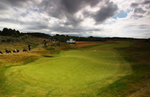
No. 17 at Birkdale, courtesy of Golfweek (click to enlarge)

....we have several fine stories full of all sorts of rich, compelling and incriminating detail.  Here's John Huggan quoting Geoff Ogilvy:

"If Birkdale were a one-hole course this green would be out of character with the rest of the course. It's out of character with the land; it's out of character with the hole.

"You can see from 250 yards away that something has gone wrong. Sadly, it could be a decisive factor in who wins the championship. You could get some really crazy putts going on there. Funky bounces, too. A guy could hit a great shot in and see his ball take a really weird kick left or right. It's fine to have a tough green, but it has to look right. It just doesn't fit the spot that it is in, or the hole that it is on, or the rest of the course."

But other than that...Huggan also shares this from Robert Allenby:
"The problem is that whenever they try to change these great courses, they always stuff it up by doing something like that. You can argue they do these things because of how far the ball goes these days, but this has nothing to do with that. It's a mess that has obviously been made by someone who doesn't know how to design golf courses. He's built a green that isn't even close to the other 17. It's just stupid. If they revisit it after the championship I hope they use someone else."

So Huggan went to the vision behind the green and well, Martin Hawtree probably didn't help matters with either the players or his architectural Godfather Peter Dawson:

"In previous Birkdale Opens the 17th had been the easiest or one of the easiest holes," said Hawtree, who will lay out Donald Trump's proposed new course near Aberdeen should the present public inquiry into the project give the go-ahead. "So it needed stiffening.

I will spare you a Viagra joke here. Continue...

We moved the green back to the point where the front of the new green is where the back of the old one was. Then we added another tier. In my original concept of the hole there was nothing at the back of the green. The two big dunes there create an amphitheatre effect so I felt that the green should run on into a hollow at the rear. I wasn't allowed to do that though; the R&A wanted spectator mounds. So now the green forms too much of a bowl shape.

"I'm taken aback by the depth of the reaction. It was a weak hole and demanded something be done. I have heard that the club want to redo the green complex after the Open. I'd be more than happy to move the mounds at the back and create my original idea."

Just guessing by the comments, the lack of a rear hollow seems to be the least of the problems here.

Mike Aitken in the Scotsman talks to the other culprit behind this mess, R&A Executive Secretary and in-house architect Peter Dawson:

"Well, this has caused a little bit of controversy," he said. "And, as a result of that, I'd like to say a few things about it. It's a par 5, so it's not as if we're expecting the green to be hit at with long irons. It's a green the pros are accustomed to facing on many of the courses they play.

"If you look at Augusta, there are probably 18 more sporty greens than this one."

Lee Westwood echoes some of his fellow competitors' concerns about the 17th green, which is described in the official course guide as a "tiny, two-tier target with extreme undulations".

"I think everybody has accepted that something has gone wrong with it," said Westwood. "It's just out of character with the rest of the course, (let's] basically leave it at that.

"It's not to the standard of the rest of the greens. The rest of them are brilliant."

Bloomberg's Michael Buteau also looked at the 17th green and shares this from Steve Stricker:

"You wish they'd just leave them alone because they're good for a reason,'' said Steve Stricker, the No. 8-ranked player. ``They've withstood the test of time, equipment and everything else.''

Buteau also shares the same excuse reply from Dawson and I thought by printing it again it would make sense, but it still does not.

Dawson said organizers weren't expecting many golfers to attempt to land their second shots on the putting surface.

``It's not as if we're expecting the green to be hit at with long irons,'' he said. ``We're aware that it's a green that could get away from us if we're not careful. We'll have to see how it goes.''

So if the green could be "hit at" with long irons, that would make it better or even worse? I really need Peter's book of design guidelines to help here, because I think he's really onto something.
Competitors such as Stricker said they wish they could roll back the clock.

James Corrigan files an excellent look at the controversy, also ends the piece with his breakdown of the "12 to follow" at Birkdale. But first, his take on the 17th green, using overheard player comments:

One labelled it "a sloping mess of mounds" while another concluded that it looks as if it's "contracted a severe case of mumps". Even those not totally anti the mogul run have agreed that it is not in keeping with the other greens that have help confirmed Birkdale's reputation as the finest and fairest course in England. In Westwood's opinion they should unload the shovels and start again. That is exactly what the members are planning. But perhaps not before next Monday.

Jack Nicklaus played here in April and was aghast. "You've got one of the greatest golf courses in the world, and they changed 16 holes because of a stupid golf ball," said the 18-time major champion. "That is just ridiculous."
Okay, how did I miss one of the best quotes ever? Where did he say this? Please readers, guide me!
Nicklaus was speaking for an ever-growing number who believe that the authorities should have placed limits on how far the modern golf ball travels. They failed to act, however, and now the only defence they appear to have to protect the dignity of old courses is either course lengthening or course toughening. Or in the case of the 17th, both. On occasions, the powers that be have gone overboard like at Shinnecock Hills at the US Open in 2004 when the greens were quick to the point of unplayable. The R&A is blessedly not the United States Golf Association and is not about to let their stubborn mistakes re-occur here. But they have created an eyesore. Slam, bam in the middle of golfing beauty.

I'm not sure about the USGA reference, since they didn't create the 7th green at Shinnecock. It's one thing go blunder a set-up, because with a little bad luck, bad planning and a steep green, anything can happen. But to make a mess of things before you even set the course up takes a special talent that takes things to an entirely different level.

This is yet another reminder as to why governing bodies should not design golf courses, particularly when it's in response to their own (continued) inability to regulate equipment.