Save Musselburgh Links
/ My latest Golfobserver.com column is posted.
If you are interested in the efforts to save the world's oldest continually played course, here's their "get involved" page.
And here's the official club site.

It’s back!
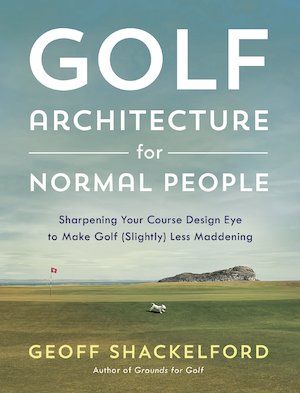
Twenty years later Tatra Press has kindly allowed me to bring back Grounds For Golf now that golf architecture is of more interest to the masses. A new Introduction looks at what’s driven the interest growth and two new chapters I had a blast adding (plus a few edits to keep things up-to-date).
The Amazon purchase page for the book arriving June 15, 2026.
My latest Golfobserver.com column is posted.
If you are interested in the efforts to save the world's oldest continually played course, here's their "get involved" page.
And here's the official club site.
At least when the USGA messes with a time-tested golf course, they try to act like it was someone else's idea. Preferably, a golf architect.
 Not the R&A. Mike Aitken writes about the effort to inundate Turnberry with more driver-eliminating bunkers. Donald Steel is the supervising architect, but he's not the one making the decisions.
"There are a number of other changes in the pipeline which are yet to be finalised between ourselves and the Royal and Ancient," [Turnberry GM Stewart] Selbie added. "The discussions are ongoing. Obviously, there are going to be some changes to championship tees. Just adding length to the links is not necessarily the answer, although there are a couple of instances where we will be looking to add a little more distance around the 16th and 17th holes."
Concerned that Turnberry's finishing stretch, which brought out the best in Jack Nicklaus and Tom Watson in 1977, is not quite as testing as it once was for a new generation of players who all hit the ball further than their predecessors, the R&A is examining a number of options related to the positioning of tees and greens.
David Hill, the R&A's director of championships, said: "Peter Dawson, our chief executive, is due to visit Turnberry later in February and will have a look at three different options. As it stands, we think we could make the 17th even better."
Now, anyone can hang out a sign and call themselves an architect. Guilty as charged.
But is it really the job of the R&A Executive Secretary to meddle in course design?
Well, it beats doing something about the distance problem.
John Huggan talks balls and clubs with Peter Dawson, who, through some form of divine intervention, actually displays a moment of wisdom:
"The longest average drive has moved up about 20 yards in the last ten years," conceded R&A secretary Peter Dawson. "There is no doubt about that. The advent of the ProV1-type ball has most to do with it, along with the bigheaded drivers. So do I think that the game at the top level - this elite few - would benefit from the ball being a little bit shorter? Yes, I do."Ah but the fun only lasts long enough for Dawson to wheel out the latest distraction. That would be this nonsense about grooves.
Speaking exclusively to Scotland on Sunday, Dawson identified a possible loophole through which golf's administrators may - without upsetting litigious equipment companies- discourage the mindless blasting from the tee that is such a feature of today's game. Last year the top three players on the PGA Tour - Woods, Vijay Singh and Phil Mickelson - finished 188th, 147th and 161st respectively in driving accuracy. To them, power is apparently all that matters.
"We are considering coming at the distances the elite hit the ball from the other end, if you like," Dawson revealed. "One of the things I don't like to see - and I know it is a view shared by many golf administrators - is this disconnection between driving accuracy and success. The top players don't care about hitting the fairway. And part of the reason why they don't care is the level of control they can get even from the rough with modern wedges and balls.
"And that is why we are having a very hard look at the grooves on club-faces right now. The key is the sharpness of the right-angled edge on every groove. The sharper the grooves, the more spin a good player can potentially put on the ball. It is an effect you see on so many short shots."
You see, the narrowing of course to offset regulatory complacency on distance did not work. And since you cannot further narrow a 22-yard wide fairway without even the most clueless observer noticing the lunacy of it all, well, then something else must be done.
Anything to not address distance. Anything.
I think they'd actually contemplate shrinking the hole before addressing optimization of launch conditions, which is odd since an appropriate policy/test would not impact average golfers. As for the other Band-Aids they are considering so they don't have to lose face and tackle the only issue that matters...
Dawson is also asked what will hopefully be an issue that goes about as far as the pleas to reduce the number of clubs in the bag (that's hopefully no where...). This would be the 60 degree wedge.
"The loft is an interesting issue," he admitted. "I know Tiger is one who has mentioned a 56-degree limit. But the best 60-degree wedge I've ever seen was made in the 1960s. So that is not new, and is not on what I would call the active list.
Is this actually something people are discussing? Eliminating the 60 degree wedge? Oh lordy!
"Ultimately, we and the USGA will decide these groove-related matters. But there is no point in us going over the top out of the trenches if no-one follows us. There are other stakeholders who need to be reasonably content with whatever is done, if anything. For change to be made, it has to be reasonably supported by the tours, the elite players and the manufacturers. And it must not be too damaging to the average player."
Huggan replies...
Speaking of you and me, Dawson needn't concern himself too much. The notion that re-grooving your 60-degree wedge is automatically going to knock six shots off your next round is unfortunately not one in which it would be wise to place too much faith. Even science can't make up for bad technique.
Oh balls.
Rick Arnett on SI.com:
...I'm displaying my birthday golf wish for all to see --especially to those conservative officials at the USGA and Royal & Ancient who rule over how the game is played.
My desire is for the official honchos to forgo all equipment limitations. No size regulations on drivers or groove depth of irons or ball-distance confines next year. No restrictions on shoe spike patterns, rangefinder use, grip or special alignment considerations. Let the golf equipment designers go nuts and think way outside the box.
Hate to be the bearer of tedious tidings here, but the golf equipment manufacturers may do whatever they want.
Following the equipment rules of the USGA and R&A is completely, 100% optional. They are free to sell as many "non-conforming" clubs and balls as they'd like.
No one in Far Hills or St. Andrews is stopping them from doing that.
Lawrence Donegan in The Guardian profiles the R&A's Steve Otto. You may recall that it was revealed a few weeks ago by Douglas Lowe that Otto has embarked on a R&A research project into flogging.
"My job, and the job of the people I work with, is to evaluate equipment and produce data," the man in charge of the R&A's research and testing says. "Larger philosophical questions about the impact that technology has on the game and what measures are required to keep everything in balance are taken at a much higher level than the one I operate at. I am merely a scientist."
Otto the scientist has some interesting things to say about distance.
Like every other senior member of the R&A hierarchy, Otto is unconvinced by the arguments that the modern ball goes too far. "There are many factors involved here," he says. "If there has been any increase in distance - and I don't necessarily accept that there has been - then I would say it is down to the greater athleticism of the players; then there is the ball and then there are the clubs. There is also the question of more efficient matching of the player and their clubs. Plus, we are also doing a study in the effect of course conditions," he says, adding the unnecessary qualification: "It is not as straightforward as people think."
No increase in distance? Perhaps he should look at these numbers, or these numbers for another point of view.
And , the efficient matching of the player and their clubs? Optimization? Perhaps Otto knows why the USGA and R&A were ahead of the curve on that issue, and chose to shelve their interest in that subject, giving us the mess we now have?
Oh no, he does better.
Unlike other R&A blazers, however, he is not coy about discussing the work that both his organisation and its American counterpart, the United States Golf Association, has put in on this issue of the golf ball. Last year the governing bodies admitted they had a "research project" into a ball that wouldn't go as far as those currently in use, although the details were sketchy. No longer.You may recall that former USGA Executive Director Frank Hannigan wrote about a "miracle ball" that the USGA was attempting to develop back in February, 2004. He was not taken seriously.
"We wanted to see if there was a magic ball out there," Otto says. "We looked at a bigger ball, and a lighter ball; we looked at balls made from different rubbers and at balls with different dimple patterns."
The project ran into many difficulties, the most significant being that a ball that was 10% shorter for one type of player might be 20% shorter for another, and therefore intrinsically unfair. "People thought there might be a solution that would keep the game the same but also address this question of distance," Otto says. "There wasn't. The problem is there is no single definition of a magic ball."
As for the current location of those intriguing, if less than magical, balls, Otto laughs. "They are in a cupboard somewhere, under lock and key." Never to be seen again? "Exactly."
It's not clear where Otto's remarks on the ball project leave the current USGA/R&A request for manufacturers to submit "rolled back" balls for testing.
Though no companies had submitted balls as of November, Titleist said last summer that they cooperated.
Lawrence Donegan reports on the significant changes to Birkdale (analyzed in a post below) for the 2008 Open Championship. Donegan has this quote from Peter Dawson, who is defending the need to drastically change a storied Open venue:
"Players are getting bigger, better and stronger and we, in conjunction with the golf club itself, felt there was the need to keep the test of golf presented by Birkdale up to date. Technology has [also] been a factor in these changes. It is advancing and it would be daft for the Open Championship organisers not to recognise that fact."
But here's Dawson the day after July's Open Championship finished, an event where the driving distance average was up 27 yards over the previous Open:
"Hitting distances have reached a plateau. This is definitely happening; all this discussion that players are hitting the ball further is not true."
Donegan also writes:
...the news that a venue acknowledged by some as the best on the Open Championship rota is to undergo such extensive surgery will add fuel to the on-going debate over the introduction of a new ball, not least because this announcement comes days after a similar plan to toughen up another Open venue, Turnberry.
The Scottish course is to gain an extra 200 yards as well as 30 new bunkers in time to host the Open in 2009. "We needed to meet the challenges of the modern game," Paul Burley, Turnberry's director of golf, said yesterday. "The players are so much more athletic, the ball is flying so much further and golf technology has come on leaps and bounds in the last few years.
30 new bunkers?
These guys make Hootie's approach to Augusta look subtle, tender and respectful.
 The R&A news release on changes to Birkdale, interrupted by my skepticism:
COURSE ALTERATIONS TO ROYAL BIRKDALE
In February 2004 The R&A announced that Royal Birkdale would host the 2008 Open Championship, the ninth time that golf’s oldest major will have graced the wonderful links at Southport.
In 1965, when Peter Thomson rounded off his collection of Open wins with a further triumph that he described as his ‘greatest win’, he added that Birkdale was "man-sized but not a monster."
Alterations are currently being put in place to maintain that description but at the same time to pose new challenges for the world’s greatest golfers.
These course alterations have been agreed between Royal Birkdale Golf Club and The R&A and have been completed with the assistance of Martin Hawtree, golf course architect, who has been involved with previous modifications at Royal Birkdale. The Hawtrees, have been involved with Royal Birkdale since the 1930’s through the original connection established with Martin’s grandfather and then father, both named Fred. The present brief was to ‘tighten up’ the course without resorting to an excessive increase in length.
This has resulted in one new green at the 17th, 20 new hazards, 16 of which are fairway bunkers and six new tees, leading to a total length of approximately 7122 yards, an increase of 154 yards.
The works are being carried out by SOL Golf Construction Ltd who are based in Ireland and will be completed well in advance of the 2008 Open Championship. Peter Dawson, Chief Executive of The R&A said: "Royal Birkdale has always been a strong Open venue and we feel that by introducing these changes, that challenge can be maintained."
But, if it was always a strong Open venue, then what chang...ah, sorry.
"We have paid particular attention to the introduction of tee shots that give players a number of strategic options and through tighter bunkering and the recontouring of green surrounds, intend to make players execute more imaginative recovery shots around the greens."Sounds like your basic desperate tricking up to impact the scoring bottom line. Adding strategy through "tightening" up (you know, the forced lay-up decision between a 4-iron and a 3-iron, that kind of strategy).
Speaking on behalf of Royal Birkdale, the Captain, John Henthorn said: "The Club is delighted and excited to be introducing these changes which will toughen up the course, providing a greater challenge not only for the world’s top players but also for our members and visitors alike."
Get a caddie, looks like we're going 16 here. Oh, and see if you can detect a trend.
The major changes are: -
HOLE 1
Fairway - Reposition and reshape left hand fairway bunker and mound, to be more threatening from the tee.
Green - Reposition left-hand approach bunker and rework and deepen hollows surrounding the green.
HOLE 2
Fairway - Two new fairway bunkers added on right at 300 yards. New mounding in left rough between 250 and 300 yards to better define the fairway.
HOLE 3
Tee - New tee back right of former tee, now making the hole slightly dogleg left to right.
Fairway - Two new bunkers added on left at 315 and 330 yards.
Green - Recontouring of surrounds with introduction of ridges and hollows. New bunker constructed front right.
HOLE 4
Green - Left-hand bunkers tightened up and right-hand bunker expanded and moved closer to green. Extensive recontouring with mounds and hollows to right of green.
HOLE 5
Green - Bunkers tightened up and green extended behind right-hand wing bunker.
HOLE 6
Tee - Tee lengthened by 19 yards
Fairway - Bunker added at left corner of right-hand dogleg (280 yards)
Green - Bunker added on left-hand approach to green with mounding to tie in to left-hand dune.
HOLE 8
Fairway - Ridging formed at 260 yards behind existing bunker on right and bunker added at 265 yards on left with ridging behind. Further bunker added on right at 310 yards and existing bunker at 320 yards repositioned into new mound on right.
Green - Green extended at back.
HOLE 9
Tee - New tee constructed back right of existing tee to give better line for tee-shot
Fairway - Fairway eased left to accentuate the left to right dogleg. Bunker repositioned (270 yards) at dogleg on right. New mounding and recontouring in right rough beyond this point.
Green - New bunker added front left of green.
HOLE 10
Tee - Tee enlarged and levelled
Fairway - Two bunkers added on left at 225 and 235 yards. Bunker added on right at 285 yards.
HOLE 11
Tee - New tee 24 yards back.
Fairway - Bunker added on left at 285 yards.
Green - Bunker at front left moved closer to green edge and tightened.
HOLE 13
Fairway - Bunker added on right at 290 yards. Existing bunker on left at 325 yards, widened by three yards into fairway. Cross bunker on left at 350 yards incorporated into a larger mound.
Green - Greenside bunkers pulled closer to putting surface and swales formed in the green surrounds.
HOLE 14
Green - Bunker added front left of green and green extended at rear. Swales recontoured
HOLE 15
Fairway - Two new bunkers constructed on right at 300 yards. Fairway narrowed on approach to green and extensive recontouring with formation of hillocks on left, short of green.
HOLE 16
Tee - New tee (+ 22 yards).
HOLE 17
Fairway - Two bunkers and mounding added at 310 and 320 yards on right. Bunker on right 100 yards short of green repositioned and additional dune added to narrow the fairway.
Green - Green moved back 20 yards with present top tier becoming the bottom tier of the new green. Bunkers repositioned as appropriate.
HOLE 18
Fairway - Bunker and mound added at 300 yards on left.
Yes, only two holes escaped change on a course that hosted the Open just seven years ago.
The work on No. 17 sounds miniature golf-esque. How do you add a dune? Oh, and the green the are re-doing on No. 17? It was a new green prior to the last Open too. Ah the tradition continues...
Colin Phillips, the Tom Meeks of the southern hemisphere, was hired by the R&A to be their new head of something having to do with Australia and Asian golf. Phillips recently retired from the Australian Golf Union after masterminding yet another Australian Open setup boondoggle. You may recall that Phillips and good buddy Wayne Grady recently exchanged loving words, as Mike Clayton wrote in this Golfobserver column.
The resort will host the 2009 Open Championship.
Lawrence Donegan weighs in from the UK on the USGA/R&A ball "study."
What hasn't happened, however, is the arrival at the R&A's clubhouse in St Andrews of a package containing the "rolled back" balls from the manufacturers. A spokesman for Titleist, the world's biggest ball manufacturer, said yesterday he had no idea when the prototype balls would be delivered.
The fact is it would take the manufacturers very little time and effort to produce such experimental balls yet they have chosen not to bother, both for sound commercial and tactical reasons. After all, why co-operate with any experiment which could result in a paradigm shift which would turn a billion-dollar market on its head, thereby endangering profits? The calculation is that the R&A will respond the way it has responded over the last decade as technological advances in equipment have undermined the history and traditions of the game - by doing nothing.
Such thinking is understandable, but for once it might be mistaken. In the past the governing bodies had neither the spine or the financial wherewithal to legislate the introduction of a new ball, but that may no longer be the case. Changes to the R&A's corporate structure have left it more financially able to take on any legal challenge from the manufacturer. Backed by the weight of public opinion, not to mention Tiger Woods, the organisation might be more inclined to accept such a challenge, not least because it now has a leadership more interested defending what is important ( the world's great courses and the integrity of the game) as opposed to what is not (silly rules about dress codes and such like).
Surprise, surprise, no manufacturers have turned in sample "rolled back" balls. Some like Titleist said they would cooperate (this is from AP story posted on Titleist.com):
Titleist chief Wally Uihlein called the research project "more of an intellectual exercise than emotional and attitudinal bits and bites.'' But to drive home his argument that it isn't just the ball, he said Titleist would supply the USGA a ball and a club specification that would produce rollbacks.
 The Guardian offered readers a chance to email questions to R&A Secretary Peter Dawson. As you can imagine, the answers are spellbinding. Dawson is getting better at answering the technology questions. Like his counterpart in the States, he can rationalize with the best. But sorry, no baseball analogies.
Should something be done to prevent technology's influence on the game? - Neal Walker Coventry
Modern equipment has certainly helped golfers of all abilities to improve their performance and this is generally to be welcomed. At top level, skill remains the dominant factor in achieving success, as evidenced by the fact that the same players - Tiger, Vijay, Ernie, etc - consistently head the rankings. If technology had taken over, then this would not be happening. Clearly, there could come a point where technology renders courses too easy and the challenge of the game is diminished. It is the responsibility of the R&A and the United States Golf Association to ensure that this does not occur by setting the equipment rules to limit the impact of technology. Course set-up, of course, has a part to play as well.
So like, if Ernie and Tiger and Vijay start to not consistently "head the rankings" (and what great rankings they are), then that could be a possible reason to consider that technology has overtaken skill?
You have tolove the stuff where Dawson and his U.S. counterpart talk about how technology has made the game easier and that's a good thing. But that they are prepared to step in when it becomes too easy and they are monitoring that closely. But how will they gauge that?
Someday they'll understand that it's not about hard or easy, but instead, how the game is played and what elements of skill somehow got the sport to this point (and why some of those elements were worth protecting). But they would have to understand what those elements were, wouldn't they?
 Here is a strange story from the UK's Telegraph quoting Grant Moir of the R&A, who is eager to let Michelle Wie know that they are on her side.
Are they that desperate to get her in the British Open, or just trying too hard to be liked? Seems they're a bit out of their jurisdiction on this one.
...the R & A were "frustrated" with Bamberger's handling of events. "If he felt at the time that he had witnessed a breach and was sufficiently sure of himself to raise it, he should have found an official at once.Meanwhile, GolfDigest.com readers weigh in and frankly, their comments are more interesting. Most are outraged at Bamberger and the overall situation, but in particular most seem to be in agreement that something needs to be done about outside rule violation reporting without time limits.
"He should have known just how serious it would be for Michelle if he hung on to the information until the following day."
The R&A announced that it is paving the way for women to enter the Open Championship.
"Our Championship Committee pledged to review entry conditions and to assess how women golfers might compete on equal terms with men for a place in The Open. As a result, I am delighted that a qualification route has now been established for the best women players to gain access to the Championship, competing alongside men on the same courses and from the same tees."
Male professional golfers and male amateurs (whose playing handicaps do not exceed scratch) may now be joined at Regional Qualifying by the top five women and ties from each of the four major championships in the women's game. In addition, any women meeting the entry requirements for International Final Qualifying, Local Final Qualifying and The Open itself can enter at these stages directly.
A frantic follow up press release indicates that they are now moving an Open Championship qualifier to accomodate women playing at Newport in the U.S. Womens Open.
I'm not making any of this up. Just check the links.
Geoff Shackelford is a Senior Writer for Golfweek magazine, a weekly contributor to Golf Channel's Morning






Copyright © 2022, Geoff Shackelford. All rights reserved.