

"Probably the most difficult name I ever had to tackle was Mark Calcavecchia at Troon. I made sure I checked that out a few times!"

Marvin Collins on Alex Harvey, long-time Claret Jug engraver Alex Harvey, who passed away at 83.

After bowing out at St Andrews in 2005, Alex recalled: "Probably the most difficult name I ever had to tackle was Mark Calcavecchia at Troon. I made sure I checked that out a few times!"

Harvey relished the day he engraved Paul Lawrie's name on the trophy at Carnoustie. "It was nice to see his name going on the trophy and not just because he's a Scot. I'd known him for years," he said. "My son Garry knew him and they'd played together on Tour."

Harvey recalled his swansong, with Tiger Woods triumphant at the home of golf. "It was a wonderful tournament, with Jack Nicklaus and I both retiring! In a way I was glad he bowed out on the Friday, otherwise he might have stolen my thunder."
ESPN Secures Rights To Open, R&A "Envisaging The Platforms"

I love that they are doing the Walker Cup when it's in the British Isles

Okay ladies and gentleman, roll up your sleeves and tell us about those platforms and other delivery mechanisms. 

For Immediate Publication

THE R&A AND ESPN REACH WIDE-RANGING EIGHT-YEAR AGREEMENT FOR THE OPEN CHAMPIONSHIP

All Four Rounds on ESPN Beginning in 2010 - Expansive Content for Digital Platforms and Expanded International Rights

13 November 2008, St Andrews, Scotland:  The R&A, the organiser of The Open Championship, and ESPN have reached an eight-year agreement that will place all four rounds of The Open Championship live on ESPN beginning in 2010, it was announced by George Bodenheimer, President, ESPN, Inc., and ABC Sports and Peter Dawson, Chief Executive of The R&A. 

The new pact will also provide broad and comprehensive rights for digital platforms; expanded television and digital media rights for ESPN International; and extensive same-day weekend highlights coverage on ABC. 

ESPN will televise 34 live hours of Championship play over the four days and produce six hours of encore highlights coverage over the weekend, to be broadcast on ABC.  The coverage on ABC will extend The R&A’s relationship with ABC beyond half a century.

Bodenheimer said: “One of the most venerable of all sporting events has embraced the 21st century worldwide media landscape, and we’re thrilled to showcase The Open Championship like never before.  The scope of this deal and the enhancements we obtained offer us tremendous opportunities to serve The R&A and golf fans around the world through any device.”

Dawson said: "It is all important to The R&A that we preserve the traditions of The Open Championship while at the same time ensuring that golf fans are able to enjoy modern state-of-the-art coverage of the event.  We know just how much ESPN respects The Open's heritage and we are very excited by their many innovative plans to cover the Championship across the whole media spectrum, both in the United States and internationally.  We look forward to a long and productive relationship."

Alastair Johnston, IMG Vice Chairman, who led the negotiating team representing The R&A said, "We had to consider not only the financial terms but The R&A's overall mission to promote and develop the game of golf to an evolving global audience.  Envisaging the platforms where a younger generation could be positively influenced to experience The Open Championship over the next decade was a significant factor in assembling this arrangement with ESPN."

Envisaging the platforms...take that Finchem!

The deal also includes exclusive US coverage of all rounds of The Senior Open Championship, which is governed jointly by The R&A and the PGA European Tour, and coverage of the next two Walker Cup matches when contested in the United Kingdom (2011 and 2015).  In all, there will be 90-plus television hours and 40-plus hours of live coverage on ESPN360.com and ESPN Mobile TV.  ESPN will provide unprecedented live coverage of the Championships, including the first and second rounds of The Open Championship, which will begin at 5 a.m. ET.  

Wow...now the EST folks will understand what us PST types were going through. Kind of. 

"All I would say is that Turnberry would have to give a lot of consideration to giving up their course to host the European Open"

Douglas Lowe shines a light on the R&A's latest act of hypocrisy reports that the R&A is not thrilled about Leisurecorp considering the European Open for years that Turnberry does not host the Open Championship.

David Hill, the R&A's director of championships, said at a news conference at Turnberry: "I don't think it would be ideal from the Open Championship's point of view if there was a European Open here for the next nine years. That doesn't mean to say that the European Open couldn't come here occasionally, but that's very much up to the Dubai team."

Key word there: Dubai.

Now, isn't the Open Championship played at a course that hosts an enormously tacky pro-am each fall? Oh yes, Mr. Lowe I didn't mean to steal your thunder:

Hill said the same principle applied to all other Open venues - Carnoustie, Royal Troon, Muirfield and St Andrews in Scotland and Royal St George's, Royal Birkdale, Royal Lytham and Hoylake in England - except for St Andrews, which stages the Alfred Dunhill Links Championship every October.

"St Andrews is unique," he said. "It has lots of other courses, the Dunhill comes right at the end of the season, and St Andrews is the home of golf. Basically, if you look at the other venues, having the Open there gives us lots of marketing kudos as part of our relationships and these courses are also hosting the Amateur Championship, Senior British Open and Women's British Open from time to time. So already these clubs are hosting a lot of events.

"All I would say is that Turnberry would have to give a lot of consideration to giving up their course to host the European Open as an annual event and be aware that if they did that they probably wouldn't get the Senior British Open, Women's British Open and Amateur Championship, and therefore leave a question mark over the Open."

Wow, such subtle blackmail.

"Without saying too much, we are pleased with the progress we're making."

I know it's ESPN and this is pocket change, but I continue to be astounded by the dollar figure being reported as a possible Open Championship rights fee, noted in this case by Mike Aitken:

An imminent new American TV deal, thought to be worth around $25 million a year, will aid the Royal and Ancient, the organisers of the Open, in a bid to keep admission costs down for spectators at the only major championship held outside the US.

After confirming yesterday that ticket prices for the 2009 Open at Turnberry, as well as prices on site for catering and merchandise, will be kept at the same level as this year's championship at Birkdale, David Hill, the R&A's director of championships, revealed the organisation is close to clinching a new agreement for TV rights in the USA.

"At least 60 per cent of our income comes from television revenues," he explained. "All our key contracts are in place. As we speak we are re-negotiating in America. Without saying too much, we are pleased with the progress we're making." 

"How much will the rule alter performance?"

Before the Ryder Cup news takes over, let's not forget the grooves. In last week's Golf World, Mike Stachura raised some interesting questions about the validity of the rule change for 2010.

Second, if several popular irons already in use on the PGA Tour are said by their manufacturers to have groove patterns that already conform to the new rule (Titleist, Cobra, Adams and Ping have irons that may meet the new requirements), how much will the rule alter performance? And if the answer turns out to be not all that much, what is the USGA's next move?
It starts with a b and ends with an l and would have been much easier to change.

I do believe that Adam Scott has been playing conforming grooves all year, and suspect many others have. If so, Stachura's point would seem to kill the case that a groove chance would reduce the amount of flogged drives.

Then there is manufacturer research that says the shot that might be affected most is the pinched wedge from the fairway. Does it not seem odd that a rule meant to restore the value for hitting the ball in the fairway might result in less effective shots from the short grass? 

Oh great, another reason to narrow fairways. Just what the game needs.

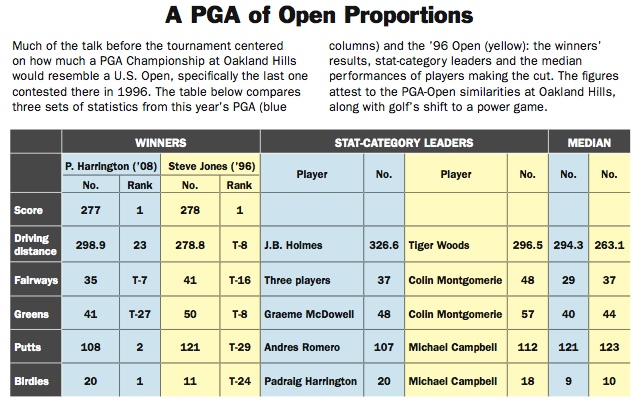
Oakland Hills: 2008 PGA vs. 1996 U.S. Open

In the post PGA coverage, Brett Avery offers a rather astounding chart in the Golf World stat package (PDF).

Now I'm in favor of the groove rule change because it has the potential to restore the importance of firm greens, but will only be meaningful if an increase in fairway width comes with it.

However, the USGA and R&A continue to contend that armed with V-grooves, the world's best will be forced to respect rough and therefore they will have to throttle back in an attempt to hit more fairways. In other words, it's a backdoor way of rolling back distance increases. I still believe it's pure fantasy, but hey, if it makes them happy and leads to other positives, so be it.

Yet no study has determined how much fairway narrowing has played a role in the driving accuracy decreases so regularly cited as the cause for regulating grooves.

So here we have Oakland Hills, host to the 1996 U.S. Open and on the cusp of the distance explosion, and again host to the 2008 PGA where a remodel narrowed fairways and rough was farmed and coifed.

The 2008 field median was 30 yards longer off the tee than in 1996 while the fairway's hit median dropped 8 fairways.

The governing bodies would like us to believe that these dramatic increases in distance and decreases in accuracy are a result of players finding themselves armed with U-grooves that persuades them to flog drives with reckless disregard for the awful fairway contours crafted to take driver out of their bag.

Seems in the case of Oakland Hills that the radically improved driver/ball combination (oh and of course, the increased athleticism!) along with a further reduction in width since 1996 was likely much more significant than the grooves in fostering such radical differences in distance and accuracy.

"Wouldn't it be fun if the possibility really existed that Tiger might have hit his approach out of the light rough on the 72nd hole of the U.S. Open over the green?"

I'm still collecting my thoughts on the groove announcement (hey, I've only had a year). But Bug and Gnat over at GolfDigest.com chime in with a couple of questions that have been, uh, bugging me too, though maybe for different reasons. First, Bug (E. Michael Johnson):

How are they going to enforce this rule and what happens if it doesn't have the desired effect of restoring accuracy as an important part of the pro game?
There is a very good chance this will only have a minor impact, which gets us back to the ball study. Which I'm sure is moving right along.

And enforcement wise, I suspect the USGA testing department gurus have developed an easy way to test. I hope.

Then Gnat (Mike Stachura) asks:

Wouldn't it be fun if the possibility really existed that Tiger might have hit his approach out of the light rough on the 72nd hole of the U.S. Open over the green?

Actually no, and it was something I contemplated while standing there watching Tiger lined up that now famous birdie putt. I wondered how much his shot spinning back was influenced by grooves and how much was the result of his swing speed and personal Nike ball. I hope for future viewing interest the grooves played no role, because even the governing bodies must know that the backspin he imparted on that ball helped make for one of the great moments in golf history.

Groove Change Clippings

Here's the announcement from the USGA if you missed it.

Doug Ferguson noted this in his story:

USGA officials said it was the first rollback in equipment since a brief experiment in the 1930s to reduce the weight of the golf ball. That was deemed ineffective, and the rule was scrapped.
Which looks minor really compared to this.

As for the pros using V-grooves in 2010 but other major amateur golf not having to conform until 2014, Steve Elling writes that "It's mildly akin to the use of aluminum bats in the amateur or college baseball ranks, versus the wooden bats of the pros. It's the same game, sort of, but it sure sounds different.

Or more succinctly defined another way, as Elling offers...
Frank Thomas, a former technical director at the U.S. Golf Association, was nibbling on a snack on Tuesday at the 90th PGA Championship when the change was broached. He wiped the crumbs from his chin and offered one word.
"Bifurcation," he said.
For the uninitiated, that's a red-letter term that means split and separate, and most assuredly not equal.
Not reported anywhere but nailing a vital point about course setup was Trevor Immelman:
I think they need to decide which way they want to go about running the game. I think you've either got to have the courses set up the way they are now, with extremely deep rough and 500 yard par-4s, which is the way they have it, which seems to be working fine. I mean, you know, nobody's blowing away these Major Championships shooting 15-, 20-under. So that seems to be a recipe that has worked over the last few years.
Or, you can change the grooves, but then they're going to have to scale the golf courses back, because you can't give guys no advantage with grooves. Because you got to understand one thing: As soon as we change the grooves, we're probably going to have to alter the ball we use, because if you're not getting as much spin, you're probably going to have to start using a softer golf ball.
In the last few years, we're using harder golf balls because the drivers allow us to launch the ball higher off the tee. So we need less spin, and we have had good grooves on our irons, so we have been able to launch the ball to create enough spin.
So we're going to have to go back and the manufacturers are going to have to go back to the drawing board. And I know Nike has been working on this since the USGA started sending the smoke up that they may be doing this. I had a look at a few prototypes where they have started working on some different groove variations.
And I like I was saying, as we change the grooves, we're going to have to start maybe looking at the way our golf ball is performing. And at that point the R&A and USGA may have to decide how they're going to set the golf courses up. Are we still going to have rough that is this deep (indicating). And like today out there, we have got guys the rough is pretty juicy here but you still got guys with these rakes out there making sure that it stands up this high. It's quite interesting.
But so I think that you're going to have to give and take. So that's where they're going to have to figure out how are they going to give and take. Because they can't just keep taking. Because at that point, you just are going to have players having just a lot of struggles out there with golf courses being too difficult. That's my opinion.
And this from Phil Mickelson was also not picked up in reports, but is nonetheless profound:
And one of the biggest issues I have with course setup is having the same penalty for everybody regardless of skill level, and that leads to the thickness of rough. If you have a ten-inch rough -- and I'm sorry a lot of people say five and a half inches or whatever the length is; everybody wedges out 80 yards into the fairway. It's the same penalty for everybody and so skill level is factored in there.
And I'm hoping that the course setups won't be like that, but they will be like the PGA TOUR has done this year and had a little bit more playable shot-making abilities, recovery shots, more integral part of the game from the rough on mis-hit tee shots.
So I kind of like it. But what's interesting for me is that this exact study was done with triple the data back in 1988, was given to the USGA, and it was disregarded, and now 20 years later, it's considered valid.
Again, I don't care, because I like the new rule change, but it just is funny to me how that -- the way the process worked out.
I assume this from Jim Furyk will be music to the USGA's ears...
I think that I might have a couple wedges in my bag that might be borderline or over the proposed limit, so I would have to pull that back.
And what that will do is it will make guys want to play a softer golf ball, and it probably doesn't go quite as far anymore, because they will want to have more control over that ball around the greens and with their wedges, where they score.
So I think all in all, it's probably going to be positive.

Thoughts On The Grooves Announcement

In announcing Tuesday's U-groove ban, the USGA and R&A accomplished something truly spectacular, unprecedented and frankly, impossible: they had people feeling sorry for the PGA of America.

I'll get to the good stuff about this rule change in another post, because for fans of strategic course architecture there could be some very exciting developments from this news. But momentarily, let's sit back and ponder at the utter lack of respect our fine governing bodies have shown their friends from Palm Beach, who have one week a year to shine and who have suppported the decision to ban U-grooves starting in 2010.

After dragging their feet so long, with R&A lollygaggery largely responsible for missing the initial announced timeline, how could anyone in these organizations say, oh, we must announce this on Tuesday of the PGA Championship?

Let's forget the disrespect shown to the PGA of America and consider this strictly from a practical perspective: you want to announce one of the biggest changes in the history of the rules at a time when people can digest the ramifications and give it full attention. With dwindling space devoted to golf in major media outlets, who in their right mind would want to compete with the year's final major?

Oh that's right, the R&A and USGA. Brilliant.

R&A Finally Acts On Grooves...To Preserve The Importance Of Rough!

Of course, the opening line of the press release is revolting on a level I can't begin to describe.

THE R&A ANNOUNCES NEW GOLF CLUB RULES
St Andrews, Scotland, 5 August 2008:  The R&A has today announced revisions to golf’s equipment Rules, which are designed to enhance the benefits of accuracy by making playing from the rough a more challenging prospect in future.
Yes, yes, rough is vital to the game. Old Tom would have wanted it that way. Don't worry about building new tees on the New Course, just make sure that we can continue to line fairways with rough. Or, in the case of the Road Hole, just eliminate the fairway. That's a priority!  Anyway, carry on...
The new Rules will augment the existing limitations on grooves and will affect all clubs (with the exception of drivers and putters), with the new regulations limiting groove volume and groove edge sharpness.  Essentially, larger volume grooves have the ability to channel away more material, such as water or grass, similar to the tread on car tyres.  At the same time, sharper groove edges facilitate a better contact between club and ball, even in the presence of debris.
Both new regulations will apply to golf clubs with lofts greater than or equal to 25 degrees (generally a standard 5-iron and above) with only the rule limiting groove volume applying to clubs of lesser loft.
So a 3 or 4 iron could have...ah forget it.
The Rules will apply to all clubs manufactured after 1 January 2010.  Clubs manufactured prior to this date, which meet the current regulations, will continue to be regarded as conforming under the Rules of Golf until at least 2024.
Well, that's not going to cause the rush to Roger Dunn's that the manufacturers would have hoped for.
It is intended that the new Rules will be introduced as a Condition of Competition at top professional level from 1 January 2010 and at top amateur level and in other professional events from 1 January 2014.  The R&A and the USGA will introduce such a Condition of Competition at their respective championships in accordance with this schedule.  The world’s top professional tours for both men and women, and the organisers of golf’s major championships, have all indicated their support for the new groove regulations and their intention to implement the Condition of Competition in 2010.

At GolfDigest.com, Mike Stachura summarizes the news while USGA.org offers...no announcement as of 10:15 a.m. PST.

"Having to play V-grooves only would make me try to stay in the fairway more than I do today."

Beatnik and Gonzo over at GolfDigest.com pretty must shred to pieces the reported European Tour player questionnaire on grooves, then obtain the actual document and are largely validated in their skepticism. Still I was pleased to see they were asking players whether they thought the rule change would discourage flogging of tee shots.


"A rollback in equipment...would be a huge boon to the golf industry in my opinion."

Thanks to reader Mark for this Tom Kite interview from last week. He appeared with Steve Czaban, host "The First Team On Fox," a nationally syndicated Fox Sports Radio show.

After the usual small talk Czaban asked Kite if he's longer now than he was in his prime. Kite says he's about 10 yards longer now than at his peak.

Czaban then asks if this is a good thing. Kite's reply: 

A: No, it's very detrimental to the game. All you have to do is look all over the place and you can hear all of these comments about how the game is not growing. Why isn't the game growing? It takes too long to play golf. It's too expensive to play golf. Those are the two most comment things that are cited for why the game doesn't grow. Well it takes longer to play an 8,000 yard course than it does a 6,500 yard golf course. Why does it cost more? It takes more money to maintain an 8,000 yard course with wider fairways and wider golf course envelopes than a 6,500 yard course. The fact that architects are forced to design golf courses...to try to build a golf course that stands up to the technology and what does it do? It makes the courses more expensive, you need more land to build the courses on and consequently the game is more expensive and takes longer to play and those are the two reasons why everybody keeps saying the game is not growing.

A rollback in equipment, which probably will never happen, but a rollback in the metal woods, in the graphite shafts and specifically the ball, would be a huge boon to the golf industry in my opinion.

Q: Who out there right now is really leading the push for that.

Nobody. Nobody. Right now the manufacturers are the ones running the game. The USGA basically lost the war when they didn't stand up to Karsten Solheim on the square grooves issue years and years ago. They backed down, they basically said if you have money and have sharp attorneys, the USGA will back down and they have ever since. Unfortunately they and the R&A are the rulemaking bodies and it's not going to happen in my opinion.

Well, glad Tom's already picked up that Bobby Jones Award from the USGA.

Can they revoke those? Let's hope not.  

"That's a pretty good record of identification."

John Huggan appears to be the only writer who saw through R&A secretary/in-house architect Peter Dawson's presentation earlier this week. You know, the one where he explained how he was renovating 16 of 18 holes at Birkdale to fit the game that has move on somewhat.
As Dawson trawled through the various changes made to 16 of Birkdale's 18 holes (16!) in the decade since the game's most important championship last made the trip to Southport, it was hard to suppress an ever-increasing level of incredulity. Justifying those alterations with the kiss-off line that "golf has moved on somewhat since then", Dawson was careful not to mention the real reason why Birkdale has joined an ever-lengthening list of classic courses that have been stretched to within an inch of their boundary fences.

Using carefully chosen phrases like "challenge to the modern-day player" and "increased player capability," Dawson, not for the first time, disguised the fact that the current "programme of significant change" that is well under way at every Open venue has virtually nothing whatsoever to do with the players themselves and virtually everything to do with the collective and joint abrogation of responsibility by the R&A and the United States Golf Association when it comes to their (lack of) legislation on the modern golf ball. Had today's equipment been properly regulated over the last decade and a half, it is a safe bet that the likes of Augusta National and the Old Course at St Andrews, to name but two classic courses that have been forced to endure unnecessary change, would not have had to be screwed up to the extent they have been.

This is juicy about 2009 host Turnberry:
It was reported last week that the Ailsa course that will host next year's Open Championship will be "narrower, longer and tougher." To which the obvious response is: "why?"

Correct me if I'm wrong, but on the three previous occasions in which the Ayrshire links has hosted the world's best golfers, the winner of the championship has been the world's best golfer at the time: Tom Watson in 1977, Greg Norman in 1986 and Nick Price in 1994. That's a pretty good record of identification.

Not only that, but every one of those Opens – in three very different weeks weather-wise – were events that have already lived long in the memories of those lucky enough to witness them. The first one, in fact, the so-called "Duel in the Sun" between Watson and Jack Nicklaus, was so good it transcended golf and became one of the great sporting occasions of the last 50 years.

So, tell me again, why is it that the course on which those great events were played is suddenly deemed inadequate, especially when the R&A, unlike their counterparts at the USGA, are forever claiming that the winning score is, to them, irrelevant?







