And The PGA Tour's Groove Rule Verdict Is...

...they are going ahead with the 2010 "condition of competition." Victory for USGA, Finchem, rough mowers. Finchem conference call highlights:

"full and thorough discussion on delaying, reaffirmation of general support for rule, some issues with the enacting date"

"the board finished discussion by continuing the history policy of using condition of competition, our intention to move ahead January 1, 2010"

"full court press" to make sure every player is paying attention to what he has to do, working with his manufacturer, to be prepared

"some challenges"

"Delaying at this point in time was not in our overall best interest"

"continues to be wide support for rule itself"

Ferguson asks: why in best overall interest? Finchem: "late in the process"

"Board did not take action" according to Finchem. Means no vote was taken, left up to the Commissioner.

Groovy Goings On...

...assuming you like tales of big egos, big money and big power plays.

The PGA Tour Policy Board votes Tuesday whether to adopt the 2010 condition of competition requiring the use of new grooves. As Alex Miceli reported Friday, three of four player votes are likely going to say no to adopting the condition for January play.

That means in order to uphold the PGA Tour's original stance in support of the USGA/R&A groove spec change, the five non-player policy board reps would have to overrule the player directors. Most insiders believe this has never occurred in the history of the policy board.

Because it's Congressional week and I try not to contemplate the idea of watching golf played there, let's consider the possible votes and ensuing fallout should the policy board postpone the implementation until 2011:

  • Postponement would be a hit to Tim Finchem's perceived power or at least, the assumption that he has control of the policy board. Finchem has made several public statements in support of the groove change. Having to spin a reversal at this late date will test Ponte Vedra's For Immediate Release wordsmiths.
  • A blow to the USGA/R&A. For obvious reasons. They'll have to retreat from their 2010 implementation at the U.S. Open and can expect to face a full assault, and perhaps even legal action. Bomb and Gouge summed it up better than I in this post.
  • Postponement would be a major victory for Titleist and Wally Uihlein. Several players have told me that master wedge designer Bob Vokey has not yet come up with a replacement groove configuration to his and Titleist's liking. Couple that ongoing research with Acushnet not feeling it will have enough time to properly develop a ball they believe is to their standards and soft enough to satisfy players who would be shifting to less-helpful grooves come January, and you begin to understand why this has become an issue (and why there was Ian Poulter's recent Twitter whining).
  • Postponement could be a major blow to the image of PGA Tour pros depending on how it's spun. Shoot, some have already likened this to golf's version of steroids. If the players need more time to prepare for the changeover, I think they'll be shocked at the apathy and even hostility they face from serious golf fans. Media types have been asking since last fall what players were doing to prepare and most had not given the subject any thought. Curiously, the Nike guys seem very prepared and many of the more thoughtful players have done their homework. (Cink here, Woods here, Immelman/Mickelson/Furyk here, Ogilvy here.)
  • Tough questions would be raised about the policy board's motives. The three players leaning toward a no vote all play the Titleist ball. Ironically, all three stand to benefit from the rule change based on the USGA's theory of forcing a softer ball into the hands of players. David Toms, Brad Faxon and Zach Johnson aren't the longest hitters in the world but all are respected for shotmaking and short game prowess. They will be expected to make convincing arguments about the strength of the USGA's research and implementation if they hope to deflect inevitable criticism. Doable, but also a lot of headache and annoyance they don't need.
  • A huge setback for the new groove configuration. Many behind-the-scenes types roll their eyes at this latest chapter in the grooves saga because they insist that the policy board would only be postponing the inevitable. I don't agree. This is bifurcation and I've never understood how the manufacturers would allow this precedent to be set without a fight. We discussed this several times (including here, here). If the board postpones, I predict that over the next year we will see the USGA's research scrutinized, attacked and we'll witness an all-out PR assault on the decision. You'll hear questions--some very legitimate--about just how many players were interviewed, how many were involved in testing, how wet newspaper shreddings simulate rough, how bifurcation is good for the sport and how exactly the USGA concluded that driving accuracy declined because of grooves instead of say, 22 yard wide landing areas.

If the board adopts the condition of the competition, it's a clear victory for Finchem, the USGA, R&A and fans of the flyer lie. Consider how many golf courses and tournaments were already improved this year by having less rough in anticipation of the rule change (along with common sense kicking in). More of that starting in 2010 is good for the PGA Tour, even better if the less-rough mentality filters down to the everyday game.

If you are in favor of regulating distance for the safety, function and interest of golf architecture, you have to love the equipment rollback precedent set by the groove rule change. But big money is at stake here and I'd be shocked if certain manufacturers go quietly.

At least after Tuesday night we'll know who the most powerful man in golf is.

Groove Measuring Methodology And Timing

One of the main PGA Tour/manufacturer gripes with the USGA/R&A groove rule change--now endangered for 2010 implementation--deals with the assertion that the USGA fell behind in getting manufacturers an appropriate measuring tool to determine if irons are conforming.

I know this isn't the sexiest topic, but it is important to understand how this process played out so that should the PGA Tour delay the groove condition of competition due to manufacturer concerns, we at least know how much time they had to prepare. So I asked Dick Rugge of the USGA for his response to the claim of not enough time:

1. The August 5, 2008 Notice to Manufacturers regarding the new groove rule implementation included a detailed explanation of how grooves would be measured.

2. The August 5, 2008 Notice to Manufactures also included the following information: “Measurement of grooves for cross sectional area and groove edge radius can be made with the same tracing equipment that the USGA has used for a number of years. The USGA may also make use of additional measuring equipment for this purpose in the future. A field test to enable groove measurements on-site has been developed. The protocol for this field test will be published in the near future.”

3. The ContourReader (that’s the “tracing equipment that the USGA has used for a number of years”) groove measurement procedure has been made available to those requesting it.

4. Both the USGA and the R&A have purchased a device from the Alicona company that utilizes a very sophisticated microscope to measure grooves. This has been considered our “gold standard” measurement device. That company has offered their equipment for sale to club manufacturers. The cost is high, so there will likely be a limited number of these in use.

5 We have developed a field test device which uses a flat-bed scanner to accurately record the groove cross-sectional shape. This device has been reviewed by PGA Tour rules official John Mutch, who is pleased with its function. This device will soon be made available to the Tours, and to other appropriate organizations, including manufacturers.

"Unfortunately, the only uncertainty in the game right now lies with who's in charge of it."

GolfDigest.com blogging duo Bethpage and Garden City kick around the power struggle over a groove rule condition of competition and ultimately determine that the USGA has handed over power to the PGA Tour and that the uncertainty over 2010 implementation has the USGA acting as a follower instead of a leader.

I can tell you this, though: The rule as currently written will not be a hardship for the playing of the game by average golfers in any meaningful way, shape or form. Not now, not in 2014, not in 2024, not ever. The rule as currently written does present the possibility for uncertainty in the minds of the best players in the game, however. Uncertainty (or as most of us know it, outright fear), I think, makes for a better game at the elite level.

Unfortunately, the only uncertainty in the game right now lies with who's in charge of it.

Poulter: "the usga are insane to make us change so quickly."

It was only a matter of time before a player would elaborate on the manufacturers concerns about grooves. In this case, it's Ian Poulter of England, Orlando and Cobra Golf fame. Thanks to reader Manny for the Tweeted comments from Poulter, writing a series of posts about the new groove rules soon after Adam Barr's report that Acushnet is trying to delay the rule change:

i tested the new grooves with vokey in feb. what a difference no spinnnnnn. the usga are insane to make us change so quickly.

i guess they were all bored sitting around that table drinking coffee and smoking cigars... get a life let us have fun on the course

it will cost the manufacturers millions to develop and distribute to all the stores global, so you AMs can get them before open qualifying

Our irons already comply, but wedges need to change for start of the year. all the best... thanks R&A and USGA softer balls here we come

The players have had plenty of time to experiment and when I've asked manufacturer reps, most players have taken little interest in experimenting, preferring to wait until this fall.

The manufacturers are pleading financial hardship because they are being forced to develop and ship new grooved wedges to their most loyal customers, who, if they are serious about tournament play, have to buy.

They've been handed a nice serving of forced planned obsolescence and they are still complaining?

"The club recently purchased a home that it has coveted for more than a decade. That will allow them to stretch the dogleg right par-4 to more than 450 yards."

In reading Dave Shedloski's preview of Merion for the Walker Cup and beyond, I couldn't help thinking how fun it would be if Merion sent the USGA and R&A a bill for this:

For instance, a new sixth tee has just been installed that takes the 420-yard par-4 to more than 470 yards, and it might be used during the Walker Cup Sept. 12-13. Behind the 12th tee, which is currently 371 yards, the club recently purchased a home that it has coveted for more than a decade. That will allow them to stretch the dogleg right par-4 to more than 450 yards.

Then there is the famous 18th, where a plaque commemorating Hogan's famous 1-iron at the end of regulation, sits in the left half of the fairway. Even with a new tee in place, most of today's players easily could fly drives past the Hogan marker and down the hill, leaving a short iron into the elevated green. That's why the club is considering cutting a new tee into a hill some 30-40 yards farther back, which would make the par-4 more than 500 yards.

"The issue is that few older courses are capable of staging the Canadian Open."

Thanks to reader John for Lorne Rubenstein look at all of the reasons why the Royal Canadian Golf Association can't consider some classic venues for the Canadian Open. Actually, there's only one reason in Lorne's view.

Last week's announcement that the RBC Canadian Open will return to Shaughnessy Golf and Country Club in Vancouver in 2011 should be cause for celebration. After all, it's a classic old course, the kind tour players say they love. And it will mean the tournament will have been played at a grand spot two years in a row. (St. George's in Toronto will be the venue in 2010.) So why did I feel some sadness upon hearing the news? It had nothing to do with the choice of course or the Royal Canadian Golf Association's commitment to taking the tournament, as often as possible, to traditional layouts. It had everything to do with what's happened in the world of pro golf tours.

The issue is that few older courses are capable of staging the Canadian Open. This is because the United States Golf Association and the R&A dropped the ball in allowing the golf ball to go so far that it's made superb courses that have held the Canadian Open obsolete for the tournament.

Here's something even the governing bodies understand, without telling it to some of the modern masters to their faces.

At least the RCGA realizes this. Its executive director, Scott Simmons, made it clear last week during the Shaughnessy announcement that the commitment isn't to a fixed rotation, but simply to quality courses. He said that could include new courses, but the message remains clear that tour players prefer traditional layouts.

"We have been on a journey of renewal," then-RCGA president Andrew Cook said last June, when it was announced St. George's would play host to the 2010 Canadian Open. "We want the tournament to get back to the stature it once held on the world stage."

The RCGA is trying. But it would have a better chance of reaching the goal if the courses of the past weren't so ill-suited to the tournament game and demands of the present.

Such are the unintended consequences of "progress."

Well they could look to the R&A solution: proudly alter the courses.

“Today’s professionals are bigger, stronger, fitter, have more technology at their command, and it’s very important that we keep our great links courses relevant to the modern-day professional"

Some day they'll look back and say, wow, the R&A changed courses to mask their regulatory incompetence. But surely they were discreet about it, right?

For Immediate Publication

THE R&A ANNOUNCES COURSE CHANGES AT TURNBERRY’S AILSA COURSE

21 APRIL 2009, Turnberry, Scotland: In advance of the 2009 Open Championship, Turnberry’s Ailsa Course has undergone a number of adjustments designed to ensure that, as one of Britain’s finest links, it continues to challenge modern professionals. The most extensive changes are on the 10th, 16th and 17th holes, though most have been enhanced in some way.

“Today’s professionals are bigger, stronger, fitter, have more technology at their command, and it’s very important that we keep our great links courses relevant to the modern-day professional,” explained The R&A’s Chief Executive, Peter Dawson. “We’ve been doing that at every Open venue, with Turnberry having had a considerable number of changes since the 1994 Open Championship.”

Thankfully, circa 2002 Major League Baseball owners never declared that the players were bigger, stronger, fitter with more technology at their command, therefore, proudly announcing that they extended the Green Monster skyward 40 feet and spent millions to alter their ballparks so that the lads can keep injecting their rear ends!

The 10th has been redesigned to bring the coastline into play and now requires at least a 200-yard carry over the rocks from a tee perched on an outcrop by the lighthouse. The fairway has been moved closer to the beach to tempt longer players to cut off more of the corner, and three new fairway bunkers force a decision to be made between safer tee-shot with a longer approach or a riskier, braver and more aggressive drive.

Significant changes have also taken place at the 16th and 17th. The shape of the 16th has been radically altered and it now dog-legs right from a re-positioned tee around newly-created dunes and hollows. 45 yards have been added along with a new bunker on the left of the fairway. The bunker, which used to guard the left side of the old fairway, now protects the right edge of the new one.

The realignment of the 16th has allowed a new back tee to be constructed on the 17th, extending the hole by 61 yards. A newly-constructed approach bunker, along with another to the front and left of the putting surface, adds difficulty to the second shot.

Including those on the 10th and 16th, a total of 23 bunkers have been added on holes 1, 3, 5, 8, 14 and 18, with two removed at the 3rd and 14th, making players think more about their course management strategy.

Uh no. They are intended to make players leave driver in their bag so you don't have to regulate equipment.

Though many Open Championship courses have upwards of 120 bunkers, Turnberry still only has 65, testament to the natural test that the landscape provides.

New tees have also been introduced at holes 3, 5, 7, 8, 14, and 18, extending the course to 7204 yards, 247 yards or 3.5% longer than when The Open was last played at Turnberry in 1994.

Shocker: R&A's Dawson Says Golf In For Rough Year Ahead

It's good to know the R&A is on top of things, as always. Mike Aitken fills us in on Peter Dawson's dire warning:

"I don't think we've seen the bottom of this and I don't think anyone is immune," said Dawson. "I'm no economic forecaster, but it's hard to see the situation turning around quickly. There may be quite a way to go.

"I think people who are members of golf clubs will be thinking twice about their subscriptions. Like everything else which is discretionary (spending], people will ask, 'Do I need to buy a new driver this year?' All these things will contract."

I tell ya, he is a visionary.

Aitken also files this piece on the state of club golf in Scotland, where memberships are not being renewed at a disturbing pace.

Governing Body Reigning In Technology...

As Lisa Dillman reports (thanks reader Scott), the folks overseeing swimming have had enough of hi-tech suits. Inspiration for our friends in Far Hills and St. Andrews:

Among the proposals was that FINA establish its own independent control and testing program. Swimsuit makers can make submissions for approval of suits until March 31. The next major meet of significance is the world championships in Rome, starting July 18.

"With these amendments, FINA shows that it continues to monitor the evolution of the sport's equipment with the main objective of keeping integrity of sport," FINA President Mustapha Larfaoui said in a statement.

Greetings From L.A., 63-72-62 Edition

A 5 a.m. wake up call afforded me the chance to:

(A) watch John Mutch set up the back nine so Phil Mickelson could torch it in 30 for a 62 to follow his 63-72

(B) check out the huge sucker hole location on No. 10 that Mutch thought might be too easy but, for a second year in a row, proved way too deceiving for the majority of today's bomb and think about the consequences later

(C) think long and hard about the need to compliment the first rate media food service with a small nap area here in our media hanger for these soft, overcast, muggy days after a nice hot lunch. I'm thinking clear booths like the radio people passed on using this week so we can all see who just couldn't stay away any longer and had to lie down.Phil Mickelson after missing his birdie try on 18 that would have tied the course record (click to enlarge)
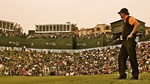
The chances are slim since last year's pleas to restore the manual scoreboard on 18 were ignored. The chances will dim even further next year when PGA Tour Championship Management steamrolls over any semblance of non-corporate aesthetics and local flavor in favor of sterility, so I guess I'll just curl up under a tree next time sleep beckons.

Fred Couples tee off on No. 9 (click on image to enlarge)Thankfully the golf was lively today, with the overcast skies apparently making it easier for players to see, as Fred Couples talked about in his enjoyable post round press conference. The cloud cover added a little "stick" to the greens in Mutch's word as we drove around and boy did the players respond. Mind you the greens were still pretty firm but just a shade slower and receptive.

Now, I know I beat this 10th hole thing to death, but watching today and witnessing the nearly endless stream of mindless shots reminded me why it is so fun and vital in gauging a player's ability. Because Riviera's 10th consistently shines a big nasty light on the course management ineptitude of today's modern golfer (look how few layed up left with a sucker front hole location in the ShotLink image right).Shotlink dispersion chart for Saturday's third round play (click to enlarge)
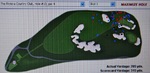

Robert Allenby and Fred Couples were tied for the lead after 10 holes (click to enlarge)Ah but you'll say, note that Couples hit it way right off the tee, a big no-no for a veteran. I asked about that and he explained after the round. His comments might shed some light on why he has so much success at Riviera:

Q. Talking about your love of the golf course, and the great architecture, on 10, you laid up very far to the right. Can you talk about how you approach the 10th hole all the time, and why you played that shot today?

FRED COUPLES: I shanked that shot today. (Laughter).

But to be honest with you, every day I try and go further left than people think. And very rarely do I hit driver there.

But over the years, I've played it really, really well. And I try and go this way.

And today in my mind, I knew where the pin was and I tried to go further to the right and then I told myself even further, and I just kind of luckily was in the fairway. If it had gone another yard to the right in the rough, I would have had no shot. But I hit a great little 75yard shot in there to stop it. But that's a tough, tough hole.

To recap for the 8 milionth time, the strategy is simple: play left in some way, either driving the green or laying up and you will be okay. Right is DEAD!!

CBS's 10th hole graphic says it all (click to enlarge)Just check out the killer ShotLink graphic CBS ran today on the six years of stats compiled under the system.

As for Mickelson's incredible round, the 7 one-putt day on the back side was nice but I was most astonished by just how far he is hitting his tee shots. Since the USGA and R&A keep saying distance has been capped, Phil's comments were interesting:

Q. How much longer are you hitting it with your new driver than previous drivers?

PHIL MICKELSON: It's a noticeable difference for me. When I say noticeable, it's 12 yards. I mean, that's a big difference for me. Being able to get eight, nine yards for carry, that's a really big difference. I mean, usually it would be two or three yards and you would notice a difference. This is a big difference for me.

The biggest thing, though, is that I'm able to work shots, hit cuts, draws, low shots, rather than just one standard shot.

And finally in media center news, the turnout was cut by more than half with Ryo's departure, but that still didn't stop a modified sign from being posted for those who apparently chose to smoke in the portable toilets.Women's restroom sign at the media center (click to enlarge)

I wonder what PGA Tour Championship Management would make of that handmade sign?

"How dreadful that they are all the same."

I'm not the only one who spotted the irony in Peter Dawson's justification of the R&A's membership practices, as Derek Lawrenson writes:

Quote of the Week: "Golf is a very broad church, and there is plenty of room for every sort of golf club. It would be dreadful if we were all the same."

Chief Executive Peter Dawson's hilarious defence of the men-only status of the Royal and Ancient Golf Club.

Coming in May: the announcement of the next captain of the R&A, who will be a white male, aged sixty-something, privately-educated, grey-haired, and an ex-CEO.

How dreadful that they are all the same.

"Tradition or otherwise, the R&A has developed a habit of ignoring history, even its own, when it wants to."

Finally, someone is scrutinizing the R&A...wait, oh, it's not for redesigning courses in lieu of distance regulation or rendering the Road hole unrecognizeable?

Lawrence Donegan reports on Scotland's senior most politician calling for an end to "chauvinistic" attitudes after not offering a membership to Dr. Louise Richardson, new St. Andrews University principal. Her predecessors were given R&A memberships.

"The Royal and Ancient Golf Club should follow their long-standing practice of offering membership to the Principal of St Andrews University and I am sure that after due consideration they will continue with that honourable tradition," the first Minister said today.

It is highly unusual for a politician of Salmond's seniority to become embroiled in the affairs of a sporting club but the politician is also a keen golfer who has long taken an interest in the health of the sport. He was joined in his criticism by Claire Baker, a Labour member of the Scottish parliament, who said Dr Richardson should be accorded the same courtesy and privileges as her male predecessors.

"It's more than 500 years since Mary Queen of Scots became the first woman to tee off at the home of golf but it seems that the Royal and Ancient is still stuck in the middle ages. It is high time the fuddy-duddies who run the club put their chauvinist attitudes to one side and joined the 21st century," she said tonight.

“A union of uncompromised originals”

...uncompromised? The R&A? Aren't they the ones who change courses instead of the equipment rules? Anyway, score one for the USGA...

The R&A and SABMiller plc today announced that they have enteredinto a long term agreement under which Pilsner Urquell, the iconic beer brand from SABMiller, will become the Official Beer of The Open Championship.

The arrangement is effective from the upcoming 2009 Championshipat Turnberry and will last for five years, taking in confirmed future Championships at St Andrews, Royal St George’s and Royal Lytham and St Annes.

Vinod Giri, International Brand Director of SABMiller plc said, “The heritage, authenticity and premium nature of The Open Championship offer fantastic synergies for Pilsner Urquell. Both brands are the original, uncompromised leaders in their fields and set the gold standard. We are excited by this partnership, and look forward to building a long and successful association with The R&A.”

David Hill, R&A Director of Championships, said, “The R&A is delighted to welcome Pilsner Urquell as the Official Beer of The Open Championship. I’m sure spectators at this year’s Open at Turnberry will be delighted that such an iconic beer is available throughout the Open Championship site.”

Yes, especially since getting to the property will induce migraines.