

First Anchoring Ban Question: Where Was The Data?

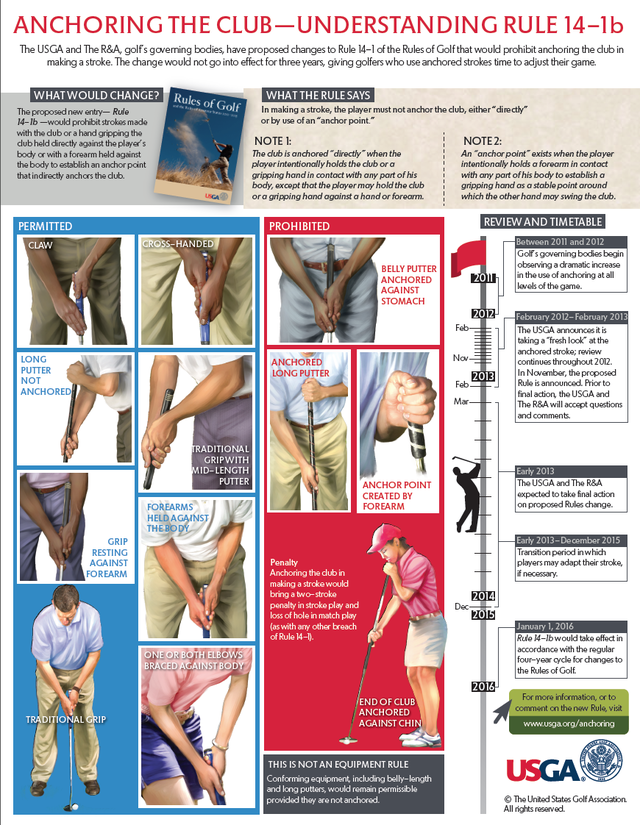
The USGA and R&A did an excellent job presenting their case both verbally and visually for the anchoring band. But I think many of us were anticipating some meaty empirical data to back up the USGA's case that players switching to this method have benefitted.

Graeme McDowell had suggested from his conversation with the USGA's Mike Davis that there would be data to back up the argument for this ban. (Brandel Chamblee had more empirical data on Golf Channel than the governing bodies presented and I hope to get that video up later.)

Randall Mell touched on this topic:

The USGA cites no controlled studies or experiments or research to support its argument that a new definition of a stroke is needed, and that will make the decision feel arbitrary to critics. It’s the Justice Potter Stewart deal. The USGA and R&A know wrong when they see it, and they saw the game changing quickly in ways they don’t like.

The lone data seems to be this, noted by Mike Stachura.

He also pointed to usage data that suggested belly and long putters were used by three to four percent of tour players from the 1980s through the mid-2000s before a sudden upsurge.

Davis said that in 2011 the number was 11 percent, and in 2012 it was 15 percent, and as high as 20 or 25 percent in some events. More importantly, Davis said, "in the junior game, where we've seen virtually no anchoring before, all of a sudden it's started to appear. And that caused us to say, 'Is this what we really want the game of golf to be in the future?' We came to the conclusion that fundamentally that's not part of golf."

Is this enough data to make the case?
Old Course Joins Twitter, Gets #savetheoldcourse Hashtag, UK Press Slowly Begins To Notice

I know it's a bigger story to those outside the United States. After all, this is the same town that approved putting up a chest of drawers (Longhurst) next to the Road hole. So expecting architectural sensitivity may be a lot to ask.

Still, it's nice to see the altering of the Old Course at St. Andrews getting attention from some press and in social media.

The Daily Mail's Derek Lawrenson writes that "It has to be said, some of the planned amendments sound positively radical," then declares, "Let’s go easy on the outrage, however, and have a little faith in the two bodies in question. After all, they have more to lose than anyone."

Got that?

The Scotsman's Martin Dempster acknowledges Tom Doak's petition to stop the work.

It's hard to tell what Philip Reid of the Irish Times thinks, but to anyone who knows the game and the R&A's public stance on scoring, this is an indictment:

...it would seem the RA, governors of the game and responsible for staging the British Open, aren’t immune from phobias of their own and the fear of low scoring – whisper it, the possibility of a 59 – is seen as the main reasoning behind plans to toughen up the Old Course in time for its next hosting of golf’s oldest Major championship.

Tom Dunne tweeted the scoring averages from the last Open Championship at St. Andrews where 73.0665 was the number for the week. As for key holes receiving new bunkers to "stiffen the defences" as the R&A's Peter Dawson put it, the second, fourth and sixth all average well over par. The Road played the toughest for the week at 4.6631 yet is already under attack just days after the announced changes.

Meanwhile, The Old Course is on Twitter now. Give her a follow.

There is a nice list of Tweets developing with the #savetheoldcourse hastag.

On change.org, Emile Bonfiglio has started a petition to halt the work.