Mixed Messages Coming From First Post Anchoring Player Meeting

Alex Miceli with a report on the PAC members meeting at Muirfield Village and joining in by phone. The takeaway? A variety of emotions on anchoring, bifurcation and rules, though he suggested more players were again in favor of the ban for reasons unknown.

According to one participant, some PAC members who were on the fence now seem to be going back to supporting the ban.

Anchoring on its own has unique issues: the potential for limiting high-profile players from competing as they have for years, potential litigation and how the Tour might be perceived if it goes against the anchoring ban.

“We’ve got a process we follow as a Tour, and we're going to let it play out,” said PAC member Bo Van Pelt. “I think that’s what you get with 144 guys. Everybody has a differing opinion.”

Jeff Overton To Rules Staff: Please Coddle Me A Little More!

From Stephen Hawkins' AP story on Jeff Overton, who was DQ'd for using a putting alignment aid mid-round after an official told him he could putt while a 10th tee backup worked its way out.

Soon after coming off the course, Overton tweeted "3 group back up at the turn. Rules official tells me we can practice chipping and putting. Disqualified for using my practice putting aid!"

Overton immediately followed that with another tweet, "Why do rules officials initiate that conversation to begin with. I wouldn't even have gone up there if I had know that. What a joke!"

Going to a designated practice area is permissible during a round, but use of artificial or instructional devices isn't. The penalty is disqualification.

"If ur gonna inform someone on a rule of something a person can do, make sure u remind them of the small things they can't do," Overton added on (at)JeffOvertonPGA.

How could that darned official not know that Overton uses a putting aid? Why, it's what all the kids do these days!

Or, Jeff could go to Rules School? Or, use your brain to wonder if you should ask before pulling out the aid? Or, I don't know, maybe have a caddy who would wonder if that's a good idea? It's got to be anybody by the players' fault!

The Overton Tweets for posterity: 

Golf Central's report starts at the 13 minute mark.

Randall Mells's explanation of the decision and rule 14-3/10.3.

And a flashback story on Juli Inkster's DQ for the same reason, only hers was at the hand of a TV viewer.

Officials Will Be Staying On The Course For Now

Doug Ferguson talks to the PGA Tour's Tyler Dennis who says it's still more productive for the PGA Tour to have one more official on the course instead of in the booth.

Of course, if the tour wasn't being so stingy with what is obviously such an important role (no contract for rules officials since January 1!), they could just hire another official to be in the booth or in a Ponte Vedra TV room and not take one of the officials off the course.

Lepp's "Saucer Shot" Will Not Be Growing The Game

Thanks to reader Ian for Brad Ziemer's story on James Lepp of Big Break fame (I wouldn't know, under doctor's order not to watch) learning from Golf Canada's Dale Jackson that the saucer shot he featured on the show (still don't know, still under doctor's order) has been ruled illegal by the USGA/R&A joint rules committee.

“The rule that would be breached is Rule 14-1 that says in part the club can’t be pushed, spooned and scraped,” Jackson said. “Pushed and spooned don’t apply here, but scraped here basically means you are intentionally dragging or pulling the club along the ground before it hits the ball, which is what he does.”

Lepp’s saucer shot is a hybrid of sorts, part hockey snap shot and part golf chip shot. Lepp, a former NCAA champion and multiple B.C. Amateur and Canadian Tour winner, came up with the shot to combat the occasional yips he was suffering when chipping off tight lies near the green.

He used it with considerable success on last fall’s Big Break series on Golf Channel and Lepp has videos of the shot posted on his website for Kikkor Golf, the shoe and apparel company he owns and operates.

Can't wait for the first cries that this, too, will be stifling massive growth of the game after Commissioner Finchem reveals that nearly 20% of golfers use the saucer to combat yips.

The Vancouver Sun posted Lepp's demo video.

Eger: Not Likely To Pick Up The Phone Again

In case you were still unclear on the completely harmless effort by David Eger to save Tiger from a 2013 Masters DQ for signing an incorrect card and the questionable response to Eger's call from Masters championship chair Fred Ridley in responding to assistance from an outside agency of Eger's stature, check out this Golf Central interview with Eger.

It won't be up long, but the key quotes are:

"I wouldn't have called if I wasn't 100 percent certain."

"First time I've ever called."

"With the outcome, I probably wouldn't call again."

Has Hot Seat Finally Shifted From Tiger To Ridley?

Kevin Ferrie takes the analysis of the Tiger drop incident at Augusta a bit far in quoting Neil Hampton, GM of Royal Dornoch, who says...

"We are trying to encourage more juniors to play our game and one of the most important things we address is the ethics involved: how to treat your fellow man, and doing so with integrity. We're looking to put great people out into the world through golf, so this is sending the wrong message to the youngsters," he said.

"We are trying to get them to police themselves but now they can look at that and say, 'if Tiger can do it, so can I'.

"He has been given a chance to stay in the tournament by people who have selfish reasons for wanting him to stay in: because it is good for their viewing figures or whatever. However, having realised that he made a mistake, Tiger should have withdrawn from the tournament."

This was my initial reaction, but as we've learned what happened, it's clear the committee made the right move and set a bold precedent in an effort to remedy its mistake. Fred Ridley was not acting out of concern for the tournament so much as for his job as competitions chair (and a possible future club chairmanship).

Considering how badly Ridley missed the opportunity to take the viewer's call seriously enough to call Tiger in for a pre-scorecard signing, the 33-7 remedy was a pretty good save. Yet it's clear as time passes that Ridley's competence will continue to be questioned because of this incident.

Based on your reading of the situation and talking to other golfers, is it fair to say the ire/blame/annoyance at the entire episode has shifted from Tiger to Ridley?

Lord Tatum: "The ruling body blew it."

Criticism of Masters Competitions Committee Chair Fred Ridley has come from about the highest place possible to anyone associated with the rules of golf world: Sandy Tatum.

Ron Kroichick talked to the former USGA President about the Masters rules incident.

Lost in all this, as Tatum noted: Did Woods not understand the rule? He could have moved farther back if his original shot had gone straight into the pond at No. 15 - but it hit the flagstick and caromed left into the water. That was the line where the ball last crossed the hazard.

Woods later said he wasn't "really thinking," but he deftly talked around the question of whether he knew exactly what the rules allowed.

As for the television analysts who called for Woods to withdraw before Saturday's third round, Tatum cut him some slack and returned to his original point.

"In that context, it's asking too much of him," Tatum said, "because the ruling body blew it."

One More Attempt To Clarify 33-7 v. 33-7/4.5

Tiger Woods was penalized two strokes for violating Rule 26-1a and/or 20-7c yet avoided disqualification under Rule 6-6d or 33-7/4.5, instead he was absolved under an obscure, maybe unprecedented use of 33-7.

Got that?

I understand the confusion over Tiger's penalty and non-WD. I misunderstood it initially because the first reports, by Tom Rinaldi (ESPN) and Steve Sands (Golf Channel) mentioned 33-7 and the recent rule change involving HD video, which was the 33-7/4.5 Decision not invoked in this case.

I tried clarifying it in Golf World Daily, have written about the episode in this week's Golf World, posted this Barry Rhodes item on the matter, but for now, just read John Morrissett's Facebook post on the Erin Hills website if you still aren't sure why Tiger avoided disqualification.

The key graphs:

While this seems like a complicated set of facts, the ruling becomes straightforward when it is boiled down to its basic elements: On Friday the Committee made an incorrect ruling (of no penalty), and on Saturday the Committee corrected that incorrect ruling. The key is that, before Tiger returned his score card on Friday, the Committee had reviewed the incident on 15 and made the ruling of no breach. (Even though the Committee did not tell Tiger of this ruling, it was still a ruling.) On reflection, the Committee realized it made an incorrect ruling and corrected that ruling on Saturday (with ample authority and precedent to do so).

If the Committee had not become aware of the incident and had not made a ruling before Tiger returned his score card on Friday, then it would have been a straightforward disqualification. It is interesting to note, therefore, that the timely telephone call actually prevented Tiger from being disqualified.

Clippings: Woods Penalty Analysis

I've written a short Golf World Daily item on this, but right off the bat, I and many others got this part of the Tiger Woods 2-stroke penalty wrong: it was the long held Rule 33-7 which the Masters Committee invoked to absolve Woods of disqualification. NOT, 33-7/4.5, which specifically addressed the HD video call in issue. Even Tiger, talking after the round, did not understand this:

TIGER WOODS:  I don't know.  Under the rules of golf I can play.  I was able to go out there and compete and play.  Evidently this is the Harrington rule, I guess.  If it was done a year or two ago, whatever, I wouldn't have the opportunity to play.  But the rules have changed, and under the rules of golf I was able to play.

The initial Golf Channel and ESPN standups suggested 33-7/4.5, and only after Fred Ridley's press conference and some help from rule aficionados did more understand the distinction. Nick Faldo, critical of Woods on his Golf Channel appearance, backed down on CBS according to Michael Hiestand.

Talking about Woods' two-stroke penalty as a result of a rules violation Friday, Faldo noted golf rules were relatively cut-and-dried in the past -- with players generally disqualified for infractions. Now, he suggested, interpretations are more nuanced. Said Faldo on-air: "We're in a new era, under new rules."

However, as this Brendan Porath posted video notes, Faldo's contrition in the CBS Butler Cabin opening continued to suggest Woods was a beneficiary of a new rule, when it was an old decision that the committee invoked.

Doug Ferguson's story provides a definitive account of the episode and he notes this right off the bat:

In a bizarre twist to a complex case, it was a television viewer’s phone call that ultimately spared the world’s No. 1 player.

Randall Mell denounced the club's actions over the last two days.

A foul odor hung over Augusta National on Friday when Tianlang Guan was penalized one shot for slow play. The club had discretion in the matter, and it decided not to cut the kid a break. Because while Guan clearly was in violation of the tournament’s slow-play policy, it’s difficult to believe he is the first player in 77 years of the Masters to be in violation. The air here freshened a bit when Guan made the cut, becoming the youngest player to make a cut in major championship history.

Now, with Augusta National using its discretion in the Woods ruling by waiving a DQ for signing an incorrect scorecard, this Masters doesn’t smell right again.
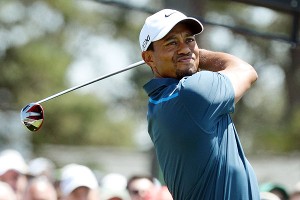
Gene Wojciechowski was also not very kind to Ridley's Rules Committee.

Woods broke a ball-drop rule -- or more correctly, he played from the wrong place after a ball-drop violation. Simple as that. Then the rules committee botched a review of the drop. Simple as that. Then Woods said what he said about the 2 yards.

And then nothing became simple.

My initial gut reaction: He should have been disqualified. If he wasn't DQ'd, he should have withdrawn from the tournament. After all, whether he realized it or not, Woods had broken a rule and had eventually signed an incorrect scorecard.

It would have been the noble thing for Woods to withdraw. I still believe that. But it wouldn't have been the practical -- or correct -- thing to do.

Jeff Rude caught up with good, great or legendary agent Mark Steinberg who says Tiger rose at 7:30 and was at the club by 8 am to explain his non-willful violation.

Cameron Morfit says Tiger can't win this Masters even if he wins this Masters.

Dave Kindred makes several key points in this column, especially this one:

Only in golf are the competitors also the referees. They police themselves and they police others. Many a player would have stopped Woods from the incorrect drop. (By the way, he said that happened because he was "a little ticked" at the misfortune of the first shot kicking back into the water. He also said he "wasn't even really thinking," which is news, considering he'd earlier said he had thought enough to plan the drop two yards back.

In the website poll here, 47% said he should WD, 50% said he should not WD and 3% were unsure.

In a must read, Dave Shedloski caught up with Dow Finsterwald, member of the Masters Rules Committee and recipient of an eerily similar bit of committee effort to avoid a disqualification.

John Morrissett, formerly of the USGA and one of the top rules authorities on the planet, praised the committee's handling and noted this in a Facebook post:

Consider the ramifications if the Committee had disqualified Tiger today. In that case, Tiger would be justified in being furious at the Committee for failing to advise him of the issue yesterday before he returned his score card so that he could have avoided disqualification. Tiger made an error and is penalized two strokes; the Committee's incorrect ruling should not result in further penalty.

Cassie Stein compiles the Tweets of players and dignitaries and they aren't very kind to the committee.

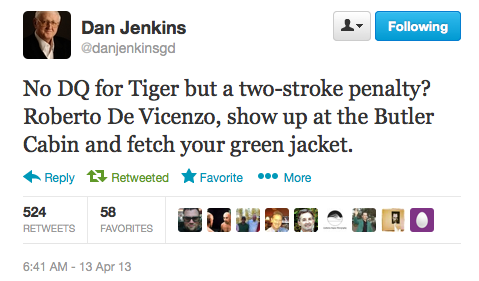
And fnally, the last word goes to the Ancient Twitterer.
Statement From Masters Tournament Committee On Tiger Penalty

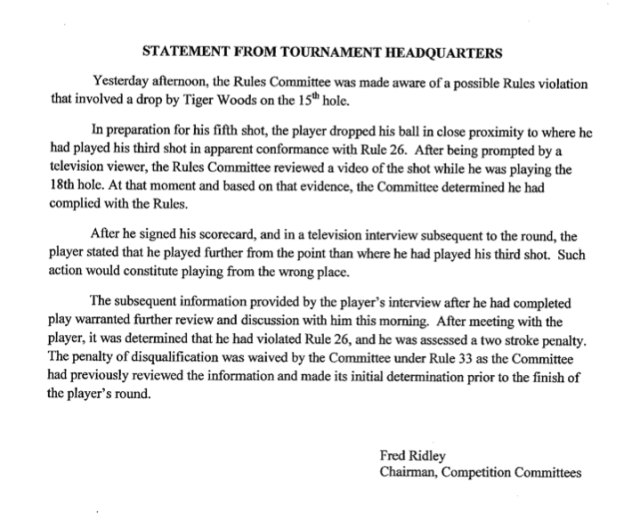
So they are not invoking the HD Decision, but instead taking some of the blame. So many questions here, but we'll just go with the statement for now: