"Changing Times Putting The Squeeze On Private Clubs"
/Thanks to reader Kevin for this Len Boselovic story in the Pittsburgh Post Gazette on the struggles for Pennsylvania country clubs.

It’s back!
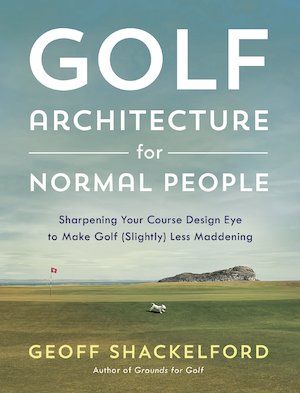
Twenty years later Tatra Press has kindly allowed me to bring back Grounds For Golf now that golf architecture is of more interest to the masses. A new Introduction looks at what’s driven the interest growth and two new chapters I had a blast adding (plus a few edits to keep things up-to-date).
The Amazon purchase page for the book arriving June 15, 2026.
Thanks to reader Kevin for this Len Boselovic story in the Pittsburgh Post Gazette on the struggles for Pennsylvania country clubs.
Titleist Golf Products Design Consultant Peter Kostis weighs in with one of those mysterious columns he pens on occasion to reminds us just how difficult it is to balance the whole pro-golf ball technology position while acknowledging the ugly stuff that comes with the whole deregulation mindset.
From the days of English aristocracy and class warfare, through racial and gender inequalities and to today's technological world,
Oh Lordy...jumping ahead:
Some people consider today's golf to be boring. They say it relies too much on power and technology while reducing the skill requirements of the player. But that's a simple, easy conclusion to a much more complicated issue.
And shame on Jack Nicklaus, Arnold Palmer, Greg Norman and all of the other greats who have said so! They don't understand margins.
Today's golf isn't better or worse than the golf played 20, 50 or even 100 years ago. It's just different, just as our lives and our world are different.
Ahhh...here comes the point of this column, which, oddly, does not include a disclosure of Kostis's corporate affiliation...
To try and roll back golf to some better time is like saying that life in the 1950s was, across the board, better than it is today. In some cases maybe it was, but in many other cases today's world is far preferable. This concept of yearning for a return to better times has been around forever and coincides with a reluctance to accept change. Dismissing all change as bad is stupid.
While we're doing cliche's, how about not confusing change with progress? Naw, that doesn't fit.
Funny too, but I guess he's referring to the USGA thinking about taking away our grooves, because most people would just like to see a little ball rollback, and let all of the other "change" stand.
Anyway, time for Kostis to break out into full Gloria Gaynor mode:
When steel shafts were in the process of replacing wooden shafts in the 20s and 30s, traditionalists of the day cried out that equipment was going to reduce the skills required to play the game.I swear I've read this speech before. Hmmm, but where?
Golf survived.
When the Haskell ball replaced the gutta-percha, traditionalists cried out that this was going to make golf courses obsolete and the game too easy.
Golf survived.
With metal shafts replacing wood shafts, was there any doubt that eventually metal club-heads would replace wooden club-heads? No! Neither was there any doubt that traditionalists would bemoan this innovation as bad for the game.
But golf survived.
Finally, graphite is replacing some steel and the solid-core, muti-layered golf ball has replaced the wound, balata ball, and, you guessed it! Traditionalists are saying golf has become too easy and courses obsolete.
Golf will survive. It will just be different.
I wonder how Peter would feel if he paid an assessment at a club because they had to renovate their course, all because the ball can't be rolled back a bit...eh, why am I wondering?
Ah, but then the conflicted view of supporting equipment on steroids clashes with that stuff about people on steroids.
Golf has, seemingly, been proactive only when it comes to preserving traditions. Golf should be proactive against performance enhancing drugs too, but it won't happen. The, bury your head in the sand, "we have no evidence to indicate a drug problem," philosophy will prevail and golf will lose another opportunity to be a leader. That's a reality that I find revolting and at the same time, laughable.
We need to be diligent in protecting the game of golf. We also have to realize that just as the world around us changes; the game of golf will reflect and not lead those changes. Golf is not a social game. It is society's game. Look to the way we lead our lives and the way the world is evolving, if you want to see what the future of golf will be. There are many who claim golf to be the beacon of civility and reason and, as such, steadfastly reject change. Those people feel strongly that tradition is a commodity to be protected. That thinking kept women from clubhouses in Great Britain, blacks from the PGA Tour in America, and will allow for drugs to invade the game in the future. Golf, because it changes so stubbornly, will always be a follower and never a leader. That is the price to be paid for traditions.
Wow, that was a lot of work. Hope the pay is good!
Robert Thompson blogs about a story he's written quoting Nick Price about the state of the game and his likely final appearance in the Canadian Open.
Unfortunately, in a professional golf world increasingly dominated by players who hit their tee shots remarkable distances, shot makers like O'Meara and Price have quickly become relics of a bygone era.And Thompson writes that Price is actually looking forward to the Champions Tour:
"It has been very tough for me to be competitive out here in the last few years," Price said. "I've been very vocal about this. The way the game is going -- especially the USGA and Augusta -- and the way it is focusing on length, they are keeping a lot of players from being able to win major championships."
"I'm tired of playing 7,600 yard golf courses," he said. "I'm sick of that. Golf has never been exclusively about length, but that seems like the emphasis now."
But both golfers have different takes on why the game has changed so much in recent years. O'Meara credits it partially to equipment, but also points out that most players are far more physically fit than they were two decades ago. But Price isn't buying that explanation.
"If you looked at Greg Norman when he was 32-years-old, he was as strong as an Olympic athlete," Price says. "So was Faldo. I think it is a slight on them to say the current guys simply work out and that's why they hit the ball further."
Given his nearly three decades of professional experience, Price says he knows the solution to the distance problem.
"Simply change the equipment," he says. "I don't care what the average Joe plays. In fact, let him play equipment that helps his game. Can you imagine what would happen in baseball if they gave Barry Bonds a titanium baseball bat? The pitchers would go berserk. But that's what we did in golf."
The Bomb and Gouge boys are back and as always, they write about the equipment issue like Nuke LaLoosh pitches.
Bomb (E. Michael Johnson) writes about reading the USGA's 104 page paper laying the groundwork for making everyone's U-grooves illegal so they don't have to regulate the ball. (A strategy that I welcome because it will absolutely enrage golfers to the absurdity of the current USGA way of thinking).
Aggressive grooves have played right into the strategy employed by several tour players of bashing the ball as far off the tee as possible and rough be damned. Take them away, and perhaps they start sacrificing a tad of distance for a few more fairways. Or maybe not. Old habits, after all, die very hard. But there’s little doubt distance is at the heart of the USGA’s research. As Rugge has said repeatedly, “The correlation between accuracy off the tee and success on the PGA Tour is almost non-existent.”
Bomb nails it. The USGA was humiliated by the flogging approach and is determined to stop it, even if it means deeming most grooves on the market today illegal (after having approved them!).
I don’t dispute that contention, but I’m still a big believer that distance is not ruining the game of golf as it currently stands. And I certainly don’t want to be writing for the next few years about motions filed on behalf of the manufacturers by noted legal eagle Leonard Decof, as was the case back in the 1980s and ’90s. But when ShotLink stats reveal that more than 40 percent of all approach shots on the PGA Tour are hit with some kind of wedge, I can at least see why the collective brains at golf’s governing bodies are whirling faster than a ball coming off one of these clubs.
That number is still just staggering to me. 40%! Yep, it's the grooves.
GOUGE: I do not want to agree with you. But there is a reason for the fairway. If the rough is not a hazard, then something must be done to make it one. Grooves might be one way, it might also be the most impractical solution to a problem in recorded history. If we all want to play by the same rules as the USGA wishes (humor me), then a groove change rule would force us all to buy new irons and wedges. That in a nutshell is a definition of a class-action lawsuit.
Actually, rough is a product of the modern game to offset poorly regulated equipment. Old Tom Morris was not out mowing and layering rough. Anyway, the otherwise sane reasoning from Gouge (Mike Stachura) ends there...
The USGA’s Executive Committee clearly is ticked off at how elite players are changing the game. Read the report Jim Vernon, chairman of the Equipment Standards committee, gave to the Executive Committee and it's obvious there is a real fear on their part that the game is out of control. But the truth is all they have to do is look at their own championship to realize they’ve solved the difficulty/skill algorithm quite simply. Layered rough makes crying babies out of all the great pretenders out there. And it’s the only thing that’s beaten Tiger Woods in the last three months.
Sigh. Oh yes, it was the rough at Winged Foot that did Tiger in. Couldn't have been that his father had just died weeks before and he was not ready to return. No, it was the rough.
Having had a few days to digest Walter Driver's ESPN.com remarks and to read your comments, it seems a bit of a assessment is necessary.
First, the key lines from the Statement of Principles are important to remember:
Golf balls used by the vast majority of highly skilled players today have largely reached the performance limits for initial velocity and overall distance which have been part of the Rules since 1976. The governing bodies believe that golf balls, when hit by highly skilled golfers, should not of themselves fly significantly further than they do today.Today being May, 2002 when the PGA Tour Driving Distance average was 279.4 (the end of 2001 number)
...any further significant increases in hitting distances at the highest level are undesirable. Whether these increases in distance emanate from advancing equipment technology, greater athleticism of players, improved player coaching, golf course conditioning or a combination of these or other factors, they will have the impact of seriously reducing the challenge of the game. The consequential lengthening or toughening of courses would be costly or impossible and would have a negative effect on increasingly important environmental and ecological issues. Pace of play would be slowed and playing costs would increase.
Should such a situation of meaningful increases in distances arise, the R&A and the USGA would feel it immediately necessary to seek ways of protecting the game.
So instead of the anticipated debate over the meaning of "significant" or "meaningful" increases, Driver's remarks make it clear that such a discussion will not take place when the USGA is unwilling to acknowledge the driving distance average around May 2002 (and remember, the PGA Tour average is the key number for them). Driver on ESPN.com:
The facts are that the tour distances are nearly flat the last 3 years. It went down somewhat a few years ago and then leveled off. So the facts show that there hasn't been much increase to show us that we need to act from when we made those statements.
He's right, the numbers are "nearly" flat the last three years, but not the last four. And we'd be giving the USGA the benefit of the doubt by using the 2002 PGA Tour Driving Distance average (279.8), when the 2001 number (279.4) would seem closer to the Statement of Principles issuing. But since the numbers are so close, either works, right? Well, not for Driver.
His statement about the number going down at any point in recent years is pure fiction and he should be embarrassed to peddle such nonsense, especially when preaching like this:
We have a great deal of facts at the USGA upon which we make our rule making. Many of the people that talk about the game are passionate about the game, but they don't have the facts that we have.
There will be no discussion about the meaning of significant from 2002 to 2006, just a shift to discussion about grooves so the USGA doesn't have to take a tough stance and can keep harvesting rough to mask the problem.
So where does the game go from here? How can the USGA be taken seriously when they post such strong statements and then turn their back on those words?
Your thoughts?
I'm not sure why it took me so long to put this Dennis Cauchon story from the USA Today up. Perhaps because it's somewhat depressing.
Here's the subtitle: "Golf courses are being plowed under in record numbers to make way for residential and commercial developments."
Golf course openings fell from a peak of 398.5 in 2000 to 124.5 last year when measured in 18-hole equivalents, the National Golf Foundation reports. During that time, course closings soared from 23 to a record 93.5 last year.Even more ominous for the future of the game:
When courses temporarily closed for renovation are included, the USA had fewer golf courses open at the end of 2005 than a year earlier — the first year-to-year decline since 1945.
Golfers still have plenty of places to play: 16,052 courses nationwide.
"Golf courses aren't generating the returns people like to see," says Mike Hughes, chief executive of the National Golf Course Owners Association. "The land has appreciated so much in value that it makes abundant economic sense to turn the property over to other uses."
Shorter golf courses and par-3 courses are being redeveloped especially rapidly, the National Golf Foundation says.
Some homeowners who bought houses on golf courses have been surprised to see their views disappear. "The golf holes go away and suddenly you have people living in your backyard," says Mike Waldron, executive director of the Georgia State Golf Association.
Golf courses are being built where land is cheaper and more rural. Golfers still have many choices but may have to drive farther to play.
"It's like when your favorite grocery store down the street closes," says Jack Nance, executive director of the Carolinas Golf Association. "You're sad, but you deal with it."
Thanks to reader Jeff for the latest John Paul Newport column in the weekend WSJ.
Course developers are well aware of golfers' masochistic tendencies, and they spend bounteously to concoct (and maintain) the many cruel features -- bunkers, ponds, linoleum-speed greens that hump and heave -- necessary to crush our spirits. For this reason the most difficult courses are often the most expensive. A rule of thumb for resort and daily-fee properties is that the operators must collect $10 in green fees to recoup every $1 million in outlays for land acquisition, design and construction. Thus a $20 million course charges $200 to play -- a beautiful thing for those who like their humiliation served in double doses.
The mania for building tough courses is also fueled by the need of developers to get their projects onto a top 100 or a best-new-courses list in the golf magazines. Securing a prominent spot can be a make-or-break proposition for hugely expensive projects, especially those whose business models depend on attracting play from traveling golfers. In the notoriously subjective pseudo-science of list making, difficulty is one of the few objective criteria available for consideration. Most courses carry both a Slope rating (a measure of difficulty for average golfers) and a course rating (which measures difficulty for experts), determined by disinterested panels dispatched by the state or local golf associations. Difficulty does often correlate with quality, design inventiveness and the resources brought to bear on a course. But it can also be a red herring.
For players, the lure of difficulty is largely about bragging rights. Like birdwatchers who maintain life lists of all the species they have viewed in the wild, many golfers keep life lists of the top courses they have played -- the tougher, the better. When returning from a trip, it's far more impressive to regale jealous friends with tales of being eaten alive by courses with macho names like the Teeth of the Dog (in the Dominican Republic) or the Blue Monster (in Miami) than it is to boast about playing at a pretty little mountain course, even if playing the pretty little course would have been a lot more fun.
Another goad to taking on the most punishing layouts in the world is the all-but-irresistible urge to play where the tour pros play. On a course seen annually on TV, even a round of overwhelming frustration can be redeemed by a few magic moments. Players hit an astounding 120,000 balls a year (an average of three per player) into the water surrounding the island green on the 17th hole at Florida's Tournament Players Club at Sawgrass. But when Joe Everyman safely drops one on the surface, even if it's his third try, it's a memory of a lifetime -- and entitles him to casually observe to his buddies while watching the next year's Players Championship that he hit his tee shot on 17 exactly where Freddie Couples did.
Pete Dye, designer of some of the world's most feared courses, including the aforementioned Teeth of the Dog and TPC Sawgrass, told me recently he doesn't understand why golfers are so keen to suffer, but added that he's happy to keep building the courses for them as long as he keeps getting paid. One thing I've noticed over the years is that the more skilled and experienced golfers become, the more apt they are to play courses, or from tees, that don't abuse their souls. They know which level of challenge truly tests their game, and which level obliterates it.
 The September 4 issue of SI opens with the traditional "Scorecard" piece, this time with Alan Shipnuck writing about the emergence of golf as a "power game." He then lays out the
 perks headaches coming with the power shift.
Golf is a power game, a point driven home by a recent confluence of events in Ohio that rocked a sport that has always been resistant to change. In Springfield on Aug. 22, the Ohio Golf Association held a tournament in which competitors were compelled to use identical balls that had been engineered to fly roughly 10% shorter than the average rock. (dead-ball golf is what headline writers at The Columbus Dispatch called the attempt to put the toothpaste back into the tube.) Then, in Akron last week, Tiger Woods took time out from winning his fourth straight tournament, the WGC-Bridgestone Invitational, to stump for the implementation of performance-enhancing drug testing in professional golf. It was a public rebuke to PGA Tour commissioner Tim Finchem, who has staked out a see-no-evil, hear-no-evil position on steroids.And after considering the recent events and Tiger's feelings on the matter, Shipnuck reminds us that Woods pushed for a pro-active stance on driver testing. And of course not mentioned here but equally as important to the topic at hand, Woods has advocated changing the spin rate of balls.
It was an open-minded band of volunteers that showed up when the OGA staged its one-ball tournament, bringing to life an idea that for years has been kicked around by everyone from Jack Nicklaus to recently retired Masters chairman Hootie Johnson, who grew weary of annually having to tear up his golf course to keep pace with advances in equipment. (Augusta National has grown more than 500 yards, to 7,445, since Woods's overpowering victory in 1997.) OGA president Hugh E. Wall III said that maintaining the relevance of older, shorter courses in his jurisdiction was the primary motivation for testing the restricted-flight ball. "[We have] great courses, but many don't have the resources or the real estate to expand to 7,400 yards," Wall told GolfWorld. "[We want] our member clubs to see there may be another option ... other than bulldozers."
Thus every competitor at Windy Knoll Golf Club received a dozen balls with an OGA logo and a side stamp of CHAMPIONS 08222306 (the name of the tournament and its dates). All other details about the ball were supposed to be top secret, but by tournament's end word had leaked that it was manufactured by Volvik, an obscure Korean company. (A U.S. manufacturer examined the OGA ball for SI and reports that it was a three-piece, dual-core construction with a Surlyn cover and 446 dimples.) These instant collector's items left most players pining for their regular ball. Derek Carney of Dublin, Ohio, typified the conflicted attitude: He agreed that something has to be done to protect older courses but said that he didn't like the OGA ball "because it doesn't benefit me."
Oddly, such a selfish attitude in other sports would be laughed, but in golf, such an attitude is seen differently. Shipnuck explains:
Such grumbling merely previews the howls of protest that would accompany any efforts to roll back the ball on the PGA Tour, where players have spent years using launch monitors and computers to find optimal combinations of balls, shafts and clubheads. The irony of the OGA event is that it is PGA Tour pros who threaten to make a mockery of classic courses. Yet bifurcation is a dirty word in golf. Differing rules for pros and amateurs would destroy the business model of the $4 billion equipment industry, which is built on stars like Woods being paid handsomely to peddle their gear to weekend hackers.
Golf is still grappling with the ramifications of the boom-boom ethos that has redefined the game, but the almighty buck remains the sport's most influential force. When it comes to reigning in the power game, steroid testing will be an easier sell than dead-ball golf. Especially when Woods is the salesman.
I couldn't help noticing in this excellent Mike Stachura Golf World story on the OGA tournament ball, a pair money quotes:
"This ball could be pretty frustrating," said Matt Ries, who tied for seventh. "Iron shots seemed to roll out more. I think if we could get something that flew 10 to 20 percent less, but checked around the greens like balata, that might be a better test. It's definitely an equalizer, though."
The winner agreed. "The hardest part was adjusting to the release," said [Tournament winner Blake] Sattler. "It brought more strategy into the game."
Included with the story is a sidebar reporting on a preliminary USGA report on spin.
On August 11, the USGA sent an "interim report" to manufacturers on its research completed to date on spin generation--specifically, spin generated with irons.
Although the report states "no final conclusions have been reached and no proposals for rule changes are included," the results appear to indicate that U-shaped grooves may be in the USGA's crosshairs.
Now, the OGA ball situation may not have been perfect (it's hard to be comfortable with a ball that on discriminates against certain clubhead speeds).
However, a ball can be made that spins a little less, therefore promoting accuracy, thought and possibly restoring strategic value to a course.
Yet the USGA is looking to change the grooves on irons instead?
Which is more costly for golfers to replace. Balls or sets of irons?
Thanks to reader Scott for the head's up on this Ari Cohn story in the East Valley Tribune revealing that the TPC Scottsdale Desert Course will undergo a modernization to keep up with the times.
The City Council voted unanimously on Monday to pay the Tournament Players Club of Scottsdale about $568,000 to design renovations to the 18-hole course and clubhouse, which was built in the 1980s on about 200 acres on the southeast corner of Hayden and Bell roads.
The council also approved a resolution to float up to $10 million in bonds to pay for the construction costs.
Construction is expected to close the course between February and September.
City senior project manager Annette Grove said the renovations will alter the layout of the fairways, greens and obstacles, replace turf, install better irrigation and drainage systems to conserve water, and make the course more accessible to the disabled.
“It’s going to be interesting to see how they configure this to make it a more challenging course,” Grove said.
From the PGA Tour:
Rookie J.B. Holmes set a new one-tournament record for Driving Distance at last week's WGC-Bridgestone Invitational with a 350-yard average off the tee. The old mark was 347.3 by Scott Hend at the 2005 Bank of America Colonial. His eight measured drives were 307-405-338-413-321-364-272 and 380 yards. Holmes finished in a T50.
Imagine what would happen if he actually worked out!
Instead of playing the game, we're consumed by the math, and unless diagnosed and attended to, the syndrome is murder. I've seen it kill off more good rounds -- including too many of my own, some before my spikes were even laced -- than any flub, foozle, yank, shank, top, yip or worm burner, all of which feed off its toxins.
Bob Rotella, author of "Golf Is Not a Game of Perfect" and an expanding shelf of companion volumes focusing on the delicate balance of the golfing psyche, advocates simply hitting good golf shots -- the rest will take care of itself. "Too many golfers get so bound by results," he says, "that they forget about the reason they're supposedly out there: to enjoy themselves."
Of the myriad choices that confront us whenever we head for the links, none is more important than the one energizing all the others: Why we opt to enter into this self-flagellating venture in the first place. For Tiger, say, the answer is simple -- it's business. Keeping score is like keeping the books. It's concrete.
For the rest of us, the answer may not be as cut and dried. Yet, like Picasso's art, certain enterprises are meant to be appreciated in the abstract, and golf, thrillingly, turns out to be one of them.
When we can get beyond the little boxes on our scorecards, we begin to pick up on golf's bigger picture: the landscapes, the camaraderies, the lovely arc of a well-struck shot. We can still note the numbers, chart progress by marking fairways hit and greens in regulation, tally the skins, collect on the Nassaus, grind through tournaments, maintain handicaps, and hope to improve on them. But is that all we want to take from the game? What about the satisfaction of going out to play golf for no reason other than, well, to go out and play golf? With passion and abandon. Like when we were kids. Getting the lead out of our golfing systems now and then may serve up no tangible proof to bring home of how we're playing; instead, it reminds us why we're playing, and even encourages us to play better.
Golfonline's Joe Passov reviews his five favorite Robert Trent Jones designs, and notes this about Firestone:
By the late 1980s, Firestone South had run into a wall of criticism. "It's too long. It's too hard. It's too boring." Indeed, most of Firestone's holes run parallel to one another and the majority of greens are elevated and fronted by bunkers, lending a certain sameness to the proceedings. Yet, in 2006, the course isn't outrageously long by modern standards and a new generation of pros has come to appreciate the layout's straightforward virtues.
Hard to imagine that a course deemed "too long" just two decades ago is now the home of mostly driver-wedge par-4s.
In Thomas Bonk's piece on the drug talk in golf, he writes:
The driving distance of the top players on the PGA Tour has been steadily increasing for decades.
Well, actually only "steadily increasing" in the last decade (which Bonk points out, leading me to believe there was an editing mistake). Anyway...
Advances in equipment, such as shallow-faced drivers with thin faces of space-age metals, plus improved physical conditioning by the players, inspired largely by Woods, are most often credited with the longer drives.
After the last five or so years of hearing executives, players, and media say that the distance explosion has been driven by the incredible player conditioning, might we going to see most of the blame shifted back to equipment in order to protect the image of players and quiet the calls for drug testing?
Wishful thinking, I know.
Geoff Shackelford is a Senior Writer for Golfweek magazine, a weekly contributor to Golf Channel's Morning






Copyright © 2022, Geoff Shackelford. All rights reserved.