
"But just a step lower, the market is vulnerable."

The Wall Street Journal's John Paul Newport says the news isn't all bad for golf. There are still a lot of rich people!

In North America alone, there are more than 40,000 families with investable assets of $30 million or more, according to the CapGemini/Merrill Lynch World Wealth Report, and approximately 300,000 U.S. taxpayers with reported annual incomes greater than $1 million, according to the IRS. Among them are many golf nuts. To say nothing of the huddled masses of superrich abroad.
However...
New residential golf developments in the U.S. are few and far between, leading to a net standstill in golf-course openings generally. More courses closed than opened in both 2006 and 2007, according to the National Golf Foundation, a sharp contrast to the course-building boom that started in the 1990s.

Even top-drawer designers are feeling the pinch. "I've got quite a few projects in the U.S.," Mr. Nicklaus told me recently, "but they have all kind of slowed down or are on hold or are kind of waiting until the economy turns a little bit." Tom Doak, the celebrated designer of Pacific Dunes in Oregon and Cape Kidnappers in New Zealand, doesn't lack for work but in recent months has seen two of the courses he designed struggle: St. Andrews Beach in Australia is closed and for sale, and Beechtree in Maryland will shut down in December.

"The people I really worry about are the young designers and apprentices coming up, and the talented course superintendents and club pros who are suddenly out of a job," Mr. Doak said.
Now this is interesting...
For golfers still clinging to jobs, there is an upside. Less demand and more supply equals bargains. But even many seemingly successful clubs and golf communities aren't filled to capacity, which often means higher fees and assessments for members and, in some cases, extreme difficultly leaving without taking a bath.
Could this be the moment that private clubs in the U.S. start going semi-private like our friends in Scotland? Or will they go down in flames before taking a little outside play?

Meanwhile, there's still Tiger's project for the super wealthy, which prompted Newport's column. Now, those of us invited to the press conference launching Punta Brava were forbidden from asking personal life questions. Perhaps because he'd filled his quota for the month in this Today Show interview?

"We learned the market is not deep enough for fractional residences at that price point."

In the new Golf World, Mike Cullity considers the plight of Hamilton Hall in St. Andrews.

Hamilton Hall's current state is a far cry from the vision promised by its owner, Wasserman Real Estate Capital LLC, a Providence, R.I., development firm that bought the building from St. Andrews University for £20 million (about $40 million) in 2006. A 40-year-old developer of retail, mixed-use and residential properties, the firm planned to transform the old dormitory into a luxury residence club called St. Andrews Grand that would open in mid-2008 and count Phil Mickelson among the members paying a seven-figure sum for a share in one of 23 lavishly appointed apartments.

But those plans have been abandoned, and as St. Andrews looks toward the Open's slated return to the Old Course in 2010, locals are speculating about Hamilton Hall's future and expressing concerns over its appearance. The public outcry is a prominent example of the conflict that has emerged in Scotland between local interests seeking to preserve the historic character of golf's birthplace and real-estate developers—including Donald Trump, who for two years has battled local officials over a plan to build a $2.1 billion golf resort along Scotland's northeast coast—looking for a piece of the country's lucrative golf tourism pie.

Aiming to attract wealthy travelers, St. Andrews Grand did not generate the interest Wasserman Real Estate Capital had hoped for, said David Wasserman, the firm's principal. "We had demand but not necessarily enough demand to carry the whole project through," he said. "We learned the market is not deep enough for fractional residences at that price point." 

Nice quote, but way too transparent.

Red Numbers Can Be The Game's Friend!

Over at GolfDigest.com I posted about some of the nuances we're seeing today that have bred some downright thrilling Ryder Cup golf.  It's so simple really. A little room off the tee, hole locations not buried in places to prevent birdies, green speeds within reason and an overall philosophy of allowing for aggressive play.

The question I ask, as always: why can't we do this all the time in golf?

Is protecting par really that sacred?

Is everyone able to watch day one enjoying it as much as I am?

"The tour's veterans may sense it's time to go back to the Way of Palmer, but the young guys know only a one-way street."

I'm not sure how I missed this, but Jaime Diaz files an intriguing diagnosis of the pro game's woes and picks up on the theme echoed in other recent columns: the players have lost touch and don't have much flair.

Golf without Woods underscores how decadent the PGA Tour has become—and by extension, how fragile. In a tanking economy in which leisure time is evaporating, what was thought to be a momentary bobble is looking more like a bursting bubble. With corporate America and TV networks worriedly wondering if they overvalued the product, that dreaded euphemism "market adjustment" is in the air.
And...
All the taking without sufficiently giving back didn't seem to matter for a long time, but now it does. As CEOs reassess where to spend their money, purses actually could be headed down for the first time in decades (following TV ratings). The tour's veterans may sense it's time to go back to the Way of Palmer, but the young guys know only a one-way street.
Camilo Villegas is a good example. Much has come the 26-year-old's way because of his looks, his body, his clothes and his game. But the native of Colombia has never been expansive with the media, so it was a welcome change when after his third-round 63 at Boston, he thoughtfully reflected on subjects ranging from his struggle as an A-student at Florida to speak English, to his fitness regime. But then, casually but with a hint of impatience, he said, "If you guys let me go, I'll go get another workout in." It's a sentence the PGA Tour doesn't need. It does need Phil Mickelson signing autographs, Padraig Harrington opening the book on his recipe for winning majors, Geoff Ogilvy offering astute analysis, Paul Goydos being droll and Rocco Mediate being Rocco.

New D.C. Area Course Closes

Kendra Marr in the Washington Post reports on the closure of The Presidential.

Billed as a boardroom with a golf course, The Presidential aimed to be an exclusive retreat for corporate businessmen to network and entertain clients. Membership was capped at 150 companies, each paying $60,000 a year for employees and clients to use the golf course and clubhouse on Waxpool Road, east of Loudoun County Parkway. It also attracted a number of big names, such as Bill Dean, president and chief executive officer of M.C. Dean, and former Washington Redskins player Darrell Green, as investors.
A second phase, with an additional nine holes and other amenities, was planned to be added by 2010 at a cost of $30 million.
Shocking that it would fail with those numbers.

According to the club website it's a Dave Heatwole design.

"Unfortunately, this is what the post-Tiger golf world will likely look like."

I've wondered when we'd see a mainstream media rant about the state of golf. It seems the LPGA's boneheaded moves combined with the PGA Tour's odd green-lighting of the media room execution chamber lit a fire under the AP's Tim Dahlberg.

Remember, this went out on the wires...a sampling:

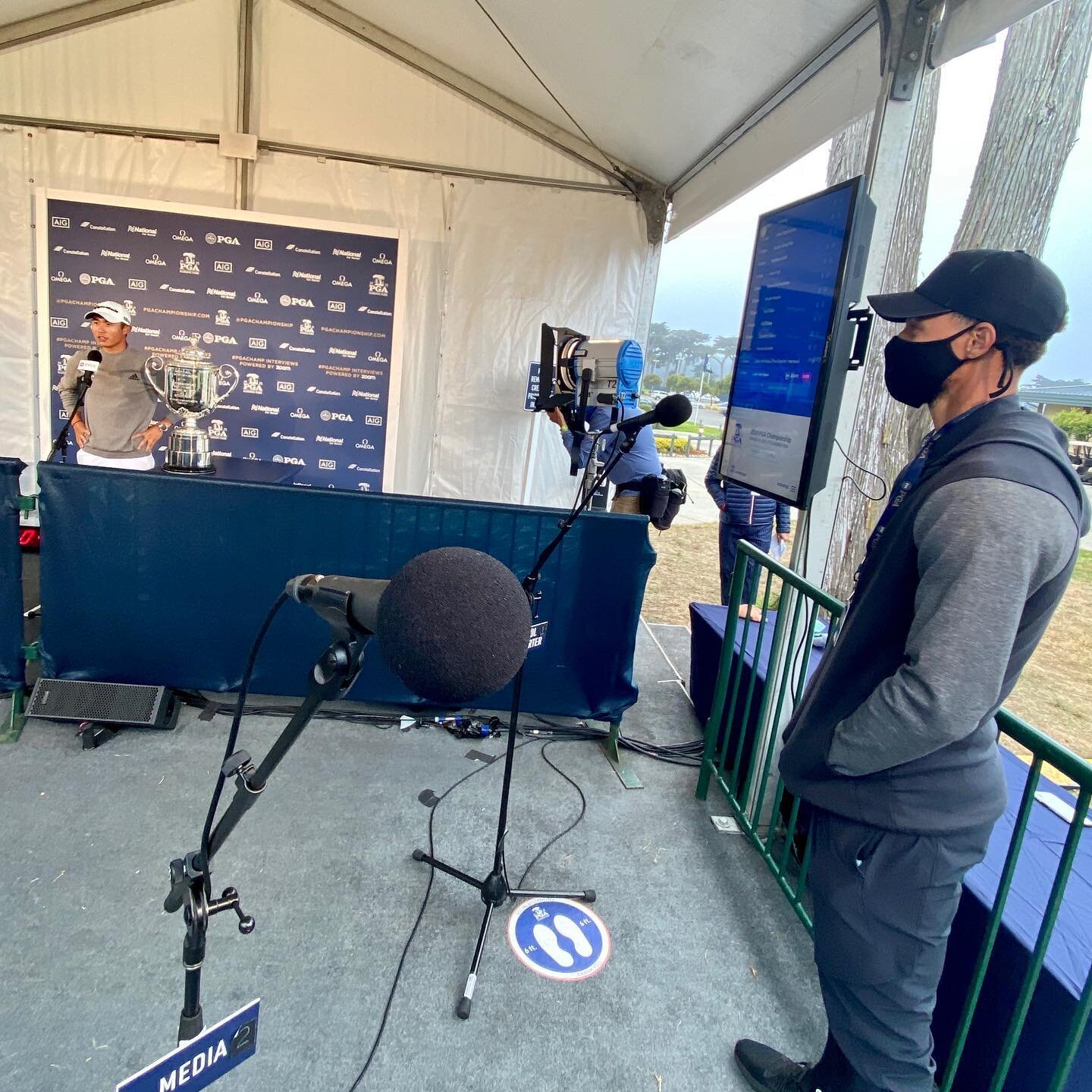
With TV ratings plunging even before the start of the NFL season and the concept of the FedEx Cup still lost on millions of golf fans, the tour apparently thought that putting a few rows of seats behind mirrors in the media tent so people could watch the sweaty media ask a few questions to equally sweaty players would be a great way to allow fans to bond with their favorite players.
What they didn't count on was that reporters might not like the idea of being on display like criminals in a police lineup. One packed up his stuff and left, while others are boycotting the interview room all together, taking a cue from players who try to escape it whenever they can, too.
Too bad, because there's nothing like listening to Singh regale the media with tales of great 7-irons and putts that were so good they had to go in.
What a guy, that Veej, clearly enjoying himself so much that even the folks in the cheap seats could see he could barely tear himself away after five minutes of going over birdies and bogeys to head back to the range.
Imagine telling your buddies about that the next day at the office.
"He was close enough to touch, if we hadn't been behind the one-way mirrors, that is. You know, I've never noticed how he takes his visor off and wipes his brow when he sits down, either. And the look of exasperation he gave when a reporter dared ask him about his 3-putt? Priceless."
Unfortunately, this is what the post-Tiger golf world will likely look like. Boring players who make no effort to connect with the fans going through the motions only because they have to.

Here's what I don't get about the media room viewing area. It may not sound like a big deal to most, but consider that Tim Finchem did not sit in there for his chat with the media for obvious reasons. There's a bit of privacy lost. Now, players are already careful with the media as it is, but these press sessions are still where we learn the little details that humanize them to the average fan. But with an audience behind mirrored walls, the players are just a bit more unlikely to open up.

Is that something the Tour really wants?

NY Times Flash: Golf Made Easier When You Can Hear and See

Bill Pennington offers another instruction piece in Monday's editions. Because the world needs more golf instruction stories and what better place to read about them than the paper of record?

Ah but Pennington isn't serving up only "it's-all-about-you" fluff. He shares this interesting bit from a USGA test center visit with

Dick Rugge.“It’s all about how much water is channeled away by the grooves,” Rugge said. “Deeper grooves get rid of more water more quickly.”
This month, the U.S.G.A. announced new restrictions on the size and edge sharpness of grooves for clubs manufactured after Jan 1, 2010. The U.S.G.A. said the new rules were aimed at professional golfers who have had an advantage hitting out of the rough with modern U-shaped grooves in their clubs. With more control in higher grass, the pros haven’t had to worry as much about keeping the ball in the fairway, an accuracy challenge the U.S.G.A. hopes to restore on some level.

No worries mate!

But the scientific research behind the groove debate is fascinating, especially as seen in super-slow motion video. At the U.S.G.A., Rugge showed me that when a club cuts through heavy rough, grass squeezed against the face of the club actually releases water. This microscopic bed of water is what reduces spin on the ball. Larger, deeper grooves whisk away the water, like treads on a car tire, and allow for crisper contact with the ball. And in expert hands, more imparted spin.
Back in March, Rugge didn’t tell me what the U.S.G.A. might do about the more efficient U-shaped grooves in golf clubs. But playing that video back and forth, and watching clubs in thick grass putting spin on golf balls, I had an inkling. It’s all about the water.

So, shouldn't the USGA and R&A just advocate putting less water on courses instead of changing the grooves?

"USGA restrictions are hindering product innovation."

Adam Schupak reports that times are tough for the equipment industry and of course, it's mostly the USGA's fault...if you ask the manufacturers.

Retailers and analysts say consumer spending domestically has stalled over concerns about an economy wracked by foreclosures and soaring fuel prices. Adverse weather has limited rounds played in key areas, which also is affecting equipment sales, they say.
Another persistent complaint: USGA restrictions are hindering product innovation. In an analyst report on Callaway, Casey Alexander of New York-based Gilford Securities wrote: “The U.S. market looks like it could produce a year where equipment sales come in down 7 percent to 8 percent, which may not sound that bad until you judge it against 10 years of equipment sales that were plus or minus 2 percent regardless of what the economy was doing.”
At this point Schupak lists all of the ways the manufacturers have made things tougher on themselves:
Retailers also say they’re being hurt by shorter product life cycles. The growing practice of launching products in almost rapid-fire succession is conditioning consumers to wait, say six months, to buy a premium-priced driver because they know it will be marked down. That consumer behavior has become more pronounced during a sluggish economy.

Those darn consumers! Don't they know they exist to help each quarter's earnings? What is wrong with you people. Shop!

“That mindset has come back to bite us,” Marney says.

"So the great thing is that professional golf might just be on the edge of seeing the end of long rough."

Geoff Ogilvy pens a grooves-related guest column for Scotland on Sunday. After explaining the beauty of the flyer lie that might return with the 2010 elimination of U-grooves, Ogilvy warns:

My big concern is that, once the grooves change, a corresponding alteration must be made to the length of the rough. There will be no point in continuing with foot-long grass. When rough gets that long, it really doesn't matter what grooves we are using. So I'd like to see rough no longer than it presently is at Augusta National. The Masters in 2010 will be interesting in that the rough will actually become much more of a hazard than it has been since it was introduced.
So the great thing is that professional golf might just be on the edge of seeing the end of long rough.
That would be the best case scenario, but I'm not as optimistic. Just look at the PGA this week, where they were coming off one of their most successful events ever with incredibly short rough and turn around with a narrow fairway, high rough setup.

However, you have to think the U-groove announcement provides a face-saving opening for the folks at Augusta National to eliminate the second cut in 2010.

I loved this point, which gets at the silliness of the hoped for elimination of bomb and gouge play.
Anyway, I like the fact that the new grooves will at least make players think more about hitting the fairway. Which isn't that big an issue, actually. I'm trying to hit the ball as straight as I can and I'm sure every other pro is too.
Geoff and others are trying to hit it straight, but sometimes it's just kind of hard to hit a sloping 24-yard fairway, no matter how good you are. That's not bomb-and-gouge, it's lousy setup.

Sea Island Slowdown

Thanks to reader Eric for this Tony Adams story on layoffs at Sea Island, as well as the resignation of CEO Bill Jones from the Synovus board.

Columbus-based Synovus declined Tuesday to discuss Sea Island Co. and its decision to lay off between 300 to 400 employees, as well as any impact the upscale hotel and development firm's business might have on the regional bankholding company.
"Basically we're in a position, as we would always be with a customer, and we just cannot provide any additional information on a customer relationship," said Synovus spokeswoman Alison Dowe.
Sea Island Co., which dates to 1928, is headquartered on the Georgia coast near Brunswick. The firm has developed several ritzy resorts in the area, most notably The Cloister on Sea Island and The Lodge on St. Simons Island. A late-July check of the rates at The Cloister showed rooms averaging between $750 and $1,700 per night.
Monday's announcement by Sea Island Co. that it is eliminating jobs follows the July 7 resignation of Bill Jones, Sea Island Co. chairman and chief executive officer, from the Synovus board of directors.
In a recent interview with the Ledger-Enquirer, Richard Anthony, Synovus chairman and CEO, commented on Jones and his resignation from the board.
"Bill, he has been, and continues to be, a very good customer and friend," Anthony said. "He just felt like he needed to spend time on his business, and we can probably serve him better without his being an insider."

Well at least he doesn't want to spend more time with his family.

Meanwhile, this could explain why Tadd Fujikawa picked the Quality Inn over The Lodge or The Cloister.

R&A Finally Acts On Grooves...To Preserve The Importance Of Rough!

Of course, the opening line of the press release is revolting on a level I can't begin to describe.

THE R&A ANNOUNCES NEW GOLF CLUB RULES
St Andrews, Scotland, 5 August 2008:  The R&A has today announced revisions to golf’s equipment Rules, which are designed to enhance the benefits of accuracy by making playing from the rough a more challenging prospect in future.
Yes, yes, rough is vital to the game. Old Tom would have wanted it that way. Don't worry about building new tees on the New Course, just make sure that we can continue to line fairways with rough. Or, in the case of the Road Hole, just eliminate the fairway. That's a priority!  Anyway, carry on...
The new Rules will augment the existing limitations on grooves and will affect all clubs (with the exception of drivers and putters), with the new regulations limiting groove volume and groove edge sharpness.  Essentially, larger volume grooves have the ability to channel away more material, such as water or grass, similar to the tread on car tyres.  At the same time, sharper groove edges facilitate a better contact between club and ball, even in the presence of debris.
Both new regulations will apply to golf clubs with lofts greater than or equal to 25 degrees (generally a standard 5-iron and above) with only the rule limiting groove volume applying to clubs of lesser loft.
So a 3 or 4 iron could have...ah forget it.
The Rules will apply to all clubs manufactured after 1 January 2010.  Clubs manufactured prior to this date, which meet the current regulations, will continue to be regarded as conforming under the Rules of Golf until at least 2024.
Well, that's not going to cause the rush to Roger Dunn's that the manufacturers would have hoped for.
It is intended that the new Rules will be introduced as a Condition of Competition at top professional level from 1 January 2010 and at top amateur level and in other professional events from 1 January 2014.  The R&A and the USGA will introduce such a Condition of Competition at their respective championships in accordance with this schedule.  The world’s top professional tours for both men and women, and the organisers of golf’s major championships, have all indicated their support for the new groove regulations and their intention to implement the Condition of Competition in 2010.

At GolfDigest.com, Mike Stachura summarizes the news while USGA.org offers...no announcement as of 10:15 a.m. PST.

"The manufacturers got ahead of the USGA and the R&A. That's the bottom line."

John Huggan talks to Tom Watson about the state of game and in particular, the ball and equipment.

"I am very adamant that I think the ball should be brought back," he says, echoing the sentiments of many others of his generation, including Jack Nicklaus. "It goes too far. It also goes straighter and is therefore easier to control in a wind. But there are a lot of factors involved other than just pure distance. The rate at which the ball spins is important. They spin less these days and that is one reason they go farther. A higher spin rate would exaggerate misses and send the ball more off line than at present.
"The manufacturers got ahead of the USGA and the R&A. That's the bottom line. Those companies made balls that conform to rules that unfortunately allowed them to go too far. They're too easy to play. And that is true for all classes of player. Yes, they make less of a difference to the handicap golfer, but they still make a difference. Just not to the degree they do for the better leading professionals."
As you'd expect of a Stanford graduate – his fellow alumnus and close friend, Jim Vernon, is the current president of the USGA – Watson has solutions to the problem that has led to the vast majority of the current generation of players never knowing the joy that comes with perfectly shaping a shot into a stiff crosswind.
"When the ball goes as straight as it does now, you don't have to 'work' it from left-to-right or right-to-left; all you have to do is aim right at your target," continues Watson. "That takes a skill factor out of the game.
"The old guys had that skill factor, but the younger guys don't seem to have that same ability. Yes, they learn how to play that famous Tiger Woods 'stinger' – I saw a few of the kids using it at Birkdale last week – and that is a useful shot to have. But can they hit a stinger from right-to-left or left-to-right? That's what I want to see them doing, but right now I'm not.
"In defence of the young players, they have never had to learn a variety of shots. They have three wedges, for example. They have never had to add loft to their 56-degree wedge to make it play as if it has 60-degrees. I'm sure they understand how to hit the ball a little higher, but it's a lot easier to hit a high lofted shot with a 60-degree wedge than it is to hit one with only 56-degrees."