
"That’s akin to eliminating the need to water six courses, saving an estimated 1.5 billion gallons each year."

Because I was going for a big picture take on Obama, bailouts, the WPA and golf, my Golf World viewpoint did not get into too many specifics regarding environmental retrofitting of existing courses. However, I can't think of a simpler, more sensical model for saving water, improving energy efficiency, creating courses that better co-exist with the environment or doing more to improve golf's image than the Southern Nevada Water Authority's "Water Smart Landscape Program."

Cindy Elliott recently wrote about it and other water-saving programs for Golfweek:

...the program provides courses and other property owners with a rebate of $1.50 for every square foot of turf converted to xeriscape, a lush but water-efficient landscape alternative that requires virtually no maintenance once established.

Major conversions at facilities, including Spanish Trails Golf and Country Club, Red Rock Country Club and Wild Horse Golf Course, have contributed to the transformation of 629 existing acres. That’s akin to eliminating the need to water six courses, saving an estimated 1.5 billion gallons each year.

Imagine how much water and energy could be saved if we could establish a federal program mimicking the SNWA's concept. Seems like a serious win-win here for our courses and the country.

"Are you doing that old business of forgetting to grip with the third and fourth fingers?"

John Paul Newport's Saturday column covers an underserved topic in golf: the art of gamesmanship. Nice plug for our friend Jon Winokur's misunderstood classic on the subject, too:

The core gamesmanship concepts, in my reading and experience, fall into four categories, all of which prey on a golfer's lonely vulnerability. Implanting irrelevant or otherwise distracting thoughts deep in a player's mind is the most time-honored tactic. "Are those butterflies bothering you? I can try to shoo them away," one may offer. Unwanted instruction is also a perennial: "Are you doing that old business of forgetting to grip with the third and fourth fingers?"

The next category involves deliberately becoming an irritant. Matching your foe's brisk pace of play with a snail's pace of your own is hard to defend against, especially for Type As. Voicing political opinions known to be anathema often produces splendid results. Boldly repeating shopworn expressions -- such as "Never up, never in" when someone leaves a putt short -- is guaranteed to get under anyone's skin.

Next, and less sporting, comes active physical distraction, such as standing just a tad too close, or absent-mindedly jangling change. Mr. Winokur describes The Mangrum, named after former Tour pro Lloyd Mangrum, who was fond of wearing bright white shoes and, while standing just inside his opponent's peripheral vision, crossing his legs at just the right, or wrong, moment.

"A family can add a nanny to the membership for $50 a year."

The Boston Globe's Stephanie Ebbert looks at changes New England area clubs are making to attract new members and keep old ones around in light of the economic crisis. Many are waiving initiation fees and trying to become more family friendly. Though I'm not quite sure about this...

As a result, some clubs are doing more to market themselves as family destinations. At Spring Valley Country Club in Sharon, a family can add a nanny to the membership for $50 a year. Spring Valley is offering new, lower-cost social memberships that lock in rates and guarantee no surprise assessments for three years.

"This allows you to bring in newer, younger families that want to utilize all aspects of the club - pool, food. That's a good thing," said membership director Jo Ann Parks. "The club is certainly reacting to what's going on with the economy, but I think we would eventually have come to this anyway. People's interests change."

Life is tough when you can't send the kids to the club because the nanny was not a member!

"Gandhi would have had a hard time winning one of these things."

Thanks to reader Bob for Gene Wojciechowski's wonderful look at the grueling Evans Scholarship awarding process. I really had no idea what they put them through.

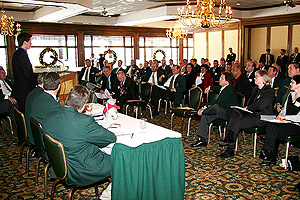
Think about it: You're what, 17, and you're summoned to a room full of adults, many of them wearing the green blazers of the Western Golf Association, which oversees the largest privately funded college scholarship program in the country? There's a waiting area and then, when it's your turn, a WGA rep leads you through a pair of glass doors, to the front of the ballroom, where you shake hands with the WGA big hitters. Then you're directed to the podium, where 100 committee members -- all allowed to ask pointed questions about your academic record, caddying experiences, life aspirations, etc. -- are assembled in front of you. These are the people who will vote yes or no on your scholarship after you leave the room.

Nerve-wracking? One finalist's face turned a splotchy red by the end of the interview. Another finalist kept wringing her hands every eight seconds. Another finalist could have used a beach towel to soak up the forehead flop sweat.

Nearly 600 caddies nationwide applied to the Evans Scholars program this year. It's a breeze: All you need is club sponsorship, a sparkling academic record, a history of community service and/or meaningful extracurricular activities, leadership skills and serious financial need (parents' tax returns are required). Gandhi would have had a hard time winning one of these things.

"But it'll be very interesting to see what happens, how guys make that adjustment."

I spent much of Wednesday asking players at Sherwood about grooves. Why, when the rule doesn't take effect until 2010?

I felt it would be interesting to hear what kind of adjustments players are making going into this year, if any. And you would think it's a topic that players have started to pay attention to now that the rule change is looming.

Naturally, my naivety is once again exposed. Most of these supposed hi-tech savvy dudes have no idea what kind of grooves are in their irons or wedges, and if they do, have given little thought to how the rule change might impact their game.

Stephen Ames was one exeception. He has already switched out his irons and wedges at the same time he went to a softer ball and sees some difference. He has had a few flyers and noticed the biggest difference in reduced ball spin on a windy day. He said he's lost maybe 5 yards off the tee because he now plays with "the softest ball possible," which I presume to be the Nike ball that Tiger uses. Asked why he already made the change in his bag instead waiting until the end of the year, he just shrugged his shoulders and said why not?

I asked Tiger Woods in his press conference and found his answer (and enthusiam on the topic) both exciting and disheartening.

Exciting:

Q. In 2010 the USGA is changing the rule for grooves. Is that going to affect what's in your bag now or how you play golf courses in the coming years?

TIGER WOODS: Yeah, it'll affect what's in my bag. I can't have my two sand wedges the way I have them now.

But as far as -- I play the spinniest ball on TOUR, so for me, my transition will be a little bit easier than the rest of the guys, guys who play a harder golf ball. They're going to have to maybe a little bit more of an adjustment, whether they do it with loft. Some guys are experimenting with 64-degree wedges to try to help them out that way so they can hit fuller shots with more spin, or guys just might be making -- actually more mental adjustments in their course management skills, going for greens, because you know you actually can't get the ball to spin like you used to so it puts more of a premium on putting the ball in the fairway. With the wedges you can't blast it out there on the par-5s and expect an easy up-and-down. You've got to miss it on the proper side more than ever. But it'll be very interesting to see what happens, how guys make that adjustment.

So the USGA and R&A should be pleased to see that Tiger thinks hitting fairways will take on importance.

The disheartening part? I think he has a lot more to say on the matter, and a natural follow up on the news of a high-lofted wedge study would probably elicit a fascinating answer as well. But with his appearances limited and minimal accessibility, we'll have to wait a while.

“He and his wife were nice golfers"

As if the game didn't have enough image problems, we now learn from Alan Feurer and Christine Haughney that the greatest investment swindler in American history was a golfer whose club memberships were a key component of his lifestyle and business. I give you, Bernie Madoff.

And soon the Madoff name — if not quite the equal of the Tisch name, for example — carried a quiet power.

"The guy never flaunted anything,” said one longtime friend. “And that fit with his rate of return, which was never attention-grabbing, just solid 12-13 percent year in, year out."

The friend, a private investor who knows Mr. Madoff from the Palm Beach Country Club and from the Hamptons, said friends and investors had been calling nonstop since the arrest.

"The pain is just unbelievable,” the friend said. “He was part of the family for so many people. There was this quiet culture of people, slightly older-money, who maybe weren’t that interested in the market, who kept saying to each other, ‘Just give Bernie your money, you’ll be fine.’ "

That culture had perhaps its best expression at the half-dozen golf clubs he belonged to, ranging from the woody Old Oaks in Purchase, N.Y., to the Palm Beach Country Club in Florida.

“He and his wife were nice golfers,” said Denise Lefrak Calicchio, part of the Lefrak real estate family, who knew the Madoffs socially through several of their clubs. “He and his wife seemed lovely.”

With time, some wealthy investors even joined clubs in order to become part of Mr. Madoff’s investments, some who knew him said. It was considered a favor to be introduced to the man as a potential investor.

“There were people joining golf clubs just to get into his fund,” said one investor who declined to be named. “This guy was held in such high regard.”

A member of the Palm Beach club said the Madoffs did not socialize as much as other members did, nor did they fight as aggressively as others to keep up with the club’s more aerobic social climbers. They were well-liked, and did not appear to be part of the “blister pack,” as one club member put it, a term that refers to those who get blisters on their hands and feet from ascending social ladders.

“They seemed to stay apart from the herd,” the club member said. “They chose not to get into that social rat race.” 

Well, at least he had at least one redeeming quality!

"It's unfortunate that the very top percentile, which is so minuscule, has really benefited."

The Orlando Sentinel's Josh Robbins talks to some of the geezers playing in the Father/Neerdowell Challenge about biggest changes to the game. My two favorites:

Raymond Floyd: Technology. Equipment and technology. ... It's unfortunate that the very top percentile, which is so minuscule, has really benefited. The masses have also benefited, but not to the [same] extent, because they've developed the ball and the club for the high swing speed. So that makes the ball go so much farther. However, the lighter club, the perimeter weighting, has benefited the masses as well. So, where do you draw the parallel? It's benefited everybody, but it's almost making old golf courses obsolete because of what happens exponentially with head speed, the distance the ball goes. ... I'm 66 years old, and I hit the ball farther than I did when I was probably 55.

But you workout Ray, don't discount that!

And Fuzzy...

Zoeller: I'd like to see the USGA step in and calm some things down, or some of these golf courses that have been over the years are just going to be obsolete. Personally as a player, I don't think they're doing their job. That's just the way I feel about it. ... [The technology and the equipment] has gotten out of hand. It seems like the manufacturers are light years ahead of the USGA. I think they need to stop it and put a cap on it somewhere. It's like a runaway dog right now.

What, no love for the groove rule change? I'm shocked!

"Tell a British golfer that the 90-degree rule is in effect and you’ll get a blank look."

Alistair Tait files a nice rant about American golf courses and golfers, and just as he was making fun of our propensity to tuck a towel into the waistband he thankfully switched to his British golf rants and addressed the issue of grown men wearing socks to their knees. Wise move Alistair, wise move.

“Golf thrives on intelligent conversation. We need to talk more about where the game is headed.”

Mark Brooks talking to Golfweek's Jim Achenbach:

The big campaign for Brooks is the golf ball. He, along with many traditionalists who enjoy working the ball and creating a multitude of different shots, would like to see spin put back into the ball.

Among other consequences, this would reintroduce the slice to golf. With today’s low-spinning, dead-straight golf balls, the slice has disappeared from the game. Sure, shots still go to the right because they are pushed or blocked, but they fly straight right rather than slicing out of control.

“It would put more emphasis on shotmaking, which would be a good thing,” Brooks said. “I’ve been screaming about it for some time, but it hasn’t done any good.”

It hasn’t done any good because the U.S. Golf Association failed to control the golf ball. For all the positive achievements of the USGA, the organization flatly failed to comprehend the ingenuity of the golf ball companies.

Along the way, golf turned into a straight-line game. A new philosophy emerged: Aim it at your target and swing like hell.

Brooks contends that an element of skill was removed from the game. Controlling the ball became too simple.

“It’s very frustrating,” Brooks said. “Shotmakers are artists. They are highly skilled at moving the ball around. Now suddenly you see a bunch of guys who never think of playing that way. The reason they can swing so hard and hit it so far is that the ball is so easy to control.”

Brooks still loves the game. He still will support the USGA, although he will lobby for change whenever he gets the opportunity.

When you shoot 66 in an important tournament, you have the opportunity.

“I’m not going to shut up,” Brooks concluded. “Golf thrives on intelligent conversation. We need to talk more about where the game is headed.” 

PGA Tour Par 4 Performance

Reader Ken emailed a list detailing the number of players finishing a PGA Tour season under par on par-4s. You can view the 2008 list here, where John Huston was the only player in 2008 to finish in red numbers for the season.

I've left Ken's notes in about major equipment advances as they might relate to performance. I'd love to hear what everyone thinks of the surprising trend in recent years. Naturally, I'd look to stifling course setup ploys as the number one culprit, but if I'm not mistaken Ken is implying that performance has been impacted by technology. He also notes that Tiger was -8 on par 4s this year in his 8 events. And note that in 2000 Tiger was -71 on par-4s, and Steve Flesch was second at -70!

1983 - 1 - TM Tour Burner introduced

1984 - 1

1985 - 4

1986 - 2

1987 - 11 - Non-wound ball wins first major (Tour Edition)

1988 - 22 –first time metal drivers outnumber wood

1989 – 7 - Callaway introduces S2H2 metalwoods

1990 - 5

1991 - 12 - Big Bertha introduced

1992 - 18 - Titleist Professional introduced

1993 - 14

1994- 15

1995 – 13 - Great Big Bertha introduced

1996 – 8 - multilayer balls and urethane cover introduced

1997 – 4 - Biggest Big Bertha introduced

1998 - 6

1999 - 8

2000 – 27 - Pro V1 introduced, Tiger switches to Nike ball

2001 – 37 - Pro V1 takes tours by storm

2002 – 17

2003 - 12

2004 - 8

2005 - 7

2006 - 5

2007 - 5

2008 - 1

“If you’re the consumer, there are more courses to play on for cheaper."

There's some nice reporting in two recent pieces on how the economic collapse may impact club life. First, John Paul Newport in the Wall Street Journal:

Every case is different and complicated. But the very fact that so many clubs and their beleaguered boards and owners are having such discussions -- walkaway risk, indeed! -- is a sign of how much the fundamentals of private golf clubs and country clubs have changed. It used to be that belonging to a private club was the pinnacle of achievement. If you made partner or were promoted to vice president, joining "the club" was a perk. In small or medium-size cities, club dining was often the best in town, the spa was the only one around and there were no premium daily-fee golf options. My late father-in-law, a doctor in Ohio, played golf every Thursday afternoon and hung out at his club big parts of Saturday and Sunday.

That model still holds for particular clubs in particular places for particular people, like well-off retirees. But for the younger generation of club members, things are different. Neither spouse in a two-income family with children has the time or inclination to while away weekends at the club. When I asked Doug Steffen, the director of golf at Baltusrol in Springfield, N.J., to describe the biggest change in club life during his 13-year tenure there, he said, "That's easy to answer. The club used to be the focal point of social life for our members, but now it's just one among many other activities they are involved with."

And this from Ben Smith in the Atlanta Journal-Constitution:

Rick Burton, the director of golf at East Lake Golf Club in Atlanta, said there’s been no noticeable decline in the number of rounds played at the course.

But sales in the golf shop and restaurant declined somewhat, and a major corporate Christmas party booked at the club was canceled recently, Burton said.

“Our bookings for the spring are good,” Burton said. “Whether that’s because people are optimistic things will turn around by then, I don’t know.”

The effect of the economic downturn has been more pronounced at East Lake’s public course next door, the golf director said.

Revenues are down 15 percent at Charlie Yates Golf Course, said Burton, who’s contemplating cutting part-time staff to help make up for the shortfall.

Crouse said the economic downturn isn’t all bad news.

“For golf owners, it’s the worst time,” said Crouse. “If you’re the consumer, there are more courses to play on for cheaper.

“If you’re the golf course player there are now clubs you can join that once cost $20,000 that now cost $2,000,” Crouse said.