"We have been looking on a research basis at high-lofted wedges"

A few things jumped out in Jim Vernon's interview with Mike James of the L.A. Times.

First, the questions, which included topics that few golf publications ask about. And no, I don't believe it's due to some perceived fear that they might upset manufacturers and lose advertising. Instead, I just don't think they care a whole lot about this state of the game stuff.

Second, is it me or does Vernon seem more candid in this interview than any USGA president in recent memory?

Obviously it's refreshing and can only help the USGA, even if you don't agree with the outcome of their research.

Here's the breaking news, first revealed by Barack and Geithner at GolfDigest.com, but not confirmed by anyone at the USGA until now:

We have been looking on a research basis at high-lofted wedges, we've heard anecdotal evidence that they may have some of the same effects as the grooves did. That is, without any particular increase in skill, a player has a way of recovering around a green or over a bunker. At the same time, we hear some pros say it is really tough to hit a 64-degree wedge. We don't have a proposal on the table, but we are taking a look at it.

About the ball study and the study of rolled-back balls:

We also have our ball-research project. We are in the final stages of player testing with shorter-distance golf balls. The ball manufacturers have been very cooperative giving us good quality but shorter-distance golf balls so that we can test them with players of all abilities, from hacks like me to Tiger Woods and that level. If we ever decided that we had to roll the ball back or reduce distance, this is something we can then pull off the shelf and put into effect.

And I don't know if any USGA President has ever acknowledged that some venues might be dated after the recent distance climb, or that it's a negative in any way. No mea culpa on behalf of the USGA here, but a huge start to acknowledging where the distance race has left us when it comes to golf architecture:

There are two problems: Courses are getting built longer, which requires more maintenance, more chemicals, all of which is more expensive. The second effect is you have these established courses our there, the Merions, the Shinnecocks, the Rivieras, these great clubs, and since all those facilities feel they have to accommodate golfers of all abilities too, they have to start incurring great expenses, moving bunkers, moving tees. It's a huge amount of money spent by courses around the country to adapt to increased distances players are hitting the ball. It's certainly added to the expense of golf, and in the long term that may not be a good thing. Golf is an expensive sport. We're going to get more people playing golf if we can keep costs down, and we're going to be better citizens if we can keep whatever effects, use of water or whatever, at a lower level.

Q: Do you see at some point reducing the distance of the ball?

A: We've seen a six-year period of stability on the PGA Tour. As long as that continues, I think it would take something pretty dramatic for us to take that big a step. On the other hand, if you were to see a shift in how far those tour pros are hitting it again, like the six or eight or 10 years before the last six, then I think you'd see a lot of pressure to do something, and rolling the ball back is one of the options.

Vernon also talks about the California Golf Tax proposal, golf in the Olympics and the potential of Riviera as a U.S. Open venue.

The Stimulus Bill And Golf

We found out that golf was specifically excluded from the Obama stimulus bill passed by the House Wednesday, but there is good news. There wasn't much infrastructure spending despite projections that far more is needed, meaning we'll probably see more debate about infrastructure.

The current bill's spending:

Infrastructure — $43 billion for transportation projects, including $30 billion for highway and bridge construction and repair and $12 billion for mass transit, including $7.5 billion to buy transit equipment like buses; $31 billion to build and repair federal buildings and other public infrastructure; $19 billion in water projects; $10 billion in rail and mass transit projects.

Of course, as I outlined in Golf World, the game could definitely do a whole bunch with a tiny portion of the "water projects" money!


"Congress has moved to prevent money from the proposed $825 billion stimulus package from being used for zoos, aquariums, golf courses, swimming pools and casinos"

Thanks to reader Joel for this:

Congress has moved to prevent money from the proposed $825 billion stimulus package from being used for zoos, aquariums, golf courses, swimming pools and casinos, an effort to ensure the bill funds only what it calls the "highest quality" infrastructure projects.

"The purpose of this bill is to direct funding at projects that are primarily and clearly aimed at benefiting the economic conditions of communities and the public at large," the bill states. "The federal government and all other levels of government are directed to look with a skeptical eye at projects that don't meet that test."
CNN revealed last month that a list of "ready to go" stimulus projects endorsed by the U.S. Conference of Mayors included museum and zoo renovations, aquatic centers, skateboard parks and bike and horse paths. One of the zoo projects in the report is a $4.8 million polar bear exhibit at the Providence, Rhode Island, zoo.

The House Appropriations Committee added those restrictions last week after criticism from watchdog groups like the National Taxpayers Union, which monitors government spending.

"To the people supporting them, these proposals aren't a joke," said Pete Sepp, the group's vice president. "But to the taxpayers funding them, yes this will be a joke for them, only they won't be laughing."

The restrictions in the bill appear meant to address reports about some of the projects endorsed by the U.S. mayors, Sepp said. 

Any followers of politics who know how to find out which fine politician drove the inclusion of this language in the bill? Or is it all done behind closed doors?

Obviously, my Golf World piece was not read by this fine guardian of American values! And clearly, Steve Mona, Bob Combs and the crew down in Florida working to educate our nation's capital have their work cut out for them.

"But good clubs realise that their best asset is the course."

In Peter Dixon's look at the struggles of clubs in the UK, he that much of a club's standing still comes down to the quality of the course:

While there are still some high-end developments being planned, the future probably lies much farther down the scale. Williamson points to a development near Edinburgh where a farmer is adding a nine-hole course to an existing driving range and is encouraging families.

In 1997, the Henley Centre identified an emerging demand for what it called “fast golf, friendly golf, family golf”. This is just such a development. “I think traditional golf clubs have to move as far in that direction as they possibly can,” Williamson suggested. “Particularly in terms of relaxing dress code, welcoming families and so on.”

And as for the Royal Troons, Muirfields and Royal Birkdales of this world? They seem immune from the downturn, earning good income from visitors without having very many of them. The one thing missing from all their websites is an invitation to join the club. Now there's a surprise.

"That’s akin to eliminating the need to water six courses, saving an estimated 1.5 billion gallons each year."

Because I was going for a big picture take on Obama, bailouts, the WPA and golf, my Golf World viewpoint did not get into too many specifics regarding environmental retrofitting of existing courses. However, I can't think of a simpler, more sensical model for saving water, improving energy efficiency, creating courses that better co-exist with the environment or doing more to improve golf's image than the Southern Nevada Water Authority's "Water Smart Landscape Program."

Cindy Elliott recently wrote about it and other water-saving programs for Golfweek:

...the program provides courses and other property owners with a rebate of $1.50 for every square foot of turf converted to xeriscape, a lush but water-efficient landscape alternative that requires virtually no maintenance once established.

Major conversions at facilities, including Spanish Trails Golf and Country Club, Red Rock Country Club and Wild Horse Golf Course, have contributed to the transformation of 629 existing acres. That’s akin to eliminating the need to water six courses, saving an estimated 1.5 billion gallons each year.

Imagine how much water and energy could be saved if we could establish a federal program mimicking the SNWA's concept. Seems like a serious win-win here for our courses and the country.

"Are you doing that old business of forgetting to grip with the third and fourth fingers?"

John Paul Newport's Saturday column covers an underserved topic in golf: the art of gamesmanship. Nice plug for our friend Jon Winokur's misunderstood classic on the subject, too:

The core gamesmanship concepts, in my reading and experience, fall into four categories, all of which prey on a golfer's lonely vulnerability. Implanting irrelevant or otherwise distracting thoughts deep in a player's mind is the most time-honored tactic. "Are those butterflies bothering you? I can try to shoo them away," one may offer. Unwanted instruction is also a perennial: "Are you doing that old business of forgetting to grip with the third and fourth fingers?"

The next category involves deliberately becoming an irritant. Matching your foe's brisk pace of play with a snail's pace of your own is hard to defend against, especially for Type As. Voicing political opinions known to be anathema often produces splendid results. Boldly repeating shopworn expressions -- such as "Never up, never in" when someone leaves a putt short -- is guaranteed to get under anyone's skin.

Next, and less sporting, comes active physical distraction, such as standing just a tad too close, or absent-mindedly jangling change. Mr. Winokur describes The Mangrum, named after former Tour pro Lloyd Mangrum, who was fond of wearing bright white shoes and, while standing just inside his opponent's peripheral vision, crossing his legs at just the right, or wrong, moment.

"A family can add a nanny to the membership for $50 a year."

The Boston Globe's Stephanie Ebbert looks at changes New England area clubs are making to attract new members and keep old ones around in light of the economic crisis. Many are waiving initiation fees and trying to become more family friendly. Though I'm not quite sure about this...

As a result, some clubs are doing more to market themselves as family destinations. At Spring Valley Country Club in Sharon, a family can add a nanny to the membership for $50 a year. Spring Valley is offering new, lower-cost social memberships that lock in rates and guarantee no surprise assessments for three years.

"This allows you to bring in newer, younger families that want to utilize all aspects of the club - pool, food. That's a good thing," said membership director Jo Ann Parks. "The club is certainly reacting to what's going on with the economy, but I think we would eventually have come to this anyway. People's interests change."

Life is tough when you can't send the kids to the club because the nanny was not a member!

"Gandhi would have had a hard time winning one of these things."

Thanks to reader Bob for Gene Wojciechowski's wonderful look at the grueling Evans Scholarship awarding process. I really had no idea what they put them through.

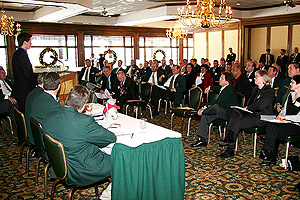
Think about it: You're what, 17, and you're summoned to a room full of adults, many of them wearing the green blazers of the Western Golf Association, which oversees the largest privately funded college scholarship program in the country? There's a waiting area and then, when it's your turn, a WGA rep leads you through a pair of glass doors, to the front of the ballroom, where you shake hands with the WGA big hitters. Then you're directed to the podium, where 100 committee members -- all allowed to ask pointed questions about your academic record, caddying experiences, life aspirations, etc. -- are assembled in front of you. These are the people who will vote yes or no on your scholarship after you leave the room.

Nerve-wracking? One finalist's face turned a splotchy red by the end of the interview. Another finalist kept wringing her hands every eight seconds. Another finalist could have used a beach towel to soak up the forehead flop sweat.

Nearly 600 caddies nationwide applied to the Evans Scholars program this year. It's a breeze: All you need is club sponsorship, a sparkling academic record, a history of community service and/or meaningful extracurricular activities, leadership skills and serious financial need (parents' tax returns are required). Gandhi would have had a hard time winning one of these things.

"But it'll be very interesting to see what happens, how guys make that adjustment."

I spent much of Wednesday asking players at Sherwood about grooves. Why, when the rule doesn't take effect until 2010?

I felt it would be interesting to hear what kind of adjustments players are making going into this year, if any. And you would think it's a topic that players have started to pay attention to now that the rule change is looming.

Naturally, my naivety is once again exposed. Most of these supposed hi-tech savvy dudes have no idea what kind of grooves are in their irons or wedges, and if they do, have given little thought to how the rule change might impact their game.

Stephen Ames was one exeception. He has already switched out his irons and wedges at the same time he went to a softer ball and sees some difference. He has had a few flyers and noticed the biggest difference in reduced ball spin on a windy day. He said he's lost maybe 5 yards off the tee because he now plays with "the softest ball possible," which I presume to be the Nike ball that Tiger uses. Asked why he already made the change in his bag instead waiting until the end of the year, he just shrugged his shoulders and said why not?

I asked Tiger Woods in his press conference and found his answer (and enthusiam on the topic) both exciting and disheartening.

Exciting:

Q. In 2010 the USGA is changing the rule for grooves. Is that going to affect what's in your bag now or how you play golf courses in the coming years?

TIGER WOODS: Yeah, it'll affect what's in my bag. I can't have my two sand wedges the way I have them now.

But as far as -- I play the spinniest ball on TOUR, so for me, my transition will be a little bit easier than the rest of the guys, guys who play a harder golf ball. They're going to have to maybe a little bit more of an adjustment, whether they do it with loft. Some guys are experimenting with 64-degree wedges to try to help them out that way so they can hit fuller shots with more spin, or guys just might be making -- actually more mental adjustments in their course management skills, going for greens, because you know you actually can't get the ball to spin like you used to so it puts more of a premium on putting the ball in the fairway. With the wedges you can't blast it out there on the par-5s and expect an easy up-and-down. You've got to miss it on the proper side more than ever. But it'll be very interesting to see what happens, how guys make that adjustment.

So the USGA and R&A should be pleased to see that Tiger thinks hitting fairways will take on importance.

The disheartening part? I think he has a lot more to say on the matter, and a natural follow up on the news of a high-lofted wedge study would probably elicit a fascinating answer as well. But with his appearances limited and minimal accessibility, we'll have to wait a while.

“He and his wife were nice golfers"

As if the game didn't have enough image problems, we now learn from Alan Feurer and Christine Haughney that the greatest investment swindler in American history was a golfer whose club memberships were a key component of his lifestyle and business. I give you, Bernie Madoff.

And soon the Madoff name — if not quite the equal of the Tisch name, for example — carried a quiet power.

"The guy never flaunted anything,” said one longtime friend. “And that fit with his rate of return, which was never attention-grabbing, just solid 12-13 percent year in, year out."

The friend, a private investor who knows Mr. Madoff from the Palm Beach Country Club and from the Hamptons, said friends and investors had been calling nonstop since the arrest.

"The pain is just unbelievable,” the friend said. “He was part of the family for so many people. There was this quiet culture of people, slightly older-money, who maybe weren’t that interested in the market, who kept saying to each other, ‘Just give Bernie your money, you’ll be fine.’ "

That culture had perhaps its best expression at the half-dozen golf clubs he belonged to, ranging from the woody Old Oaks in Purchase, N.Y., to the Palm Beach Country Club in Florida.

“He and his wife were nice golfers,” said Denise Lefrak Calicchio, part of the Lefrak real estate family, who knew the Madoffs socially through several of their clubs. “He and his wife seemed lovely.”

With time, some wealthy investors even joined clubs in order to become part of Mr. Madoff’s investments, some who knew him said. It was considered a favor to be introduced to the man as a potential investor.

“There were people joining golf clubs just to get into his fund,” said one investor who declined to be named. “This guy was held in such high regard.”

A member of the Palm Beach club said the Madoffs did not socialize as much as other members did, nor did they fight as aggressively as others to keep up with the club’s more aerobic social climbers. They were well-liked, and did not appear to be part of the “blister pack,” as one club member put it, a term that refers to those who get blisters on their hands and feet from ascending social ladders.

“They seemed to stay apart from the herd,” the club member said. “They chose not to get into that social rat race.” 

Well, at least he had at least one redeeming quality!

"It's unfortunate that the very top percentile, which is so minuscule, has really benefited."

The Orlando Sentinel's Josh Robbins talks to some of the geezers playing in the Father/Neerdowell Challenge about biggest changes to the game. My two favorites:

Raymond Floyd: Technology. Equipment and technology. ... It's unfortunate that the very top percentile, which is so minuscule, has really benefited. The masses have also benefited, but not to the [same] extent, because they've developed the ball and the club for the high swing speed. So that makes the ball go so much farther. However, the lighter club, the perimeter weighting, has benefited the masses as well. So, where do you draw the parallel? It's benefited everybody, but it's almost making old golf courses obsolete because of what happens exponentially with head speed, the distance the ball goes. ... I'm 66 years old, and I hit the ball farther than I did when I was probably 55.

But you workout Ray, don't discount that!

And Fuzzy...

Zoeller: I'd like to see the USGA step in and calm some things down, or some of these golf courses that have been over the years are just going to be obsolete. Personally as a player, I don't think they're doing their job. That's just the way I feel about it. ... [The technology and the equipment] has gotten out of hand. It seems like the manufacturers are light years ahead of the USGA. I think they need to stop it and put a cap on it somewhere. It's like a runaway dog right now.

What, no love for the groove rule change? I'm shocked!

"Tell a British golfer that the 90-degree rule is in effect and you’ll get a blank look."

Alistair Tait files a nice rant about American golf courses and golfers, and just as he was making fun of our propensity to tuck a towel into the waistband he thankfully switched to his British golf rants and addressed the issue of grown men wearing socks to their knees. Wise move Alistair, wise move.