Q&A With George Kirsch
/George Kirsch is the author of an important new book: Golf In America. A literate and entertaining read,
Read More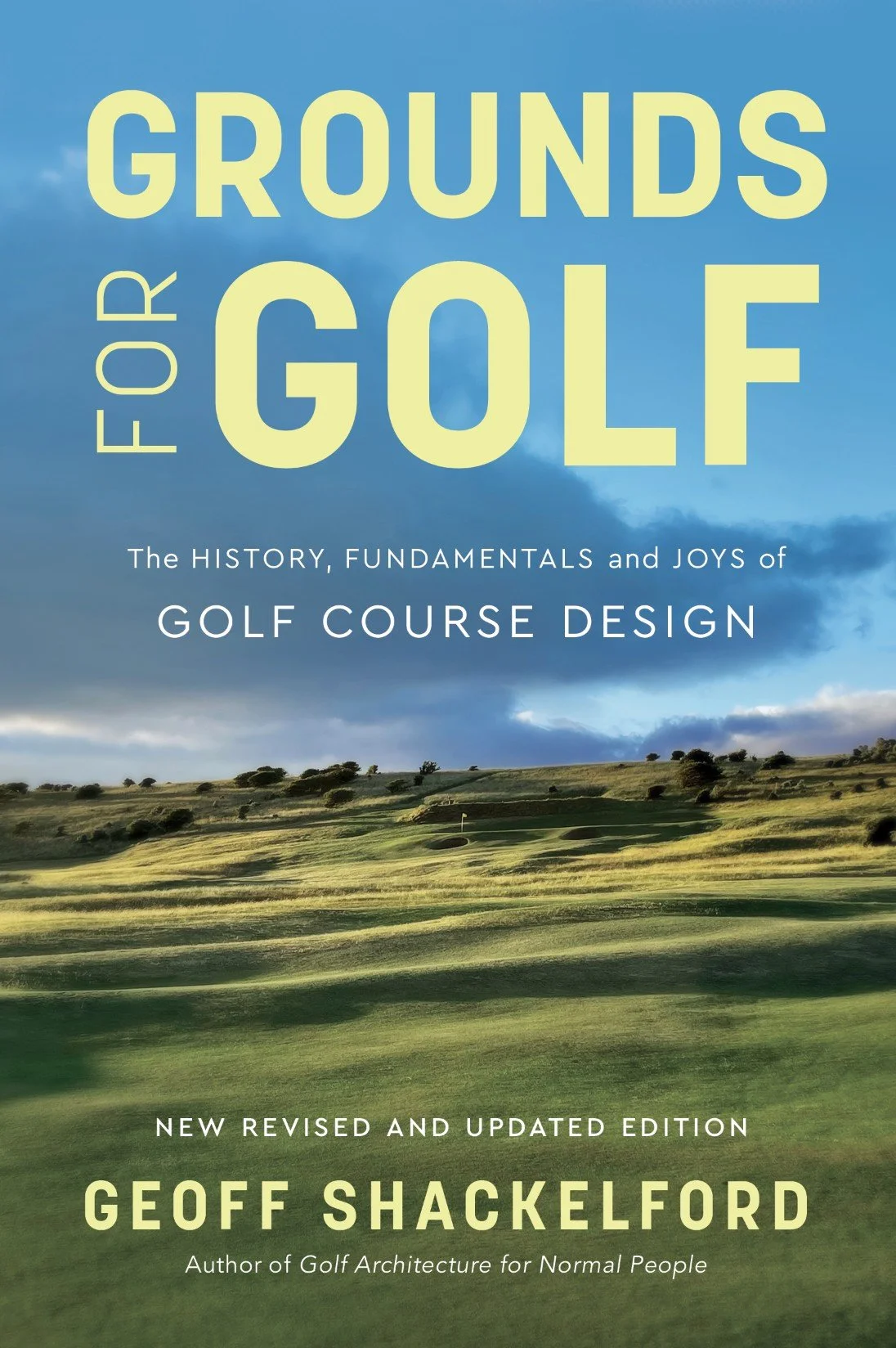
It’s back!
Twenty years later Tatra Press has kindly allowed me to bring back Grounds For Golf now that golf architecture is of more interest to the masses. A new Introduction looks at what’s driven the interest growth and two new chapters I had a blast adding (plus a few edits to keep things up-to-date).
The Amazon purchase page for the book arriving June 15, 2026.
While Ron Sirak attributes the emergence of teens Rory, Ryo and Danny to Tiger, John Huggan says their success at a young age may be thanks to equipment changes.
Such a phenomenon is relatively new in men's professional golf, certainly in terms of so many new and unshaven faces arriving at once. Where the women's game has long seen wee lassies in their mid-to-late teens capable of contending in the biggest events, it has traditionally taken longer for physically less mature laddies to achieve similar heights.
And...
So it is that, where the separation between good and great used to have much to do with the aesthetically pleasing art form that was shot-making, today the game is more about raw power. Very early – much earlier than before – young players armed with the requisite talent and nerve to survive with the very best begin playing basically the same muscle-bound game favoured by their supposed superiors. Accompanied by squeals of anger and disappointment from purists everywhere, draw, fade and feather have been replaced by crash, bang and wallop.
Which is not to say that there is not a lot of fun to be had from watching this new generation of stars in action.
True, but will the quality of play ultimately be impacted the way a rush of youth in the NBA has affected play, or is this just a natural progression of the sport?
Bloomberg's Michael Buteau looked at golf fallout from the economic crisis and something tells me that this falls into the "needed to happen" category:
Maintenance crews at Atlanta Athletic, where golfing legend Bobby Jones grew up playing the game, will soon start cutting the fairways in a back-and-forth pattern, instead of the more decorative crisscross. The adjustment will save about 100 gallons of diesel fuel a month, or about $2,300 a year, said Ken Mangum, the grounds superintendent.
“You’re looking at every little thing you can to save a dollar,” Mangum said. Fewer flowers will be planted, something “spoiled” golfers will have to get used to, he said.
It's good to know the R&A is on top of things, as always. Mike Aitken fills us in on Peter Dawson's dire warning:
"I don't think we've seen the bottom of this and I don't think anyone is immune," said Dawson. "I'm no economic forecaster, but it's hard to see the situation turning around quickly. There may be quite a way to go.
"I think people who are members of golf clubs will be thinking twice about their subscriptions. Like everything else which is discretionary (spending], people will ask, 'Do I need to buy a new driver this year?' All these things will contract."
I tell ya, he is a visionary.
Aitken also files this piece on the state of club golf in Scotland, where memberships are not being renewed at a disturbing pace.
It's been so long since I've had anything to add to The List. Great to see what Greg Norman had to say this week:
Norman, who was in Australia to play the Johnnie Walker Classic last weekend in Perth, also said golf's international administrators should limit the impact of technology to save time and money rather than lengthen courses to accommodate for players hitting the ball further with increasingly advanced clubs.
"I think the powers that be could have done a better job of managing the technology breakthroughs that took place over a period of time and implemented different rules for us, the professionals, and not having to spend millions upon millions of dollars to change golf courses for four rounds," he said.
The most disturbing thing about FBR pulling out of the Scottsdale stop (thanks Steven T.) is not that a penny stock investment group can't go on, but that the Commissioner is talking about "bumps in the road" and offering this as reported by Doug Ferguson. Finchem is discussing extensions with Travelers and Accenture during a press room gathering Tuesday:
"In these times, any level of growth is a victory," he said. "And if I had to guess right now where we come out after another year of this, I would still say we are in a position where we can see lesser growth — but growth."
Is the growth mantra is appropriate right now? I'm guessing Greg Norman suggesting this (thanks reader John) would not agree with Commissioner:
"Prize money's being scaled back in Europe, I wouldn't be surprised if prize money's scaled back in the U.S. just out of respect to every citizen and taxpayer over there who's suffering dramatically," the two-time British Open champion was quoted as saying Wednesday on the Australian Broadcasting Corp. Web site. "It seems like on the PGA Tour the players are still playing for a million dollars first week, like they're recession-proof.
"I think there's got to be a lot of sensitivity shown. If I was PGA commissioner that's what I would be recommending," he said.
 I leave for a few hours and we go from a shoddy TMZ report with exaggerations and blatantly incorrect information about the Northern Trust Open, to prominent members of Congress using it to call for everything but a public execution.
There are a number of ways to look at the Northern Trust situation. Obviously it's hard to sympathize with a group that received TARP money going on to do over-the-top entertaining when other recent examples of such excess have turned prominent companies into dirty words (A.I.G.).
Northern Trust signed on as L.A. Open sponsor to build it's brand in the west. Well, today they went national today.
On the other hand, Northern Trust is a victim here. Having been forced to take TARP money they apparently forgot there were new rules of doing business attached to that money no matter how unnecessary they believed it to be. If CEO Rick Waddell and his board had any cojones, he'd hold a press conference tomorrow with a big $1.6 billion winner's check in his hand and an offer to give it all back to the government.
My initial reaction to these events has more to do with the PGA Tour and the future of the sport. You may recall that I spared you more detailed thoughts about the direction the L.A. Open has taken with Northern Trust and PGA Tour's Championship Management whispering in their ears to push out the L.A. Junior Chamber of Commerce, corporatize everything in sight and in general, make the event more like events the PGA Tour operates: bland, soulless and devoid of local character but "elegant" to the discerning corporate clients visiting from Chicago who can pass a blindfold taste test between Grey Goose and Smirnoff.
While some of you might giggle at my pleas for an 18th green manual scoreboard, it's little things like this that lie at the heart of the utterly disastrous direction the PGA Tour has taken where the corporate world takes total priority over the experience of the everyday fan. Do we really need an on course concierge? (click image to enlarge)
As Barack Obama spoke Tuesday night and made the boldest declaration yet to end corporate greed, malfeasance and excess, I couldn't help but think that the PGA Tour had better be holding emergency meetings through the night figuring out how to wean themselves from a fatal attraction to this peculiar world of arrogant excess that mercifully died on February 24, 2009.
Obama: "I intend to hold these banks fully accountable for the assistance they receive, and this time, they will have to clearly demonstrate how taxpayer dollars result in more lending for the American taxpayer. This time, CEOs won't be able to use taxpayer money to pad their paychecks or buy fancy drapes or disappear on a private jet. Those days are over."
 Countrywide was visible at the 2009 NTO (click to enlarge)This doesn't mean golf or the days of golf tournament sponsorship are over. Nor does this unravelling of greed and corruption mean that corporations are going to be going away as hosts of golf tournaments and supporters of the game. And nor do we want them to go away.
However, the folks running the game are going to have to rethink their complete and utterly nauseating obsession with pleasing often out of touch and sometimes downright moronic hooligans who want tinted windows on their elevated luxury boxes so they can look down on the little people, who have little genuine regard for the values golf stands for, and who consistently display a disdain for anything beyond themselves.
 The general malaise displayed by Sunday's Northern Trust field resulted from a return of the dreaded Beef Stroganoff cream-of-too-much-butter pasta in the media center dining room following a week of stellar menu options. Players could sense post round interviews would come before a refluxing band of scribblers and therefore played tentatively throughout Sunday's gloomy but warm finale.
That's my theory anyway.
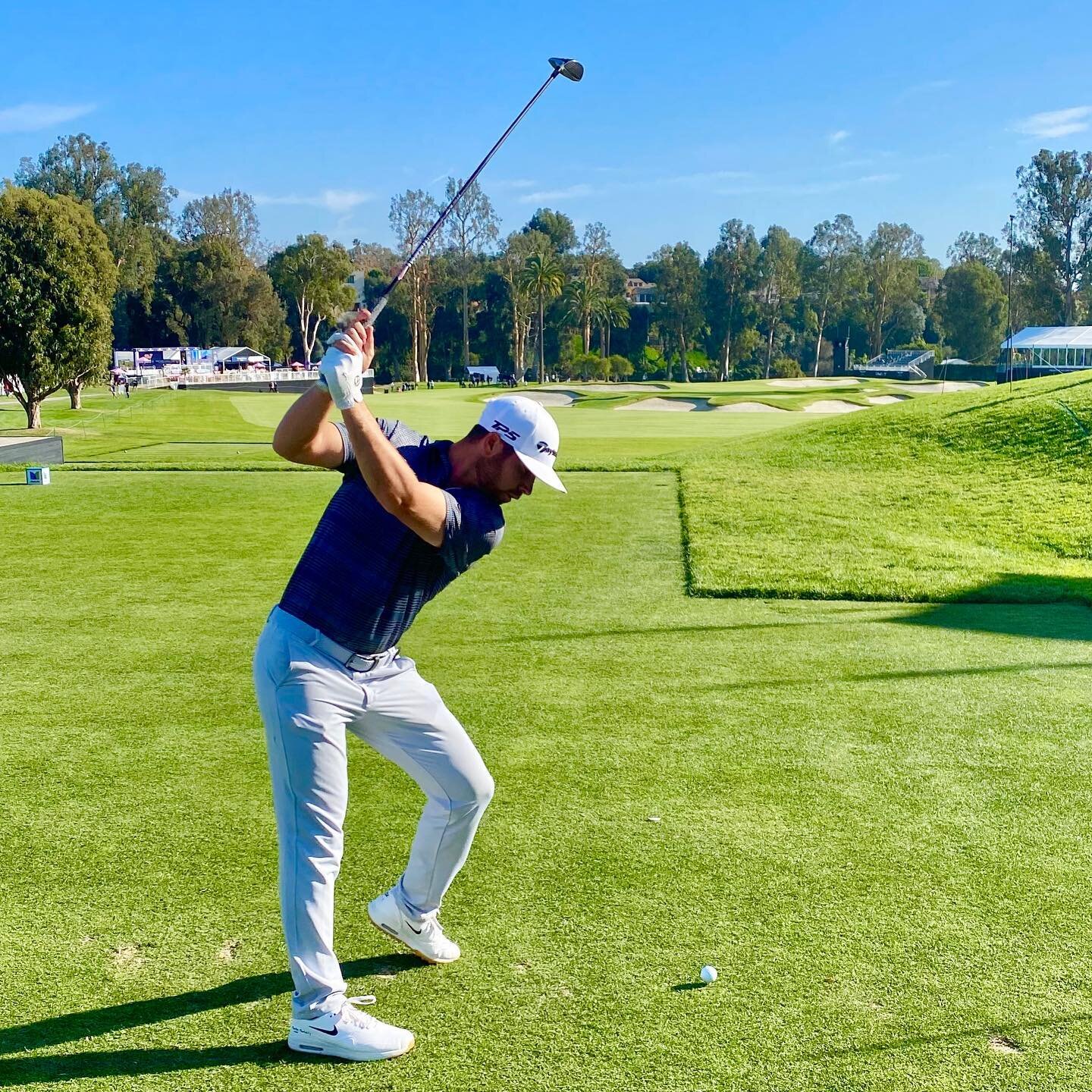
Phil Mickelson sprayed it around Riviera this weekend and has a 62-72 finish and second straight Northern Trust Open trophy to show for it.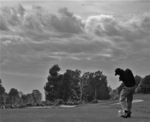 Phil Mickelson tees off on the 4th Sunday (click on image to enlarge)
You can look at his win two ways.
Behind door number one, you could say his ball striking is a mess and he was lucky to win. After all, how many times of you heard of a Hall-of-Famer hitting balls after a 62?
And behind door two, you could say that much like Tiger, Phil's a man among boys. He can be shaky with the ball striking, still post two over-par rounds, and go on to win a big time event on a course that exposes the slightest miscues.
I'm definitely voting for option two.
 Fred Couples approaches the 1st hole Sunday as fans and photographers look on (click to enlarge)A similar conclusion could be drawn about Fred Couples, only his problems were on the greens (well, until the shank on 18). He outdrove Phil and Andres Romero several times and his overall iron play was stellar. Not bad for a 49-year-old part-time golfer.
As for the media center reports, Doug Ferguson does a nice job encapsulating a bizarre final day.
John Bush at PGATour.com shares some pretty impressive "With This Win" deals, including this one which should give Phil slightly more satisfaction than the 500 FedEx Cup points he picked up:
The win moves the left-hander out of a tie with Vijay Singh and into solo possession of 13th place on the all-time wins list.
Freddie's record isn't too shabby either: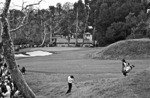 Andres Romero plays a remarkable recovery on No. 5. Note how far right he's lined up to compensate for the sidehill lie (click on image to enlarge)
Fred Couples, the 2009 United States Presidents Cup captain, made his 27th start at the Northern Trust Open a good one, finishing tied for third. His amazing record here includes wins in 1990 and 1992, as well as 25 made cuts, 19 top-25 finishes and 13 top-10 finishes.
 Mickelson on 14 (click on image to enlarge)Helen Ross wonders if in spite of the win, if this is really the confidence booster Phil had hoped for.
Ferguson also notes that Couples was playing with a heavy heart, making his play that much more impressive.
Jim Achenbach does a beautiful job explaining why Riviera is such a great spectator course.
This reminds me how much I detest modern courses that are virtually unwalkable because they sprawl from one housing segment to another. Sometimes the ride from green to tee is longer than the ride from tee to green. In my mind, there is a disconnect in this design scheme. One hole never seems to flow naturally into the next.
 One last Phil shot, the 9th tee shot (click to enlarge)Unless you are Walter Driver and Fred Ridley looking for validation of the change-courses-not-the-ball philosophy, don't read the rest of the column where Jim says that it's time for the governing bodies to start looking out for the Riviera's of the world, and then advocates...oh I can't even type it. And to think we could have bickered about this Jim!
Speaking of the ball going too long, I had heard from a marshal that Shigeki Maruyama was nailed in the back by an incoming range ball Saturday while he was in the 11th fairway...past the barranca. For those of you who don't know the course, this requires about a 330 yard carry. A reliable source says Shigeki is still awaiting a show of concern/acknowledgment of pulse from the culprit, the one and only J.B. Holmes.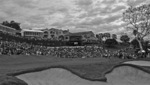 No. 18 continues to be one of the great stages in the game (click to enlarge)
That's all for now, but I have a few more NTO posts to mop up with this week. For now, hope you enjoy the black and white images and other iphoto distorted stuff. As someone who loves the old imagery of L.A. Opens past, I thought it'd be nice to see 2009 the way tournaments used to look. And besides, it was a B&W kinda day Sunday, don't you think?
Scott Duke Harris and Pete Carey offer more examples of corporations cutting back their involvement in golf for fear of giving the wrong impression.
And the Pebble Beach pro-am has indeed downsized this year, but probably not as much as your 401(k). Declines in corporate sponsorships and ticket sales are expected to bring the tournament's donations to charity down about 10 percent from a record $6.74 million in 2008.
"Given everything else going on, it's a little bit of a success story," said Ollie Nutt, president and chief executive of the Monterey Peninsula Foundation. The group uses the tournament's proceeds to support about 200 charities in the region that provide youth activities, education, nutrition and legal services for the needy.
The Pebble Beach classic has had a winning formula that allows Hollywood celebrities and capitalist chieftains to play alongside top pros. It has raised $73 million for charity since 1947, including $50 million since 2000.
But this year, several regular corporate sponsors bowed out; there are 18 skyboxes, compared with 20 last year, and about 11 hospitality tents, down from 15.
"Part of the issue is perception," said Nutt, suggesting that companies don't want to be seen lavishing perks while laying off workers. But the budget decisions, he noted, are genuine.
Peter Kostis raises a point I've been wondering about: why does golf have to be so ashamed of itself in this down time while other athletic pursuits seemingly go on with their usual antics and inflated budgets.
It's unfortunate that golf is somehow made to be the whipping boy for this economic malaise. Why not all the excessive, guaranteed contracts in baseball and basketball?
Unfortunately, the darkness has settled over fans and regular golfers too. I can't help but feel that we're in a time when people are almost afraid to be seen having fun. That somehow, with so much bad news on TV and negative sentiment out there, laughing and enjoying yourself has become almost politically incorrect.
Is there any way golf corrects this, besides hoping for a healthy Tiger to return and continue his historic run?
Brad Klein seems to be saying, forget about the way things were done, move on and deal with reality. Can't say I disagree with any of his "six dimensions to golf’s new business paradigm," though I do think that it's a bit early to completely reinvent the country club concept.
A few things jumped out in Jim Vernon's interview with Mike James of the L.A. Times.
First, the questions, which included topics that few golf publications ask about. And no, I don't believe it's due to some perceived fear that they might upset manufacturers and lose advertising. Instead, I just don't think they care a whole lot about this state of the game stuff.
Second, is it me or does Vernon seem more candid in this interview than any USGA president in recent memory?
Obviously it's refreshing and can only help the USGA, even if you don't agree with the outcome of their research.
Here's the breaking news, first revealed by Barack and Geithner at GolfDigest.com, but not confirmed by anyone at the USGA until now:
We have been looking on a research basis at high-lofted wedges, we've heard anecdotal evidence that they may have some of the same effects as the grooves did. That is, without any particular increase in skill, a player has a way of recovering around a green or over a bunker. At the same time, we hear some pros say it is really tough to hit a 64-degree wedge. We don't have a proposal on the table, but we are taking a look at it.
About the ball study and the study of rolled-back balls:
We also have our ball-research project. We are in the final stages of player testing with shorter-distance golf balls. The ball manufacturers have been very cooperative giving us good quality but shorter-distance golf balls so that we can test them with players of all abilities, from hacks like me to Tiger Woods and that level. If we ever decided that we had to roll the ball back or reduce distance, this is something we can then pull off the shelf and put into effect.
And I don't know if any USGA President has ever acknowledged that some venues might be dated after the recent distance climb, or that it's a negative in any way. No mea culpa on behalf of the USGA here, but a huge start to acknowledging where the distance race has left us when it comes to golf architecture:
There are two problems: Courses are getting built longer, which requires more maintenance, more chemicals, all of which is more expensive. The second effect is you have these established courses our there, the Merions, the Shinnecocks, the Rivieras, these great clubs, and since all those facilities feel they have to accommodate golfers of all abilities too, they have to start incurring great expenses, moving bunkers, moving tees. It's a huge amount of money spent by courses around the country to adapt to increased distances players are hitting the ball. It's certainly added to the expense of golf, and in the long term that may not be a good thing. Golf is an expensive sport. We're going to get more people playing golf if we can keep costs down, and we're going to be better citizens if we can keep whatever effects, use of water or whatever, at a lower level.
Q: Do you see at some point reducing the distance of the ball?A: We've seen a six-year period of stability on the PGA Tour. As long as that continues, I think it would take something pretty dramatic for us to take that big a step. On the other hand, if you were to see a shift in how far those tour pros are hitting it again, like the six or eight or 10 years before the last six, then I think you'd see a lot of pressure to do something, and rolling the ball back is one of the options.
Vernon also talks about the California Golf Tax proposal, golf in the Olympics and the potential of Riviera as a U.S. Open venue.
We found out that golf was specifically excluded from the Obama stimulus bill passed by the House Wednesday, but there is good news. There wasn't much infrastructure spending despite projections that far more is needed, meaning we'll probably see more debate about infrastructure.
Infrastructure — $43 billion for transportation projects, including $30 billion for highway and bridge construction and repair and $12 billion for mass transit, including $7.5 billion to buy transit equipment like buses; $31 billion to build and repair federal buildings and other public infrastructure; $19 billion in water projects; $10 billion in rail and mass transit projects.
Of course, as I outlined in Golf World, the game could definitely do a whole bunch with a tiny portion of the "water projects" money!
Thanks to reader Joel for this:
Congress has moved to prevent money from the proposed $825 billion stimulus package from being used for zoos, aquariums, golf courses, swimming pools and casinos, an effort to ensure the bill funds only what it calls the "highest quality" infrastructure projects.
"The purpose of this bill is to direct funding at projects that are primarily and clearly aimed at benefiting the economic conditions of communities and the public at large," the bill states. "The federal government and all other levels of government are directed to look with a skeptical eye at projects that don't meet that test."
CNN revealed last month that a list of "ready to go" stimulus projects endorsed by the U.S. Conference of Mayors included museum and zoo renovations, aquatic centers, skateboard parks and bike and horse paths. One of the zoo projects in the report is a $4.8 million polar bear exhibit at the Providence, Rhode Island, zoo.
The House Appropriations Committee added those restrictions last week after criticism from watchdog groups like the National Taxpayers Union, which monitors government spending.
"To the people supporting them, these proposals aren't a joke," said Pete Sepp, the group's vice president. "But to the taxpayers funding them, yes this will be a joke for them, only they won't be laughing."
The restrictions in the bill appear meant to address reports about some of the projects endorsed by the U.S. mayors, Sepp said.
Any followers of politics who know how to find out which fine politician drove the inclusion of this language in the bill? Or is it all done behind closed doors?
Obviously, my Golf World piece was not read by this fine guardian of American values! And clearly, Steve Mona, Bob Combs and the crew down in Florida working to educate our nation's capital have their work cut out for them.
 In Peter Dixon's look at the struggles of clubs in the UK, he that much of a club's standing still comes down to the quality of the course:
While there are still some high-end developments being planned, the future probably lies much farther down the scale. Williamson points to a development near Edinburgh where a farmer is adding a nine-hole course to an existing driving range and is encouraging families.
In 1997, the Henley Centre identified an emerging demand for what it called “fast golf, friendly golf, family golf”. This is just such a development. “I think traditional golf clubs have to move as far in that direction as they possibly can,” Williamson suggested. “Particularly in terms of relaxing dress code, welcoming families and so on.”
And as for the Royal Troons, Muirfields and Royal Birkdales of this world? They seem immune from the downturn, earning good income from visitors without having very many of them. The one thing missing from all their websites is an invitation to join the club. Now there's a surprise.
Geoff Shackelford is a Senior Writer for Golfweek magazine, a weekly contributor to Golf Channel's Morning

Copyright © 2022, Geoff Shackelford. All rights reserved.