"The obvious question is: What the hell has happened to American golf?"

There are a couple of good reads today about the continued decline of American performances at majors following the U.S. Open where Kevin Chappell and Robert Garrigus were the low Yanks (though it should be noted that Chappell, a former NCAA champion, playing his first U.S. Open finished T-3).
Read More

"If the goal with this new format is to grow the game of golf, why was there no talk of how to stage such an event at your own club?"

I enjoyed the many suggestions from readers who watched the Power Play Golf event at Celtic Manor, and also thought this observation from Stina Sternberg, reviewing the event for GolfDigest.com, should be noted by the television folks.

 If the goal with this new format is to grow the game of golf, why was there no talk of how to stage such an event at your own club? The UK commentators, mainly from SkySports, seemed like they were making things up as they went along and obviously weren't very familiar with the PowerPlay movement.

I think that was most evident when Ian Poulter hit an incredible drive next to the last hole to set up an eagle putt and the on course commentator acted like he'd hit a nice wedge in there, only to be rescued by the play-by-play man who noted what an amazing shot it was.

Jay Townsend, you of course were spectacular.

"Funny that 'Tee Forward' program suggests a professional play courses 7,700 to 7,900 long. Only one such course on PGA Tour - Cog Hill"

So here's something I can't reconcile with the announcement of the USGA-PGA of America "Play it Forward" campaign to play the proper tees to help make the game more fun and faster. 

There is no question too many golfers play the wrong tees. Men letting machismo get in the way are the most obvious candidates to play it forward, as are a surprising number of lower handicap female golfers.

Quite often, folks play too far back because they want to feel connected to golf at the elite level. After all, they buy the same clubs the pros use and on occasion, hit a drive they think is as long as the big boys and in general, buy into marketing that connects the everyday game with the professional. Shoot, we've all be guilty of it and there's nothing wrong with wanting to walk in the footsteps of elite players. Some of us even believe that keeping that connection is a good reason to restrict equipment for professionals.

So now we have the USGA telling us that 7,600 to 7,900 yards is the proper yardage for those big boys. Doug Ferguson noted what makes this so humorous:
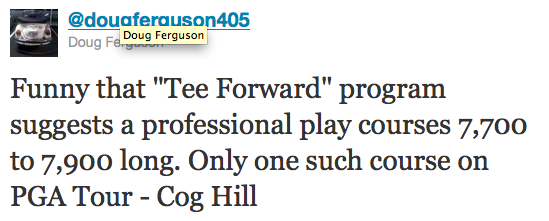
While the governing bodies are against bifurcation of the game via a tournament ball or a special rules for professional equipment (well, except grooves), the Play It Forward campaign acknowledges a massive divide between the PGA Tour professional and the amateur. So massive, that only one course on the PGA Tour qualifies as the appropriate yardage in the eyes of the PGA of America and USGA!


USGA Embracing Alternatives To Golf...Sort Of

John Paul Newport looks at the attempts to attract new players and retain longtime golfers through twists on the way most play golf. Interesting to see how the USGA is not resisting. Seems like a wise approach.

You might think that the USGA, as official keeper of the rules of golf, would be appalled at these newfangled notions. Not so. "Our job is to protect the traditional game as people know it," Mike Davis, the USGA's new executive director, told me. "But if people like Flogton come up with different kinds of games that relate to golf, we are fine with that." The scramble format commonly used in outings is not USGA-legal, he pointed out. Neither are gimmes or mulligans. But all are part of the fabric of golf as it is actually played.

Jack: Pitching 12-Hole Concept To Finchem

Joe Biddle reports on Jack Nicklaus' visit to "The Vinny" on Sunday, a charity fundraiser for Vince Gill.  Seems Jack was chatty about the game. Thanks to reader Jim for this.

“Since 2006, we’ve lost 20 percent of the women in the game and we’ve lost 20 percent of the juniors in the game,” Nicklaus said. “If you’re the CEO of a corporation and have those numbers, you say, ‘What do I do?’ The professional game is great. The showcase is great.

“But is the showcase bringing people into the game, or is it running them out of the game? It’s a good question.”

Jack feels the pro game is no longer relatable to the average man, woman and junior.

“Quite often, by local knowledge, he would beat me,” Nicklaus said. “You go to these courses today and play the club champion at 7,500 yards and you run in Phil Mickelson and there’s no chance in the world (the club champion) is going to beat them.

“I worry about that as it relates to what is happening in the game.”

Jack's now on the 12-hole kick.

Looking forward, Nicklaus believes cutting a round of golf to 12 holes would be more palatable for golfers who don’t want to make it a day-long process.

He tossed the idea past Finchem, who pooh-poohed it six or seven months ago. Finchem talked to Nicklaus at the Masters this year, and Nicklaus said Finchem is starting to consider the idea.

Now Jack just has to figure out how to make it Tim's idea!

At two of Nicklaus’ courses — Muirfield and the Bear’s Club — he had them make up 12-hole scorecards.

“My seniors are loving it,” he said. “The game is so difficult to start with. You take kids. They start basketball at a 6-foot hoop, 7-foot hoop, small ball, big ball.... All the sports work their selves up. In golf, you start with a set of clubs and a hard golf ball and it’s not easy.

“It’s the health of the game, the growth of the game, keeping people in the game, that I’m interested in.”

There's a video accompanying the story as well:

"I think golfers are more aware than ever that the game lost its way, and a correction is needed."

Jaime Diaz reports on the latest regarding Barney Adams' noble campaign to get people playing forward.

Adams posted his findings on the Internet (in the January Golf Digest, he advocated moving up a set of tees), and he received a positive response. But his persistence at lobbying for his idea was most meaningfully rewarded by American golf's powers that be. Beginning in late May, the USGA, the PGA of America and the GCSAA will begin a campaign -- with the tentative handle of Play It Forward -- to convince golfers to move up. It will start with television segments during the Senior PGA Championship, the U.S. Open and the U.S. Women's Open. Then the organizations will urge course operators across the nation to set aside two weeks beginning July 5 in which they ask customers to play from a shorter set of tees, following Adams' guidelines.

And will there be incentives in the form of reduced green fees? If not, I'm guessing this campaign won't register.

"That brings in shotmaking, even for an average player, and that's what really makes the game interesting." For all that, Adams doesn't believe scoring will be dramatically affected.

"Maybe a 13-handicap becomes a 10," he says. "That's where the USGA would have to really get involved, to make sure handicaps don't lose equitableness.

"This is about a change of habits, which is always hard," Adams says, "but I think golfers are more aware than ever that the game lost its way, and a correction is needed."

This is where I just don't get as excited about Adams' cause as some. He's absolutely right that people should play shorter courses but how can than happen when, contrary to what he says, people are using today's equipment to hit the ball longer? Courses were not lengthened because architects thought it would be fun for the average man, but in reaction to the demands of golfers, course owners and safety concerns. Reversing that trend will be tough. Still, it's certainly a campaign worth getting around because they are not advocating consumerism as the savior of golf.

Seve Wasn't A Fan Of Long Putter, Changing Courses Instead Of Ball

Thanks to reader Stan for Brian Viner's Seve tribute, that included a reminder of Seve's philosophy on long putters and technology.

"He approved of gamesmanship because it was a test of psychological strength. But he deplored players getting technological assistance. "I would ban the long putter," he told me. "Golf in my opinion was invented to reward the skill, ability and intelligence of the player. But when I see guys using that putter, on the short putts especially it looks like an incredible help. People who can't putt at all, all of a sudden they're making everything inside 20 feet."
 
I asked whether we shouldn't spare a thought for his friend Sam Torrance, whose career was extended by conversion to the broomhandle putter.
 
"That's a good question. But if the long putter did not exist, Sam couldn't have tried it. He would have continued to find another way. I would also change the loft on the sand wedge, from 60 degrees to maximum 54, so there is more feel involved. Some guys carry four wedges, I need only one. I would have only 12 clubs in the bag, not 14, to eliminate all those wedges. And I would change the size of the ball. It should be bigger, to stop distance. Great golf courses all over the world are being redesigned, because with new technology players hit so far. That is wrong because great courses, like St Andrews, are pieces of art. The ball should be changed, not the course."

“You know the easiest way to get the ball in the middle of the fairway? Walk down there and place it with your hand. Who are you kidding?”

While traveling today I got to spend a little time with the hard copy of the NY Times and inspected Dick Rugge's response to the Polara ball and other suggestions that the rules of golf are scaring golfers away. I like that he was both logical--we've seen greater advances in the last 15 years than ever before--and a wee bit sarcastic too.

“For the last 15 years, advances in conforming club and ball technologies have made it easier to play,” he said. “So we’ve already had a 15-year experiment on this make-it-easier logic. And what have been the results? Participation has not gone up. So we’re not going to dumb it down.

“You know the easiest way to get the ball in the middle of the fairway? Walk down there and place it with your hand. Who are you kidding?”

Day Two Of NY Times War On USGA: Polara Ball Makes Front Page!

Why this is front page news, I'm not sure, but Bill Pennington on the Polara ball.

It is physics, not magic, but there is, of course, a catch. The Polara ball has an irregular dimple pattern that means it does not conform to golf’s official rules. The ball, which is designed to reduce slices and hooks by 75 percent or more, would be illegal to use in the Masters, for example, or any other competition, local or otherwise, sanctioned by the United States Golf Association.

But as golf works to appeal to a younger generation that hits the links in cargo shorts and sandals and without a rulebook, does a nonconforming label still matter?

“It wouldn’t matter one bit to me,” said Fredric Martenson, 36, of Jersey City, who was also pounding balls into the night. Mr. Martenson, a beginning golfer with a wicked slice, also found the Polara ball went considerably straighter.

“I just want to go out and not spend the whole day looking for my ball,” he said.

And we know that's all been the ball's fault!

But many at the driving range here last week wanted nothing to do with the Polara ball.

“Part of the game is the challenge of hitting it straight,” said Charles Yoo, 33, of Edgewater.

The dialogue at the range mirrors a debate in the greater golf community. With the number of golf rounds declining in recent years, especially among beginners, what is the best way to draw new players to a difficult, intimidating, tradition-bound game? Can new technologies enhance the recruitment of players, even if some advances are outside rules in place for centuries?

Dave Felker, the former Callaway golf ball engineer and executive behind the Polara, said his product was meant to grow the game because it is not for the elite golfer.

“It’s for the other golfers, the ones who rarely hit it straight,” he said. “It’s for people who want to be embarrassed less, play faster and enjoy it more. I respect the U.S.G.A., they help identify the best golfers in the world, but what about the rest of us?”

After yesterday's Flogton story, might we see a USGA rebuttal to all of this?

The story also features an accompanying video piece.