In golf construction art and utility meet; both are absolutely vital; one is utterly ruined without the other. GEORGE THOMAS

It’s back!
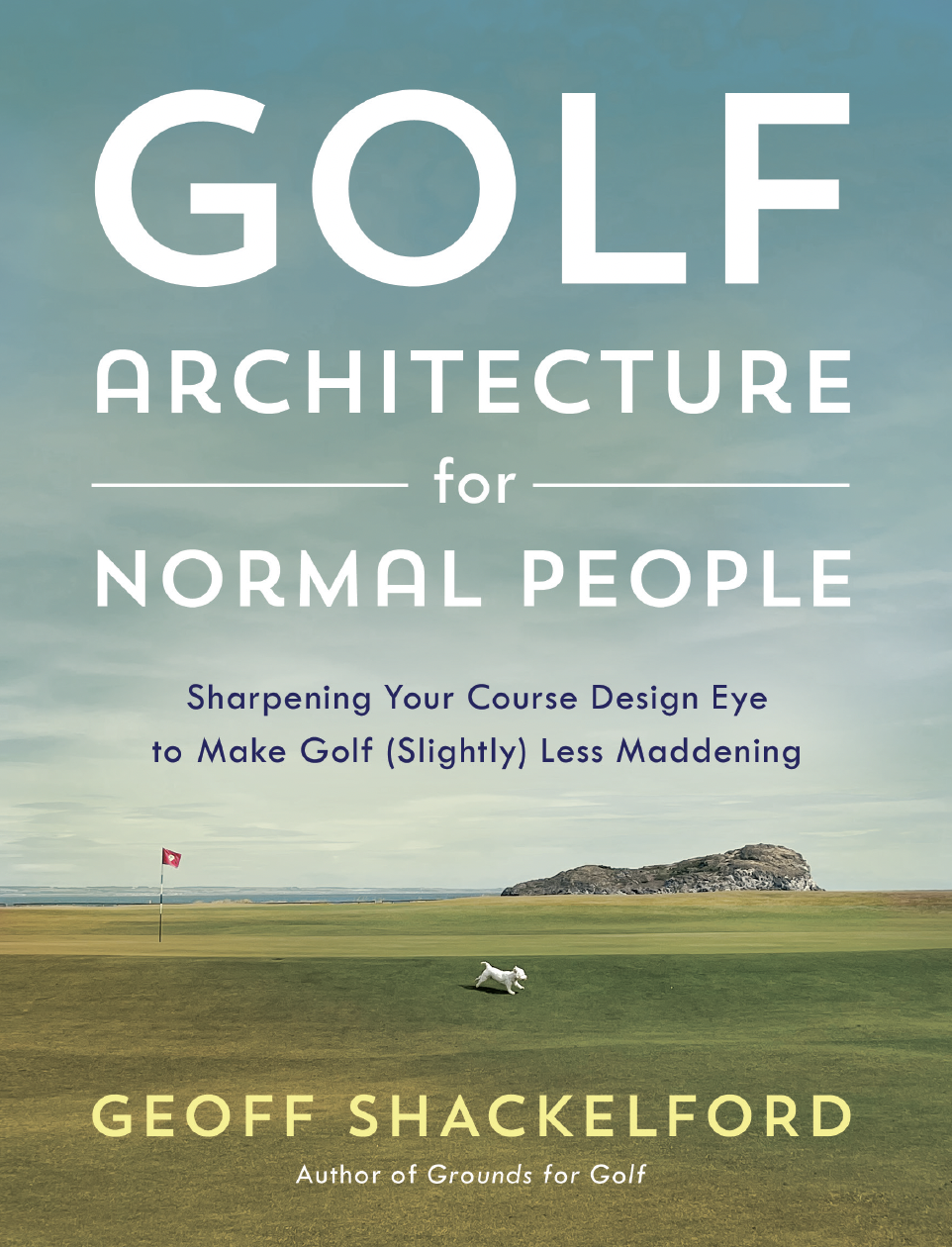
Twenty years later Tatra Press has kindly allowed me to bring back Grounds For Golf now that golf architecture is of more interest to the masses. A new Introduction looks at what’s driven the interest growth and two new chapters I had a blast adding (plus a few edits to keep things up-to-date).
The Amazon purchase page for the book arriving June 15, 2026.
More Love For The USGA's Lack Of Distance Oversight
/The USGA made the top of Alan Shipnuck's no-so-hot list with this week's trip to lengthy Erin Hills.
Read MoreLong Putter Shows Up In Obama's Vineyard Four-Ball!
/ The Note reports that some of the White House press corps on Martha's Vineyard felt the earthquake, but as usual the lede was buried. Check out that putter being used by the Presidential playing partner. I can't tell if he's bracing, but the Obama look of disdain says all I need to know about his stance on long putters. Thanks to reader Rob for this.
"I don’t think until they get to 8,000 or 8,100 yards or something that there’s going to be a long course.”
/ Sean Martin talked to players after day one at the gigantic Erin Hills and the scale failed to intimidate. At least, not 68-shooter Justin Thomas.
"Unless the ruling bodies want a fight even messier than the infamous Ping lawsuit, expect more long putters at the top of the game."
/That's Jaime Diaz writing about the long putter trend in this week's Golf World Monday. He says the "stigma" attached to using a long putter no longer exists, particularly with the younger set.
So knowing the governing bodies have more important things to act on like wedge lofts and paddle grips, how do we get that long putter stigma back?
Another Win For The Belly Putter, Jesus
/AP's Joedy McCreary details Webb Simpson's win at the Wyndham Championship, vaulting him up the FedExCup standings on the eve of the playoffs.
Read MoreThe $68 Million Golf Course Needs More Work
/Richard Riehl of the North County Times is skeptical that Greg Nash's The Crossings at Carlsbad is worthy of more investment to increase play--so says a city consultant--after $68 million was spent to build the first iteration!
Read MoreSankaty Head's Caddie Camp In Golf World
/ It's not posted online, but hopefully you non-subscribers have a dentist who gets Golf World, because Jeff Silverman's feature on Sankaty Head's caddie camp is a real eye opener on so many levels. I'd love to hear what others thought, but not only was it a super read with tremendous photography from the husband-wife team of Jensen Larson Photography who were there when fire broke out at the camp.
"What you’re talking about here is big money, a $24.5 million development on a site once occupied by the East and West courses."
/After Phil Mickelson's critique at last week's PGA, the Times-Picayune's Peter Finney suggests that a proposed $24.5 million redo of New Orleans' 36-hole City Park courses into an 18-hole, 7,200-yard championship layout by Rees Jones might not be the best approach.
Read More"Mickelson has a point."
/Bob Carney of Golf Digest supports Phil Mickelson's PGA rant about modern design and makes me wonder if it's time for long-needed change to Golf Digest's influential course ranking criteria. (Full disclosure, I've only been lobbying for this change for, oh, ever.)
Owners or club boards wanted to put their course on the map. Suddenly course and slope rating became the measure of greatness. We've heard people say, "It's got a slope rating of 155!" as if that were a good thing. Ask Pete Dye about it and he'll tell you that if you want to excite golfers about your course, you make it tough, and he's been told by developers to do just that.
But that's from the back tees, and Dye and most architects offer plenty of shorter options. Which is why, we think, the Tee it Forward initiative supported by the USGA and the PGA is so important. Based on Barney Adams contention that if the average golfer were playing "tour-equivalent" tees (based on their distance off the tee) most would be moving up a set.
The popularity of places such as Bandon Dunes, and of more "playable" architecture by the designers like Tom Doak and Ben Crenshaw (with partner Bill Coore), prove that not all of us are masochists. And those designs have done very well on rankings like Golf Digest's, that emphasize shot values over resistance to scoring.
Ah but maybe this would be the right time to drop "Resistance to Scoring" altogether? Or change the wording, call it Resistance To Fun, and deduct the points from the course's overall score?
Meanwhile in this week's Pond Scrum wrap up of the PGA, Huggan and Elling discuss Phil's "point" and conclude as I did that he needs to think through his attacks on certain styles of modern design.
Elling: I have very mixed feelings when hearing Mickelson belittle Jones. It's become rather catty to me. Phil is hugely pro-technology and went on a reasoned rant last year against another favorite target, Dick Rugge of the USGA, about rule changes designed to keep players from inhaling golf courses whole in a single breath. Mickelson fails to acknowledge that with players flying drives 300 yards in the air, changes to courses are a necessity. So while Jones and his ilk might not get it right every time, they have to add teeth to keep scores from becoming laughable. Keegan Bradley birdied two of the last three holes in regulation. Somebody managed to avoid the carnage.
Huggan: You are right. That is where Phil's argument breaks down. Of course, he is being well compensated for his support of turbo-charged balls and clubs. I suspect, deep down, he is just as hacked off as I am. After all, it would be to his advantage if shaping shots returned to the pro game. He is one of the best when it comes to that.
Phil: "This is a great example again of how modern architecture is killing the participation of the sport because the average guy just can't play it."
/Phil Mickelson, talking to writers after the round, made similar remarks to PGA Tour radio. Thankfully, he did not share these with Atlanta Athletic Club member and Member Hall of Fame member Jim Huber's face during his TNT interview!
Q. Talk about the golf course, different than what you played ten years ago?
PHIL MICKELSON: It's totally different. It's great for the PGA. It's terrific. It's in great shape. It's difficult. It's challenging. There's some really hard holes, and there's some birdie holes. And I think it's a great site for the PGA.
But....
But I also think if you look at the four par 3s here, it's a perfect example of how modern architecture is killing the game, because these holes are unplayable for the member. You have water in front and you have a bunker behind, and you give the player no Avenue to run a shot up, and the 7th hole, where there is not any water; there's a big bunker in front and right of the green, instead of helping the player get it on to the green, it goes down into the lower area, as does the left side.
Now, for us out here, it doesn't make a bit of difference, because we are going to fly the ball to the green either way. And that's why I say it's great for the championship.
But it's a good reason why the number of rounds are down on this golf course amongst the membership. And it's a good reason why, in my opinion, this is a great example again of how modern architecture is killing the participation of the sport because the average guy just can't play it.
And a follow up question from Tom, who must have missed the first part?
Q. Can you talk about your views on the golf course, the par 3s here?
PHIL MICKELSON: Well, Tom, I think this is a great site for the tournament, I really do. It's perfect, because there's some really hard holes and there's some really easy holes for birdies. And I think it's going to be exciting to watch. You're going to see a lot of calamity coming down the stretch and a lot of birdies early and late in the round -- early and middle of the round.
Did and again, it's a wonderful site. But the four holes, the four par 3s, are a wonderful example, and a number of others throughout the course; that is the reason why participation in the sport is going down, because of the modern architecture, that doesn't let the average guy play.
Now, we have no problem playing these holes, but when you put water in front and a bunker in back, and you give the player no vehicle to run a shot up, the member can't play and that's why membership participation on this golf course is down like 25 per cent.
And it's every course throughout -- modern architecture, there are some great ones, but the guy that redid this one, you know, it's great for the championship, but it's not great for the membership.
While I share Phil's view about modern designs like AAC and share his disdain for Rees Jones' no-reward design, it's still unreasonable to blame modern architecture for the game's problems. Modern designs like AAC are a response to the distance the ball is flying. Maybe not a great response, but a response nonetheless. You can't blame the folks for trying to respond, but when the situation is constantly in flux, you are bound to get it wrong.
And Phil is opposed to any kind of regulation of his equipment to keep courses relevant without changing them.
So complaining about such designs without also wanting something done to rein in distance advances is like complaining about credit default swaps, and then fighting any new laws to regulate them.
AAC Flashback: Remember When 500-Yard Par-4s Were Embarrassing
/Reading Brad Klein's raters notebook review of Atlanta Athletic Club's oft-renovated Highland Course, I was reminded of this from the last time the PGA was played there:
Read More“I think caddie day is such a part of the fabric of American golf."
/ That's former USGA Executive Director David Fay, as quoted in Paul Rogers' NY Times Monday golf piece on caddie day at Sleepy Hollow. Not only is a fun read because of the characters that the club's caddies appear to be, but also because it's a fundamental example of why caddy programs have died at so many courses: they do not value caddies the way they do at Sleepy Hollow.
Kudos to the club for having a program, letting their caddies play on Mondays and for letting the Times write about the program. And thanks to all the readers who sent in the link.
The club’s current membership includes several Rockefellers as well as the best-selling author James Patterson and the actor Bill Murray, who starred in the popular 1980 film “Caddyshack.”
On a recent caddie day, however, the faces and names of the golfers at Sleepy Hollow were decidedly different.
They included Kevin Ceconi, a tattooed former PGA Tour caddie who was playing in a fivesome on the club’s lower course, a short nine-hole loop that’s easier to walk than the championship upper course, once the home of a Senior PGA (now Champions) Tour stop. Ceconi, who steered Blaine McCallister to two victories and Ed Fiori to one on the regular tour, carried a cold can of Budweiser along with his clubs.
“Playing golf with your buddies,” Ceconi, 58, said when asked about the appeal of caddie day. “It ain’t about the golf. It’s about the beer and your buddies.”
7,400 Yard Firestone: Nine Drive And Pitch Holes!
/Nick Faldo Tweeted about his letter to the IGF Saturday but I found this much more revealing about what he's seeing this week at Firestone. Love the hashtag: