FL GOV: I Want More Golf Courses By "Well Named" Architects!
/Alex Miceli on Governor Rick Scott, sounding about as disconnected from reality as Tim Finchem weighing in on slow play,
Read More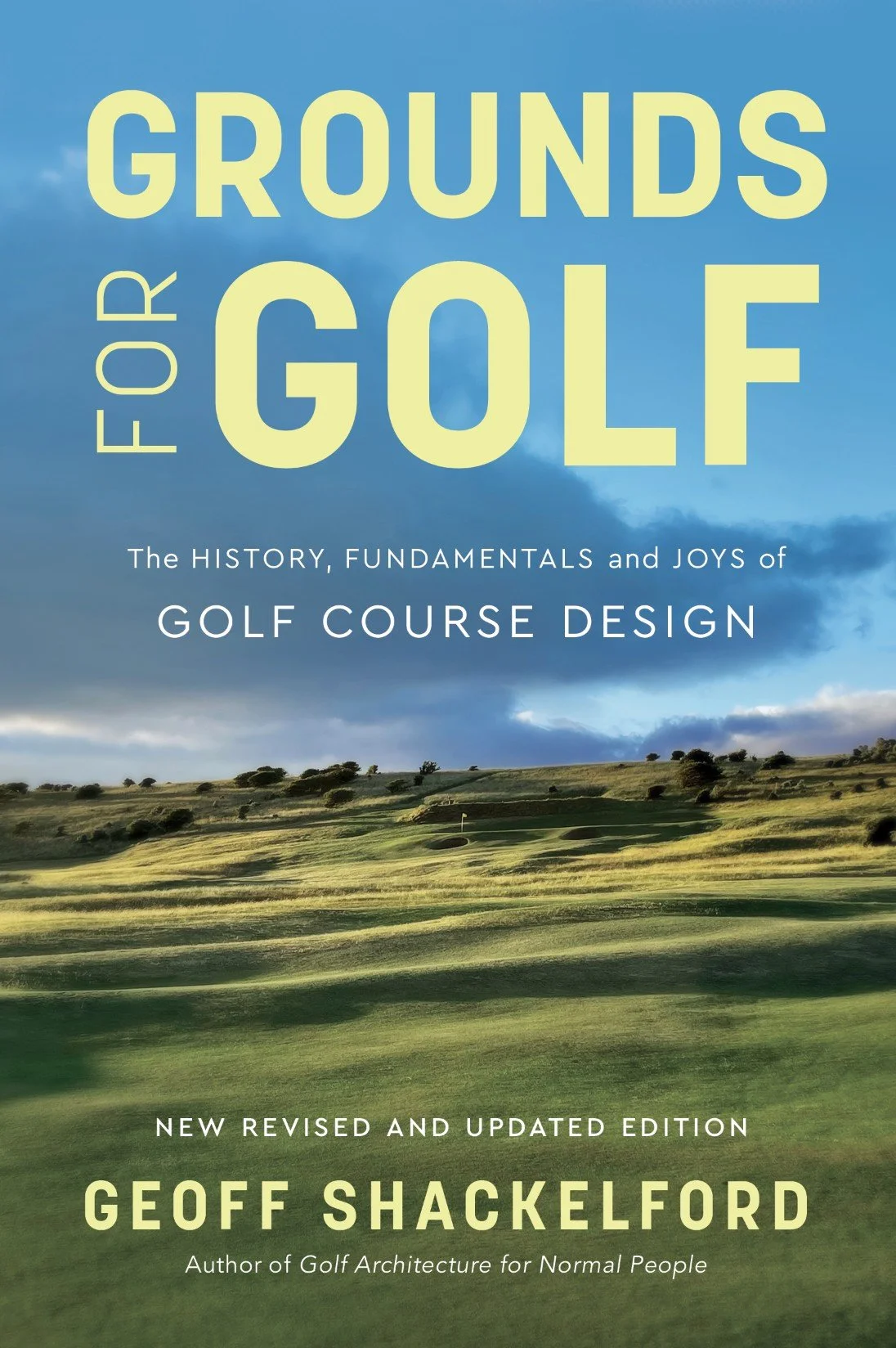
It’s back!
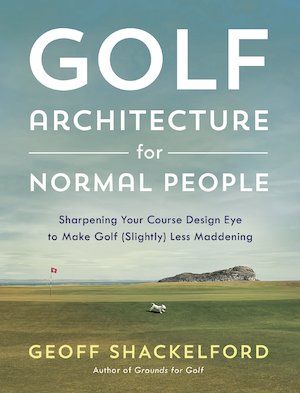
Twenty years later Tatra Press has kindly allowed me to bring back Grounds For Golf now that golf architecture is of more interest to the masses. A new Introduction looks at what’s driven the interest growth and two new chapters I had a blast adding (plus a few edits to keep things up-to-date).
The Amazon purchase page for the book arriving June 15, 2026.
Speaking in his native Michigan and contradicting himself sentence by sentence, pro-technology instructor and course designer Rick Smith is all over the map.
“I love new technology,” Smith said. “So the ball is hot.
That's right, so what if it's juiced!
You look at the PGA Tour pros and they still hit it all over the place.
Oh, well, if you want to put it like that, okay...
I think we need to preserve tradition, and I think the driver and ball are maxed out (per USGA limits).
So if it's maxed out, then why not reel things in a tad for "tradition" purposes of using classic courses and having players play a game we can relate to?
So if technology helps people play the game, I don't see anything wrong with that.”
Now that is some good stuff! It helps people. The pros hit it all over the place. The ball is hot. We should preserve tradition and the distance is maxed out. Now that's "all over the place."
 With the opening of Bandon's par-3 course, Chris Santella posts a NY Times item on the history and possible resurgence of par-3 courses.
But although the image of par-3 courses is decidedly downscale, they need not be ugly or unchallenging. The par-3 course at Augusta National Golf Club has holes that replicate some of the greens and approach shots of the famed site of the Masters. The par-3 tournament held the day before the Masters has been televised in recent years, helping to elevate the status of par-3 golf, Whitten said. There is also a par-3 course at San Francisco’s Olympic Club, where the United States Open will be held in June.
Doug Ferguson files many third round Wells Fargo Championship notes including this one on the trim and more athletic looking Rory McIlroy, who has been intensely working the weights and it shows.
McIlroy hit an incredible drive on the par-4 16th, blistering one 377 yards down the right side of the fairway, leaving him with only 102 yards to the hole. But he finished with a bogey after three-putting from 15 feet.
McIlroy attributes his newfound strength to an intense weight program.
''I don't think I hit it any longer, I just don't need to try and hit it,'' McIlroy said. ''So when I hit it, it just goes. I don't have to go after it quite as much.''
 Thanks to reader Jim for Greg Hansen's morbidly depressing story about the state of golf and our economy in Tucson, where the golf courses are literally ghost towns. Tucson Parks and Recreation Director Fred Gray says the numbers don't lie.
Gray tells the commission that 299,583 rounds of golf were played on the city's five courses in 2001. A decade later, 2011, that total was 193,166. It is a staggering decline that reflects national golf numbers and, of course, the nation's struggling economy.
Gray and Hayes have chopped the equivalent of 81 full-time jobs from the golf payroll over the last year, from 145 to 64. That's 176,280 reduced man-hours off the books.
"We've cut about as much as we can cut," Gray says. He acknowledges that the courses will not be mowed as precisely or as often. If you desire golf instruction, you must now work through an outside contractor, not a Tucson City Golf pro. If you buy a beer from the cart lady, her paycheck is coming from an outside firm contracted to sell you that beer.
This is golf in Tucson, golf in America, 2012. If the industry worked like TV ratings, the whole sport would've been canceled.
These are the numbers that stop the audit commission and raise a collective eyebrow: In 2011, Tucson City Golf had operating revenues of $7,015,000 and operating expenses of $8,275,000.
 Jim Schoettler reports on the latest slow-play-induced course violence, this time on the 18th green at Jacksonville Beach Municipal Golf Course in Florida. If they make a movie out of this one, I like J.K. Simmons for the old guy who flips out. (Thanks to reader Jon for this.)
Police arrested a 61-year-old Jacksonville man and charged him with slamming his golf cart into a group of bachelor partygoers and then whacking one with his golf club, leading to a brawl ended by other stunned golfers and police.
"It was some guy who must have been having a bad day," said Murdock Hampe, 27, who suffered a badly swollen leg when hit by the golf cart and a long knot when a golf club was broken over his head.
James Alonzo Hines of the 11500 block of Young Road was charged with aggravated battery with a deadly weapon, an arrest report said. Hines, who a witness said was bloodied in the brawl, was jailed and later released. No other arrests occurred.
And...
Hampe said he was sitting in a golf cart when shouting erupted between the two groups from a distance. He said Hines then began hitting golf balls at them from about 200 yards away.
That always helps speed people up.
Here's where it becomes apparent this joined the other slow play violence of late (here and here)...
Hampe said at one point Hines shouted he was a veteran of the course and complained about the group of younger golfers taking too long.
"The first thing he said was, 'You need to respect your elders,'" Hampe said. "We said, 'That's no way to conduct yourself in public.'"
Salsbery said he and his buddies had no choice but to subdue Hines.
"We all just went there thinking it was going to be a cool, chilled day and right at the end it got crazy," said Salsbery, 26. "I didn't know golf was a contact sport."
Ravel, 23, called the attack ridiculous.
"If the older group had just held their frustrations in for another five minutes, the whole round would have been over," Ravel said.
Bill Pennington follows up on his story from last year about Polara's non-conforming ball and in his latest story reports that sales have been solid for the dreaded pill that could finally convince manufacturers that there is a market for non-conforming equipment.
About 70 percent of these same driving range golfers also said they would not use the ball. Summoning a kind of hacker moral code, they said it was against the rules. Interestingly, nearly every golfer wanted a handful of the balls anyway. As one duffer said: “Just to test out.”
Since then, the Polara golf ball has generated close to $3 million in sales, which represents more than 1.2 million nonconforming golf balls in the market. The Polara, which had modest beginnings, now is available in about 750 stores nationwide as well as online at Polaragolf.com.
 Edwin Watts carries the ball in 60 of their 86 stores
Steve Claude, an Edwin Watts purchasing agent who participated in the decision to place Polara balls next to the displays of traditional, established golf balls, said the Polara ball was the only nonconforming item sold in the chain. But he said the company hoped more nonconforming equipment found its way into mainstream golf.
“Anything that gets more people playing,” Claude said. “We need to welcome everybody and grow the game. If that gets people out there, then I’m not worried about what they’re using. If they learn to love the game, in time they’ll want to try other kinds of equipment, too.”
Of course, USGA and R&A rules do not forbid anyone from making or selling non-conforming equipment.
Geoff Shackelford is a Senior Writer for Golfweek magazine, a weekly contributor to Golf Channel's Morning

Copyright © 2022, Geoff Shackelford. All rights reserved.