Record Scoring, Parity To The Extreme At U.S. Amateur
/Ron Balicki's
Read More
It’s back!
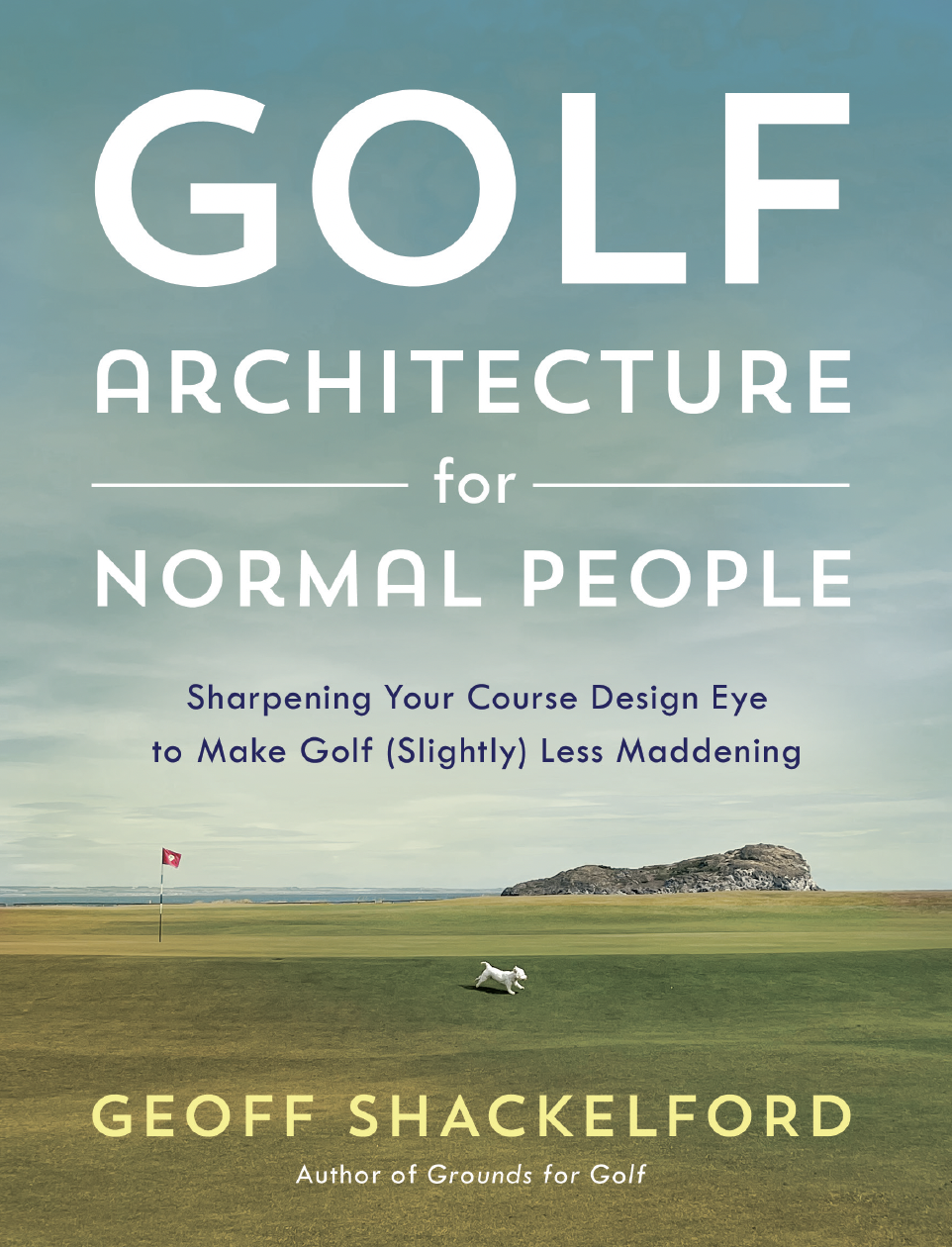
Twenty years later Tatra Press has kindly allowed me to bring back Grounds For Golf now that golf architecture is of more interest to the masses. A new Introduction looks at what’s driven the interest growth and two new chapters I had a blast adding (plus a few edits to keep things up-to-date).
The Amazon purchase page for the book arriving June 15, 2026.
Just when I was feeling so good about the trajectory of banning anchoring, Webb Simpson had to go and inject these thoughts into the skill/rulemaking debate.
First though, Hank Gola shares Graeme McDowell's discussions with the USGA's Mike Davis and his counter position on anchoring a long putter.
"They feel like their research has shown that putting under pressure down the stretch on the back nine on Sunday, when you can anchor the putter to a part of your body . . . that just takes one extraneous movement out of the putting stroke," he said. "It's just kind of a physical fact that if you can just take one element of movement and motion out of the stroke that holing putts will become easier.
And here's Simpson's comment that certainly makes sense.
"Do I think they should be banned? No, and here's why," he said. "You take a wooden driver compared to a 460 cc's titanium, and to me that's a lot bigger difference than a 35 inch putter to a 45 inch putter. Also last year, the strokes game putting, nobody in the top 20 used a belly putter or a long putter. If anybody says it's an advantage, I think you've got to look at the stats and the facts."
There goes any potential run as a USGA poster child!
The story also includes comments from Keegan Bradley, who is concerned that taking away long putters could cost the manufacturers "millions" of dollars.
"To me, to change something that big and to cost manufacturers millions of dollars, you've got to have some pretty good facts," he said. "I think just because some of us are winning majors or winning tournaments with the belly putter, I don't think that's a good reason to say, 'hey, we're going to take them away. That's my real take."
 Ewan Murray reports Rory McIlroy's comments on the eve of Glory's Visit To Kiawah:
McIlroy, whose honesty in public is one of his most endearing qualities, said: "I'm just happy to be part of that group of 16. I think the reason it is like this, fields are much deeper. Partly because the guys have just got better and have worked hard; they are putting more into the game physically, mentally, practice, technical, everything.
"But I think one of the big things is the technology. I think 25 years ago you had the really good players that could play with basically anything and nowadays the technology lets maybe some of the lesser players catch up with the better players. And I think that's why you see so many more guys winning these days."
The comments pick up where Ernie Els left off a few weeks ago. It might also be a nice time to read the Joint Statement of Principles, where the skill component is key to action by the governing bodies. At least, according to the Statement:
While generally welcoming this progress, the R&A and the USGA will remain vigilant when considering equipment Rules. The purpose of the Rules is to protect golf's best traditions, to prevent an over-reliance on technological advances rather than skill, and to ensure that skill is the dominant element of success throughout the game.
Interesting take from the always provocative Brandel Chamblee on parity in today's game.
We finally see a firm golf course on the PGA Tour with the ball running, drivers not taken away from the players, and the average...was 313.8 yards.
Of course, Mike Stachura, as he can always be counted on, tells us why this is nothing to worry about, it's too soon to say, it's...ah you know the usual denial tactics!
Technically he's right, the damage was done long ago when the governing bodies were outsmarted and now we're stuck with hundreds of 7,000-yard plus courses no one wants to play, own or maintain.
Due to technical issues I wasn't able to join Rod Morri and Lorne for this Canadian Open week episode that covers Moe Norman, the state of the game and Lorne's retirement from the Globe and Mail.
Give it a listen here or via iTunes where you can also listen to all previous episodes.
The R&A's Jim McArthur yesterday. Well worth reading again:
I have to say to you, we are intent on doing what we can to improve the pace of play in golf. I mean, I think we feel that particularly maybe not so much at professional golf but certainly amateur golf that slow play is, in some ways, if not killing the game, is killing the club membership because of the time it takes to play. And whatever we can do in our events, and bear in mind that we are not seeing the players week in, week out. We see them two or three times a year, professionals once a year, amateurs two or three times a year, we're doing whatever we feel we can in the circumstances to contribute to improving the pace of play.
But it needs to be a concerted effort, not just the R&A, not just the Tours, but the golf unions and other golf organisations to, I think, come to a coordinated effort to improve the speed.
And I think we should ‑‑ personally I think we should be aiming in club amateur golf for three and a half hours maximum for a threeball, perhaps elite amateur four hours. These should be maximum times, and we should be trying to improve these at all times.
Tim Finchem in May at The Players, talking about how the PGA Tour is a different beast than the everyday game:
Anything we can do from‑‑ we reach all of the fans. Anything we can do from a communications standpoint to encourage people playing faster, we will do. But clubs have got to take the initiative to drive play, and the average player has got to take the initiative and say, guys, let's go out here and play in three hours and 45 minutes, and that doesn't happen too many places.
So if I'm watching‑‑ I'm giving you a long answer, but I've been talking about this for a long time. If I'm watching a PGA TOUR player, and I'm going to go through the same pre‑shot routine that that player takes, and he's hitting it 69 times and I'm hitting it 93, I'm going to be playing a lot longer than that guy. So it's a different game from that perspective.
At least one of the Five Families talks a good game.
Gary Player files a lovely Observer remembrance of his win at Lytham, though it is short on details about nearly losing his ball on 18--that is peppered with anecdotes and tips on playing the course.
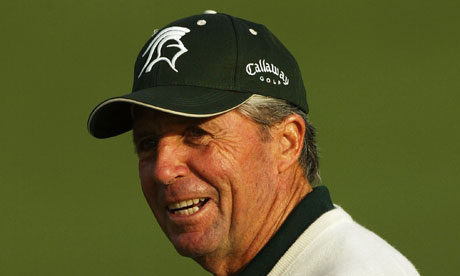 Included is this nice little sidetrack of a rant.
They have made deeper and more riveted bunkers on the 2nd and other holes at Lytham, although the fact they have to do that concerns me on a wider scale. Lytham is hosting the greatest golf tournament on earth and they have to change the golf course.
It is happening everywhere, at the cost of hundreds of millions of pounds. And why? All that needs to happen is that the ball needs to be slowed down in the professional game. They shouldn't have to make changes to these great golf courses; money wasted on that should be spent on youth, the trustees of prosperity.
Geoff Shackelford is a Senior Writer for Golfweek magazine, a weekly contributor to Golf Channel's Morning






Copyright © 2022, Geoff Shackelford. All rights reserved.