
WSJ: Golf's "Ugly Season"
/Besides dismal ratings, the ubiquitous nature of over-saturated pro golf
Read More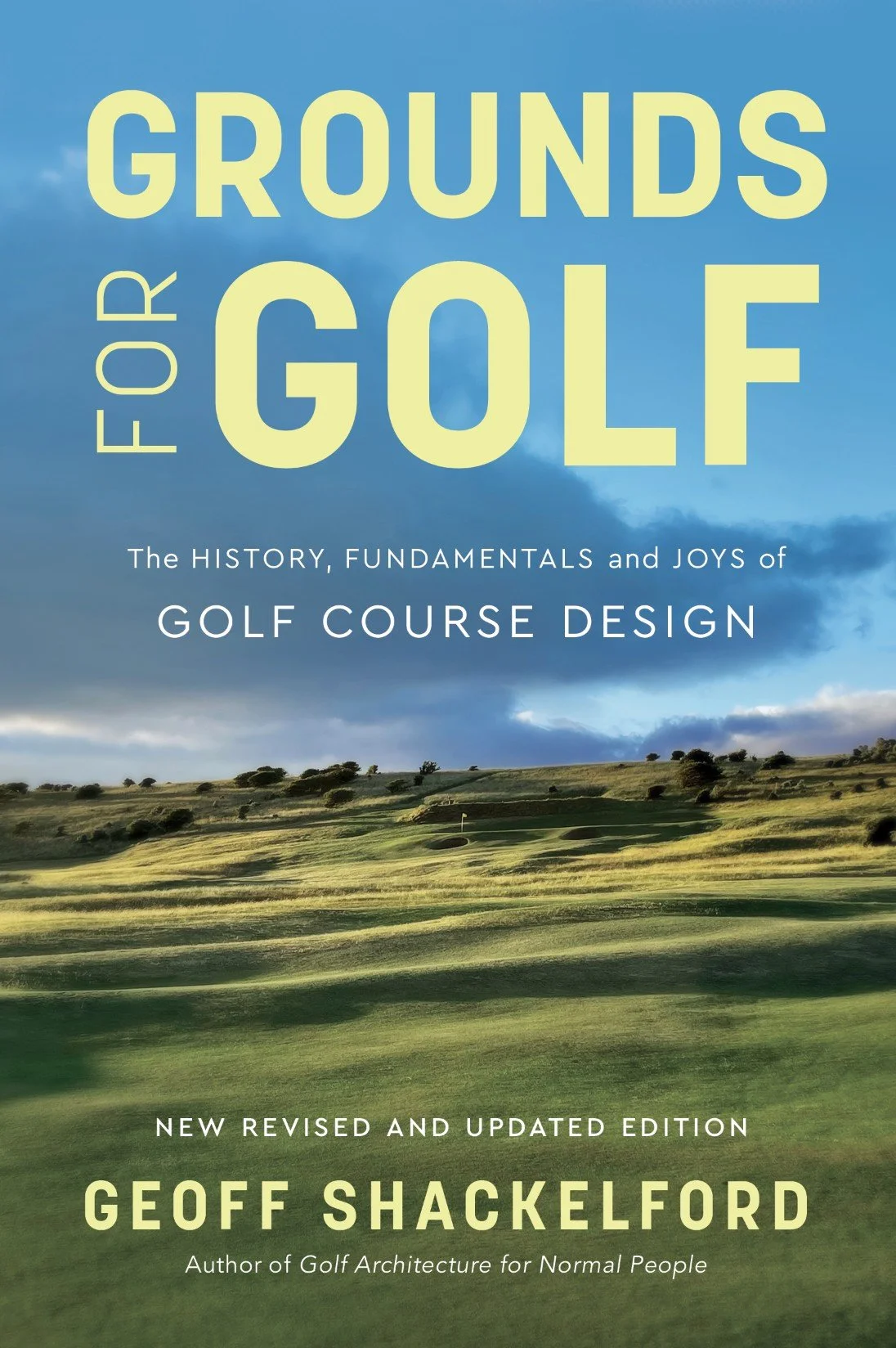
It’s back!
Twenty years later Tatra Press has kindly allowed me to bring back Grounds For Golf now that golf architecture is of more interest to the masses. A new Introduction looks at what’s driven the interest growth and two new chapters I had a blast adding (plus a few edits to keep things up-to-date).
The Amazon purchase page for the book arriving June 15, 2026.

The inevitable re-interpretation of the amazing ShotLink treasure trove is about to start becoming a major topic in the game as Tim Rosaforte recently noted.
Jason Sobel delves into Mark Broadie's view on golf stats and mentions Broadie's upcoming book, “Every Shot Counts.” His message: "Long game is more important than short game."
“When I compare the top players on the PGA Tour, I find that the long game contributes about two-thirds to their success while the short game and putting contributes about one-third,” Broadie said. “Initially I was surprised, so I analyzed the data in different ways and found that all roads led to the same conclusion.”
For example, in any given year if you looked at the scoring average of the top 10 on the money list compared with those ranking 116-125, the scoring average differential would be about two strokes. Based on Broadie’s comparative analysis, about 1.4 of those strokes gained would come from the long game, while only 0.6 would be attributable to short game and putting.
Larry Dorman also takes a look at Broadie's book and offers a similarly positive review, though he focuses on several different elements, including this about Tiger's putting prowess getting too much love:
As the author points out, “applying math to settled wisdom,” putting accounted for an average of 28 percent of the strokes Woods gained in his 24 victories.
“This is significantly less than the winners overall average of 35 percent,” Broadie writes. “In his victories, Tiger gained 1.14 putts per round on the field, but he gained 2.94 strokes per round with his tee-to-green play.”
Bryce Mereness of the St. Joseph News-Press looks at Tom Watson's proposed kids course design in Maryville, Missouri, inspired by local Dr. Bruce Twaddle who clearly made a visit to North Berwick. Fundraising for the $550k course attached to a First Tee is underway:
“That’s the whole idea for this, to make it fun for them and not too long, where they can hit a shot and get rewarded for it.”
The proposed new nine-hole course at Mozingo Lake could become reality by the spring of 2015.
The project came after Dr. Bruce Twaddle, a local dentist, took a trip to Scotland before the 2011 British Open. His caddy pointed out a group of young kids playing on a shorter course.
From there, Dr. Twaddle worked to secure funding for the project, similar to many others sprouting up across the country as a response to the declining number of youths participating in the sport.
“They had a sign there that said, ‘No adults allowed unless under the direct supervision of a child,’” Dr. Twaddle said. “That’s when the light went off. Everyone I related that story to, it made sense."
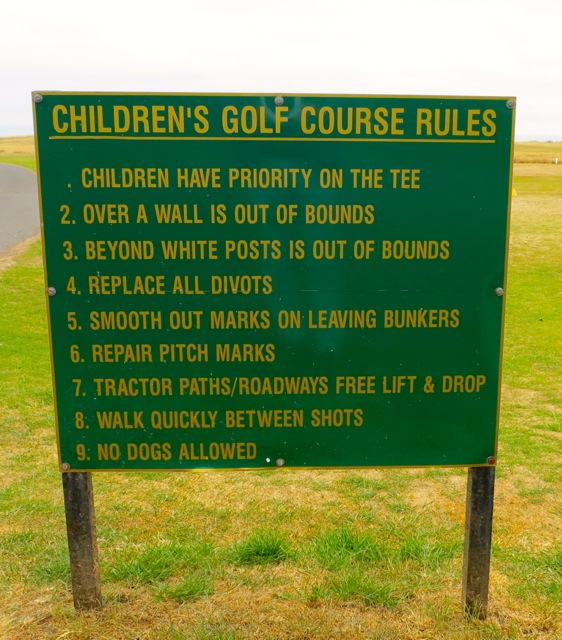
The sign(s) in question:

Judy Rankin is a 26-time winner on the LPGA Tour, a member of the World Golf Hall of Fame as a player, and if there was ever a golf broadcasting wing, she'd be inducted again for her eloquence, class and succinct appraisals that set the standard for on-course reporting.
Judy kindly spent more than hour with the State of the Game podcast to talk about her career, the LPGA Tour, golf broadcasting and of course, the state of the game.
You can listen via MP3 here. Or to past shows the same where via this page. And the iTunes option for all past shows, or this week's episode to listen/subscribe.
**And while we're in podcast mode, here's my chat with Josh LaBell and Adam Fonseca on the Dimplehead golfer podcast about the Presidents Cup.
It's been a longtime coming, but the Moneyball mentality has finally come to golf, reports Tim Rosaforte in this week's Golf World. Most notably, Brandt Snedeker and Zach Johnson are attributing some of their recent success to more numbers crunching by outside sources, and it's not all ShotLink stats helping the players prepare. Snedeker won't reveal much other than the role Mark Horton has played.
"The lines [between a good and great season] are so thin, so I'm trying to find any edge I can get," Snedeker said. "Mark's done a great job for me of understanding who I am as a golfer. We, as professional golfers, have a tendency of thinking we're strong in particular areas, and that may not be the case at all. He does a great job of identifying what I need to work on, what my strengths are so I play to those, and what my weaknesses are, so I can play away from them."
At East Lake a year ago, Horton worked his computer in the clubhouse, and Snedeker executed a game plan that resulted in a sweep of the final playoff event and the FedEx Cup title for an $11.44 million payday. At the end of the year, Snedeker said Horton was the difference for him in jumping from 38th to ninth on the World Ranking.
Johnson was less secretive about his work with Peter Sanders, whose Shot By Shot website is part of the numbers crunching process.
Sanders, who works out of his house in Connecticut, contends that ShotLink stats are "myopic" and "one-dimensional answers to multi-dimensional questions." The blunt comments point to the theory that identifying tangible areas of improvement that can truly help improve scoring comes from a more focused exploration of the data.
Ryan Lavner sums up the AJGA announcement on Morning Drive to tout their 4 hours, 17 minute 2013 pace of play average.
According to AJGA Executive Director Stephen Hamblin, that was six minutes faster than last year and much of the improvement could be attributed to the system of first player holing out heading to the next tee.
At the AJGA level, the tournament committee designates six holes for timing checkpoints, where volunteers are stationed to record both the threesomes’ gap time relative to the group ahead and to the overall time par for the course. In recent years, this system has been duplicated at the college level.
The AJGA said its quickest tournament was the Kansas Junior at Buffalo Dunes, where the average pace of play was 3 hours, 50 minutes. The fastest round of the year was 3 hours, 23 minutes, while the low round of the year played in less than four hours was Wes Artac’s 10-under 62 at the Genesis Shootout.
The interview:
Lots of interesting stuff in a National Golf Foundation survey probing deeper on the question of nine is fine, a big push by Golf Digest with some support from the litany of for-profit non-profits who gather regularly and sign off on pretty ad campaigns.
 Besides the number of people who seem to think there is a stigma attached to 9-holes, the haunting number for golf has to be the majority that cites time and cost as the ultimate issue.
We found that just over half of golfers (54%) report that time constraints negatively impact their frequency of play. Coincidentally, 54% of golfers also reported that money constraints negatively impact frequency of play. When measured together, 72% of golfers play less frequently due to time constraints, money constraints, or both.Only 28% of golfers tell us their frequency of play is not affected very much by either.
We asked the 27% of golfers who don’t play 9-hole rounds why they do not. Most mentioned that they just prefer playing 18-hole rounds. Many simply see golf as an 18-hole game, and that 9holes just isn’t enough.
Geoff Shackelford is a Senior Writer for Golfweek magazine, a weekly contributor to Golf Channel's Morning








Copyright © 2022, Geoff Shackelford. All rights reserved.

