In golf construction art and utility meet; both are absolutely vital; one is utterly ruined without the other. GEORGE THOMAS
It’s back!
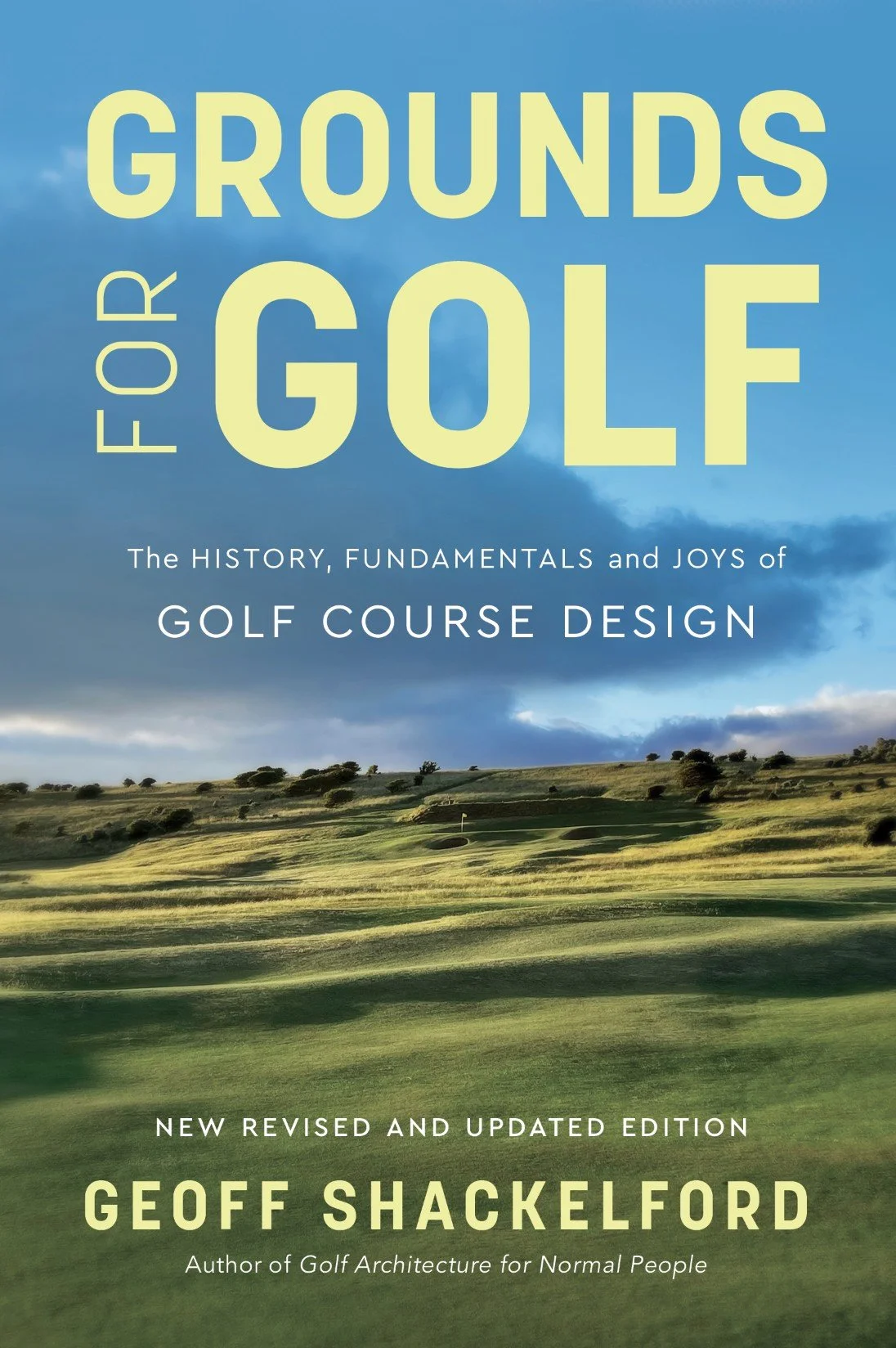
Twenty years later Tatra Press has kindly allowed me to bring back Grounds For Golf now that golf architecture is of more interest to the masses. A new Introduction looks at what’s driven the interest growth and two new chapters I had a blast adding (plus a few edits to keep things up-to-date).
Words I never thought I'd type. But a reader who is also a litigation attorney has seen some of the discussion about Team Tiger never having secured a non-disclosure agreement with instructor and author Hank Haney, and offered this in an email explanation:
In light of Hank Haney’s recent comments regarding the absence of a non-disclosure agreement, it is my insight that any purported non-disclosure agreement that attempted to cover this book would be overbroad and unenforceable. As such, the absence of a non-disclosure agreement is really a straw man argument.
As a litigation attorney, I come across many NDA’s and confidentiality agreements in my practice. Generally, NDA’s cover “confidential information,” which covers data or information proprietary to the non-disclosing party. “Proprietary” is simply another term for ownership. As Haney claims that these are his memories, he would have a factual basis to argue these stories were not proprietary to Tiger and he is free to write about it. So even if an NDA was in place, Haney could find a way around it.
To come up with an agreement that forbade Haney to ever talk about anything said between him and Tiger would be truly overbroad. I would never recommend a client to sign such documents, unless it is within the context of litigation and the agreement is to resolve a lawsuit. Additionally, no golf instructor like that would ever sign such agreement, as it would hinder their abilities to market themselves.
“(Hank) Haney admits he never had in-depth, personal discussions with Tiger. This self-serving book is full of guesses and false assumptions,” Steinberg said in an emailed statement.
“Most don't merit a response, but his stories about Tiger's injuries are simply not true. Tiger's injuries, and how they occurred, were exactly as described at the time they happened. Despite repeated claims that this is a golf book, it’s not.”
So just to recap, Haney claims Tiger injured himself pursuing his passion for SEAL training. Not the diversion I would choose for a pro-athlete, but the great ones are all a little bit different. I can safely say from what I've read so far, this is not the worst revelation in the book. Unless of course you're Steiny trying to negotiate a new endorsement deal and companies keep asking for SEAL-related injury clauses.
That said, it's not as if Haney is out suggesting Tiger's body was somehow damaged by Dr. Anthony Galea's, uh, cutting edge therapy methods. Nor is Haney even bringing up the sheer stupidity of associating with Dr. Spaceman. So in that sense Steiny, it could be a lot, lot worse.
His ball safely over the water, Tiger Woods walked toward the 18th green Sunday as he had done over the last 30 months on the PGA Tour, with one big difference.
They exchanged a high-five of such ferocity that it could have registered on a spring training radar gun. Woods barked something that the TV microphones didn't quite pick up. Just as well.
"He said, 'F-yeah,'" laughed LaCava.
Music to many ears.
Just like that, Woods was back atop the firmament, rough edges and all, and taking aim on Augusta National and the assortment of players who have been piling up wins while he was reconstituting and reclaiming his personal and private lives.
After winning his record seventh Arnold Palmer Invitational on Sunday at wind-whipped, baked-out Bay Hill, Woods said he'd go back to work this week before heading to Augusta National for the Masters in April.
"I still need some work, and it's going to be good to get a week off and work on a few things," Woods said after earning his 72nd PGA Tour win, third on the all-time list. "I enjoyed the progression we made this week. Each day there was a little bit of fine-tuning here and there, and we were able to make those adjustments, which was good, and especially with the conditions getting more difficult on the weekend. I was able to hit some really good shots the last two days, and that's a very good sign going into Augusta. I understand how to play Augusta National, and it's just a matter of executing the game plan."
All the while, he had to hear the support from the gallery, which was jam-packed and primed to witness Woods' return to winning ways.
"Welcome back, Tiger!"
"Trophy time!"
"It's a new day!"
"Bring it home!"
By the time fans were allowed to funnel in behind Woods and McDowell as they played the 18th, it would have taken a monumental blunder to blow it, although Woods kept his head down and his emotions in check until he knocked the final approach over the water and onto the green.
The guy who won this week did so with a flair for closing that no other recent champion has displayed. In the first 13 tournaments of this PGA Tour season, no winner triumphed by more than three strokes over the nearest competitor; on Sunday, Woods prevailed by five.
It’s the type of performance that Woods used to proffer on a semi-regular basis. It earned him the reputation as an intimidator and dominator, but in reality, he’s always been more keenly defined as a closer – the rare player who knows exactly what it takes to accomplish the end goal of winning a tournament, then goes out and executes that plan.
Woods' five-stroke victory in the Arnold Palmer Invitational won't change the conversation entirely -- Haney will be ubiquitous in the coming days as his publisher puts the publicity machine in overdrive. But it will set the golf world abuzz, returning the bulk of the focus to Woods' golf, rather than peripheral issues that include his now very public private life. Winning, of course, was always going to be the easiest path to redemption.
The timing of Woods' victory was propitious in another regard, one of indubitably greater importance. Two weeks before the Masters, it was imperative that he take into Augusta something other than imperceptible progress that he habitually labeled "a process." Say it often enough and it begins to sound like an excuse.
Van Sickle: If Tiger isn't playing, McDowell runs away with this thing. Instead, he's the B-Flight champ. Sound familiar? Tiger was a touchdown ahead of everyone else.
Michael Bamberger, senior writer, Sports Illustrated: The win is deeply impressive because he earned it on the practice tee, and it's hard to devote yourself to the practice tee when you're 36 and your kids need rides and the lawn needs mowing. He earned it. It wasn't smoke-and-mirrors. It was not like old times. It was totally different.
Shipnuck: I loved Tiger's demeanor. He seemed utterly in control all day, and even a couple of 50-footers from G-Mac early in the round couldn't change that.
Woods also dominated the par-5s at Bay Hill, finishing -12 on those holes, the best mark in the field. Entering this tournament, Tiger was -101 on par-5s at the Arnold Palmer Invitational in his career and +6 on par-3s and par-4s.
The dreaded phrase "Tiger is close," first uttered following an initial birdie early into Woods' return at the 2010 Masters and to virtual absurdity after each hint of his previous golfing prowess right up until the morning of his 2012 Arnold Palmer Invitational victory, has died.
"Tiger is close" succumbed at 23 months, just a month shy of his 2-year-anniversary.
Woods, who had not won a PGA Tour event in three years but had exhibited a healthy dose of his trademark play and improved ball striking compared to his pre-2009 accident days, continued to hear the phrase used in conjunction with his game from all corners of the world. Even following a thrilling win at the 2011 Chevron World Challenge, recognized by the Official World Golf Ranking as a points-earning victory, Woods' game was subjected to repeated "close" references in various forms and on all media platforms. Earnest but at times painfully-desperate Golf Channel personalities were typically the worst offenders.
"They really rode the phrase to death, not just on the air but also on Twitter," said Terry Posthumous of Golf Media Matters. "Just this morning I heard them use it ad nauseum and frankly, the entire golf media can put the over-used phrase to rest. But it will go down as a very special two years for inanity."
Arrangements are pending, but it is believed a ceremony to retire the phrase is being planned by Woods spokesman Glenn Greenspan for Tuesday, April 3rd in the Masters Media Center, five minutes before Woods takes the podium to address the press. Woods is said to be "close" to making a decision on whether to attend the service.
Woods's record with the third-round lead is daunting, 48-4. But Woods has lost three of the last five times he has held or shared the 54-hole lead.
So, which will it be on Sunday? The Woods whose presence on the leaderboard with lead in hand was virtually unbeatable on Sunday? Or the more vulnerable Woods of recent times, who surrendered leads at the 2009 PGA Championship, the 2010 Chevron World Challenge and the 2012 Abu Dhabi Championship?
"I'm looking forward to getting out there and seeing what happens," Woods said, smiling.
His legacy is secure as a one of the greatest players of all-time, but a win at Bay Hill could signal a new period of growth in his career and a check on those who seek to completely dethrone him as the barometer of great play on the world scene.
In a season filled with riveting finishes, careening crashes and Sunday shootouts, this could be the white-knuckle Maalox ride to top them all. Reclamation beckons for the world's biggest sports figure, and Woods almost casually said he's ready to answer the doorbell.
"I'm looking forward to getting out there and seeing what happens," he said, as calmly as he would order a pizza.
Now, there's this business of Tiger's OB-hook on the 15th hole. You can see it within ESPN's highlight package. Or this YouTube video that Yahoo's Jonathan Wall posted, and which the PGA Tour's finest censors are complaining to YouTube about as we watch it.
A woman screamed during Woods' backswing, after her teenage son fainted. So, yeah, that probably played a role in the errant shot.
Woods commented on the incident after the round, saying: "Yeah, we're finding out what happened, there was an 18‑year‑old kid that passed out right at the concession stand, hit, and she yelled, and it happened to be right in midway on my downswing, and I tried to stop it but I passed the point of no return. I stopped it and flipped it out‑of‑bounds."
Even more revealing than the swing material is evidence of Woods’ emotional blank wall: his indifference to people around him, his inability to empathize, and an obsession with military training and the Navy SEALS that, according to Haney, probably led to the leg injuries which have hampered Woods’ golf career.
How much of this is Haney’s insight and how much of this is due to his writing collaborator, Jaime Diaz, can only be a matter of speculation. The result makes for an alarming look at an athlete whose public glories masked a day-to-day existence of profound superficiality.
Geoff Shackelford is a Senior Writer for Golfweek magazine, a weekly contributor to Golf Channel's Morning Drive, is co-host of The Ringer's ShackHouse is the author of eleven books.