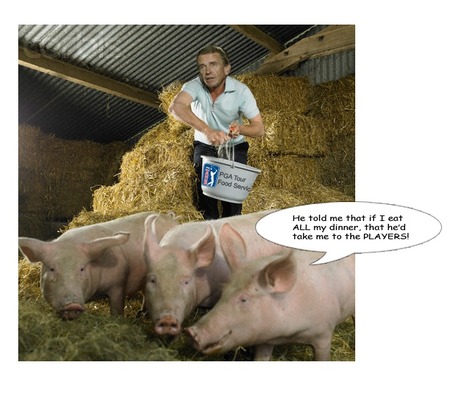
Tim Finchem's press conferences are always amusing, particularly as he faces an increasingly hostile media (as you'll see). Today's talk announced the signing of Farmer's Insurance to a four-year sponsorship extension for the Torrey Pines event, but it was talk of Tiger, metrics, analytics and the astounding quote above that overshadowed the Farmer's news.
Right out of the chute, from an Orlando television station:
Q. I wanted to ask if the PGA TOUR has any information at this point about when Tiger Woods may return to golf.
COMMISSIONER FINCHEM: Well, we have the general information that Tiger is preparing to play, and there's been a lot of speculation about when he might come back out. Tiger has indicated to us that he will give us reasonable notice, because we know we have got some preparation to do.
I don't have the specific date when he’s going to come back, and I could only assume that all of the speculation about late March and early April, if he's going to start back then, we will know soon. Beyond that, I can't help you.
Such brevity and so little jargon! Though as Steve Elling notes, this wait until Tiger calls thing isn't going over too well with some.
Q. And if I could follow-up with another question for Tim. When, and obviously that remains to be seen, when Tiger does come back, can you address at all the security measures, the logistics of it? Sean McManus had said the other day that he thinks his return will be one of the biggest events of the decade. So obviously there will be significant -- if it is a regular PGA TOUR event, I understand if it is the Masters, that's out of your control, but if it were to be Bay Hill, for example, what sort of logistics do you have in place to address his return?
COMMISSIONER FINCHEM: Well, we have a plan for -- it varies. Every site in golf is different, the capacity to handle media. I think media is the biggest mover. Most of our tournaments sell out from a ticket standpoint, anyway.
Really? Most tournaments sell out from a ticket standpoint, eh?
I can't think of a more ludicrous Finchem statement. Ever. And he wonders why the press is growing increasingly skeptical of his statements?
Q. Just on the phone with Tom Wilson, the tournament director here, and he was saying that Farmers is getting a substantially better deal than it would have a couple years ago with the TOUR; yet, the purse is going up, and Tom believes there will be more charitable dollars available to the Century Club. How does that jive? Is that because the TOUR is contributing more money, or what? How does that --
COMMISSIONER FINCHEM: No, I think this transaction is very much at market rate, market level and consistent with -- we have announced in the last eight months 15 either new sponsors or extensions to 2014 and beyond.
Transaction?
And in every one of those situations, we have had transactions that allow us to grow, whether it's prize money on the one hand or charitable dollars on the other; every single one.
I know there has been a lot of discussion about Tiger Woods being out. But as Bob said, most companies evaluate their tournament involvement based on the value that is generated after careful analytics. Tiger historically has played in about a third of our tournaments, and yet they have all been sponsored over the years, and there's a reason for that. And that's because there is real value: Business value, advertising value, audience-reach value and value generated from being involved with positive economic impact and charitable giving. That business model is very strong. It's a sponsor-centric business model that drives value to sponsors, and it's been successful. Today's announcement is just another indication of that.
And we just read a sentence with SIX value references! Get the Guinness people on the line! I'm referring to the book of world records, not the brewsters.
Q. If Tiger plays at Tavistock, we found PGA rule that says he must then play in the PGA TOUR in that city where Tavistock is; can you talk about that for a little bit? Obviously Bay Hill is following a few days later.
COMMISSIONER FINCHEM: I don't know what rule you're referring to but I'm not aware of it, and I have no information as to what he's playing. So as soon as he announces what he's going to do, we will know and you will know.
Now here's where it gets fun.
Q. I just wonder what your thoughts are on that. And Tiger did not play on the weekend in any of the first ten events last year, so seems like a fairly fair apples-to-apples comparison, sounds like a significant drop to me, wonder if there might be a anti-golf hangover from the Tiger affair, or what other theory you might be able to put out there for me.
COMMISSIONER FINCHEM: I don't have the numbers in front of me, but actually some weeks we have been up this year.
But no, I think that -- I think everybody needs to understand that when Tiger Woods plays, and he's in the hunt on the weekend, he spikes the ratings; that's true. When he doesn't play, we have very acceptable ratings from a sponsor-value standpoint and from an audience-reach standpoint. So you can look at it as the glass half-empty or glass half-full. Our view and our analytics tell us it's a glass half-full, if our ratings spike. But it's off of a very acceptable base.
As a matter of fact, on an average basis, the average PGA TOUR event, year-long, is second in cum. audience reach in sports only to a NFL game; only to an NFL game. We average 23 to 25 million people every week tune in to our tournaments. Now, we are over four days, but that's 23 to 25 million unique viewers.
Okay, first, I thought we pointed out that this cum audience talk just doesn't work? Is there some reason he can't say the world cumulative? Is it tainted?
Second of all, 23-25 million every week tune in on average, eh?
So we have a significant gross audience reach. And when people like Bob Woudstra and the companies that come to the PGA TOUR analyse the quality of the audience, which indexes higher in almost every upscale category than any other sport, and the total audience, which is significant; that's how they determine value, and that's why we are 100 percent sponsored.
These companies, these many, many companies that spend millions of dollars with the PGA TOUR, also spend significant amounts of money measuring the value that they get. They are smart companies, they are good marketers and they make good decisions.
So I know the Tiger thing is important, and I think he spikes things, but don't turn it and make it a negative when it doesn't need to be a negative. It's very strong story week-in and week-out. And as Bob mentioned earlier, in his analytics of this particular sponsorship, for example, he was more focused on the overall quality of the field and the impact of the tournament; and the experience coming out of a week in which Tiger did not play, in this particular case, Farmers Insurance, concluded that they wanted to move forward.
So, I don't know what else I need to say.
Next on the line is another cynical writer...
Q. I understand the power of the demographics. I think we have all got a pretty good grip on that. I'm just wondering if you've got a theory as to why the drop of 18 percent.
COMMISSIONER FINCHEM: Well, it has not been 18 percent. But there are a variety of factors.
Now, for example, in an Olympic year, there are three weekends when we are up against the Olympics. It happens every four years. If you go back four years ago when we were up against the Winter Olympics or go back to the Beijing Games in '08, you will see an impact on that. So those things happen in and out of any year or any quarter, and you see movements in the ratings.
But if you compare us in terms of overall audience reach, to any other sporting activity; most companies divide their marketing dollars between some percentage to sports marketing and some percentage to other kind of marketing. We stack up very, very positively, whether it's baseball, basketball, NASCAR or football, in terms of an audience reach standpoint, cum. audience. In addition to that, that cum. audience is a very, very valuable audience. Particularly, with companies that are in the auto area, the financial service area and related areas.
So, there's real value there. So you have to look at the entire picture and do the analytics, and then you come to grips with why we have been successful.
Come to grips? I think someone needs his afternoon siesta!