Harding For President's Cup?
/Harding Park sounds like an ideal site for the 2009 President's Cup.

It’s back!
Twenty years later Tatra Press has kindly allowed me to bring back Grounds For Golf now that golf architecture is of more interest to the masses. A new Introduction looks at what’s driven the interest growth and two new chapters I had a blast adding (plus a few edits to keep things up-to-date).
The Amazon purchase page for the book arriving June 15, 2026.
Harding Park sounds like an ideal site for the 2009 President's Cup.

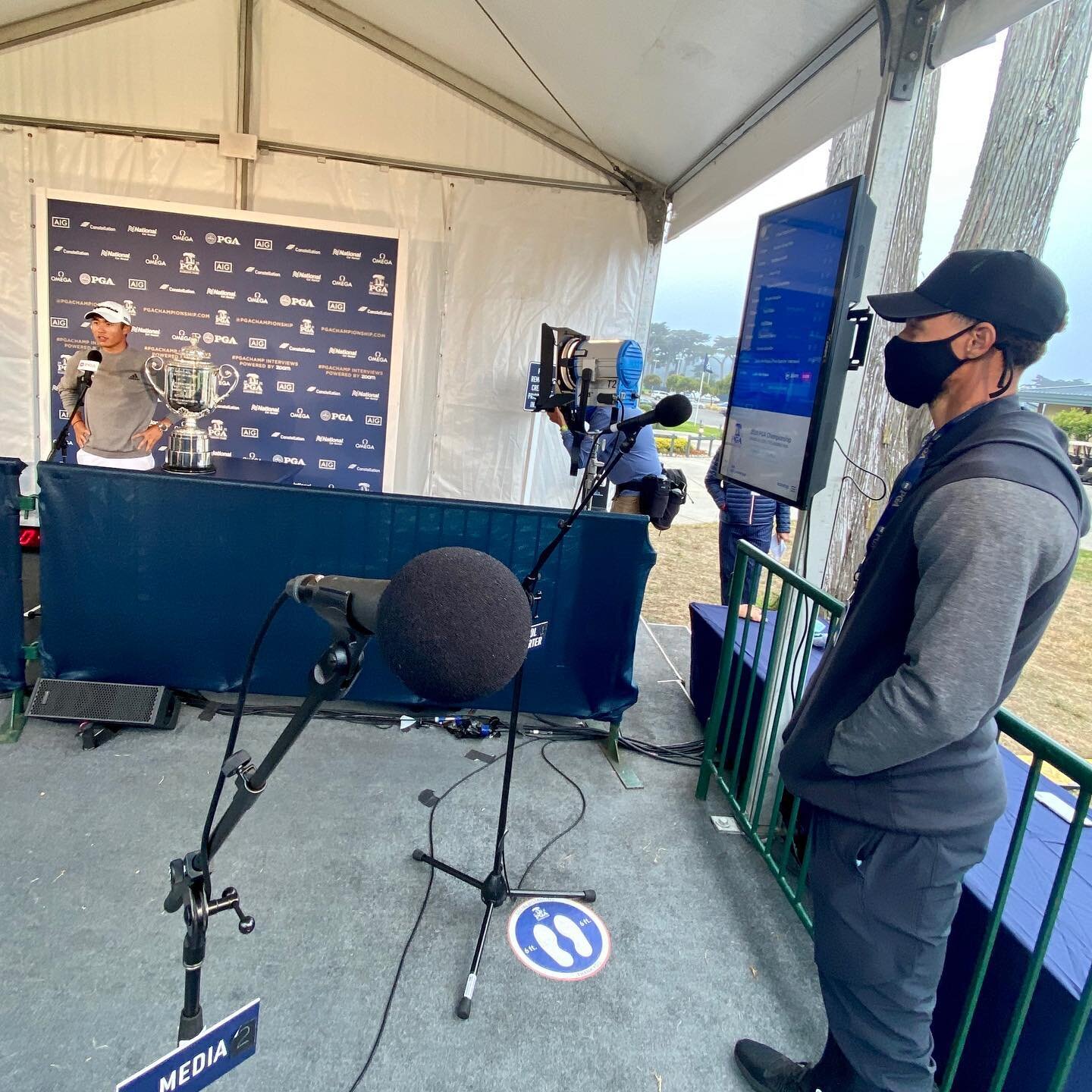
Ernie Els came to the interview room right when Tiger Woods talked to the press above No. 18. I picked Tiger, and it was your basic debacle, with a bunch of TV folks asking banal questions about how Tiger is feeling, when did you open the learning center, etc... Oh and a bunch of questions asking why he's never won at Riviera.
Els apparently didn't have much to say in his chat, though I was hoping to ask him about changes he's making at Wentworth. The driving range buzz is not positive.
Elsewhere...
Speaking of range buzz, a few players have said that they are pretty sure the USGA is going to regulate driver head size, taking the driver back to a 290 cc's limit for competition.
Oddball Thursday pairing: Brad Faxon and J.B. Holmes. The Tour's shortest driver statistically and the second longest.
The greens are the firmest they've been in years. With it dry and breezy tonight look for firm and fast surfaces in round one, unless the hoses come out. Hopefully they'll leave the watering work to the bunker crew.

John Daly and Pro Am Partner (click to enlarge)If you ever think PGA Tour pros make too much money, don't forget just how dreadful pro-ams can be. I was speaking to one player on the putting green and a pro-am guy interrupted to tell his life story, all because he and the player went to the same college.
Poking around ShotLink today, I wanted to see what the players were averaging on all drives versus the two measuring holes. Here are a few players, with their average and their rank. (The NA's don't have enough drives to earn a rank).
Player Driving Distance Avg. Driving Distance
(2 measuring holes) (All Holes)
Bubba Watson 320.5 (1) 310.5 (2)
Tiger Woods 306.3 (NA) 305.6 (NA)
Phil Mickelson 298.9 (17) 301.8 (4)
Davis Love III 292.8 (50) 291.5 (44)
Charles Howell 287.7 (81) 287.2 (80)
Jeff Gove 293.5 (47) 287.2 (80)
Jason Gore 292.8 (50) 294.6 (26)
Sergio Garcia 282.4 (125) 293.7 (30)
Jim Furyk 267.5 (180) 275.8 (168)
Brad Faxon 257.3 (187) 263.1 (188)
John Daly 302.2 (NA) 298.5 (NA)
Olin Browne 272.6 (174) 273.5 (174)
J.B. Holmes 313.5 (2) 314.6 (1)
Lorne Rubenstein looks at the emergence of the "thoughtless" player.
The old barranca/hazard on Riviera's 7th then and now. Note the subtle but significant change to the fairway edge caused by the late 30s flood. Oh, and the cool bridge.


Reader Josh noted that the 517 yard-par 5 18th at The Vines, site of last weekend's European Tour event won by Kevin Stadler, played to an average of 4.14.
That prompted this remark from Mike Clayton: “It’s not even a tough par 4!”
I'm suspecting the first at Riviera will look the same way this week. Last year it was hovering in the low 4.3 area, and that was in two wet, cold rounds playing as long as possible.
Doug Ferguson reports that the PGA Tour is about to create two fall "Quest for the Card" events in California, starting with a tournament in Fresno on a still under construction course, followed by an event in San Jose.
Also in the works is a tournament near San Jose, Calif., that would be sponsored by Fry's Electronics on a private course called The Institute, which is owned by Silicon Valley mogul John Fry. During the American Express Championship at Harding Park last October, a few players took part in an outing at The Institute. Fred Funk was said to have shot the lowest score (75) on a course that measured about 7,900 yards.
Wow, fun.
Meanwhile, Golf World reports that the Honda Classic may become a Jack and Barbara Nicklaus hosted event.

Ogilvy has plenty of interesting things to say about the state of the Tour. I finally found someone who agrees that the Tour's course setup philosophy leaves a lot to be desired. I know you all were worried. Elsewhere...
Q. Are you a weights and/or conditioning guy?But don't forget, it's the athleticism and working out!
J.B. HOLMES: Not really.
Q. I'm guessing not really.
J.B. HOLMES: No, not really. I ride the bike a little bit or whatever. I'm not really big on the weights and stuff. I probably need to do a little more running or biking or something like that. I'm strong enough, I really don't need to hit the weights.
Q. John, with the way that you have been piping it out there the last few years, now that you are out here with the big boys, and blowing it passed all of them, there has been sort of a negative side to it to, people are saying he hits it too far, they need to rein that in. What's your response to all of that? You can become the poster boy for the USGA making rules changes.Get this young man some talking points!
J.B. HOLMES: I mean if they knock it back 20 yards, I'm still 50 yards ahead of the guy. So I don't see any point of changing. Everybody says that golf is changing. It's a new sport, the distance, everything like that. I really don't believe that truly. Look at all of the great players; Palmer, Woods, because he was hitting it past everybody. Nicklaus hit it a long ways. So technology made the distances further, but it seems like all of the great players that you see back in history, they hit it passed everybody. Even Tiger, Tiger hits it past everybody. So technology is making the distances further. But I mean the courses are getting longer too, so I really don't think that it's changed the game that much.
Q. You don't think there has been a lessening of the skill factor because you only have to hit your 3iron, 4iron, 5iron a couple of times per tournament? It's mostly a wedge, 9iron. These are some of the points that have been raised. You are just overwhelming golf courses?
J.B. HOLMES: You know, they are starting to make them longer. I can see the distances, some of the advantages on some of the courses. Like they said, say they do dial the ball back 20 yards back, instead of hitting a wedge, I'm hitting a 9iron or 8iron. The people that are hitting 6iron or 7iron, now they're hitting 4iron and 3iron.
I'll take anybody with my 8iron or 9iron when they're hitting 3iron and 4iron. I almost think that will be a bigger advantage because you can hit a 7iron and 6iron close. It's hard to dial in a 4iron and a 3iron.
Q. J.B., you said that you're not much of a weights guy, but I'm curious if that's the case, do you think there is even more distance out there for you if you really got on a program, could you add 10 or 15 yards to what you already have?
J.B. HOLMES: I don't know, maybe. There is not really any sense of it. I think I hit it far enough. If you get into the weights it can change your swing, if you got too big something like that. All in all I got real strong legs, quick hips, pretty strong upper body and big forearms. So I don't think there is really any need of me getting stronger.
I can see riding a bike, something like that, doing a little more conditioning, maybe strengthen my core a little more. But as of weightlifting just to get stronger, I could. I don't think it will do anything. It might, it might not. I might get stronger with the weight and tighten up a little bit and hit it shorter, you know.
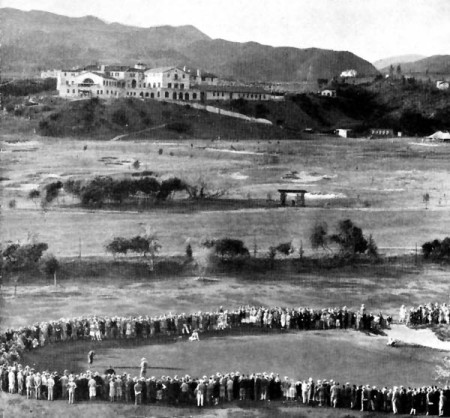
Notice the historic photo with No. 12 to the left. In the distance is the Riviera par-3 course (today's range) and clubhouse.
The spectators below are encircling the old green floor.
The photo below that shows the newly enlarged green, which has lost the "long, thin" character of the old green and actually appears to be larger than the original. There were also changes to the fronting bunker (now less deep and less intimidating than it was before...).
It's debatable whether this green really needed expansion.

The enlargement work shares the same problem as the expansion on No. 9: the new green falls away from the primary surface, making it debatable whether a hole location can be cut on the new area because of its slope.
Looking at it today with Geoff Ogilvy, he felt it was dicey if the greens were fast.
Since the idea was to restore a purportedly lost hole location (if it every existed, which appears iffy), the goal of this work doesn't make sense. Nor does it bode well for this summer's expanstion of other greens).
And once again, the expansion of the 12th green makes shots missing this surface so much different and easier than in the old configuration. Once arguably the most difficult up and down on the back side, the larger green should make recoveries simpler. Because in effect, they are no longer recoveries, but instead, birdie putts.
 Note this photo of PGA Tour pro John Riegger putting on the 12th during the practice round. Last year he would have faced a devilish lob recovery shot from this spot. Today it's a relatively easy two putt.
That would be fine if the new hole location added some strategic enhancement. But both of those questions are up for serious debate, especially with a 25-yard wide fairway that makes it impossible for someone to flirt with the O.B. by driving down the left side to open up the best angle of attack.
 Instead, the new green seems to be an addition designed to offer an inaccessible "Sunday" hole location.
But with the bunker made more shallow, it actually becomes relatively harmless since and up-and-down isn't too difficult (whereas before it was deadly.)
None of this adds up to reflecting Captain Thomas's style.
Gary Baines in the Daily Camera (!?) covered a recent address by David Fay and offered these sound bites from the USGA Executive Director.
"I understand people like Nicklaus, (Arnold) Palmer and (Greg) Norman want to do something about the ball, and I respect that," Fay said. "But who are we governing for — the elite players or the people like the ones at the Golf Expo? I'd say for the latter. ...So this begs the question, why does the USGA regulate equipment at all? Equipment rules are by and large for "elite players."
If someone established the "American Association of Elite Players" and it was created to handle equipment regulation, amateur status and run the USGA championships, what would be the role of the USGA that governs the game for the folks at Golf Expo?
They'd do some handicapping. Green section would still be around. The museum and library would be important. Anything else?
It would seen that the USGA, divorced of the elite player, probably wouldn't need a $600,000 a year Executive Director.
On the state of golf in general: "As a participatory sport things are pretty good for golf," Fay said. There are courses that "fit all sorts of income levels. All participatory sports are relatively flat right now. There are so many more things people can participate in these days.
"We're concerned (about the game's growth). But should golf have 50 million players in the country (rather than the current 25 million)? It we did we'd have a lot more slow play. A lot of the growth in golf is as a spectator sport. It's a hard game, it can be costly and it takes time to play. Those factors can eliminate some people (from participating)."
There would be a lot more slow play if the game grows.
Orwellian I tell you.
The short par-3 16th at Riviera in the late 1920s and today...


Dave Shedloski on PGATour.com:
If it seems like TOUR members aren’t concerned with a little thing like hitting fairways, you’re right. Since 2000 the number of players who have hit at least 70 percent of their fairways has been on the decline. There were 75 guys hitting 7 of 10, on average, in 2000, but the number fell to 67 in ’01, then 61, 40, 24, 19, and, so far in this young season, there are only 16 players finding 70 percent (up from seven the previous week – thank goodness for generous fairways on the Monterrey Peninsula).
The last three years the driving accuracy leader has been below 78 percent. Since stats were first monitored in 1980, only five other times has the leader in that category been below 80 percent – and only one other time has the leader been below 78 percent (Calvin Peete, 77.5 percent, in 1984).
Want more? On the other end of the scale, there are 105 players hitting fewer than 60 percent of their fairways thus far in ’06. That’s up more than 100 percent from the 52 such wayward whackers last year. As recently as 2001 only five players failed to hit at least 6 of 10 fairways for the entire season. It doesn’t mean players aren’t as good today; in many ways they’re better. But no doubt they play with different priorities.
It’s likely the winner will not get away with such untidy play on the narrow avenues of Riviera (but because the fairways are narrow, hitting them is always chore).
The question is, how much is this decline a result of flogging, and how much of it has to do with the excessive narrowing of fairways?

Hey, if it's any consolation, we're supposed to have below-normal temps Thursday through Sunday. Anyway, a few observations

Riviera has long served as a classroom for those interested in golf architecture.
It continues to serve as a place for study, though at the current pace, study of a different kind.
Namely, how not to "restore."
As Thomas Bonk outlined in the LA Times, Riviera management, superintendent Matt Morton and Tom Fazio's firm have overseen the expansion of three greens: No. 3, No. 9 and No. 12. The changes have been described as a restoration of the original George Thomas-Billy Bell design.
While the idea of expanding greens back to their original size is nearly always a great idea on older courses, Riviera is sadly serving as a case study in how not to go about it.
In their defense, the problem is extremely complicated: trying to add green space onto existing USGA spec greens. It's a bit like trying to expand an aquarium while keeping the tank full. In this case they are attempting to tie into a sand substructure while also working into the surrounding terrain.
As difficult as the task is, it is manageable.
The current expansions of No. 3, No. 9 and No. 12--a precursor of even more changes to come this summer--was ultimately unsuccessful because of the failure to account for the nearly 80 years of top dressing build up that elevated the green floors above the surrounds.
Ah, but for those of you whose eyes haven't glazed over at this point, you might be saying, "the greens were rebuilt in 1993, how can their be topdressing build up?"
When the greens were rebuilt, they were not lowered the 4-5 inches that would have taken the greens down to their original height. A mistake? Perhaps, but Bill Coore and Ben Crenshaw were not attempting to restore the greens to their original sizes. They were adding some lost hole locations, but in general, trying to not disturb the evolved course.
Therefore, today you have the original green areas (slightly expanded in '93), and then these newly "restored" areas that are sloping down and away from the elevated, primary green space. The effect is Donald Ross/Pinehurst-like. Unfortunately, Thomas-Bell were not into the crowned green look (and Donald Ross wasn't either if you look closely at the evolution of Pinehurst).
 Now, all of this would seem to be a minor technicality except that nearly all of the "restored" green space on No. 9 and No. 12 does not tie-in with the primary green, and worse, is unpinnable in tournament conditions because of the noticeable tilt away from the main green floor.
(Well, unless Tom Meeks was handling the setup, then this quibbling is all irrelevant!)
The approach to No. 9's front hole location has long been extremely difficult. But the expanded putting surface should make the shot much easier with such an inviting target and less difficult recovery pitches for those missing the green.
Most noticeable is the front expansion on No. 9, which will help players landing short of the green. (Before, the chip shot over kikuyu to the small green surface was incredibly demanding...now those misses will be putting.)
 In this historic photo of No. 9 taken from the third tee, notice how the green in the front area has a backstop of sorts (the approach comes into this green from about 2 o'clock in the photo).
Also notice how that banking has changed to today's look (above), which is a false drop off. Then look at the photos taken today where you can see the border of the old green, and the new surface in the lighter shade. That entire "restored" area of new surface falls off gently toward the left of this photo.
With a bit more attention to this type of detail, I suspect that these green expansions could have tied in better with the existing green and served to restore the original design.
Unfortunately the green expansions appear to do a disservice to the original design.
They fail to add more hole locations, while also not adding any strategic interest, which was always the number one priority for Captain Thomas.
 Alistair Tait calls the PGA Tour's original pledge for the World Golf Championships "hogwash" while looking at the power struggle won this time by Tim Finchem.
Geoff Shackelford is a Senior Writer for Golfweek magazine, a weekly contributor to Golf Channel's Morning



Copyright © 2022, Geoff Shackelford. All rights reserved.