Huggan On Ryder Rumblings
/John Huggan reports that the possible move to a four-day Ryder Cup (with other possible format changes) is a product of the new PGA Tour TV deal.
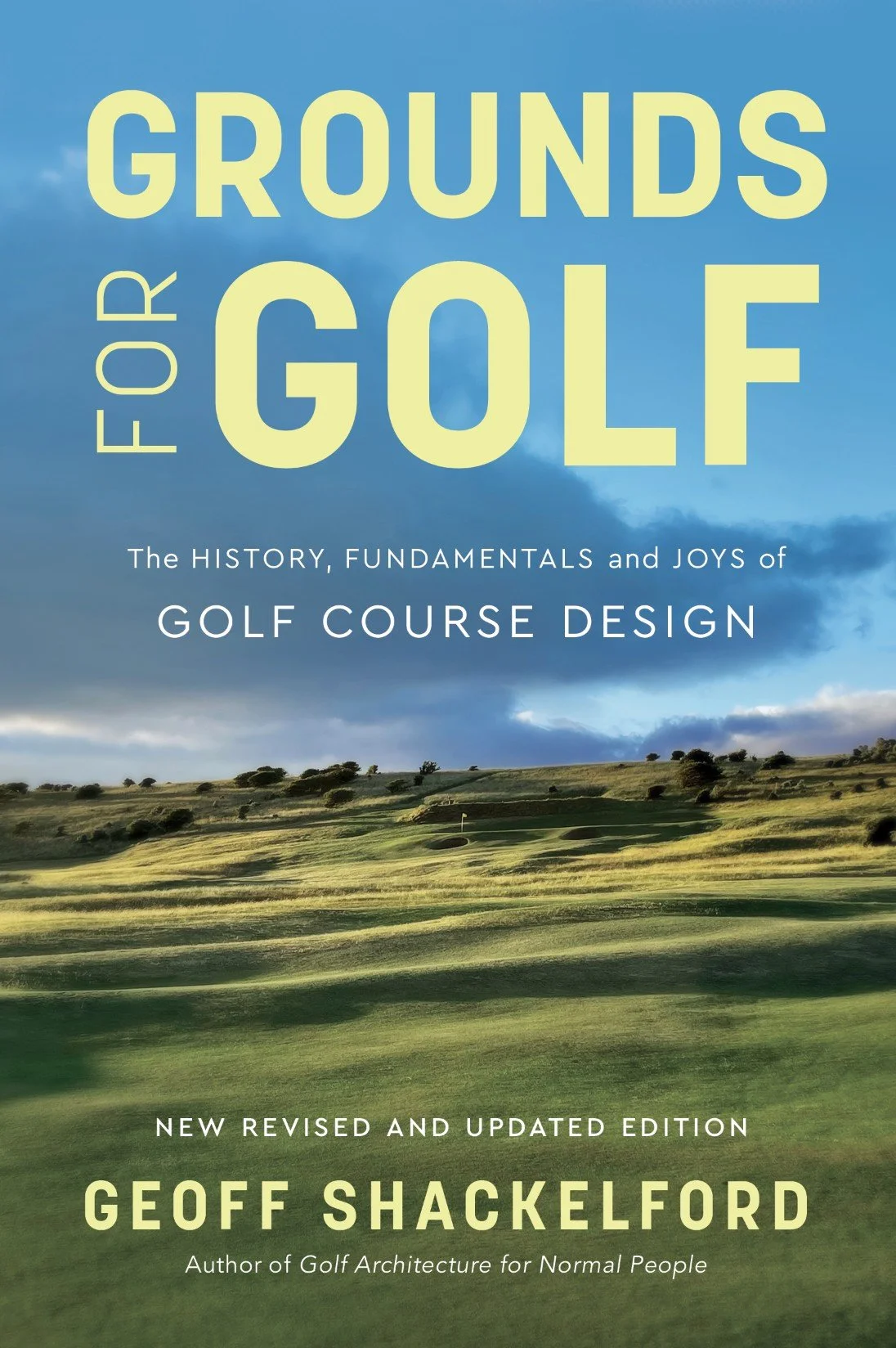
It’s back!
Twenty years later Tatra Press has kindly allowed me to bring back Grounds For Golf now that golf architecture is of more interest to the masses. A new Introduction looks at what’s driven the interest growth and two new chapters I had a blast adding (plus a few edits to keep things up-to-date).
The Amazon purchase page for the book arriving June 15, 2026.
Today I received my paperback copy of Geoffrey Cornish and Michael Hurdzan's new bibliography of golf architecture writings, Golf Course Design. Grant Books (www.grantbooks.co.uk) published it and has created three editions: paper, a limited 425 edition and a 75 leather bound signed edition.
You can poke around the Grant Books website to find the various editions. But just on an initial glance, the book is outstanding (though I'm biased, several of my books are featured and praised). From the web site:
The book is divided into three sections: Part I: The Architecture of Golf, a chronology which discussses the evoloution of golf course design, architecture and construction. Part II: The Literature of Golf Design, which deals with the literature of golf design, land marks in the literature of golf design, biographies of golf architects, architects who are authors. Part III: The Bibliography which is devided into various sections. Part IV: Arrangements of Large Collections. Part V: Resources. The appendix includes short title index and the index of authors. This is a landmark production in the field of golf course design. The extensive bibliography is graded in both importance and value.
Mike Aitken reports on the R&A's not so stellar start in the design business.
You may recall that most links have only seen minor tinkering in preparation for Open Championships, but now that the pesky ball is going so bloody far and scores might go lower if something isn't done, why, driver must be taken out of the players hands.
Therefore, the R&A has begun to inflict assorted design atrocities on the rota links that pale when compared to anything the USGA has ever...well I just had an Oak Hill flashback.
Anyhow, Aitken reports:
...after embarking this winter on the first phase of a programme of improvements which will cost around £250,000 and increase the number of bunkers on the Ayrshire links to nearly 100, Turnberry has been advised by the Royal and Ancient to remove a number of traps and soften others because the test was in danger of becoming too severe.
Peter Dawson, the chief executive of the R&A, believed alterations to the first, 12th and 14th on the Ailsa now demanded too much of the golfer and needed to be revised.
You know how much I hate to be sarcastic, but you may recall this post about Dawson's planned February visit to help supervise these changes.
You see Mr. Dawson, there are people called golf architects who do this for a living and...oh I know, they would tell you to do something about the ball instead of littering Turnberry with rabbit-dropping inspired bunkers. Silly me!
Aitken provides the crime report:
On the first, for example, two new bunkers were introduced down the left and a third, large pot bunker was also added on the right at around the 280- yard mark. Dawson's reaction to this hazard was that it might take the driver out of the long hitters' hands and persuade them to err on the side of caution with an iron or utility club.
"Sometimes you can't fully appreciate the impact of an alteration until it's been built and you have another look at them in reality rather than on a drawing," said Dawson yesterday. "What happened on the first was that when we saw the new bunkering, we were concerned the element of risk and reward in going for the green might be taken away and the players would use an iron off the tee. But we haven't gone back to the way the hole was before. The hazard is just less severe than it was going to be."
On the back nine, though, the R&A did ask for new bunkers to be removed on the 12th and 14th holes. On the 12th, a new bunker was built on the left of the fairway beyond the existing traps. From what will be the new tee, however, the landing area was miniscule.
That bunker has been filled in as was one of the new traps on the 14th, where there were concerns the hazard couldn't be seen from the tee.
Stewart Selbie, the manager of Turnberry Hotel, was happy to comply with the R&A's wishes, though perhaps not displeased with the notion that the Ailsa had become so challenging.
The original plan was to add 30 traps before the Senior British Open is staged in Ayrshire in the summer and as many as 100 by 2009. Before work began, Turnberry had just 66 bunkers, the fewest of any links on the Open rota.
The second phase of upgrading will take place after the Seniors when Turnberry's finishing stretch will also be toughened up. Although plans for the closing holes have not yet been made public, it's thought the 16th could become more of a dogleg to create enough space to build a new tee which would extend the par-5 17th.
With an Amateur Championship also on the horizon, both Turnberry and the R&A are keen to retain a balance between heightening the challenge and retaining the character of a scenic links regularly ranked in the world's top 20. "What we don't want is to end up making the links unplayable for the regular golfer," said Selbie.
Aitken also outlines changes to Carnoustie to deal with "new technology and improved fitness," and the boondogglery continues...
And, on the treacherous 17th, there was concern a bail-out area now existed on the "island" rather than players having to think about laying up short of the burn or going for broke. This will be remedied by the introduction of rough mounding.
"We did feel that a bit of a bail-out area had emerged since the re-turfing of the 17th and so we've done something about that," acknowledged Dawson.
Rough mounding?
Maybe I've underestimated the USGA's recent propaganda releases on distance. I was thinking that they would be easily misunderstood by the golfing public and would only increase member apathy. But maybe they're laying the groundwork for something else? If so, they have Titleist biting, with a post on the corporation's website of the latest position paper.
I've only skimmed it (I see equations on page 1, eh), but reader G. Bayley writes:
The paper starts by giving trajectory formulae, but then never uses or references them again. The paper gives references to experiments showing that COR declines with higher swing speed. The largest portion of the paper then replicates this result with five unidentified tour balls. A clear explanation of the previous results would have been enough for me, why replicate an accepted result. Is that doing science? This replication is the first of three results claimed. The second result being that launch angle decreases with increased swing speed. It is totally unclear as to how this came about. The final result claimed was the astounding (satire) result that ball spin rate increases with increasing club speed.
In an appendix, tour driving distance is charted for distance ranges and implicated to agree with the COR result. Since this data has no controls, no reasonable assumption as to what it correlates to can be made and is of little scientific value. Also, the paper claimed that 2000 data was from pros using wound balls, but a graph on the Titleist website would seem to indicate that at the beginning of 2000 27% of the tour players were using the modern ball and by the end of the year 42% were using the modern ball.
The article could stand a little better writing given that it was referenced as the lead item on the USGA home page. For example, I would appreciate it if someone could explain what the following means, "some specification had to be made in how the ball would be positioned on the tee. The tee position was first set at the highest speed in accordance with the ODS" which gives me visions of a tee streaking through space with a ball sitting on it. Perhaps it has no meaning and is just poor writing.
What I would have liked to see was graphs of ball trajectory predicted by the equations that were presented and then ignored, and graphs of ball trajectory as seen in experiments with balls. I would also like to have seen what the model would predict for older balls.
Reuters offered these Tim Finchem comments on the Tour's return to New Orleans:
"The PGA Tour is trying to do its part to communicate to corporate America what is happening in New Orleans and what can still happen," Finchem told a news conference after hosting an economic forum attended by around 100 chief executive officers (CEOs).
"Our telecast this week will be speaking to the decision-makers throughout America.
"Our telecasts skew higher than any other sport in terms of reaching CEOs, vice presidents, chief marketing officers, people that would make the decisions to bring groups here, the individuals who make the decision about how to expand their businesses.
"I don't think most people recognise it, but if you add up the cumulative audience of a PGA Tour event it is second only to the NFL (National Football League) in terms of the total number of people that come in for a telecast."
AP's Chris Duncan reports that the Rees Jones-David Toms course at Redstone didn't exactly remind them of Riviera.
The Shell Houston Open will move to the weekend before The Masters next year, a change organizers hope will lure a more star-studded field.
It's not the date, but the course that could keep many away.
The Tournament Course at Redstone, where Stuart Appleby shot 19 under last weekend to win the event, got a lukewarm response from the players, most of whom were seeing it for the first time.
Vijay Singh won the previous two Houston Opens at the adjacent Jacobsen/Hardy course at Redstone. The event moved to the 7,457-yard Rees Jones layout this year.
Singh said too many of the holes look the same.
"The golf course did not grow on me," said Singh, the 2000 Masters winner. "Normally, the more you play, the more it grows on you. I just hope they go back to the old golf course next year. I think that's the consensus of most of the players."
Bob Estes, who finished second to Appleby, didn't like the distance between holes. The second tee was more than a quarter mile from the first green and though players had carts waiting to shuttle them, Estes said the process backed up play.
"It's just so spread out, the rounds were really long, and that's the downside of it," Estes said.
I'm shocked. Jim Nantz said it was getting rave reviews!
My April Golfdom column is now posted, just in time for the Masters to have faded from memory.
Reader MacDuff supplies us with this week's breakdown of where players would stand if this were 2007, the first year of a PGA Tour "playoff" that will be created with a seeding of some sort.
1 Mickelson 15346.87 9
2 Singh 14021.87 10
3 C.Campbell 12837.5 11
4 Furyk 12712.5 9
5 Glover 12404.16 9
6 Gf. Ogilvy 12237.5 8
7 Toms 11871.87 7
8 Sabbatini 11741.66 8
9 Weir 11459.37 8
10 Pettersson 11333.33 11
11 Olazabal 10875 7
12 Verplank 10725 8
13 T.Woods 10659.37 6
14 Pernice 10625 8
15 Mayfair 10479.16 9
16 Appleby 10425 8
17 Donald 10289.37 7
18 Oberholser 9550 8
19 T.Clark 9547.5 9
20 Van Pelt 9302.5 11
21 Goosen 9162.5 6
22 Cink 8633.83 8
23 Parnevik 8530 10
24 Gay 8500 9
25 Z.Johnson 8475 8
26 Lehman 8350 7
27 Warren 8237.5 8
28 Villegas 8225 8
29 Chopra 8212 9
30 Choi 8050 7
31 Ames 7975 6
32 G. Owen 7975 8
33 Els 7925 7
34 Pampling 7867.5 7
35 Bohn 7770.83 8
36 Love III 7762.5 8
37 Rollins 7675 7
38 Jerry Kelly 7662.5 6
39 D.Wilson 7425 8
40 JB Holmes 7420.83 7
41 Funk 7337.5 8
42 Purdy 7325 7
43 Palmer 7291.66 7
44 Vn Taylor 7237.5 6
45 Garcia 7175 6
46 Jobe 6892.5 7
47 Couples 6825 7
48 Franco 6800 7
49 Beem 6768.75 8
50 Imada 6717.5 8
51 Barlow 6657.5 7
52 Bertsch 6575 8
53 RS Johnson 6525 5
54 Baird 6517.5 7
55 Harrington 6500 6
56 Hoffman 6457.5 6
57 Fischer 6425 9
58 Langer 6354.16 7
59 J.Smith 6312.5 6
60 D. Howell 6262.5 5
61 Pat Perez 6262.5 7
62 Leonard 6220.83 7
63 Bjornstad 6217.5 7
64 Allenby 6187.5 6
65 Watney 6187.5 7
66 F.Jacobson 6075 6
67 Bryant 6050 6
68 Rose 5991.66 6
69 JJ Henry 5875 5
70 M.Wilson 5852.5 5
71 A.Scott 5850 5
72 J.Ogilvie 5845 6
73 Waldorf 5787.5 7
74 Estes 5775 5
75 Crane 5770 5
76 Senden 5750 5
77 Gove 5737.5 6
78 N.Green 5662.5 7
79 B. Quigley 5650 5
80 Atwal 5625 5
81 J.Byrd 5500 4
82 Baddeley 5387.5 6
83 DiMarco 5384.37 5
84 Curtis 5375 7
85 Olin Browne 5337.5 8
86 Gronberg 5312.5 5
87 Calc 5200 8
88 Westwood 5187.5 5
89 Slocum 5150 7
90 Hart 5137.5 6
T91 Cabrera 5100 5
T91 Immelman 5100 5
93 Bub Watson 5075 5
94 Branshaw 4962.5 6
95 Maggert 4937.5 7
96 D.Clarke 4900 4
97 Howell III 4862.5 9
98 Flesch 4805 7
99 Triplett 4750 4
100 JL Lewis 4675 7
101 Matteson 4600 6
102 Barron 4581.25 5
103 Poulter 4550 6
104 Herron 4507.5 5
105 Azinger 4500 6
106 Gore 4450 5
107 Br.Davis 4437.5 7
108 Micheel 4425 6
109 Leaney 4337.5 4
110 Sluman 4287.5 8
111 Lickliter II 4250 5
112 Frazar 4187.5 6
113 Stricker 4125 3
114 Mahan 4112.5 6
115 Geiberger 4100 6
116 Veazey 4025 5
117 Cook 4000 4
118 Dickerson 3975 7
119 Kenny Perry 3962.5 4
120 Lonard 3937.5 6
121 S.Jones 3912.5 5
122 Faxon 3812.5 6
123 Pavin 3787.5 4
124 Goggin 3737.75 4
125 Ridings 3700 5
126 Lowery 3612.5 6
127 Kaye 3575 5
128 Wetterich 3550 4
129 Andrade 3545 5
130 Kent Jones 3537.5 4
131 Petrovic 3512.5 5
132 Sindelar 3512.5 6
133 Jimenez 3387.5 3
134 Stankowski 3290.5 6
135 Sean O'Hair 3287.5 6
136 Kevin Na 3275 4
137 Ws Short Jr 3187.5 6
138 Katayama 3171.87 4
139 Daly 3050 5
140 Gamez 3037.5 5
 The PGA Tour Driving Distance average rose a wee, wee bit from 287.6 yards following the Heritage to 287.7 after four days of golf over the artistic, glorious, character-rich and just plain soul-stirring Redstone.
 Brian Allee-Walsh of the New Orleans Times-Picayune sits down for a Q&A with Commissioner Tim Finchem.
Q: A local business leader said your decision to bring upwards of 50 corporate leaders to New Orleans to participate in Monday's economic forum will be the "most powerful thing to happen in our city this spring." What is your response?Oh some crafty editor inserted that (with) after the dreaded interface word. Somehow I think he really did mean to say "interface our customers." Just sounds so much more MBAish, don't you think?
A: It's a nice comment. I don't know powerful it will be. It should be helpful, because what we're trying to do is get the positive side of the equation in front of the corporate community and get them thinking about business, not just tourism, but business in general. We thought the best contribution we could make along that line was to interface (with) our customers. We have a broad range of companies that are involved in our tour. We want to bring those companies in and let them hear first-hand from the city, state and the feds about the future of New Orleans and why people are optimistic.
Q: How did the idea hatch?I know, I know, I was worried too. Platform has been on the sidelines for some time now, but it's back. Well, "kind of."
A: It goes back to last fall when our golf course was damaged and we had to move our tournament. We were trying to figure out a way to get things moving on our tournament. Then the community down there was telling us that there were some struggles with other sports and wanted us to be the first major televised sporting event to happen in post-Katrina. That was when we decided to move our Commissioner's Cup competition, where we invite all CEOs of our sponsoring companies to New Orleans. The idea to is to combine that with this message and use it kind of as a platform.
Of course, on the telecast that weekend we'll be trying to weave in some of the messaging that comes out of those meetings. We have a TPC club presence there and a longtime tournament history. So we're obviously about the community and it just made sense to try to help out.Weave in the messaging that comes out of those meetings. Let me set my TiVo now.
Q: How much did your business interruption insurance play into the decision for the PGA Tour not to reopen the TPC of Louisiana for a year after the storm?Oops! Where did that little cut slider come from!? Sorry I interrupted...
A: I don't know the details on that.
I don't think it was hugely significant. It was a combination of things. A lot of our employees got spread around. It had something to do with some of the work that had to be done on the golf course. Once we determined that we weren't going to be prepared to play the tournament there, and we were moving the tournament, that sort of took away the necessity to get the golf course ready that quickly. So there were a number of factors. I can't really speak to the extent to which the insurance-related matter figured into it. It may have had some impact.Given that most players hate the course, were you hoping it was completely destroyed? Oh sorry...
Q: Are you hopeful that the golfers will take time to tour the devastation for themselves?Uh, am I missing something here? What's interesting about the spouses tagging along?
A: I think they will. Interestingly, we've invited spouses with our corporate guests. Particularly in a situation like this you wouldn't see a fairly good turnout of spouses because it's partly a golf event. But a lot of spouses are coming because there is this interest in terms of where New Orleans is and what has happened. There's that side of it.
Q: You must be proud of the PGA Tour players' relief efforts and fund-raising work the past eight months, specifically the three Louisiana pros, Kelly Gibson, David Toms and Hal Sutton. Do you anticipate the contributions of your players increasing during the week of the tournament?Sheesh, relax, it was just an innocent question!
A: I can't speak to that. I don't want to assume anything. The players have families at home and they give an awful lot themselves for charities around the country. Our tournaments raised over $90 million last year for well-deserving charities. The players themselves raised over $25 million in fund-raisers around the country. People need to recognize that they do an awful lot. Whatever we're doing in New Orleans is just an extension of that. But it's also important to recognize that there are hundreds of thousands of people around the country who are impacted by what players do and what tournaments do.
Q: As you look long-term at the FedEx Cup Championship Series, what is your vision? Are you looking at this as a Final Four or Super Bowl environment?
A: The PGA Tour FedEx Cup Championship Series, those last four weeks, it's unheard of in this sport to have all the best players playing head-to-head in the same field week after week after week. It just doesn't happen. There is a question of stamina. There will be a lot of movement after these players are seeded. They'll be seeded after the first part of the season and when they go into the playoffs they'll be seeded again. It has a tremendously exciting potential to elevate a consistent relevance with the fans and will give the media a lot of things to focus on and continue to raise the profile of the sport. I'm very optimistic about what can happen. Now we have to execute and we have a lot of work to do to bring this on next year. I'm very bullish on it.
He's bullish! The part about players being seeded after the first part of the season is interesting.
And I don't know what this next answer means:
Q: Are you concerned that you might lose some elite international players who might be involved in the European Tour at that time of the year?If this doesn't make you laugh out loud, I don't know what will...
A: Not really. It may be that a particular player who's also playing the European Tour and isn't very highly seeded, he might not play in the FedEx Cup Championship Series. Mathematically, everybody has a shot and there's a lot at stake here. Each of these tournaments in and of themselves is going to be a big tournament. So you add it all up, I've got to believe virtually everybody is going to be playing.
Q: Is there one accomplishment you're most proud of during your tenure?See, I told you it was funny. Continue...
A: It's a very simple one. I'm most pleased that we've developed and continued a history of a close working relationship between the people who work at the Tour and the players.
That's fundamental. I think we've done a much better job of working closely with our tournaments and represent our volunteers out there on the charity side. There are a lot of specific things I'm pleased that we've done. It's like anything else in business, you can't move away from the fundamentals. There are things that might have more notoriety and have a little bit more flash that are great, but in this sport it's very important to have these working relationships. We have a great team here.
Garry Smits reports on Tom Fazio's latest masterwork, Florida's Amelia National (aren't we about to run out of names you can put next to National?).
You'll be shocked to learn that the course is going to be tough from the back tees, but still playable from the member tees.
"Tom did a very nice job," said 2005 Players Championship winner Fred Funk, who conducted a clinic and participated in an opening-day tournament, along with Fazio. "It's a very good test from the back tees, but it's also going to be a very good member's course."According to Smits, the only thing left is a decision on the signature hole.
Although a "signature hole" hasn't been established, it might be the 460-yard, par-4 18th, with a series of fairway bunkers down the right side. But the par-5 ninth hole, reachable in two shots for good players, is a twisting, winding beauty, and the parallel par-4 fourth (424 from the back tees) and par-4 fifth (405) form a picturesque pairing.The American Society of Signature Hole Comittees (ASSHCom) will have a tough decision on their hands. I say give 'em two signatures, the front nine and the back nine signature holes.
You may have noticed that AP story about Tiger Woods saying he may not play until the U.S. Open because of his dad's health?
Well, so far the vigil has included a 440-deep bungy jump (what a great idea!) and a $500k night at the MGM Grand's "Mansion" tables.
From the Las Vegas Review-Journal:
Playing blackjack in Las Vegas was more profitable over the weekend for Tiger Woods than his recent Masters appearance. Woods, who won $315,700 for sharing third place in the Masters, told friends he won more than $500,000 on the green felt surface at the MGM Grand's Mansion.
This may not be the endorsement he's looking for, but Monty has Paul Casey on his side when it comes to the 2010 Ryder Cup captaincy. Count me in too. After all, wouldn't it be fun to have the European writers rooting for America every now and then! What better way to have Huggan and Donegan and Lawrenson rooting for the red, white and blue than a Monty captaincy!
"I think he'd be a wonderful captain," said Casey, who is hoping to be in the team for the showdown in September at the K Club outside Dublin.
"I know it is not the same level, but I played for Monty in the Seve Trophy last year and he has been a fabulous captain for that."
In a world populated by truants, he is a true student of the sport from which he makes a living. Good grief, the man even reads books!And...
He's curious, too. At home for a brief visit over the winter, Ogilvy, with former European Tour professionals Mike Clayton and Bob Shearer, played Royal Melbourne using wooden-headed clubs.
"It was a whole new level of fun," he says, smiling at the memory. "You had to hit it well for the ball to go anywhere. The difference between a good hit and a bad one with a driver was about 40 yards. With a modern driver you can hit the ball anywhere on the face, really. The difference is only about five yards. Only afterwards, when I had thought about it more, did I get depressed by all of that."
Indeed, the modern game in general is a bit of a worry for Ogilvy, a self-confessed and unabashed traditionalist.
"Two important aspects of golf have gone in completely the wrong direction," he maintains. "Most things are fine. Greens are generally better, for example. But the whole point of golf has been lost. Ben Hogan said it best. His thing was that you don't measure a good drive by how far it goes; you analyse its quality by its position relative to the next target. That doesn't exist in golf any more.
"The biggest problem today is tournament organisers trying to create a winning score. When did low scores become bad? At what point did the quality of your course become dependent on its difficulty? That was when golf lost the plot. The winning score should be dictated by the weather.
"The other thing is course set-up. Especially in America, there is too much rough and greens are way too soft. Then, when low scores become commonplace, they think how to make courses harder. So they grow even more long grass.
"But that misses the point. There is no real defence against a soft green. Today's players with today's wedges can stop the ball from anywhere. The angle of attack and the shape of the shot mean nothing. It doesn't matter where you hit it, as long as it is between the out- of-bounds stakes or between the trees. And so the game becomes a one-dimensional test of execution, time after time after time."
As you'd expect, Ogilvy is a big fan of the endlessly-fascinating strategic aspect of true links golf, and the Old Course at St Andrews in particular. It was there last year that he finished fifth in the Open Championship, shooting the lowest score over the final two rounds.
"St Andrews is the best course in the world because of the shots it makes you play," he points out. "In our increasingly black-and-white game, the Old Course is a million shades of grey. Stand on a tee there, and you have choices to make about where to hit your drive. That's a huge contrast with any course covered in rough, where any decision has already been made for you. It's: 'Hit it here you're good, hit it there you're f*****.' Which is stupid.
"Look at the last hole. It is a masterpiece, all because of one little hollow in front of the green. You have a 150-yard-wide fairway, and you don't know where to hit it. One day you might want to get some spin on the approach, so you lay back a bit. Then the next day, you might want to go way left, so that you can access a pin cut way to the right. On another day, you might want to hit past the pin, and on others that may not work - all on a dead-flat hole with no rough and one little hollow.
"But, because the green is firm, it is one of the best holes in the world. Plus, everyone gets to hit the fairway. And everyone finds his ball.
"If the first game of golf was played on some of the courses we play today, it wouldn't be a sport. It would never have been invented. People would play one round and ask themselves why they would ever play a second. It would be no fun."
Ogilvy also has some strong opinions on Augusta National, where he recently finished tied for 16th place in his first Masters.
"I've read a few of Bobby Jones' books," he says. "I don't think he'd be that flustered by the addition of length. I think he'd have done the same, given the neglect of equipment by the USGA and the R&A. But there is no way he'd have grown rough. He'd have kept it 100 yards from trees to trees. And every blade of grass on the course would have been cut short.
"With the greens they have there, they don't need rough. Which is what Jones wanted. His philosophy was: 'Okay, you have 100 yards to hit into, you tell me where you want to go.' Move the pin 10 feet, and the other side of the fairway becomes the place to be. That's the aspect that has been lost. And if Augusta misses the point, what hope has golf got?
"My mind goes back to the Road Hole at St Andrews during last year's Open. It's the most fearsome hole in golf, and yet they had to grow all that silly rough up the right-hand side. If they hadn't, we would have been hitting chip shots to the green. Symbolically, they could not allow that. That golf hole is the reason the golf ball needs to be changed. It's no fun with the modern ball. I was hitting a 4-iron off the tee at the Road Hole! Are you kidding me?
"There are people who seem to think winding back the ball is impossible. Rubbish! All they have to do is get a ball from 1995, test it every way you can think of, then make those numbers the limits. Job done."
Lorne Rubenstein talks to Greg Norman about the Canadian Open and his issues with the PGA Tour:
"It's a shame that tournaments like the Canadian Open, which have had a tremendous history, are not kept up in the upper echelon of events," the Australian said. "I really, really, truly believe that, because national events are made by the competitors. I remember watching the Australian Open when Jack Nicklaus and Gary Player and Arnold Palmer always came down."
The result is that a once significant championship is reeling. It's becoming possible to contemplate the contemptible: that it could become a bottom-feeder on the PGA Tour, or disappear altogether. That's unlikely, but the scenario was once impossible even to imagine.
"A Canadian Open isn't just for the professional golfers," Norman said. "It's also what the Royal Canadian Golf Association does behind the scenes to bring out a Mike Weir into the world. That can come only through national associations and [a tournament like] the Canadian Open."
There was emotion in Norman's voice. He doesn't like a lot of what's going on with the PGA Tour, and has been trying to get access to its financial records. Norman's engaged lawyers to help him. He's been stymied, but said he won't give up. Norman wrote a letter to PGA Tour members before their mandatory meeting with commissioner Tim Finchem and his staff during last month's Players Championship.
"I needed them to know what I was doing," Norman said. "I didn't want them to be told what I'm doing."
Norman will have more to say in his new book, which is scheduled for October publication. As for now, perhaps the RCGA should contact him. Norman doesn't plan to play the Canadian Open, but the former winner and two-time British Open champion has a passion for national championships.
Geoff Shackelford is a Senior Writer for Golfweek magazine, a weekly contributor to Golf Channel's Morning

Copyright © 2022, Geoff Shackelford. All rights reserved.