Nelson and Singh Give HOF Induction Speeches, DVD Of Event To Be Sold As Generic Alternative To Lunesta
/ Really, I'm just so sorry I wasn't there for Vijay's Hall of Fame Induction.
Oh, and nice to see that someone in the family owns a tie.
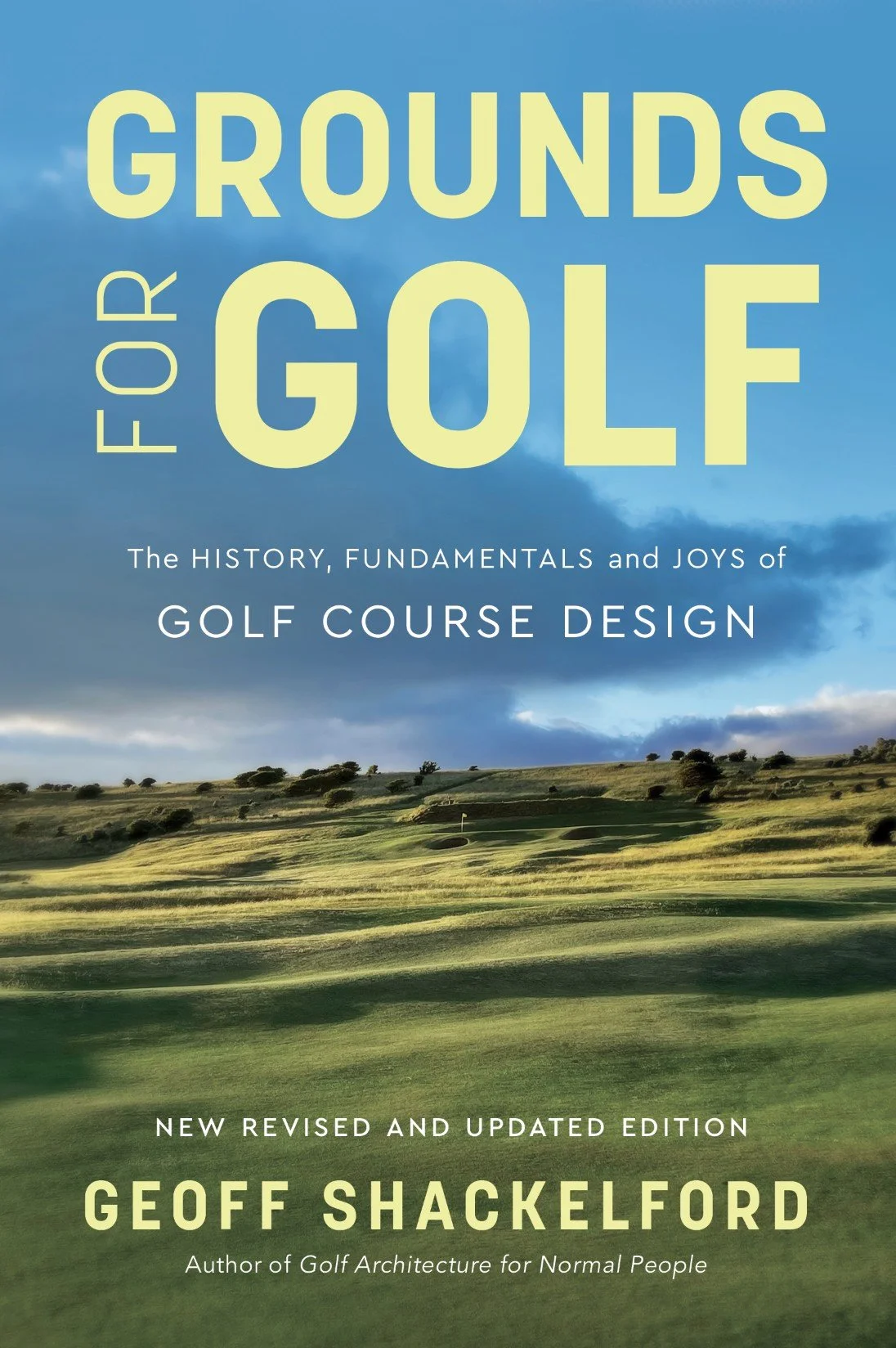
It’s back!
Twenty years later Tatra Press has kindly allowed me to bring back Grounds For Golf now that golf architecture is of more interest to the masses. A new Introduction looks at what’s driven the interest growth and two new chapters I had a blast adding (plus a few edits to keep things up-to-date).
The Amazon purchase page for the book arriving June 15, 2026.

Really, I'm just so sorry I wasn't there for Vijay's Hall of Fame Induction.
Oh, and nice to see that someone in the family owns a tie.
With the FedEx Cup playoffs on next year's schedule, players are looking at playing the year's last four events in a row -- the four FedEx Cup playoff events, culminating in the Tour Championship. The playoffs are preceded by the Bridgestone Invitational, a World Golf Championship event, the PGA Championship and the Greensboro tour stop. That means the top players will have to play six out of seven weeks. From the British Open on, they're looking at playing in seven of the final nine events and then, after a week off, teeing it up in the Presidents Cup or the Ryder Cup.
It was playing seven weeks out of nine this year that Woods used as his primary reason for skipping the Tour Championship. While he paid homage to next year's FedEx Cup in his withdrawal notice, you have to wonder if part-time warriors like Tiger and Phil will actually play seven out of nine next year, or any year. Because the money, as big as it is, doesn't matter. Not to them.
Mick Elliott on the Tour's sponsorless Tampa stop, which will be returning to Innisbrook in March:
Crazy is what this has become. Long ago it was common knowledge Chrysler planned a dramatic decrease in its golf sponsorship, ending tournament involvement for Tampa Bay, Tucson, Ariz., and Greensboro, N.C., after this year. Yet the season is ending with the PGA Tour and Tampa Bay tournament officials desperate and dateless.And...
A tournament designated worthy of a place on the spring schedule, played on a golf course players call one of the best and most popular on tour, and contributor of more than $8 million to local charities since its 2000 inception hasn't found a sponsor.
With the exception of two "out of the box" hopefuls - both invited by the tournament and both getting their initial introduction to golf - no corporate checkbooks searching for a place to put the company name set foot on Innisbrook during the week.
I'm just wondering how the Tour could move this event to March without having had a sponsor locked up? Did they underestimate Chrysler's desire to get out of golf?
Or was there a little Florida-is-wonderful bias that led them to assume sponsors would line up for a week at Innisbrook?
Because we know the resort didn't want to move to March and well, most importantly, the drapes and decor are outdated.
 There were several surprises in the USGA's announced Executive Committee "nominations."
Most notably, James Reinhart, currently a vice president, big fan of Erin Hills and distance measuring devices and thought to be the next president, is retiring. That will end the streak of presidential Augusta National members at two, which if nothing else, gives David Fay a two-year reprieve from answering questions about having president's of male-only clubs.
Craig Ammerman, a big fan of this scribe's work, is also retiring. And Lew Blakey, considered one of the top rules authorities in the world and who was strongly in favor of making the rules of golf more user friendly, will be off the Committee starting in 2007.
The other surprise is that being a venture capitalist seems to be the USGA's 21st Century answer to attorney-at-law.
The new members are: Christie Austin of Cherry Hills Village, Colo.; John Kim of Farmington, Conn.; and Geoffrey Yang of Menlo Park, Calif. Their bios:
Austin, 49, executive vice president of Marsico Capital Management since 2003, has been involved in the last two USGA championships held at Cherry Hills Country Club in Cherry Hills Village. Most recently, she served as vice chairman of the 2005 U.S. Women’s Open at Cherry Hills. She also was registration chairman for the 2003 U.S. Senior Open at Cherry Hills. A member at Cherry Hills, she recently won her 11th Club championship. She also has qualified for seven U.S. Women’s Mid-Amateur championships. Professionally, Austin, a CPA, helped found MCM in 1997 and served as its chief financial officer for six years until 2003. Today, MCM has 70 employees and manages more than $75 billion in assets. Prior to 1997, she helped found Englewood Mortgage Company in 1987 with her husband, Bob. They have two children, Michael and Julie. She is a graduate of the University of Colorado.
Kim, 46, has been president of Prudential Retirement (formerly CIGNA Retirement and Investments) since 2002, a leading plan provider that serves more than three million customers and manages roughly $140 billion in assets. The company has 2,500 employees. A graduate of the University of Michigan (BBA) and the University of Connecticut (MBA), Kim is a chartered financial analyst who has been an industry leader since 1995, when he served as chief executive officer at Aeltus Investment Management. In 2001, he moved to the president and chief executive officer role of BondBook, LLC. He and his wife, Diane, have three children: Andrew, Emily and Caroline.
Yang, 47, is a founding partner and managing director of Redpoint Ventures, a family of early stage venture capital funds based in California’s Silicon Valley. He is responsible for the firm’s investments in new companies, such as Ask Jeeves, Excite, MySpace, TiVo, Foundry Networks and Juniper Networks. Prior to 1999, Yang was a general partner with Institutional Venture Partners for 12 years. Born in New York, N.Y., Yang is a 1981 graduate of Princeton University. He earned a master’s degree in business from Stanford University in 1985.
Yang was also involved in starting Golfweb according to one story. I'm not sure why that was left out of the release.
A few things worth pointing out.
First, all three seem to be unusually wealthy with strong ties to corporate America. Not sure if that's a good thing.
Two of the new members are from the "west" and one from Connecticut, so they've made some progress on finding new blood from outside the Augusta-Hobe Sound circle of trust.
All three are surprisingly young for the USGA, which might bode well for some outside-the-box thinking.
Not so encouraging is that once again, the USGA has not managed to find anyone who is a public course player. Or at least, someone who was a muni golfer in the last 20 years.
 Thanks to reader Bob for noticing this Doug Ferguson description of the square driver K.J. Choi used to win at Innisbrook:
"(Choi) started using a new driver last week that not only is square, but sounds like someone swatting an empty cola can upon contact. Els played with Choi on Saturday and compared the sound to a tuna can attached to a shaft."
Tom Hanson continues his look at the TPC Treviso Bay's construction, with the dilemma facing player Hal Sutton: he doesn't like the planned short par-4 finish.
Eight months after breaking ground, the 18th hole is nothing but piles of dirt. But it's already providing loads of drama.
The lakes on the championship course in East Naples have been dredged. Negotiations to begin the shaping of the 7,200-yard layout is under way. And still there is one minor debate: Is a 320-yard, par-4, too, short?
That's the plan for the final hole at Treviso Bay.
With today's juiced balls and trampoline-effect drivers, players will have to decide if they want to drive the green or lay up and play it safe. The tempting proposition will make it possible for an eagle to win a tournament. Talk about instant excitement.
But not everyone is thrilled.
Hal Sutton, the PGA Tour player consultant on the project, isn't sold on the idea.
Sutton, standing by his classic golf course design theories, feels that a reachable par-4 will only create headaches instead of heart-stopping action. Sutton fears that the short strike will result in slow play. He also worries that the agony of defeat, (i.e. bogey, double-bogey or even a triple-bogey) will be taken out of the equation.
"Is it exciting that everyone is going for it and the difference between winning and losing could be an eagle?" Sutton said. "Or is exciting, OK there are 10 different ways to make a 3 here and only one way to make an eagle if you knock it in from the fairway."
"I think having a hole that short as the final hole is a real risk," Sutton said.
Arthur Hills, Treviso Bay's lead architect, and Chris Gray, the project manager for VK Development, both agree there is enough give and take with having a 320-yard finishing hole.
The hole is designed to be a slight dogleg to the left with water running down the entire left side. The green will be angled so that the lake will cause players to think twice about going for the green.
"There still will be plenty of risk but I think the reward will make it a unique hole," Hills said.
I love the idea of a short 4 finish. And at that point in the round, who cares about slow play? It's already been 5 to this point, what's another wait!
The final PGA Tour money list...well, the one that matters to the guys trying to make the Top 125.
David Owen pens a fascinating Tiger Woods profile for The Guardian. It reads more like a New Yorker piece and far much more interesting than his Tiger at 10 Year story for the August Golf Digest,.
Soak it up, this is all the Tiger you're going to get this week!
There was talk early in the week about these apparently ugly new square headed drivers tested out by the Callaway players in Europe, and I mistakenly chalked the articles up to scribblers hoping that Larry Dorman would send them a freebie.
But Mark Reason in the Telegraph dug a bit deeper and suggested this:
And it could become even harder for those Europeans to win majors next season if Tiger Woods takes advantage of the new square-headed driver that has been on show in Spain this week. So far the players have been reluctant to use the new driver in actual competition — although Thomas Bjorn employed it in Thursday's round of 78 — but they have no doubt as to its advantages.
They also believe that it might straighten out the one weakness in Tiger's game. After yesterday's round, Nick Dougherty said: "Thank God Tiger's driving like he is or there would be no point in the rest of us turning up. There almost isn't now. But if he starts driving it again like he did in 2000, then we really needn't bother because his iron play and short game is so much better than it was then." Dougherty believes that Woods might well turn to this new technology to minimise his weakness from the tee. He says: "Well, he looks like a traditional guy … but if he's still driving it poorly next year then I would say yeah, we will see him using it at next year's Open." The point of the square-headed driver that has been developed by both Callaway and Nike is that it doesn't twist as much on impact as conventional drivers — the introduction of super-slow-mo having shown, to the surprise of many experts, that a large proportion of crooked shots are the result of the clubhead twisting from the impact of an off-centre hit.
PGA Tour players are calculating precise distances while playing by yardages in the Chrysler Championship near Tampa, but golfers here are immersed in traditional golf. The three beguiling, walking-only courses at the much acclaimed Bandon Dunes Golf Resort invite golf that tells the player to throw away the yardage book."I don't know how far it is, but this is the club," a Bandon caddie is likely to say. Golfers can consult inconspicuous markers on the fairway, but most learn not to bother. The ground game matters, because the firm, fast fescue fairways welcome a bouncing ball. The golf's about more than the aerial game, into the fescue greens and the fairways.
Steve Elling has the excuse details...
Steve Elkington talking to The Age...
"This is just a good course, one of the better ones we play," said the battle-hardened veteran, who trailed American leader Brian Gay by three strokes at demanding Innisbrook.
"Some of the crap we play on is ridiculous. As big as the tour is, you'd think we could play some better courses."
"It's very frustrating," George said of the tendency to focus on what the Champions Tour is lacking rather than its strengths, "because I think we've got one helluva product. When you attend our tour on a regular basis, we've got some tournaments that are really stepping it up. But is there a buzz in every community? No. We need to get it there. We've told the tournaments that this tour is only as good as the weakest tournament."There's "buzz" at the events in well populated areas and when played at public courses. There is no buzz when the Champions play at suburban country clubs.
1. Bandon Trails
Bandon, Ore.
Bill Coore & Ben Crenshaw, 2005
2. Old Sandwich Golf Club
Plymouth, Mass.
Bill Coore & Ben Crenshaw, 2004
3. Trump National Golf Club
Bedminster, N.J.
Tom Fazio, 2004
4. Lakota Canyon Ranch Golf Club
New Castle, Colo.
Jim Engh, 2005
5. Boston Golf Club
Hingham, Mass.
Gil Hanse, 2005
6. Forest Creek Golf Club – North Course
Southern Pines, N.C.
Tom Fazio, 2005
7. Pronghorn Club – Nicklaus Course
Bend, Ore.
Jack Nicklaus, 2004
8. May River Course at Palmetto Bluff
Bluffton, S.C.
Jack Nicklaus, 2004
9. Stone Eagle Golf Club
Palm Desert, Calif.
Tom Doak, 2005
10. The Territory
Duncan, Okla.
Randy Heckenkemper, 2005
Geoff Shackelford is a Senior Writer for Golfweek magazine, a weekly contributor to Golf Channel's Morning


Copyright © 2022, Geoff Shackelford. All rights reserved.