Spackler Looped
/DUI in a golf cart? Seriously?
When you come to think of it that is the secret of most of the great holes all over the world. They all have some kind of a twist. C.B. MACDONALD
DUI in a golf cart? Seriously?
Steve Elling reports on the latest waffling from the other superstar who wanted the season to end earlier.
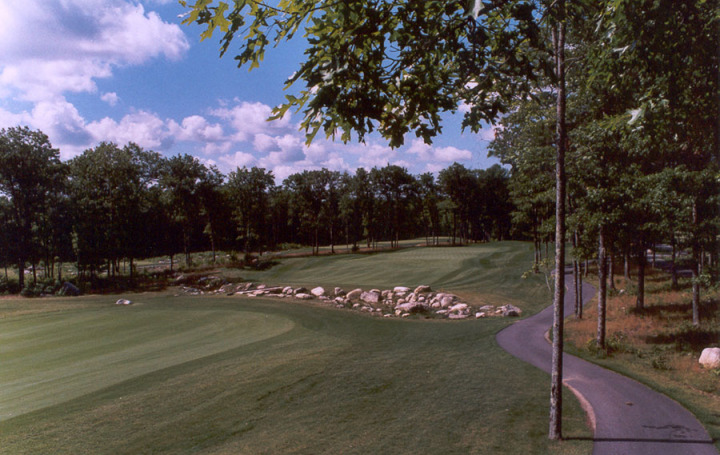
I will be posting more images in a few days, but thanks to TPC Boston superintendent extraordinaire Tom Brodeur, who managed a a major econstruction and grow in of his course since last year's Deutsche Bank event, we get to see some before/after shots of Gil Hanse and Brad Faxon's redo.
Home to next week's PGA Tour playoff event, TPC Boston was overhauled to reflect more of a New England-style look and feel. Much of the new-meant-to-look-old bunkering was crafted by Jim Wagner, who was recently featured in this YouTube video.
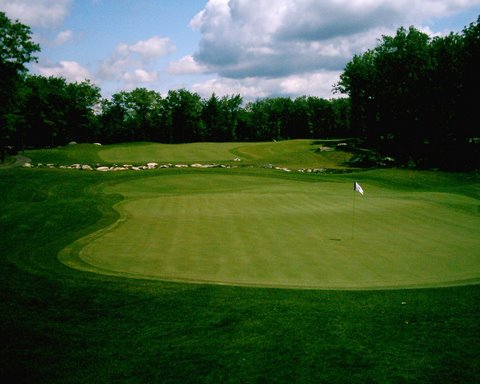
Here's the 17th hole's fairway view, before and after. Note New England style fescue bumps just off the fairway of this 420-yard par 4:
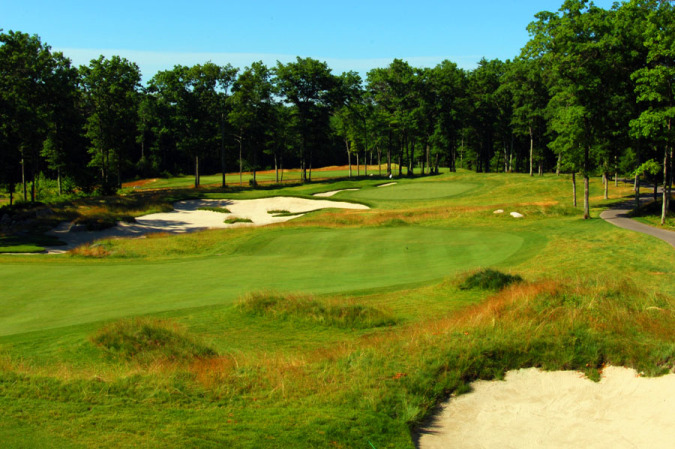
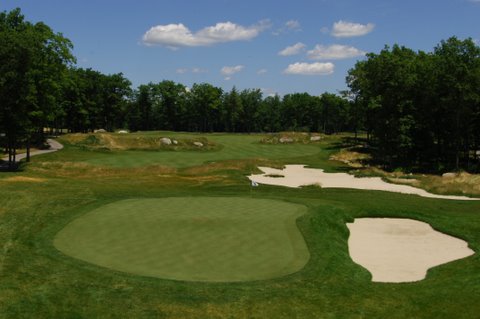
And the rear view of the 17th where the green has been reduced in size:
 Claudia Deutsch of the New York Times looks at the FedEx Cup ad campaign and serves up a nice warning for New York businessmen prone to rolling their eyes. Or maybe people eat this stuff up? That wouldn't surprise me either.
If you are south of Greenwich Street in Manhattan between noon and 5 p.m. today, look for a weird miniparade: A guy carrying a “quiet” sign followed by a golfer, his caddy and an entourage of nattily dressed “fans.”Just think of the poor struggling actors who have to play these parts out...in public. Then again, people are paid to perform Cats, so anything is possible.
Don’t think it’s another bunch of aging hippies commemorating the 30th anniversary of the Summer of Love. The stunt is part of the endgame in a long and expensive campaign by FedEx to drum up frenzy over the FedEx Cup golf playoffs that start at the Westchester Country Club tomorrow.
But now, the race to the pin begins. FedEx has set up a 12-story, three-dimensional billboard of a golf hole on a building on Greenwich Street, the starting point for today’s golfer’s walk. It has cloaked its delivery trucks in a green plastic wrap that simulates grass and that advertises the FedEx Cup.Oh but you haven't seen me TiVo through a telecast before.
It is peppering telephone kiosks, Pennsylvania and Grand Central stations, and the Port Authority Bus Terminal with what it calls guerrilla stickers — messages suggesting excuses for skipping work from Aug. 23 through Sept. 16, the duration of the event. (“The dry cleaners lost all of my shirts.” “The copier is jammed.” “I am downloading a file on dial-up.”)
The hoopla will be replicated in Atlanta, where the finals will be held: another staged miniparade will go through the business district there; guerrilla stickers will decorate the airport, train and bus stations; and rapid-transit commuters will be treated to cheeky observations like “most golfers will have played in the rain longer than it takes you to commute to and from work.”
Many of the commercials that FedEx will run during the tournament will continue to promote the cup, but others will promote services like printing (remember that FedEx now owns Kinko’s), shipping and supply chain management. Since most people watch sports in real time, “when you’re embedded in the event, you’re TiVo proof,” said T. Michael Glenn, executive vice president for market development at FedEx.
And golf, marketing experts say, is likely to establish an equally strong track record as an executive sport.
“Golf is one of the fastest growing sports, both for watching and playing,” said Michael Watras, president of the brand consultancy Straightline International.
And who apparently just came out of a 5 year coma.
Younger people, he suspects, embrace golf by choice; aging boomers turn to it by necessity.
“With tennis, your knees give out,” he said. “But with golf, you walk, you swing, you walk again. You can do that for a long time.”
Or take a cart.
 Golfweek's Adam Schupak offers a detailed and timely report on the PGA Tour's deferred compensation plans as they relate to the Fed Cup the most painfully obvious flaw of the event: the $10 million annuity for first place.
For those top FedEx finishers who make it to Champions Tour age, the miracle of compounding interest should ensure their golden years are lived on Easy Street. For Woods, or anyone else in his late 20s or early 30s, that’s likely more than 20 years of tax-deferred compounded growth.That $10 million annuity isn't looking so huge is it?
Dave Lightner, a partner in FSM Capital, a Cleveland-based financial planning firm that represents 60 professional golfers, predicts the numbers will be staggering.
“You could easily see guys with $250 million-$300 million in a retirement account,” he says.
The PGA Tour’s performance-based retirement plan is universally regarded as the most lucrative in sports (see story, page 48). It is not fettered by a maximum annual contribution; last year the average contribution for an exempt player exceeded $195,000, according to the Tour’s annual report to its membership. As first reported in Golfweek (March 24, 2001), a Tour member who sustains a lengthy career should be set for life thanks to his retirement account, which increases by at least $3,700 every time he makes a tournament cut.Now to the fun behind the scenes stuff...
This season, FedEx Cup bonus money has raised the stakes significantly. For instance, if Anthony Kim, the Tour’s youngest player at 22, wins the FedEx Cup and doesn’t dip into his retirement plan until he is 50, his $10 million bonus, compounding at 8 percent annually and doubling every nine years, would grow to $80 million.
Much about the PGA Tour’s retirement plan has changed with the advent of the FedEx Cup. What originally was devised as a safety net to compensate journeymen pros who never made it big has evolved into a tax shelter for the rich and richer. Though hardly anyone is complaining about competing for FedEx Cup purses (each of the four playoff tournaments is offering $7 million), several Tour members have protested that at least some of the bonus money, if not all, should be paid in cash – taxes be damned.
Those who want the money up front resent that the FedEx Cup was created to accommodate the Tour’s elite and not its rank-and-file. More significantly, the discord magnifies a growing schism between the Tour’s haves and have-mores. (Which can be defined as those who still fly commercial and those who travel in private planes.) Yet however one looks at the issue, there are more than 10 million reasons to compete in the playoffs.
Unable to influence their stars’ schedules, Tour executives eliminated the two incentive plans, and instead reallocated the $16.5 million in these two programs as FedEx Cup bonus money. Into this pot they added $18.5 million, thanks in part to the sponsorship deal with FedEx, and ditched the vesting requirements that punished players for not playing enough.But it's also important to note that is has been rumored that Tiger was against the annuity in place of cash as the FedEx Cup bonus. Was he looking at this from the fan perspective? These guys obviously weren't...
“The guys generating the show, bringing in the sponsors and TV dollars – and they’re only getting 62 percent? That wasn’t going to last,” says Tour veteran Sean Murphy, playing on the Nationwide Tour this season. “But by rolling it into the FedEx Cup, it allows these guys to keep playing their same old schedule (assuming they play well enough) and vest at 100 percent.”
For a player such as Woods, well on his way to becoming the first billionaire athlete, that’s significant.
“He’s got a chance to have 40 percent of his net worth in the retirement plan,” says Joe Ogilvie, a player director on the Tour’s policy board.
Some players contend the FedEx Cup was designed to benefit the Tour’s elite in other ways, too. What had been golf’s endless season left little downtime to conduct off-course business. There are courses to design and openings to attend, commercials to shoot, and, of course, family time. (Mickelson skipped the 2006 Tour Championship in part so he could take his children trick-or-treating on Halloween.) In exchange for playing three to four events in a row during the playoffs, and perhaps as many as six of seven events between the World Golf Championships Bridgestone Invitational and the Tour Championship, the superstars can call it a year shortly after Labor Day.
Nevertheless, in the final analysis, the FedEx Cup is a classic example of the rich getting richer. The top players benefit the most by deferring money into their retirement accounts. At that income level, say financial advisers, elite players need all the tax breaks they can get.
The decision to defer the FedEx Cup money ultimately rested in the hands of the Tour’s nine-member policy board, comprising four player directors (Stewart Cink, Joe Durant, Davis Love III and Ogilvie), four independent directors (Richard Ferris, Victor Ganzi, John McCoy and Ken Thompson) and the president of the PGA of America (then Roger Warren). According to an e-mail response from the Tour, the Tour policy board determined that a deferred compensation structure for the FedEx Cup was in the best long-term interest of the vast majority of players. That decision, in part, was based on the conservative premise that the Cup winner will have earned upwards of $5 million in prize money for the season – and likely wouldn’t be hurting for cash.
But according to several players who attended meetings to discuss the proposed FedEx Cup last year, the membership initially favored an immediate cash prize.
As talks progressed to the 16-member Player Advisory Council, an early show of hands produced a deadlock on the issue of how players should be paid. Then the Tour invited to PAC meetings several financial advisers who espoused the benefits of deferred compensation. Eventually, the PAC recommended retirement contributions to the Tour policy board. But the debate didn’t die there. The policy board, too, hashed out the pros and cons of deferred compensation at several meetings. They even considered paying half the bonus money in cash and deferring the other half to appease players who wanted at least some of the money up front. But the policy board voted unanimously in favor of 100 percent deferred compensation at a November meeting in Ponte Vedra Beach, Fla.
Jim Wagner, who did the bunker work that will be on display next week at the TPC Boston, talks on the latest Castle Stuart video about the "chunking" process that gives his bunkering such a unique look.
 A few more interesting FedEx Cup observations and anecdotes, this time from AP's writers and a Golf World scribe.
Tim Dahlberg notes:
This week in New York City there is a giant 12-story billboard advertising the start of the playoffs, and actors walking around in golf clothes to remind people about how important it all is. All year long, anyone who has been near a golf broadcast has been bombarded with the message that this is the biggest thing to happen to golf since Gene Sarazen holed his second shot on the 15th hole at Augusta National so many years ago.
Never mind that the whole thing is hard to understand, players don't like much about it except the money, and that it makes every tournament after it this year irrelevant. And forget for a moment that it pays the $10 million first prize in, of all things, an annuity that can't be cashed until long after Woods loses his hair.
I would agree with this, in part. Though the flaws in the system have something to do with the ridicule too:
It doesn't help that the FedEx Cup has become an easy target of ridicule, mostly because of the way the tour went about promoting it. It could have just announced the events and watched to see how it played out, but instead golf fans were bombarded with commercials touting the greatness of an event that had never been played, while golf announcers were forced to drink the Kool-Aid and play along.
Doug Ferguson notes that talk about next year's schedule is already a major issue.
The Ryder Cup will be played immediately after the four-week playoffs, leading to some speculation that Woods won’t be the only player who takes a week off during the playoffs.
“I’m disappointed in the schedule,” Jim Furyk said.
Someone asked Padraig Harrington if golf was less of a grind when he doesn’t have to think about the Ryder Cup, and he immediately thought about next year.
“That’s five in a row. That will be tough,” he said. “That will be a big ask, a big take from any player who plays in all five events. The Presidents Cup this year ... is such a big event, or the Ryder Cup is such a big event. It does require effort. Coming in off something as big as this, it’s a tough bit of work.”
And over at GolfDigest.com John Hawkins blogs this note about Tiger:
Bottom line? A guy who can find motivation in a kernel of popcorn seems to be suffering from a lack of incentive when it comes to the postseason. "We can't promise that everybody's going to play unless we have regulations," Pernice added, referring to everyone who might have been counting on Woods' unconditional commitment. "At some point, Tim has to sit down with Tiger and Phil [Mickelson] and find out what they want to do, because this thing won't work without them."
 An Ishtar reference. I think Gorant's "disaster" mention just got passed by! Does that supercede Elling's FraudEx Cup reference too? Eh...it's a toss up.
Steve Campbell calls the $10 million FedEx Cup annuity "a serious miscalculation" and really, that was the nicest thing he said in this Houston Chronicle column.
The question: Can you name a stud, a spud, a Fudd and a dud?And Tiger?
They haven't yet hit a shot that counts in the FedEx Cup playoff series, and the whole thing is beginning to look like the kind of idea that got Ishtar, Gigli and The Adventures of Pluto Nash on the big screen.
Just like that, Woods rendered the Cup about as meaningless as Paris Hilton's views on tackling terrorism. Just like that, Woods made who isn't playing The Barclays the story instead of who is playing. Just like that, Woods set the cause of golfers as actual athletes back into the 20th century.Meanwhile Tod Leonard in the San Diego Union Tribune is a bit kinder. A bit.
He is supposed to be the fittest, finest athletic specimen of a golfer on the planet. And after a week off, Woods is sitting out the first round of a playoff series designed to inject life and interest into his sport because he's too pooped to play.
His actions, in other words, speak much louder than the words he uttered the week of the PGA Championship: "I know we're trying to build a lot of excitement towards the end of the year where it's been a dull period, and this might do it."
Woods did it to the FedEx Cup, all right. He lobbied for a shorter tour season. PGA Tour commissioner Tim Finchem delivered a points-race system that ends seven weeks earlier than last season did. Woods wanted a tour event to call his own. Finchem delivered the AT&T National, which became yet the latest benefactor to the Tiger Woods Foundation.
The PGA Tour convinced FedEx and other sponsors to ante up $28 million in cash prizes and another $35 million for a deferred-payment pool for this inaugural year alone. Those companies and the TV networks expect a payoff in public interest, measured by buzz and ratings.And...
So far, the buzz has been in a frequency only dogs and tour execs can hear, but that is expected to change this week, when the first of the four playoff events, The Barclays, is contested beginning Thursday at Westchester Country Club in Rye, N.Y.
Woods, citing fatigue after two straight wins, essentially took a first-round bye when he decided last week not to play at Westchester, where he has never excelled. But he is expected to participate the following three weeks, when the initial field of 144 qualifiers is eventually cut to 30 for the Tour Championship in Atlanta.
The winner of the playoffs gets $10 million, which the tour is touting as the biggest prize for an individual in pro sports, but there is a huge caveat to that. It will be paid into a retirement account and the champ might not see that cash for 20 years.
Oooooooh, doesn't 401k talk just send chills up your spine, like watching that green jacket ceremony each April?
Anytime the math goes beyond season records or games behind, they lose most of us. Same for dollar figures. We are numb to, and mostly resentful of, the outrageous money athletes make these days. Why emphasize it?
Thanks to the math, it's also possible the winner of the Tour Championship won't be the champion of the FedEx Cup. “Great victory Phil, now please go away so Tiger can accept the FedEx trophy!”
Weak.
 I finally got around to Alan Shipnuck's SI piece on Angel Cabrera, which unfortunately was relegated to the Golf Plus Fed Ex Cup stand alone issue. Unfortunate because it's an oustanding and revealing read that should have made the main issue. Well, those NFL training camp spreads are pretty special.
Anyway, don't miss this. And because I'm kind, the link is to the single page version to save you the trouble of the nine-page version.
Ron Sirak says it's a blessing that Tiger is missing the first event, but he's in the minority on that one.
David Whitley in the Orlando Sentinel isn't so kind.
The FedEx Cup was a contrived money-grab to begin with. When the sport's pre-eminent star blows off the opening act, all credibility is lost. It's like baseball starting the playoffs without the Red Sox, Angels, Mets and the national anthem. Tour officials are trying to put a happy face on things, but they must feel as if they've had a graphite shaft plunged into their backs.
Doug Ferguson reminds us that the Tour tried this once before at the Vantage Championship and has this from David Toms, talking about the $10 million annuity:
"If you have kids old enough to understand, they're more excited about the $10 million than we are because they're the ones who are going to end up getting it," David Toms said.
Furman Bisher sees it as a threat to...uh, the Champions Tour?
The tour is the stage on which he performs and creates his endorsement connections. For that matter, it isn't cash in hand, anyway. At first the payout was referred to as an annuity, then later it was changed to "deferred compensation." Thus, players don't collect their winnings until they retire from tour competition, and not before they reach age 45, this affirmed by the office of Bob Combs, vice president of communications.
This might be a threat to the prosperity of the Champions Tour, for how many seniors might decide to take early retirement with a fat deferred payment there to be collected?.
Gary Van Sickle offers ways to fix the FedEx Cup before it even starts.
And Douglas Lowe sees plenty of positives...for the European Tour.
After the play-offs, there will be lesser PGA Tour events at which the lower orders can fight out who retains their Tour cards and at that point, with no significant competition from the US, the focus will return to the European Tour, which will be lifted by the returns of Harrington & Co.
The British Masters that has recently heralded the start of British involvement on the Tour in May has been shifted to September 20 to 23, the week after the Tour Championship, to mark the start of a strong tail-end of the season.
The Seve Trophy, Dunhill Links Championship and HSBC World Matchplay Championship will follow in a rousing conclusion to the European Tour, leading up to the Volvo Masters in Spain.
Leave ESPN for the USGA? Now that takes a certain, uh...vision! Thanks to reader Phil for this, which did not land in my email box. You don't think they would...no, not the USGA I love and know!
FOR IMMEDIATE RELEASE
USGA APPOINTS ALEX WITHERS
AS DIRECTOR OF NEW MEDIA
Withers leaves ESPN new media post to take newly created USGA position, reporting to Chief Business Officer Pete Bevacqua
Far Hills, N.J. (August 20, 2007) – The United States Golf Association (USGA) has named Alex Withers as the organization’s director of new media, a newly created position making Withers responsible for the overall online and new media efforts of the USGA, with the goal of maximizing online advertising, partnerships, e-commerce initiatives, and industry events to drive revenue and improve the USGA’s core functions.
Having most recently held the position of marketing director for ESPN New Media, Withers brings to the USGA over ten years of marketing and product development experience across a range of global brands. While at ESPN New Media, he managed the marketing strategy and brand positioning for both ESPN.com and ESPN360.com, which included the launch of the myESPN personalization tool as well as the sites’ networking platforms. Prior to his work with ESPN, Withers oversaw marketing, digital, and branding initiatives for the Financial Times and Pepsi Cola. He earned his bachelor of science honors degree in business administration from Britain’s Cardiff University.
Withers’ expertise will first and foremost position the USGA to better identify and capitalize on a range of interactive digital and online capabilities that will ultimately raise awareness of the organization, as well as communicate the USGA’s numerous initiatives and goals.
"As an avid golfer, I’m looking forward to putting the USGA front and center among the next generation of golfers via the online platform,” said Withers. “This is an exciting time for the USGA, as we are tasked with the responsibility of maintaining the history and tradition of golf, whilst helping the sport come of age in a digital world."
"Alex is a perfect fit for the USGA and the ideal person to bring our digital vision to life," said Peter Bevacqua, USGA chief business officer. "A key growth driver and top priority for the USGA is to make our organization relevant and appealing to a younger generation of digitally savvy golfers. We’re looking forward to connecting with them online and, in doing so, making it possible for our members to connect with each other and the great game of golf."
Thanks to reader David for catching Jeff Maggert's remarks to the News-Record's Ed Hardin:
"Probably half the players out here couldn't care less about it," he said of the FedExCup. "The other half are indifferent."
That's hardly the marketing phrase Tour officials want to hear heading into the playoffs, and if Maggert's feelings reflect anything close to those of the rest of the players, Finchem's postseason playoff experiment is doomed.
"I hear a lot being written, but I don't see anybody writing anything about Finchem," Maggert said. "I mean, this was his idea. He really didn't consult any of the players. He kind of shoved it down our throats and said, 'This is what we're going to do.' "
I think reader Toby is right: if The Onion is making fun of the FedEx Cup, something is really wrong with the concept.
Geoff Shackelford is a Senior Writer for Golfweek magazine, a weekly contributor to Golf Channel's Morning




Copyright © 2022, Geoff Shackelford. All rights reserved.