"Money games seem to have gone the way of the niblick and stymie."

Thanks to reader John for catching Jim McCabe's excellent overview of practice round gambling in pro golf:

"It's different out here. It's way too serious," said Brett Quigley, who isn't against tossing down his own money to back his game, except his colleagues seem to prefer the company of swing coaches, sports psychol ogists, and agents as they walk the fairways in practice rounds. A spirited Nassau? Not enough of his peers seem to go for that sort of thing anymore, "at least, not like when I was watching Dana grow up."

That would be his uncle, Dana Quigley, who at 60 is old enough to remember when money games during practice rounds were standard.

"I'm sure guys would still want to do it, but the fact is, they're all in their private planes, going home between tournaments, so they don't travel together," said Dana Quigley. "It's too bad, but there's no one around to have money games with."

Certainly not like the days when players such as Doug Ford and Bob Goalby were part of the traveling PGA Tour show.

"We had to play the money games," said Ford, a two-time major champion. "We made our money in the practice rounds."

To illustrate his contention, Ford recalled a practice round at the 1957 Masters when a colleague challenged him. Accepting the game and the stakes, Ford pocketed a sum of money that nearly matched what he made later in the week when he captured the coveted green jacket ($8,750).

OK, that pales in comparison to the gaudy sums that Mickelson and Huston took from Daly, but Goalby offers reminders of inflation and perspective.

"You'd probably have to play a $100 Nassau to match the $5 and $10 Nassaus we played for," said Goalby. "The only difference is, we didn't have the sort of money that these fellows do today, so the pressure was probably greater back then, because we couldn't afford to lose what little money we had."

Still, Goalby doesn't begrudge today's players for their treasures.

"They're so much better than we were, it's unbelievable," said the 1968 Masters champ. "They drive the ball better, they putt it better, they practice more."

But Goalby offers a disclaimer.

"But I think we had a better time playing golf in our day," he said. "We definitely had better times in our practice rounds. I'm sure of that."

 

U.S. Amateur Final Set

506-t.gifI was wrong when I posted that Colt Knost wants to be the next Tom Scherrer. He wants to be the next Chris Patton. Holy guacamole is he, well, uhhh...let's just say I hope they pad that U.S. Walker Cup budget so Buddy Marucci can meet Colt's dietary needs.

Ryan Herrington blogs about Colt's so-called Masters dilemma, and Colt says no matter what there is no chance he's remaining an amateur to the U.S. Open should he win Sunday.

Meanwhile there is this unbylined game story on Saturday's matches, while Dave Shedloski also looks at Knost, Ken Klavon writes about the other finalist Michael Thompson and Alex Miceli posts notes.

And Yet More FedEx Cup Reviews

fedexcuplogo.jpgNot since Tiger turned 30 have the scribes found such an easy column, only in this case, they're actually interesting to read. Chris Lewis lists various reasons to question the playoff concept but loves that it has revealed an "unparalleled surfeit of tour pro honesty."

Meanwhile John Huggan says the FedEx Cup...

...is merely the latest attempt by commissioner Tim Finchem to set a place for himself at golf's top table, where sit the Masters, run by the Augusta National Golf Club; the US Open (United States Golf Association), the Open (Royal & Ancient Golf Club), the USPGA (PGA of America) and the Ryder Cup (PGA of America and European Tour). The world's biggest and richest circuit, the PGA Tour, has long been driven crazy by its almost total lack of influence over any of the game's five most important and lucrative events.

Which is why the Presidents Cup matches, a glorified exhibition between a 12-man team from the US and another drawn from anywhere and everywhere except Europe, exists. Ticked-off Tim wants to be the centre of attention.

Sadly for his sizeable ego, however, the Fed-Ex Cup has just about the same level of (in)credibility as does the transparently tacky PC, a biennial affair that is but a pale imitation of the Ryder Cup.

Also check out Huggan's column for his review of Scott Macpherson's new book on The Old Course. 

TPC Boston Before/After 8th Hole

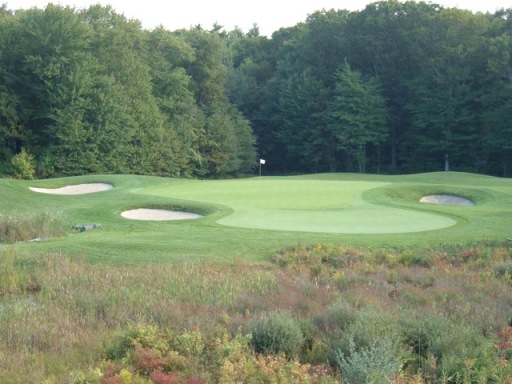
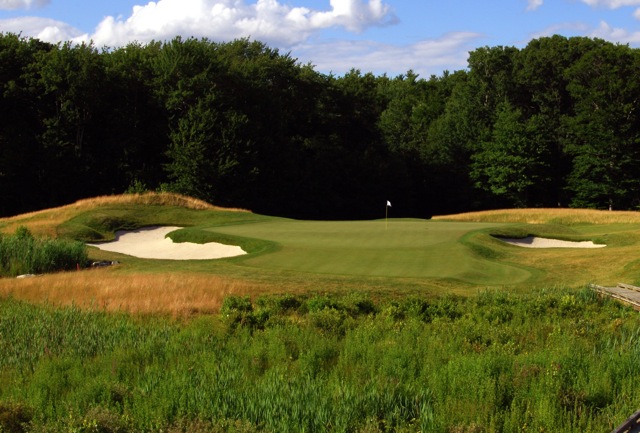
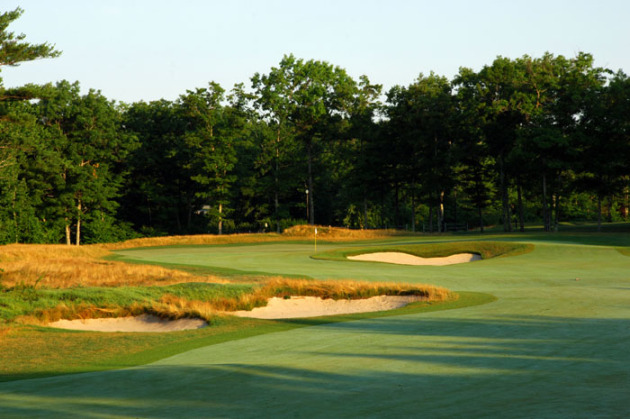
The TPC Boston's 213 yard par-3 8th appears to not have provided the Hanse-Faxon-Wagner team much to work with, but the bunker has less of that lovely Rees quality to it in the after shot (below). I also like the little bumpy ridge cut out short right that eliminates some of the modern shaping look and probably helps the player see into the right bunker better.

TPCBoston__before3.jpg 

TPCBoston8thafter.jpg 


U.S. Amateur Saturday and Other Olympic Club Observations

506-t.gifI'm a little behind because the matches are underway, but for those tuning Saturday at 1 on NBC, a few stories will acquaint you with the final four.

Beth Murrison has the Friday game story summing up the day's play with a nice overview of the semifinalists.  Art Spander writes about Jhonattan Vegas, whose impressive game I got to see some of Friday. There's also Dave Shedloski on Colt Knost and Stuart Hall on Michael Thompson. 230136-992923-thumbnail.jpg
A big gallery follows the Vegas-Pan match Friday (click to enlarge)

As for the event, it was my first U.S. Amateur and if you've never been, it's one of the great spectating experiences in golf. Very few ropes dot the property and you get the chance to roam a great golf course watching elite golfers. Until you see it, you forget how unique it is to get so close to such high quality play in today's game. 230136-992909-thumbnail.jpg
(click for a word from USGA sponsors)

As for Olympic, it remains one of my very favorite places in golf thanks to the atmosphere, singular design and fond memories from playing USF's collegiate event there. I was a both thrilled and disappointed in how the course looks. On the sensational side is the extensive tree removal work since the U.S. Junior Amateur that has left mostly Monterey Cypress and some pines. Vistas have been opened and the Cypress look more impressive than ever. The view from the clubhouse of No. 3 green is particularly eye-catching.

230136-992905-thumbnail.jpg
View from behind No. 8 (click to enlarge)
The fairways and greens looked to be in fine playing condition, but outside the main playing areas, the course looks worn out. And there is a difference between looking natural and rugged, and appearing beat up.

Here it was the U.S. Amateur, with very limited galleries and it looked like Tuesday after a PGA Tour event. The many fescue native areas that looked so good during the U.S. Junior Amateur now look less appealing, with too many non-native weeds and a less than satisfying appearance.

Bunkers were recently resodded so it's hard to say how the sod will settle, but right now the bunkers have lost some of their gracefully aged look. Give them time and play and I suspect they'll settle back into their classic antique look. 230136-992914-thumbnail.jpg
New tee on No. 3 stretches it to 247 (click to enlarge)

Several new tees were in play since my last visit, and while the third and fourth were conceptually fine, the execution was uninspired and in the case of the third, they appeared to have been done very close to the Amateur. Two new modern and even less inspired practice greens right below No. 3 don't exactly add much ambiance either. I have a feeling this overall feel may be the reason Olympic has slipped a bit in some of the recent course rankings.

And just to be the broken record I am, the fairway widths were incredibly depressing. On a course where the slopes and trees are such a prominent part of the design, the confining widths just seem to keep errant balls in play instead of taking missed shots to greater trouble. When firm and a lot wider, Olympic is infinitely more interesting to play or watch. I would contend that when it is firm enough, as it was Friday, it is far more difficult the wider it gets. I have played it when it's wider and it was exhausting! In a good way.

230136-992934-thumbnail.jpg
Rough around and behind No. 6. What a contrast to Southern Hills (click to enlarge)
Two narrow fairway examples come to mind: No. 2, with it's beautiful helping slope to the right and steep fall off to the left was reduced to a meaningless sliver, while No. 6, at a paltry 22 yards wide and featuring the lone fairway bunker, offers nothing but rough over that bunker, even though a player should want to hug the hazard and the left side to get at right side hole locations (and tee shots missed left trying to secure this angle find serious trouble).

Of course it would help if the guys weren't hitting wedges into a 440-yard hole, but that's an issue for another department in Far Hills. I hope that by the 2012 U.S. Open some of the fairways are tweaked.

Still, for overall tournament golf atmosphere, I don't think there are many better places than The Olympic Club. 230136-992937-thumbnail.jpg
One of the game's great scenes, No. 18 at Olympic Club (click to enlarge image)


More TPC Boston: 16th Before and After

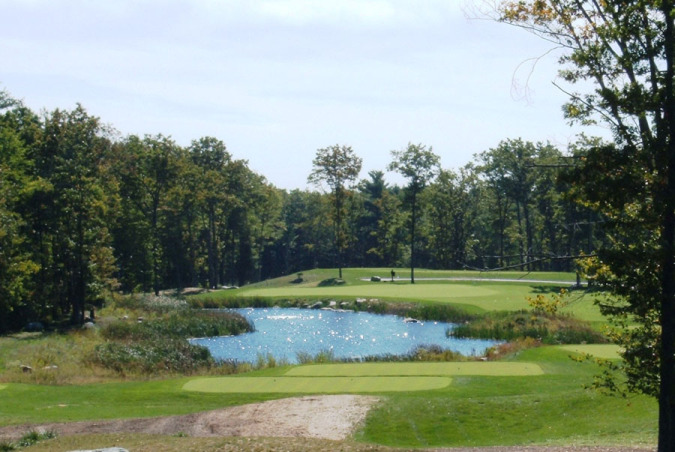
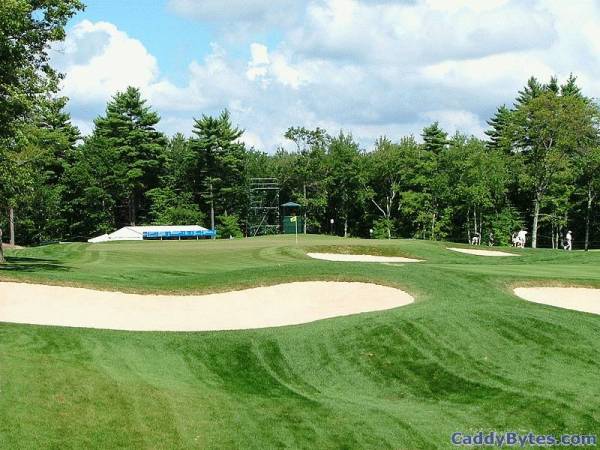
I believe this is a new green by Hanse/Wagner/Faxon at the TPC Boston, with the par-3 shortened and the green given more of a peninsula effect that should make Sunday hole locations fun.

Before and after, with the old green site sitting where you see the reddish fescue grass:

TPCBoston16Before.jpg 

TPCBoston16after.jpg 


"Rory Sabbatini still found a way to tug on Superman’s cape"

That's Steve Elling writing about Rory Sabbatini's latest comments directed toward Tiger. Now, they say the definition of insane is when you keep doing the same thing ov...you go Rory! We love when Tiger wipes the floor with you!

His favorite foil, Tiger Woods, isn’t even in the field this week, yet cantankerous Rory Sabbatini still found a way to tug on Superman’s cape and court another mini-controversy.
 
Sabbatini shot an 8-under 63 Thursday to take the first-round lead at the inaugural FedEx Cup playoff event, The Barclays at Westchester Country Club, but he couldn’t resist taking the bait when the topic of Woods’ controversial absence was broached.
 
Sabbatini, whose opinionated honesty has repeatedly landed him in some sticky situations with regard to Woods this year, characterized the decision of the game’s top player to skip the first round of the mega-hyped playoff series as an embarrassing black eye.
 
“It's a disappointment because, obviously the whole purpose of this new system was to try and create an atmosphere that would draw everybody to the final four events of the year,” Sabbatini said. “Obviously, it's kind of backfired in the sense by Tiger skipping the first event.
 
“It leaves a lot of questions and a lot of interesting questions to what they need to do, to maybe change it so that you definitely have the incentive to play all four.”
 
Sabbatini, who won earlier this year at Colonial and stands sixth in FedEx Cup points entering the week, said those who skip stages should suffer a penalty of some sort and possibly should not receive the full $10 million bonus if they win the four-week race.
 
“There's many guys that play on tour that are out of shape and they play six, seven weeks in a row,” Sabbatini said. “It's just, I don't know if there's any solution to it, but there's got to be some kind of financial incentive.”

This ought to go over particularly well in Orlando this week. 
Woods’ claim that he was too tired to play after winning back-to-back weeks at the Bridgestone and PGA Championship rang hollow in Sabbatini’s ears. For Woods, the FedEx bonus money is probably no great windfall, odd as it might sound to civilians out there, he said.
 
“Oh, I definitely think it's something other than fatigue,” he said. “Well, I think maybe to some people $10 million doesn't seem like a whole lot of incentive but to others it would seem like a good incentive.”

 For more of Rory's thoughts, here is his press conference transcript.

"His dad taught him a lot outside of golf that has carried over into the way he plays"

Tim Rosaforte posts a peculiar little blog item about Andrew Giuliani, the Duke golfer and son of presidential candidate Rudy.

It didn't surprise Phil Mickelson that Andrew Giuliani (right, with Tiger) was doing so well in the Met Open, shooting 71 in the opening round Wednesday at the Meadow Brook Club on Long Island. Lefty and the former New York City mayor's son played in the Buick Classic Pro-Am a few years ago, before Giuliani enrolled at Duke, where he is entering his junior year as a walk-on member of the golf team. "He's got game," Mickelson told me after his opening-round 67 at The Barclays.

Rudy Giuliani is an 18-handicapper, but in Mickelson's mind, Giuliani's 21-year-old son got his father's disposition. He lists a muny, Van Cortlandt Park, as his home course, but also plays out of Trump National in Briarcliff Manor. "His dad taught him a lot outside of golf that has carried over into the way he plays," said Mickelson. "He doesn't let bad shots affect him. He plays without fear. He plays aggressive. He plays smart. He's got a good overall way to attack the game."

Uh, that stuff his dad taught him outside of golf. Was that when they were still speaking?


The Promotion Or The Format?

fedexcuplogo.jpgRon Kroichick says what others have been saying, namely that the Tour's promotion of the FedEx Cup is largely to blame for fan and media apathy:

The flaws of the FedEx Cup, then, begin with how Finchem and other tour officials promoted their pet project. They tried to jam it down our throats all year, as if the playoffs really were more important than the majors. They didn't put it that way, of course, but the implication turned off many fans (and players).
It seems to me that while that is true, the PGA Tour is in a tough position because of a perceived need to cater to "tradition."


Now, I'm just as guilty as anyone of revering golf's traditions, but if the promotion conveyed that the FedEx Cup was simply a new, fresh way to conclude the year and merely meant to entertain us, would they have been raked over the coals for daring to imply that professional golf is in the entertainment business above all else?

I'm afraid so. Which is a shame, because the pro game needs more variety outside of the major season. The Tour needs ore interesting formats, more diverse courses and more variety in setups.

But it seems golf, and in particular, pro golfers, are too conservative and devoid of imagination to accept anything outside of 72-holes of stroke play each week played on a course looking pretty similar to the one played the week before.

So has the promotion rubbed you the wrong way or is it the format?