Rule 78 On The Way Out?

Finally someone (Doug Ferguson) files a piece on the possible Rule 78 change following Tuesday's meeting.

A tour official said on Wednesday that the 16-man Players Advisory Council, which met this week at Riviera Country Club, wants to return to the traditional 36-hole cut of the top 70 and ties. If that results in more than 78 players, another cut on Saturday to the top 70 and ties would help reduce the field for the final round.
This should be interesting considering that the four involved have been vocal in defending Rule 78:
The policy board will vote on the proposal at its Feb. 25 meeting at the Honda Classic in Florida. Because it relates to competition, the vote must get majority approval by four players on the nine-member board.


"This might have been the best ham and egg job of all time"

Thanks to reader Chris for this follow up from Golf Las Vegas Now on Billy Waters' sandbagging remarkable  performance at the AT&T.

"It was the most phenomenal week of golf that I've ever had."
 
"I have never, ever, ever putted that well I don't think," says Walters, who admits to having the yips in the weeks leading up to the tournament but received a magic grip that ended those. "I don't think I ever missed anything inside of 10 feet the entire tournament."
 
"This might have been the best ham and egg job of all time," says Walters.


Greetings From Los Angeles, Vol. 2, 2008 Edition

greetingsfromLA.jpegLet's get the important gossip out of the way first: Phil is an iphone man. I'm sorry to all you Motorola and Nokia hopefuls, but I just report what I see.

A twenty degree temperature drop did not improve my odds of getting decent answers out of the PGA Tour's finest. I was working the range and putting green in search of interesting quotes for a story I'm working on and mostly heard the same stuff I've heard for the last few weeks. Perhaps everyone was just too overwhelmed to speak after seeing Vijay's new swing, which looks a lot worse in person. 

Stack and Tilt man Andy Plummer was on the side tee and I spent an enjoyable few minutes hearing about his background and teaching philosophy. It's incredible how many players appear to be adopting S&T. 

The best rumor of the day comes from a player who says that Paul Azinger is so worked up over drug testing that he is attempting to organize a player revolt starting July 1st when the tests begin. I think I'm understanding why we did not have a media room sit down with Azinger and the PGA of America's Julius Mason, a Ryder Cup year tradition in L.A.

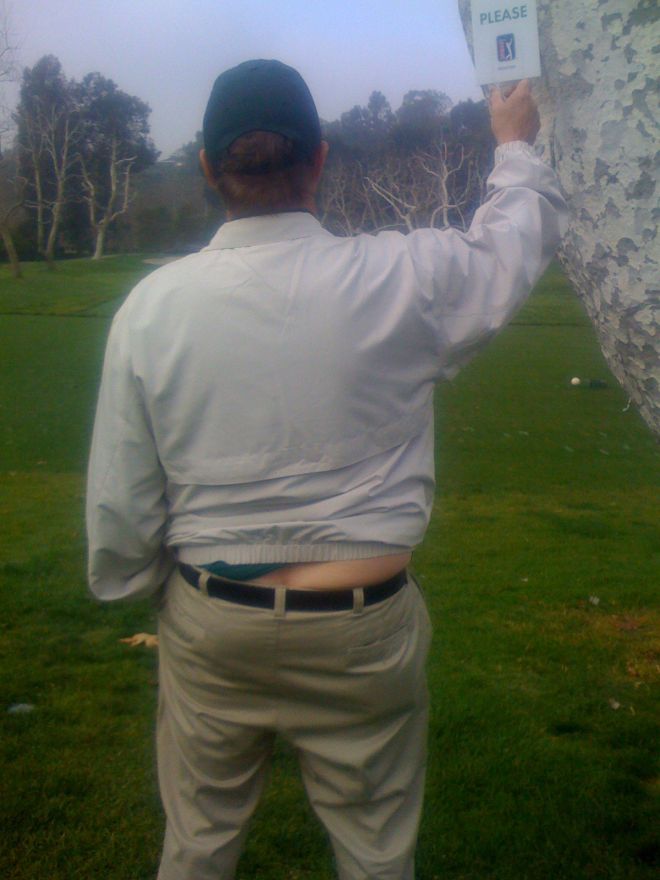
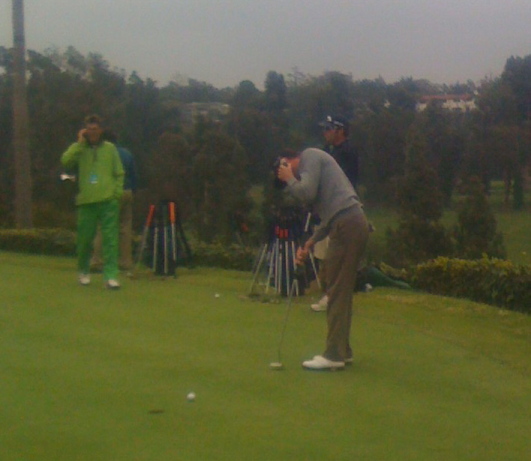
And finally, my favorite images of the day, starting with an underwear-challenged volunteer followed by an unidentified player who practiced his putting one-handed for a solid 15 minutes. Granted, it was a belly putter but still, could it be the next big thing?

MarshalCarpentersCrack.jpg 

PlayerPuttingWithCellPhone.jpg 


"It's about unchaining from a relationship but in a broader sense, the feel, the rhythm is kind of airy feeling."

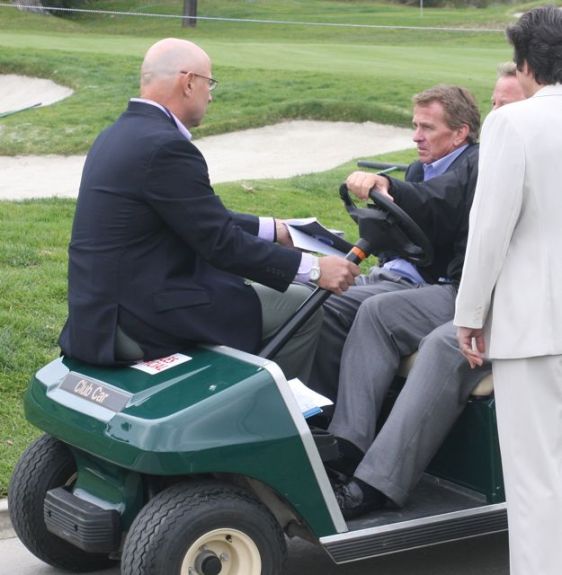
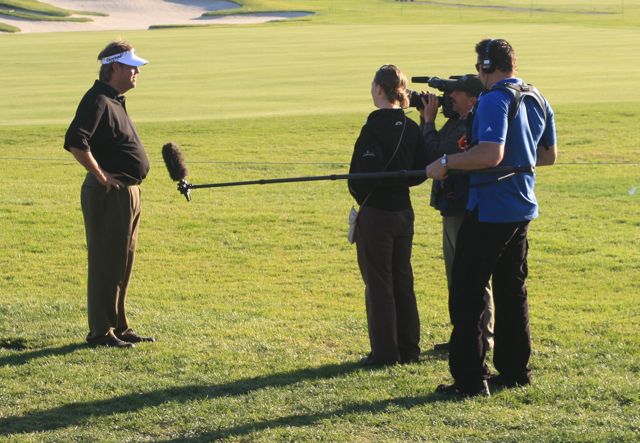
Commissioner Tim Finchem for a Golf Channel roundtable with Tim Rosaforte, Rich Lerner and New York Times correspondent Larry Dorman as part of a what media tenters said is an intentional "rebranding." Oddly, it did not include an exclusive to GeoffShackelford.com's reporter on the property, but I'll keep trying.

roundtable_450.jpgWhile Golf Channel hasn't posted the interview online (and scheduled to air this weekend on Golf Central), we have a few hints of what to look for. Note the photo from PGATour.com, where Larry Dorman looks like he's just sat through one of the Commish's mind numbingly wordy answers.

Helen Ross at PGATour.com sat in on the chat and shares some of the stunning revelations we can look forward to.

Finchem talked about drug-testing, the success of the FedExCup and the TOUR's new cut policy, which is currently being reviewed. The most interesting part of the wide-ranging, 45-minute discussion, though, may have been about the commissioner himself.

Like his prowess in the kitchen, which is as considerable as Finchem's solid 5 handicap on the relatively rare occasions he gets to play golf. While it's been written that he's a gourmet cook, Finchem stopped well short of calling himself a chef.

"I follow recipes -- there's a big difference between that and being a chef," a relaxed Finchem said with a smile. "I find cooking to be therapeutic. I don't know if I am a single digit handicap as a cook, though. It depends on what I'm cooking."

And what would a Finchem rebranding be without a mention of that Steel Wheels tour, back when Charlie Watts had dark hair and people still bought CD's.

Finchem, as the father of three teenaged daughters, is marginally acquainted with hip-hop and rap. His tastes, though, run more toward classic rock and roll, most specifically the Rolling Stones and the Eagles.

"Steel Wheels, was in '89, '90," Finchem said, "flexing his rock and roll chops," Lerner interjected. "In '94 when the Stones were in San Francisco during THE TOUR Championship, that was a pretty good show.

"(I like) the Eagles, too. I went with Peter Jacobsen in '96 to see the Eagles, and of course, Glenn Frey is a big (golfer). They're probably the best band of all time. I've seen them twice since. They put on a phenomenal show."

You don't think Freud would have something to say about Finchem's favorite song?

Among his favorite Eagles songs is Already Gone. "The song just makes you feel freedom," Finchem said. "Just personal freedom. It's about unchaining from a relationship but in a broader sense, the feel, the rhythm is kind of airy feeling."

Already gone? Hmmm...wonder if that's what he cranks up on those days when John Daly is being John Daly?  

Greetings From Los Angeles, Vol. 1, 2008 Edition

greetingsfromLA.jpegGreetings from the  Los Angeles Open  Glen Campell Los Angeles Open  Los Angeles Open Presented by Nissan  Nissan Los Angeles Open  Nissan Open Northern Trust Open. The new sponsors clearly have money to burn along with the PGA Tour's best championship management folks whispering in their ears. The signage and presentation has been classed up (except for one tacky decision you can see in the photo below). More importantly, the media center upgraded significantly (I know that's just the news you were waiting to hear).

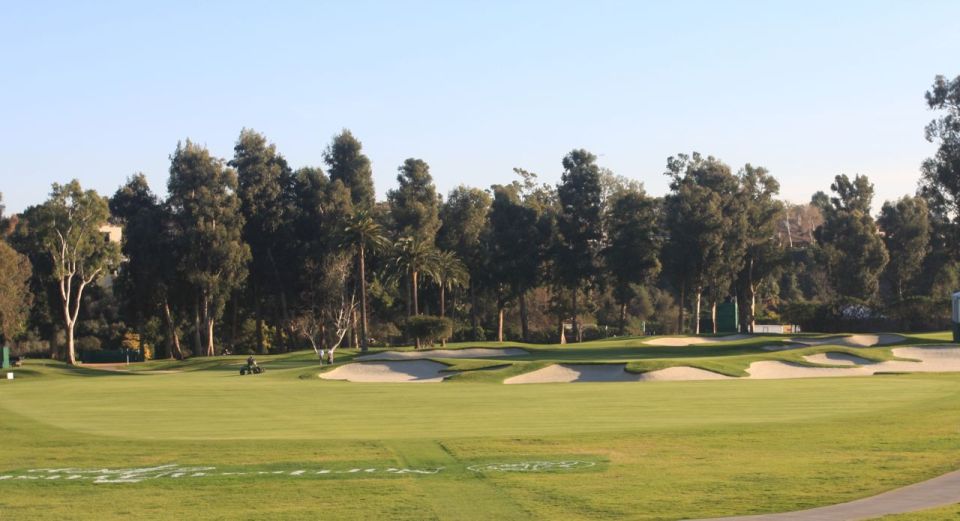
I toured the back nine today with John Mutch of the PGA Tour field staff and watched him prepare his plans for hole locations and tee placement. The excellent greens seem soft to the foot but balls are taking a nice first bounce before checking, so it should be a lot like last year's excellent event where you'll see plenty of good rounds rewarding accurate play and yet a nice dispersion of scores. The way it should be.  

Who it favors? I have no idea. Go with Daniel Wexler's preview and his listing of the betting odds for a better idea.  

Sadly, the pre-tournament talk is not about green firmness but instead, about rough, which is very benign. Just once it would be refreshing to read a pre-tournament article about how they are hoping to firm things up, not about rough heights and density. With today's grooves, it really is pointless to worry about rough when it's firmness that tests the players.

As always, the highlight included watching guys play No. 10. Steve Marino missed a hole in one by two inches, but even more fun was talking to Zach Johnson about his strategy depending on the hole location. Laying up all four days is not in the cards.

Tiger's absense certainly can be felt in the size of the crowd, which was tiny. However, I haven't yet to hear anyone say they really miss him. Which is good since I don't think he'll be back anytime soon. Still, with 17 of the top 20 in the world on a great layout with a solid weather forecast, the "Northern Trust" is doing just fine.

Riviera10NorthernTrustLogo.jpg 


"Steve Lowery looks like he might do 10 minutes of breathing exercises or something."

On his CBSSports.com blog, Steve Elling shares this from Fred Funk:

"Not everybody’s in great shape on the Champions Tour or the regular tour," said Fred Funk, appearing at media day Monday for the Ginn Championship in Palm Coast, Fla. "I’m going to throw Steve Lowery under the bus. Yesterday, I came back from practicing, and I got home just in time for the playoff, and here’s Vijay Singh, who works out who knows how many hours a day plus hitting balls how many hours a day – 12 hours of his day is some sort of working out or practicing.

"Steve Lowery looks like he might do 10 minutes of breathing exercises or something. Steve is a great player, but it just doesn’t mean a whole hill of beans all the time."

Here was Steve at Riviera today. Fred might be onto something:

LoweryGut.jpg 


"Gearing Up for Northern Trust"

Golf Channel is doing the ESPN thing by airing a show celebrating themselves and their construction of an on-site studio to host their various shows this week. However, they promise a segment on Riviera's history, which I talked to them about. Not sure if I'll make the final edit, but just in case there are small children watching, I thought you should be warned.

Air times are Wednesday, February 13th from 7:30 PM - 8:00 PM EST and 1:00-1:30 A.M EST.

"Don't let them just stick a peg in the ground and bomb it."

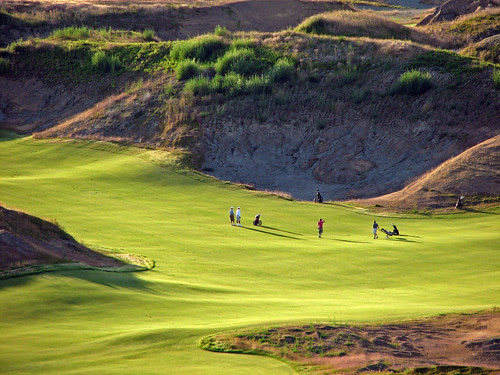
gwar03_080215chambers.jpgA couple of interesting bits over on GolfDigest.com flesh out the Chambers Bay-2015 U.S. Open story, starting with this hunch-confirming item from Ron Sirak that indeed, the USGA was hoping to not prevent a repeat of Whistling Straits.

When Whistling Straits opened to raves in 1998, the PGA of America acted quickly and in January 2000 awarded the Wisconsin course the 2004 PGA Championship, essentially planting its flag on the property. Whistling Straits performed so well it was given the PGA in 2010 and 2015 as well as the 2020 Ryder Cup. The USGA made certain it did not miss out on Chambers Bay.

"I think that is a fair representation," USGA president James F. Vernon said when asked if Whistling Straits provided a lesson. "We thought we had found something special [in Chambers Bay], and we wanted to, not stake a claim, but we really did want to make it clear that we wanted to have an opportunity to have a championship on it."
Meanwhile Ron Whitten does an amazing job on short notice (or did he have advance warning!?) filling us in on details about Chambers and the quest to get an Open. One of the more interesting things we learn is this note on the tees:
There is hardly a flat spot on the premises, and that includes the tee boxes. In what may be the first truly original design idea of the 21st century, Charlton convinced his colleagues to abandon traditional tee pads in favor of long, skinny, free-flowing ribbons of teeing space. Many are not much wider than walking paths; many are recessed rather than elevated; most are gently contoured with a variety of flats spots just the size of throw rugs. The idea is to pick the lie that might best help shape a shot off the tee: sidehill lies if you wish to fade or draw the ball, a slightly uphill lie if you need help getting airborne, a downhill lie if you want to keep it under the wind, or a flat lie. It's too early to know whether USGA officials will accept those unorthodox teeing areas for the U.S. Open. Jones hopes they will.

"We'll probably address that after the [2010] U.S. Amateur," he says. "But it's not like there are no flat spots out there. We have dozens of 'batter's boxes' within the undulations. I would hope they'd position the markers far apart and let golfers chose their particular lies. Our goal was to get into the players' minds, even on the tee, and to put some integrity back into tee shots. Don't let them just stick a peg in the ground and bomb it."

Wouldn't it be great if they USGA embraced this and sent a message that tees do not have to be perfectly level? Or is that just too retro for you? 

"You've gotta love it when Camp Ponte Vedra pledges to do what's best for the players, then drops its crown jewel of the West Coast swing in the middle of a cactus farm."

In John Hawkins' latest edition of the Aristocratic Golfer, he vents about the poor venue choice for next week's WGC Accenture Match Play.  He somehow manages to make a lousy point that leads directly to an excellent point that often seems to go overlooked in Ponte Vedra when selecting new venues:

Forgive me for trying to make sense, but why not move the Match Play north to the TPC Scottsdale? Pro golf's largest galleries would totally invigorate this feeble gathering -- it's hard to imagine those crowds getting any smaller if they were given a field full of top-50s.

Okay, so that makes no sense. You don't break up the Phoenix Open/FBR at TPC Scottsdale for the WGC match play. However, the thinking was sound: 

Because of the format, which comes with a higher risk in terms of holding TV viewers, no week on the schedule relies more on peripheral factors to make it a success.

On-site buzz ranks first, second and third on the periphery. Of course, it's easy for me to say. I wasn't in the board room when the tour agreed to transfer the elephants to a petting zoo.

A case could be made that on-site buzz is fueled in part by compelling architecture that excites fans. And playing within 15 miles a population base helps too. 

Danny Gans Helps Fuel AT&T Pro-Am Ratings Slide

After all, he's no Phil Harris.

From the Sports Media Watch blog:

2.6/5: PGA Tour on CBS, AT&T Pebble Beach Pro-Am, Final Round (3 PM Sunday)
1.9/5: PGA Tour on CBS, AT&T Pebble Beach Pro-Am, Third Round (3 PM Saturday)

    * While the Pro Bowl and NASCAR saw their ratings increase, the PGA saw major declines for the Pebble Beach Pro-Am. Third round coverage drew a 1.9 on Saturday, down 24% from last year, and final round coverage drew a 2.6 on Sunday, down 16%.

Bush Denounces Use Of "Lynch"; "Back Alley" Left Open To Interpretation

Certainly not timely, George Bush seems to have Kelly Tilghman on his mind:

"The noose is not a symbol of prairie justice, but of gross injustice," the president said. "Displaying one is not a harmless prank, and lynching is not a word to be mentioned in jest."

As a civil society, Americans should agree that noose displays and lynching jokes are "deeply offensive," Bush said.

"They are wrong. And they have no place in America today."


The Power Of Short Grass

For my recent Golf World story on short par-4s, the PGA Tour's communications department provided me all sorts of fascinating stats and "scatter charts" produced from its ShotLink system. There were so many interesting little details that popped up, but one of my favorite was this clear demonstration of how a change at Riviera's 10th impacted play in 2007.Riviear10_2007.jpg
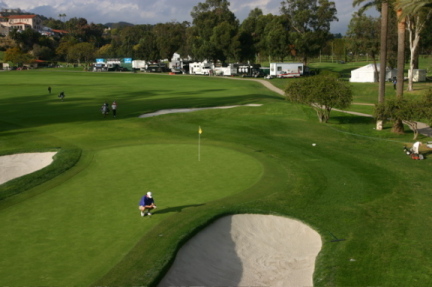
From about 1993 to 2006, a short grass chipping area had been cut on the front left of the green and was one of the reasons the hole vaulted to its place as the world's best short par-4. As I noted in the Golf World sidebar on No. 10, this was the work of Jim McPhilomy, Peter Oosterhuis and consulting architects Ben Crenshaw and Bill Coore.

In 2007, apparently having not gotten the memo that the 10th hole was cited as one of the best holes in the universe, architect Tom Marzolf jacked around with the bunkers, adding several tacky capes and bays while expanding the lay up aiming bunker. But worst of all, he eliminated the short grass area next to the green that had added so much intrigue (see above photo).

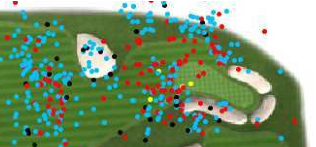
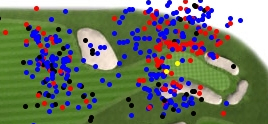
I believe it's one reason why there was a 20% increase in players driving the green in 2007. Having longer grass near the green meant balls would stay closer to the putting surface and provide a simpler recovery shot.

So check out the 2006 "scatter chart" with the short grass area (blue means pars made from that tee shot location, red means birdie, blue means par, black means bogey and yellow means eagle).
 Riviera10th2006.jpg


And now look at the 2007 chart, with the cluster of birdies congregating in the front left area that used to be tightly mown. A fine example how short grass makes a hole more difficult...in a good way:
Riviera10th2007.jpg 


Chambers Bay Aftermath

628630462_0dae26229f.jpgThe cynical interpretation of the USGA's decision to award the 2015 U.S. Open to Chambers Bay is that this was a money grab designed to prevent the PGA of America from moving in. And what's not to love? It's a muni in the Northwest market where they can structure a favorable contract, erect tents galore and host a concert at the amphitheater currently under construction next to the course.

The optimistic take (the only way I read these things) says this is a victory for architecture and USGA course setup man Mike Davis who is trying to shake things up. Chambers Bay is an all-fescue course, meaning the USGA's usual bowling alley corridor concept simply won't happen in 2014. It's also a Robert Trent Jones Jr. design (well, Bruce Charlton and Jay Blasi), marking a break from the stifling litany of Rees Jones renovated courses fueled in part by David Fay and the Executive Committee's lousy eye for architecture. Most of Rees' work severely limits a creative course setup man like Davis. Couple this with deteriorating relationships at Winged Foot and Shinnecock, and Chambers Bay may be ushering in an era of surprising U.S. Open venue selections.

Now, if the USGA sells a reality show to NBC where Rees is named the Chambers Bay Open Doctor and we get to sit on conversations between he and Bobby over a Rees-jigging of the course, then we know it's a cash grab. But in the meantime, I like the move and look forward to seeing a new course injected into the rotation.

Though I'm curious what you all think of the concern raised by Tom Doak who wrote on GolfClubAtlas.com:

Nothing against Chambers Bay in particular, but I think it's a bad thing -- only because it will make everybody developing a new public course drool unrealistically about hosting a U.S. Open themselves.

We don't need architects to create more potential U.S. Open venues.  We need the USGA to do something about preserving the ones we've got.

He does have a point, no?