
Robert Hunter On Book TV
/Speaking Out for America's Poor: A Millionaire Socialist in the Progressive Era
Author: Edward Allan Brawley
Upcoming Schedule
Saturday, March 22, at 3:00 PM
Sunday, March 23, at 4:45 AM
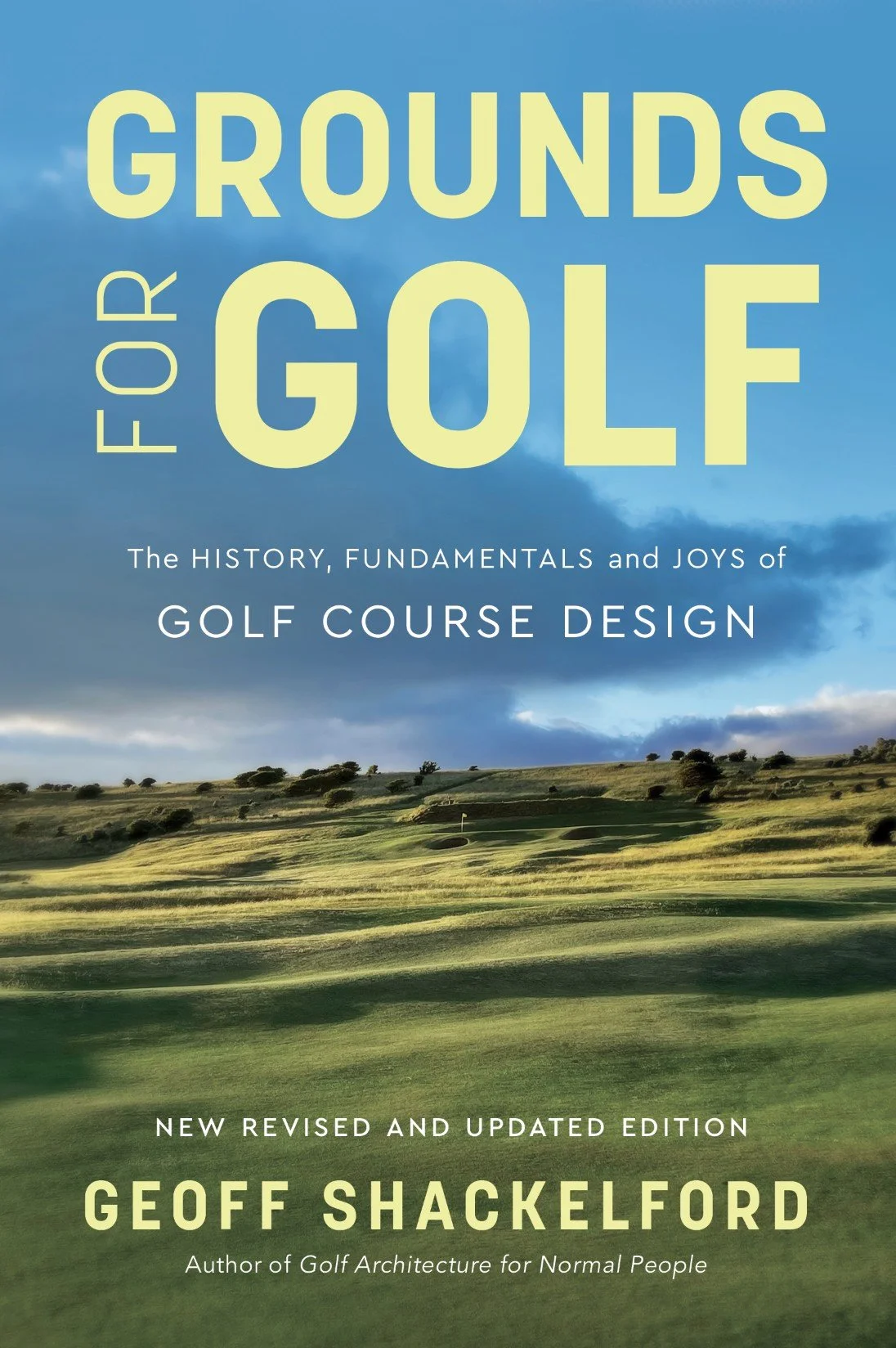
It’s back!
Twenty years later Tatra Press has kindly allowed me to bring back Grounds For Golf now that golf architecture is of more interest to the masses. A new Introduction looks at what’s driven the interest growth and two new chapters I had a blast adding (plus a few edits to keep things up-to-date).
The Amazon purchase page for the book arriving June 15, 2026.

Speaking Out for America's Poor: A Millionaire Socialist in the Progressive Era
Author: Edward Allan Brawley
Upcoming Schedule
Saturday, March 22, at 3:00 PM
Sunday, March 23, at 4:45 AM
Geoff Ogilvy's post round press conference at Doral is worth a read.
Steve Elling condenses the best lines in this blog post.
Phil Mushnick appears to be the first media critic to note that ESPN is not letting Chris Berman get anywhere near Augusta National. I know, I know. What took so long to celebrate?
But wouldn't you love to see something like this in Butler Cabin?
Got to give Bob Carney credit for posting an entertaining but not particularly flattering letter from a Golf Digest reader.
Oh I'm sure he's been there many times. Probably slaved over the details of each hole. Anyway, the news that will not improve the field unless The King trades Bay Hill exemptions for appearances at the Hope, but which will ensure several hours of bantering with Kelly Tilghman and Nick Faldo:
ARNOLD PALMER NAMED HOST OF 2009 BOB HOPE CHRYSLER CLASSIC
The man who won the event five times will host its 50th anniversary next year
PALM SPRINGS, Calif. – Golf and Palm Springs icon Arnold Palmer will host the 50th anniversary of the Bob Hope Chrysler Classic, to be played Jan. 19-25, 2009.
Palmer has not only played the tournament 42 of its 50 years, he also won five of his 62 PGA TOUR titles there, including his last, and he’s as much a staple of the Coachella Valley as the tournament itself.
“We can’t think of a more appropriate person to help us celebrate our 50th year of this wonderful event,” said Bob Hope Chrysler Classic President Dave Erwin. “In addition to his success as a player here, Arnold’s classic style and unmatched connection to his adoring fans helped us reach such an honorable milestone. We feel privileged to have him as our host for this special year and know that Bob would agree.”
“It was very special to me when I was asked to serve as the host of next year’s 50th anniversary Bob Hope Chrysler Classic,” said Palmer, who won the inaugural event in 1960. “I enjoyed some of my greatest success in the Hope in the early years and have loved the Palm Springs area ever since I first went there. I consider it a great honor to follow in the footsteps of Bob Hope as host of this wonderful tournament, which has been a mainstay on the PGA Tour for so many years. I thought the world of Bob Hope and spent many priceless hours with him on and off the golf course.”
Palmer’s 62 career wins – seven majors – rank him fifth on the all-time wins list, but it was his go-for-broke style and approachable, charismatic personality that made him a fan favorite.
Rex Hoggard offers an intriguing behind-the-scenes look at Shaun Micheel's issues with drug testing and changes he is making to accomodate the tour's mandated "normal" testosterone level.
When Micheel was originally diagnosed, his testosterone levels were 279. A recent test recorded his testosterone levels at 537, which his doctor, Tour-approved endocrinologist Dr. Adrian Dobs, said was perfect.
According to Dobs, normal testosterone levels range from 300 to 800. The Tour, however, has set a normal level at 250.
“If people are sick, they deserve to get the medications they need,” said Richard Young, the Colorado-based lawyer who helped create the Tour’s anti-doping program. “You don’t get in the door unless you need something. But if a doctor says this is good for you, you don’t necessarily get a (therapeutic-use exemption).”
The first drug testing isn’t scheduled until early July. But make no mistake, the policy’s first exam is already under way.
According to his caddie, Tiger Woods had about a 1-in-15 chance of making that downhill, 25-foot birdie putt on the final hole to win at Bay Hill last week.
But upon further review, Steve Williams must have been confident it was going in.
Look at a replay of Woods standing over the putt, and Williams is in the background with his caddie bib already removed. If Woods had missed, there would have been a playoff with Bart Bryant.
This was brought to Williams’ attention Thursday. He thought about it, then smiled.
“Just a habit,” he said.
One can only assume the “habit” was taking off his bib on the 18th green. It had been seven years since Woods was in the final group and made a birdie putt on the 72nd hole to win.
Thomas Bonk gets this from Adam Scott after a practice round at Augusta National:
"[The] green is significantly different and you can see the difference, and I think they did a nice job of it," Scott said. "It's very subtle. But there's a new [pin] location now on 7."And Jim Moriarty on GolfDigest.com shares this from Phil Mickelson:
While Augusta's 17th seemed like an even tighter driving hole than it had been and there was some minor softening of the ledges on the ninth green, the biggest change was the room added to the back of the seventh green. "It changes the hole because now long is OK," says Mickelson. "You can go over the green and get up and down possibly. Whereas before that wasn't really realistic."
This ought to be an interesting change. Taking away the fear of going long is certainly a nice compensation for the added length and narrowness. Though I'm not really sure what was wrong with the old drive and pitch Maxwell hole where the fear of hitting approach shots long made for so many unusual situations.
Steve Elling reports on Sean O'Hair's reaction to Johnny Miller's criticism of slow play and in particular, O'Hair's pace at Bay Hill.
"As far as last week, I actually heard that I was criticized a little bit more than Tampa. The thing I don't understand is that we played the front nine in 1:42. We waited on every single shot on the back nine. So when you're watching the telecast, is he sitting there saying that? No.
"I mean, to me what does it matter if I take two practice swings or eight practice swings? I do what I have to do to play well. Obviously what I'm doing right now is right. But I think it's a little unfair to criticize somebody about their routine and talk about how slow they are when basically you're waiting on every single shot.
"We waited for almost ten minutes on the 16th tee, and I took eight practice swings because obviously we were just standing there not doing anything. If I walked up to the 16th tee and the fairway was clear, I might have taken two or three practice swings. You know, he can say what he wants to say. I can't control that. But I have a little bit of a problem with criticizing somebody when you're on time."
So if you are waiting on schedule you can take over a minute and a half to play a shot? That's just not going to fly. Now, maybe once in a while I can understand a 90 second grind if it's an absurdly difficult shot, but just to go through too many practice swings after not being ready when the green cleared?
Penalty shots really do need to be assessed. O'Hair's thinking speaks to the mentality of too many players better than just about any rationalization I can recall.
Golfweek.com finally got around to posting Gil Hanse's promised-in-print piece on designing in the technology era.
Wow, guess they didn't think the press was that negative if they only coughed up $60k:
BOB HOPE CHRYSLER CLASSIC TO DONATE $60,000 TO THE NATIONAL KIDNEY FOUNDATION OF SOUTHERN CALIFORNIA IN THE NAME OF GEORGE AND ANN LOPEZ
Charitable contribution will cover expenses for three Kidney Early Evaluation Program screenings in the Coachella Valley, accommodating 300 participants
PALM SPRINGS, Calif. – The Bob Hope Chrysler Classic announced it will make a $60,000 donation to the National Kidney Foundation of Southern California in the name of 2007 and 2008 tournament host George Lopez and his wife, Ann – the foundation’s national spokespeople.
The contribution, taken from the tournament’s Special Grants Fund, will go towards the foundation’s Kidney Early Evaluation Program (KEEP) – designed to screen those at increased risk for kidney disease because of high blood pressure, diabetes or a family history of kidney disease – and will fit the bill for three screenings in the Coachella Valley, accommodating 300 participants.
Since the inception of the Bob Hope Chrysler Classic in 1960, the tournament has donated over $45.5 million to charities throughout the Coachella Valley. In 2007, over $1.6 million was raised for charity, and at least as much charitable contribution is expected for 2008.
“Our chief mission is to give back to the community that hosts and supports the Bob Hope Chrysler Classic,” tournament President Dave Erwin said. “We are proud to be in a position to help the National Kidney Foundation with their endeavors. We thought it fitting that this gesture comes from George and Ann Lopez, who serve the National Kidney Foundation, and served our tournament, with such a high regard for excellence.”
“I have enjoyed hosting the tournament for the past two years and I am grateful for the Classic’s donation to the National Kidney Foundation of Southern California,” George Lopez added. “Many lives will benefit as a result of their generosity.”
Well, 300 to be exact.
The National Kidney Foundation of Southern California, based in Encino, serves 10 counties from San Diego County to San Luis Obispo County and seeks to prevent kidney and urinary tract diseases, improve the health and well-being of individuals and families affected by these diseases, and increase the availability of all organs for transplantation. Most people at risk are unaware of the symptoms or causes of kidney disease.
“We’re so grateful for the donation, which will enable us to launch our first three KEEP screenings in the Coachella Valley,” said Linda Small, Executive Director of the National Kidney Foundation of Southern California. “There are two million people in Southern California with kidney disease and another two million people at risk. I know this is close to the heart of our spokespeople, George and Ann Lopez.”
In this week's Golf World (not posted), there's a strongly-worded piece by Jaime Diaz explaining that Lopez's departure had more to do with his edgy humor than Arnold Palmer. Diaz sums up the item by recalling the committee's various boondoggles and what the series of missteps means for the seemingly doomed event.
From Alan Shipnuck's golf.com Hot List:
5. The Bay Hill parking lot. With so many players making their homes in Orlando, it's a chance to celebrate conspicuous consumption: two Lamborghinis, a Ford GTO, and too many Escalades, AMG'd Mercedes and Motorsports BMWs to count. Plus enough rims and tinted windows to supply a half dozen rap videos. Proposed new slogan: These guys are ballers.
 Golf World's E. Michael Johnson talks to players about the last time they used a persimmon driver. Some of the answers are pretty interesting.
Phil Mickelson says he last used persimmon during practice for the 2007 EDS Byron Nelson Championship, conducting an experiment of sorts. "It was an old Wood Brothers," said Mickelson. "Callaway did some tests three years ago with a persimmon driver and a ball from the 1990s, comparing it to an HX Tour ball and modern driver. There was a 50-yard difference. The testing said it was 25 yards driver and 25 yards ball. So I tested it, and that turned out to be about right. I couldn't believe how different the launch conditions were -- and that was a driver I used to play with."
It was a 5-iron from 164 yards, and those two numbers are but one example why this was an exquisite shot.
The wind had switched and was coming into him from the right. The flag was tucked behind the lake on a green framed by rocks. Bunkers guard the back of the green, which slopes toward the water.
And the most important detail? Woods was on the 18th hole, tied for the lead.
He could have hit an 8-iron that distance, even in this scenario. It's surprising to hear Woods' club selection over various shots, considering his strength, yet Haney said Woods is all about control, and he prefers to use more club than usual in the wind.
"The hardest thing to do under pressure is play a delicate shot," Haney said. "Under the hardest conditions, you'd rather have a shot that you can swing at hard. All he could talk about was the shot on 18. He told me, 'I knew if I didn't do it right, I could upshoot it into the wind and it's in the water. If I flipped it, I hit it in the back bunker.' He had to commit to do it correctly. And he pulled it off.
"That was phenomenal. That made him feel good."
Geoff Shackelford is a Senior Writer for Golfweek magazine, a weekly contributor to Golf Channel's Morning








Copyright © 2022, Geoff Shackelford. All rights reserved.


