
The Par 3 Contest Blues

Clifford Roberts called. He wants his Par 3 Contest back.

Now, I love the Par 3, and some of you may know my first design was a par 3 course. I believe they are vital to the health of the game and I'm most content playing a fun pitch and putt. Furthermore, good players can get so much better on a par-3. They are great places for kids to learn and an ideal setting for a quick round if you don't have the time. I truly admire Billy Payne's vision of wanting to show people that, wait, his words:

We are televising the Par 3 event this afternoon for the first time, hoping kids will be inspired by seeing golf competed and conducted in a fun and family manner.

And who knows, maybe it will send a message across the world that golf can be played and immensely enjoyed on only a 1,000-yard course needing just four- or five-clubs and taking less than two hours to complete.

However, today's Par 3 Contest, the first ever televised by ESPN no less, turned into a complete disaster. Not only did it run so long that ESPN had to abandon Pardon The Interruption (take that, irony!), but the last two groups played in together because play was so slow.

After an hour of the telecast the entire exercise had grown exceedingly painful thanks to the mess that this once semi-legitimate competition has become. Kids were all over the place. Stepping on holes, having to have their hands held to prevent running into the lakes, etc...  Even caddies and wives were hitting putts or shots by the end of the competition. Putts rolling to the cup on No. 9 early in the day saw a nice smooth surface. By day's end the ball was wobbling through Croc marks and countless other dents.

As a viewer all I could think was, every grown man who has discouraged kids from being able to use his country club course is sitting there saying, "see, this is why we have to keep the kids outta here. Them and their doting parents will make a mess of the place."

There is a time and place for this kind of mess, but the Masters Par 3 Contest on national television was not the one. Assuming any kid was watching (hopefully they in school), I can't imagine they would have wanted to take up golf after sitting through the Par 3. Late in the day, one of the kids caddying for dad could be seen sitting on the 8th tee, his face buried in his hands out of sheer boredom. And he didn't even have to listen to Andy North and Peter Kostis conducting interviews! 

Though Kostis did at least remind us (twice) who is to blame for starting this mess: Jeff Maggert. He started the tradition of bringing the little ones along and dressing them up in caddy jump suits.  But it's the club's fault for letting this spiral into a disaster that ensures Tiger Woods will never play in it as long as he is a serious competitor, and even when he's bald and over the hill I suspect he's not coming back.

It is even hard to see ESPN wanting to televise this again unless the club puts an age limit and a time limit on the groups.  Not like they have a choice, but you have to think the boys in Bristol were agonizing today when the affair ran nearly an hour long.

The last Par 3 Contest I witnessed was in 2003. Tiger Woods played and it was great fun to see the variety of old guys, new players and other major winners whizzing around that pretty little layout. Some of their offspring caddied and every once in a while they'd let the rug-rat hit a shot.

Somehow in five years it has become PGA Tour daycare's graduation ceremony. A cotillion, bar mitzvah and ridiculous coming out party rolled up into one, with eligibility for every child under 10 holding some genetic tie to a contestant.

This is not what Clifford Roberts envisioned when he started the Par 3 Contest. It's most definitely not what he envisioned when he left that big pile of money to Planned Parenthood.  And it's not what anyone would envision as a way to grow the game.

USGA Job Search: An Editor!?

I like my chances!

From Medabistro.com:

Publication or Company       United States Golf Association
Industry      Corporate/Institutional/Technical Writing, Internet/Online/New Media, Non-profit, Other Publishing
Salary     Competitive
Benefits     401K/403B, Dental, Health
Job Duration     Full Time
Job Location     Far Hills, NJ USA
Job Requirements     The USGA seeks an Editor who will oversee publishing, editorial, and design for internal and external communications. This hands-on Editor will also proofread and copy-edit and collaborate with other departments responsible for on-line/digital products and media relations.

See, I told you Walter Driver could have used an editor.

Requirements include:
Proven writing, editing, proofreading and copy editing skills
Good people-skills: ability to motivate, manage, collaborate
Demonstrated project management skills
Strong computer skills
Comprehensive knowledge of the game of golf, especially as it relates to the USGA's mission and activities.

"The Tony Stewart of New Zealand"

etick_rd_swc01b.jpgSomehow I doubt even Tony Stewart went this far, but ESPN is treating Tiger's sunny caddy Stevie Williams as if he's died. Check out this devotional page to the loaded looper sent in by reader Lee.

So good to see Stevie is as humble as ever.

Here, Steve Williams is the star. Though his team is called "Caddyshack Racing" and a sticker on each of his two cars reads "HOOK A KID ON GOLF," Tiger is far from his mind.

"I hate when I go to a race and I'm looked at as Tiger's caddie, because here, I'm not Tiger's caddie. I'm Steve Williams, driver of the No. 21 Mustang," he says. "And a pretty damn good driver at that."

If you're unusually constipated or simply desiring to see what a good publicist can do, here's ESPN's sitdown with the world's wealthiest luggage handler.

Whittlin' Down The Field

Jim McCabe has always been a fine newspaper man, but something about writing columns online for GolfBrief.com brings out his most creative side. Today he whittles down the field to who really has a shot. Hard to disagree with his take, though eliminating all of the Aussies may prove to be a mistake.

And if you are looking for last minute advice, the Golfweek staff offers their picks here and Sal Johnson breaks down the field here, and Larry Dorman offers his "others not to be ignored" at the end of his New York Times piece, but maybe he should have cut it off at this excellent note: 

Geoff Ogilvy, whose victory three weeks ago at the W.G.C.-CA Championship at Doral stopped Woods’s worldwide winning streak, employed a similar strategy of ignoring Woods until the final few holes of the tournament. “I wasn’t really interested in beating Tiger today,” Ogilvy said last month after his first-round 63 at Doral. “I would like to beat him after four rounds. No, I don’t really give it any thought to him. I just want to give thought to how good can I play and can I win this golf tournament.”

That makes two golfers who have recently shown they can beat Woods. Others who have won events in which Woods finished second are Phil Mickelson (four times), Vijay Singh (three), Ernie Els and Jim Furyk (two each), and Ángel Cabrera, Michael Campbell, Stewart Cink, Retief Goosen, Trevor Immelman and Mark O’Meara (all one).

"The scary thing about 12 is it's the only hole where when the ball is in the air, the caddies start praying."

Bob Harig looks at Amen Corner and lets Nick Faldo share some fascinating insights:
Faldo, who won three Masters, would purposely seek out a corner on the Augusta driving range where he could hit to a flag that was about 140 yards away -- all in anticipation of Amen Corner.

"You really have to have the ability to land the ball left or right of the flag, in precise spots, you can't just hope,'' said Faldo, 50, who will be working the Masters as an analyst for CBS. "I used to do a lot of visualization on the practice ground. The last thing you want, coming over that hill on 11 ... with all that history ... it's the first real suck-it-up shot of the back nine. They put you under serious pressure on that shot.

"The scary thing about 12 is it's the only hole where when the ball is in the air, the caddies start praying. Two balls hit identically can come up different because of a gust of wind. That one is in the lap of the gods.

"On 13, it is very difficult to describe that second shot up on that slope. You have the ball above your feet but on a downhill lie. Three slopes working against you. And you really have to hit a precision shot.

"At Amen Corner, you have five or six really precision shots that you have to hit absolutely spot on. You have to have the ability to place the ball exactly where you intend.''

Faldo pauses, takes a deep breath. "I even scare myself reliving that,'' he said.

"As far as Boo is concerned, a breathtaking view is not so much Augusta's azaleas as a grazing deer in his telescopic sights."

sgmj109.jpgMartin Johnson, Telegraph curmudgeon, weighs in on Boo Weekley:
Boo is a man who makes a living reaching for a driver and shooting birdies, but he'd much rather be reaching for a rifle and shooting furry animals.

As far as Boo is concerned, a breathtaking view is not so much Augusta's azaleas as a grazing deer in his telescopic sights. He has the sort of eye for beauty that, in the unlikely event he ever found himself inside the Sistine Chapel, would probably persuade him that there was nothing much wrong with the ceiling that a layer of artex and a pot of emulsion wouldn't put right.

"I think what has changed the golf course immeasurably is one hole, and it's No. 7."

Phil Mickelson was asked Tuesday about the possiblity of low scoring in the future and offered an intriguing insight into how the flow of the course has changed:
PHIL MICKELSON: They won't be lower. I think the scores may get a little bit higher, yeah, and the length is the biggest factor. Also all of the trees and the tightening of the golf course.

I think what has changed the golf course immeasurably is one hole, and it's No. 7. Because the whole thought process of playing the golf course used to be get through the first six holes around par, and you can birdie 7, 8 and 9 and you have three birdie holes and try to get one or two there, you turn at under par and then you shoot under par on the back side and you have a great round.

But now, 7 has become -- I think it's the first or second hardest par on the golf course. I think between 7 and 11, I think it's the two toughest pars that this course has; and because of that, it changes when you can be aggressive and how many birdie holes you have now and the whole complexion and mind-set of how to play the first six or seven holes. Now you feel like you have to be under par through the first six because you want to be around par when you get through 7. 7 is one of the toughest holes now.

"The second cut, yeah, if you go out there, you'll see it. That's all you need to change this golf course."

Tiger Woods sat down with the scribes and while I'll leave it to Jaime Diaz to analyze the surprising number of references to late father Earl, let's get to the golf stuff. First, this rambling mess of question from someone with a strong British accent:

Q. Now that you have obviously entered the zone of extreme expectation, probably unprecedented in golf, does that affect you in any way? Are you able to shut out what people expect of you, or does it get to a point where you have to exclude it completely, or is it an incentive for you to be aware that people are expecting you to fulfill these extraordinary feats of consistency? Does it have any real impact on you as an individual?
Okay, the golf course stuff is good:
Q. Is it safe to say that hitting long or whatever else, that's why you've done so well --

TIGER WOODS: You have to putt well here. You can't putt poorly here and win. Now, you have to drive the ball well in order to win here; before you could spray it all over the place and it didn't matter -- actually tried to spray it all over the place to give yourself the best angles. 9 you used to hit the ball so far right to give yourself an ankle up to those left pins; now with the added trees you can't really do that anymore.

The holes have changed over the years in that way. 17, sometimes you had to hit it to 15 to get to the back left pin just to get a shot at these angles; they have taken that away. It's playing a lot more different and a lot more penal off the tee but the greens are still the same. The greens are still just as penal.

Of course the club will read that and react with glee that you can't hit it in some bizarre place to open up an ideal angle. Got to toe that center line!

Brace yourselves...


Q. I read the other day, Jack Nicklaus said, "I wish they would get rid of that rough up there." What rough is he talking about?

TIGER WOODS: The second cut, yeah, if you go out there, you'll see it. That's all you need to change this golf course.

Shots, for instance, on No. 1, if you pull it up the left side it used to run straight to the pine needles and you had no shot. Now it has a chance to get caught up, pull tee shots down 2 can get caught up. It changes the speed of this golf course quite a bit. Shots on 10, if you don't turn it, used to land up the right and actually roll through the gallery down into the trees and now it can get caught up.

Q. That much rough makes that much difference?

TIGER WOODS: Mm-hmm. (Nodding).

Good to see the scribes really thinking this stuff through before sitting down with Tiger.

 Q. When Jack was in his prime, he wasn't a huge fan of playing in the Par 3 Tournament because he thought it was a distraction for him and he wanted to focus. Talk about your approach to the Par 3 and what you enjoy about it and your memories?

TIGER WOODS: My last one I played when Arnold, at the time, it was his last Masters. (Laughter) I made a hole-in-one and that was it. Good way to end it.

Q. You won't play tomorrow?
TIGER WOODS: No.

Q. Why?

TIGER WOODS: It's changed over the years. Used to be, I thought was a lot of fun to play, but now it is a little bit distracting to get ready and be ready for the tournament.

He's such a curmudgeon. I love it! Oh no, the guy asking about the rough is back...

 Q. I would like to clarify a point on the rough, please. Some guys have said that it helps more than it hurts because it keeps the ball from running off into the trees. What's your feeling on that? Does it help you or hurt you, generally speaking.

TIGER WOODS: Well, I think it helps on tee shots, there's no doubt because it does slow the ball from going into the trees. But second shots, it does hurt you, because it's hard to control your distances on a golf course in which you have to be so precise, and if you're not with your distances, you're going to pay a pretty good price.

So, yes, it does help you off the tee, but certainly hinders you quite a bit going into the greens.

Tiger, don't bother. You're wasting your time.

USGA, R&A Move Quickly To Address Mistake...

...unfortunately it had nothing to do with the golf ball. Instead, it was to address a stupid rule change and not anything of consequence. 

Stewart Cink will not be DQ'd in the future for practicing basic etiquette based on today's USGA release.

Though based on something John Vander Borght interpreted in his blog entry, I'd still say this needs work. If you are in a front bunker and hit it in the back bunker, don't rake the front one until you've finished making a mess of the hole.

Why can't we just play it as it lies? I'm so glad Max Behr isn't here to see this disaster. 

Questions For Billy Payne

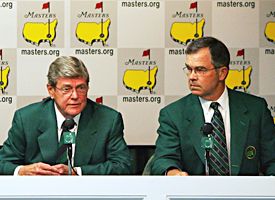
pga_hootie_payne_275.jpgI don't have much for the club chairman, who takes the podium Wednesday after the Golf Writers Association bicker over important stuff like WiFi and press releases winning GWAA awards. 

My questions are all golf course related since Billy Payne is doing some pretty progressive stuff off the course (brand building baby!). And let's face it, he's not Hootie, though my questions do relate to mopping up after the former chairman:

  • Considering how long the course is playing this year along with the high scores from last year's tournament where the lack of flexibility in teeing grounds led to new tee extensions this year, will the club reconsider its confining two-tee setup in order to give the committee more setup options?
  • In defending the second cut, the club stated to Golf Digest that players no longer use many of the original MacKenzie-Jones design options. Did this conclusion come from talking to players or via statistical analysis?
  • The club has maintained statistics on the impact of the second cut, will you ever share this information in future media guides?

Feel free to post your questions just in case the golf writers at Augusta need inspiration.

Two Tee System

You know I've been ranting and raving about Augusta's insistence on just two teeing grounds per hole, and as we saw with last year's cold and wind some flexibility would have come in handy. I noticed Brad Klein brought it up in his Golfweek preview (not posted), and Ron Whitten said in his preview story that they should be ashamed for only having two tees, though his reasoning is purely sentimental and not related to function.

And it came up again in David Westin's story today on course changes:

The other change is on No. 1, where the tee box was extended 10 yards forward. It isn't expected to be used unless the northwest wind blows, which makes the hole play into the wind. It would have come in handy in the third round of the 2007 Masters, when the northwest wind was blowing at 12-17 mph with gusts of 23 mph.

It's also interesting to hear people who play Augusta talk about how there really isn't a set of tees for most golfers there. Either you play at 6200 yards or from the back, and neither really fits the majority of people who play there.  

I've given up trying to figure out why they insist on only having two teeing grounds per hole? I know they are vain, but you'd think common sense would eventually prevail.