"He only plays about 15 times a year anyway"

A wire story on surprise and shock at news of Tiger's knee surgery includes this comment from Tim Clark:

"He only plays about 15 times a year anyway," Tim Clark said. "So it's not going to do a lot" to affect the PGA Tour.

Last year Woods played in 16 official events, meaning that if he misses the Wachovia and Players, he's likely going to have to add one event this year to maintain full membership privileges.

Four playoff events this time, perhaps?

Steve Eubanks posts a Yahoo piece on the prospects for Tiger's recovery as well as what he might face in the future.

Teeing It Up From The Members Tees

Jay Coffin of Golfweek and Tom Cunneff of Links were plucked from the media lottery and got to play Augusta Monday after the Masters. Coffin filed a report here and Cunneff here. Noted Cunneff about the bizarre disparity between Augusta's two sets of tees:
 The Member Tees measure just 6,365 yards, almost eleven hundred yards less than the Masters Tees. On some holes, like 16, the disparity was negligible, but on others, like 11, the difference was more than 100 yards. It was a lot easier coming into the treacherous 11th green with a wedge instead of a 3-iron, that's for sure.

Third Masters Question: Has The Telecast Style Altered Our Perspective?

There were so many great posts on the first two Masters "questions" posed (here and here), including Mark B's "rant" about changes to the presentation of the event and the impact the coverage window expansion has had.

And while there is clearly disagreement about whether the last two events are an aberration or the inevitable result of letting golf architecture's Jackson Pollock restore one of its Monet's, I wonder if we underestimate how much the lack of excitement for television viewers has been impacted by the pace of play and director Lance Barrow's different approach to the telecast.

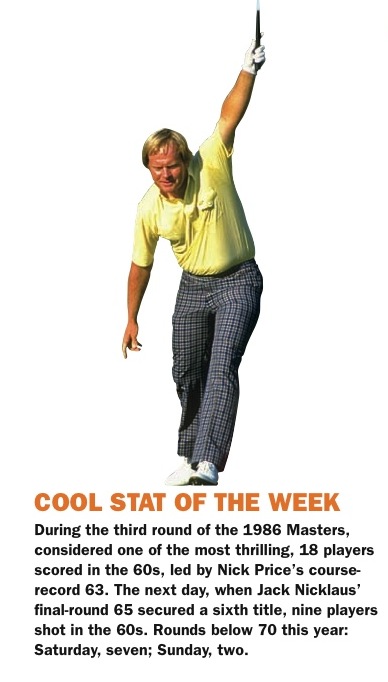
Some of you noted that the high water mark for Masters telecasts came in 1986, which was followed by several more great finishes. Having grown up a student of that great stretch (and still owning them on VHS), I remember that the shorter telecast window and Frank Chirkinian's preference to show as many shots as possible lent a sense of urgency to the proceedings that seems to be missing today. There was also a sense of extreme control over the entire telecast back then, something noted in this Richard Sandomir piece from 1995 that's worth reading.

In Barrow's defense, the broadcast window has expanded, play has slowed, fans expect a graphic for each player's shot and the opportunity for a birdie run three or four in a row has disappeared.

But I'm wondering if we are unfairly judging the event based on a presentation style that went out with Chirkinian's retirement?

Has the length and pacing of the telecast exaggerated the negative reaction to the last two events? 

"This tournament has become all about playing defensively and minimizing damage."

They're not throwing snowballs anymore. This is an avalanche.

From John Hawkins' Golf World game story on the 2008 Masters:

Those who have begun comparing the Masters to the U.S. Open in terms of punitive nature aren't thinking clearly,

We'll let you tell that to Tiger and Phil's face...

...since the outrageous homestretch produced by the top of the leader board in 2004, this tournament has become all about playing defensively and minimizing damage. The addition of the second cut (rough), a billion trees and 500-plus yards, all of which occurred during the tenure of former Masters chairman Hootie Johnson, has resulted in a conspicuous subtraction of charm and suspense.

It's easy to blame Hootie and the Blowtorch for the growing pile of late-Sunday snoozers, but the game's sharpest minds failed to foresee the most obvious effect of the changes.

Oh do tell us why you see what the rest of us only saw five years ago...

A competition once weighted heavily to favor power players and good putters has fallen into the hands of the control freaks. You have to hit fairways to even think about winning. Scoring angles have been reduced to direct lines. Certain sections of the course have gotten alarmingly tight, but it's the congestion framing those alleys that has nullified the shotmaking and recovery skills that helped brand the Masters from its inception.

The Seve Ballesteros of the early 1980s couldn't make a cut at Augusta National nowadays.

Okay, that's a bit silly, but we'll let it slide because the point is well-intentioned.

Immelman hit 48 of 56 fairways and won. Zach Johnson averaged 265 yards per measured drive but hit 45 fairways and won. Heck, those guys made a cottage industry out of laying up on par 5s once routinely attacked by anyone with a little pop in his bat and designs on a seat at the Champions Dinner.

Not to indict the last two green jacketeers -- they only did what they could and had to do -- but things have really changed. Good strategy is now conservative strategy at a place where all hell used to break loose on a regular basis. "It usually doesn't turn out too well if you try to be aggressive," said Geoff Ogilvy, who shot six over on the weekend and finished T-39. Not that he needed to finish the thought, but Ogilvy did: "Aggression doesn't work, but the guys four or five back have to be aggressive because you're not going to win parring every hole."

After years of dealing with disadvantages one could trace to his lack of supreme power, a top-tier control player such as Jim Furyk might figure to factor, but even he speaks in somewhat jaded tones. "It's a pretty good test of golf," Furyk said. "I mean, it used to be a lot of fun to play. It's not fun anymore, but it definitely got a lot more difficult." Addressing the notion that people don't hoot and holler over solid pars, Furyk added, "I don't think we have [heard roars] for the last few years. It's obviously a decision they [tournament officials] made. It's their event, a different golf course, and there's a different way to approach it now."

All over a silly little golf ball that no one wanted to roll back. Such a shame.

Meanwhile, even one of the old guard proudly declares its continued love for using course setup ploys to put the flatbellies in their place -- except at the Masters. 

John Hopkins writes of the course changes in The Times:

Some of the unique appeal of the Masters has gone as a result.

“When do you say to the West Coast, ‘The tournament must end at 4 o’clock your time.'"

Doug Ferguson talks to David Fay about the U.S. Open finishing at 7 p.m. Pacific. Now, I'm a conoisseur of David's spin and do love his baseball metaphors. Which, I must say, would come in handy right about now:

“When do you say to the West Coast, ‘The tournament must end at 4 o’clock your time,’” USGA executive director David Fay said.

And that means what, exactly? Finishing at 4 p.m we are deprived of having dinner at a normal hour? Flying out of San Diego on Sunday night? Perish the thought!

“I know it puts Europe at a disadvantage. We tend to look east, where it’s just as easy to look to the west. If K.J. Choi (of South Korea) is leading, the time might be better for Asia.”

Always thinking of Asia. That's why he gets the big bucks! Thank God it wasn't something flimsy like wanting to finish in prime time to grab another Nielsen point.

Ferguson also notes:

The last time a major was held on the West Coast was Pebble Beach for the 2000 U.S. Open, and the final round was scheduled to end at 5 p.m. PDT.

John Daly Rehabs...

...an injury. Yes, that's right, Doug Ferguson reports on the minor surgery Daly recently underwent. More stunning is the news from his doctor that Long John engaged in rehab of an injury.

Daly has cited injury as the primary reason for his poor play over the last two years, during which he has withdrawn eight times and missed the cut 14 times in 33 events. The injury dates to the ‘07 Honda Classic, when he tried to stop his swing upon hearing the click of a fan’s camera. More than a year later, his doctor believes he found the problem.

The surgery was to repair a torn muscle in his stomach.

“When he tried to stop swinging at the Honda Classic, he tore his rotator cuff and he also dislocated two rib joints where they attach to the spine,” said Dr. Steve Whitelaw, who works with the Arkansas Razorbacks. “We rehabbed all that, but the whole time he had dislocated ribs, he tore the ligaments around them.”

Whitelaw said when Daly complained of more pain, they ran a full body scan and discovered the muscle tear in the stomach.

“It was not attached, and the muscle shrunk down,” he said. “When he swings, he uses that area with his stomach and core strength. He could only go so long without hurting. He was in a cycle he could not get out of.”

In more ways than one. 

Tiger Has Knee Surgery Just In Time To Jeopardize Appearance In Fifth Of Four Majors

Thanks to reader Chuck for sending the news that Tiger Woods underwent arthroscopic surgery on his troublesome left knee and is scheduled to be out 4-6 weeks. The Commish weighs in:

"Of course, we're disappointed when Tiger is unable to compete in a PGA TOUR event," Finchem said. "He's the No. 1 player in the world and a fan favorite wherever he goes. There is really never a good time for an athlete - especially one of Tiger's caliber - to take weeks off from competition during the season, but his health concerns have to come first.
Even if it threatens his chances of playing in The Players Championship.
"We wish him the best toward a speedy recovery and look forward to welcoming him back to the TOUR when he is ready and able to compete."

And we hope it's really, really soon. 

Finchem Endorses Olympic Golf Movement...

...and does it in a blog post!

I’ve just returned from Augusta National and The Masters. I always enjoy Masters Week very much, not only for the great golf we see, but also because everyone involved with golf attends. It gives me an opportunity to discuss issues and ideas with everyone from around the world.

And see Tom Fazio in a seersucker jacket. Sorry, continue...

One of the matters that we have talked about over the last several years and which came up again last week is whether golf should be an Olympic sport. In 1993, we actually announced that golf would be in the 1996 games in Atlanta. However, this never materialized for various reasons.

Let's not go there.

Since then we have continued to examine the various issues presented by golf being an Olympic sport.  While there remain questions to be answered and issues to be resolved, I believe the time is now right to move forward. The LPGA and the European Tour have previously indicated their support for Olympic golf. Also, the R&A, the USGA and the PGA of America are evaluating the possibility of Olympic golf.

And David Fay and Peter Dawson have been dreaming of their next jobs.

Finchem goes on to explain how he's been inspired by a study that says golf in the Olympics will grow the game and bring peace to the Middle East.

Here's why it will be interesting to watch this unfold: the entire thing will be geared to what NBC and Dick Ebersol want.

Now, Dick could either be shallow and obsess about getting Tiger Woods to play, then settle on some dull, simple-for-TV format like 72 holes of individual stroke play. 

Or, Dick could be bold, forget trying to please Tiger and say, we need a compelling team format that brings out passion and patriotism. Something that will prove golf is Olympic-worthy. Something that stands alone from all others in golf, but also exciting for the world's best to be part of something unique.

Say, three-man teams in a Dunhill Cup style stroke/match play event? Suggestions?

"Whatever happened to subtlety?"

Richard Sandomir in the New York Times isn't a fan of the Masters theme music (I love it!). He also offers several telecast notes, including this about the maudlin father-son themed opening.

...the script was fattened with phrases — “imbued with a towering source of inspiration,” “simply the circle of life at Augusta” and “walking in the green jacket footsteps of his hero” — that made my blood sugar spike. Whatever happened to subtlety?

Nantz ended the 2-minute-50-second piece by saying, “Bobby Jones built the foundation, a journey borne at the heart, from a father to a son, always by their side.” (It’s TV English, not Webster’s.) The final four words sounded like a subliminal nod to his new memoir, “Always By My Side: A Father’s Grace and A Sports Journey Unlike Any Other,” about his relationship with his father, who has Alzheimer’s disease.