Comcast Exec Admits Golf Channel Needs Work

In discusing the hiring of consultant Mike Weisman, Comcast exec Jeff Shell talks to the New York Times' Richard Sandomir about Versus and Golf Channel.

Look at Weisman nailing three MBA buzzwords in the first quote while weaving it into a beautiful metaphor. Or is that a simile?

“This is an opportunity to leave some footprints in the sand and build brands and networks,” Weisman said.
According to Comcast's Shell, the Golf Channel's presentation needs Weisman's touch. 
“We don’t have someone responsible for everything that goes on over the air,” Shell said. “If you look at what goes on over the air, it’s respectable, but not memorable. We want it to be memorable.
And...
 The Golf Channel has a studio program, “Golf Central.” “It’s good, but not good enough,” Shell said.

That's what happens when you pay people next to nothing.

One issue that Shell said was being worked on was occasionally leaving an early round of a PGA Tour event before it had ended to go to the studio. “It’s a contractual obligation and reasonably easy to fix,” he said.

Really? Somehow I think if it were an easy fix it would have been addressed already. 

"Augusta National had suddenly become Dodger Stadium."

Add SI's Alan Shipnuck to the list suggesting the changes at Augusta National have impacted the aura of the Masters:

"Interesting" is a generous way to describe Sunday's action, as for the second straight year the Masters devolved into a U.S. Open-style war of attrition, and this edition was especially lacking in drama.

Augusta's normally die-hard fans didn't even pretend to be enjoying the spectacle. When the leaders' scores were posted for the 13th hole — showing Immelman's birdie that pushed his lead back to four — the massive bleachers around the 15th and 16th holes began clearing. Augusta National had suddenly become Dodger Stadium.

In only his second year Augusta National chairman Billy Payne has proven himself to be a forward thinker, but he may need to consider revisiting the course's old setups, which almost every year produced memorable Sunday pyrotechnics.

Augusta National has grown brutally long and increasingly narrow, and it still boasts the most frightening greens in championship golf. Unless Payne chops down a bunch of trees and shaves away the second cut, the course will continue to humiliate the game's best players, especially on days when the weather is less than perfect.


Fourth Masters Question: When Can We Assess Augusta National's Renovation?

masterslogo.gifCountering the claims that Augusta National has been altered beyond repair are several pointing to the wind as the sole source of Sunday's dull Masters affair.

Now, I seem to recall that since 2000 or so we've had to wait several years to judge the tree planting, rough and lengthening because the course was usually too wet to evaluate the impact. Then last year it was finally firm and fast but the spin said it was too cold to make a call.

This year we saw ideal weather for the first two days and pretty scoring conditions for the first three days (yet was there ever a sense anyone could get hot and post a 65?).  The tough winds on Sunday made the course incredibly difficult, and therefore, we apparently still can't evaluate the state of ANGC.

Now, that assumes that the course can only be setup to be interesting and exciting on Sunday. A most contrived approach. However, let's not debate that and instead consider a few more reviews of Sunday's round.

David Feherty has no choice but to do some serious brown-nosing when it comes to the club, so here's what he says about Sunday's dull affair:

— We saw the perfect storm of conditions at Augusta on Sunday. The course couldn't have played harder, with the speed of the greens, the softness of the fairways and the howling wind. It's too bad the gusts were so great. A calmer day could have produced some back-nine fireworks. But the wind took an already difficult course right to the edge.
Again, wasn't it pretty calm the first three days and pretty clear that a birdie run was out of the question?

His golf.com/SI counterpart Alan Shipnuck Jim Gorant was less forgiving
A phrase that had come to symbolize anything-can-happen excitement could now be sponsored by Sominex. Sunday's climax was all denouement.

Meanwhile over at ESPN.com they did their "Fact of Fiction" deal, asking if ANGC should be set up to encourage low numbers...assuming that's even possible.

Bob Harig, who reviewed the recent changes and the disappearance of a sense of vulnerability in a Monday column, says that "for the second straight year, the weekend was a survival contest, rather than the drama-filled back nine Masters fans have come to expect."

Jason Sobel, who apparently didn't notice the weather the first two days, asks "what would happen on a perfectly calm, 80-degree day?"

While Ron Sirak laments

There are no more 30s to be shot on the back nine of Augusta National Golf Club. It's way too long and difficult now. I miss the roars triggered by eagles echoing through the Georgia pines. Now, you are more likely to hear groans triggered by double bogeys. I miss seeing a player in contention pondering over whether to go for the green in two on that pair of great par-5 holes , No. 13 and No. 15. It makes me sad to see players opting for an automatic lay-up on those holes.

So here's the fourth Masters question: is there something wrong with a design when it can only resemble its former self under a very select set of idea weather conditions?

To put it another way, is it simply not possible for an architect and committee to consider these weather extremes by offering alternate tee locations and enough width to maintain its integrity in unusual conditions?

How are those for two rhetorical questions?

"It would probably be a limited-field event, like a WGC or something like that"

Steve Elling shares a prime example of why when European Tour Commish George O'Grady enters a room, scribblers sprint knowing he'll say something stupid newsworthy.
The European Tour hosted a banquet during Masters week and a couple of scribes corralled Commissioner George O'Grady early to ask a couple of questions about the drug testing rollout planned for this summer. As he has said in the past, the Euro plan won't be nearly as comprehensive as the PGA Tour program, which will cost over $1 million to administer.

"We simply don't have as much money," he said.

O'Grady said, in broad brush strokes, that he hopes to perhaps test the winners and a few more players in the field each week, and hopes to have tested every fulltime player at some point by the end of the year. Then he dropped a little bombshell of sorts. O'Grady said that PGA Tour counterpart Tim Finchem intends to test an entire field at some point, which could be prohibitively expensive, it was pointed out.

"It would probably be a limited-field event, like a WGC or something like that," he said.
So much for randomly testing and keeping the process pure!

"He only plays about 15 times a year anyway"

A wire story on surprise and shock at news of Tiger's knee surgery includes this comment from Tim Clark:

"He only plays about 15 times a year anyway," Tim Clark said. "So it's not going to do a lot" to affect the PGA Tour.

Last year Woods played in 16 official events, meaning that if he misses the Wachovia and Players, he's likely going to have to add one event this year to maintain full membership privileges.

Four playoff events this time, perhaps?

Steve Eubanks posts a Yahoo piece on the prospects for Tiger's recovery as well as what he might face in the future.

Teeing It Up From The Members Tees

Jay Coffin of Golfweek and Tom Cunneff of Links were plucked from the media lottery and got to play Augusta Monday after the Masters. Coffin filed a report here and Cunneff here. Noted Cunneff about the bizarre disparity between Augusta's two sets of tees:
 The Member Tees measure just 6,365 yards, almost eleven hundred yards less than the Masters Tees. On some holes, like 16, the disparity was negligible, but on others, like 11, the difference was more than 100 yards. It was a lot easier coming into the treacherous 11th green with a wedge instead of a 3-iron, that's for sure.

Third Masters Question: Has The Telecast Style Altered Our Perspective?

There were so many great posts on the first two Masters "questions" posed (here and here), including Mark B's "rant" about changes to the presentation of the event and the impact the coverage window expansion has had.

And while there is clearly disagreement about whether the last two events are an aberration or the inevitable result of letting golf architecture's Jackson Pollock restore one of its Monet's, I wonder if we underestimate how much the lack of excitement for television viewers has been impacted by the pace of play and director Lance Barrow's different approach to the telecast.

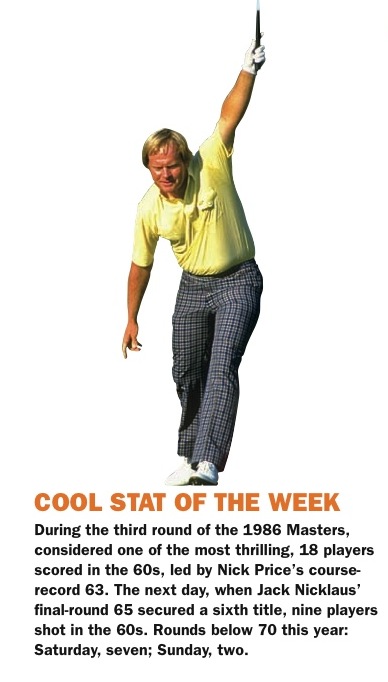
Some of you noted that the high water mark for Masters telecasts came in 1986, which was followed by several more great finishes. Having grown up a student of that great stretch (and still owning them on VHS), I remember that the shorter telecast window and Frank Chirkinian's preference to show as many shots as possible lent a sense of urgency to the proceedings that seems to be missing today. There was also a sense of extreme control over the entire telecast back then, something noted in this Richard Sandomir piece from 1995 that's worth reading.

In Barrow's defense, the broadcast window has expanded, play has slowed, fans expect a graphic for each player's shot and the opportunity for a birdie run three or four in a row has disappeared.

But I'm wondering if we are unfairly judging the event based on a presentation style that went out with Chirkinian's retirement?

Has the length and pacing of the telecast exaggerated the negative reaction to the last two events? 

"This tournament has become all about playing defensively and minimizing damage."

They're not throwing snowballs anymore. This is an avalanche.

From John Hawkins' Golf World game story on the 2008 Masters:

Those who have begun comparing the Masters to the U.S. Open in terms of punitive nature aren't thinking clearly,

We'll let you tell that to Tiger and Phil's face...

...since the outrageous homestretch produced by the top of the leader board in 2004, this tournament has become all about playing defensively and minimizing damage. The addition of the second cut (rough), a billion trees and 500-plus yards, all of which occurred during the tenure of former Masters chairman Hootie Johnson, has resulted in a conspicuous subtraction of charm and suspense.

It's easy to blame Hootie and the Blowtorch for the growing pile of late-Sunday snoozers, but the game's sharpest minds failed to foresee the most obvious effect of the changes.

Oh do tell us why you see what the rest of us only saw five years ago...

A competition once weighted heavily to favor power players and good putters has fallen into the hands of the control freaks. You have to hit fairways to even think about winning. Scoring angles have been reduced to direct lines. Certain sections of the course have gotten alarmingly tight, but it's the congestion framing those alleys that has nullified the shotmaking and recovery skills that helped brand the Masters from its inception.

The Seve Ballesteros of the early 1980s couldn't make a cut at Augusta National nowadays.

Okay, that's a bit silly, but we'll let it slide because the point is well-intentioned.

Immelman hit 48 of 56 fairways and won. Zach Johnson averaged 265 yards per measured drive but hit 45 fairways and won. Heck, those guys made a cottage industry out of laying up on par 5s once routinely attacked by anyone with a little pop in his bat and designs on a seat at the Champions Dinner.

Not to indict the last two green jacketeers -- they only did what they could and had to do -- but things have really changed. Good strategy is now conservative strategy at a place where all hell used to break loose on a regular basis. "It usually doesn't turn out too well if you try to be aggressive," said Geoff Ogilvy, who shot six over on the weekend and finished T-39. Not that he needed to finish the thought, but Ogilvy did: "Aggression doesn't work, but the guys four or five back have to be aggressive because you're not going to win parring every hole."

After years of dealing with disadvantages one could trace to his lack of supreme power, a top-tier control player such as Jim Furyk might figure to factor, but even he speaks in somewhat jaded tones. "It's a pretty good test of golf," Furyk said. "I mean, it used to be a lot of fun to play. It's not fun anymore, but it definitely got a lot more difficult." Addressing the notion that people don't hoot and holler over solid pars, Furyk added, "I don't think we have [heard roars] for the last few years. It's obviously a decision they [tournament officials] made. It's their event, a different golf course, and there's a different way to approach it now."

All over a silly little golf ball that no one wanted to roll back. Such a shame.

Meanwhile, even one of the old guard proudly declares its continued love for using course setup ploys to put the flatbellies in their place -- except at the Masters. 

John Hopkins writes of the course changes in The Times:

Some of the unique appeal of the Masters has gone as a result.

“When do you say to the West Coast, ‘The tournament must end at 4 o’clock your time.'"

Doug Ferguson talks to David Fay about the U.S. Open finishing at 7 p.m. Pacific. Now, I'm a conoisseur of David's spin and do love his baseball metaphors. Which, I must say, would come in handy right about now:

“When do you say to the West Coast, ‘The tournament must end at 4 o’clock your time,’” USGA executive director David Fay said.

And that means what, exactly? Finishing at 4 p.m we are deprived of having dinner at a normal hour? Flying out of San Diego on Sunday night? Perish the thought!

“I know it puts Europe at a disadvantage. We tend to look east, where it’s just as easy to look to the west. If K.J. Choi (of South Korea) is leading, the time might be better for Asia.”

Always thinking of Asia. That's why he gets the big bucks! Thank God it wasn't something flimsy like wanting to finish in prime time to grab another Nielsen point.

Ferguson also notes:

The last time a major was held on the West Coast was Pebble Beach for the 2000 U.S. Open, and the final round was scheduled to end at 5 p.m. PDT.

John Daly Rehabs...

...an injury. Yes, that's right, Doug Ferguson reports on the minor surgery Daly recently underwent. More stunning is the news from his doctor that Long John engaged in rehab of an injury.

Daly has cited injury as the primary reason for his poor play over the last two years, during which he has withdrawn eight times and missed the cut 14 times in 33 events. The injury dates to the ‘07 Honda Classic, when he tried to stop his swing upon hearing the click of a fan’s camera. More than a year later, his doctor believes he found the problem.

The surgery was to repair a torn muscle in his stomach.

“When he tried to stop swinging at the Honda Classic, he tore his rotator cuff and he also dislocated two rib joints where they attach to the spine,” said Dr. Steve Whitelaw, who works with the Arkansas Razorbacks. “We rehabbed all that, but the whole time he had dislocated ribs, he tore the ligaments around them.”

Whitelaw said when Daly complained of more pain, they ran a full body scan and discovered the muscle tear in the stomach.

“It was not attached, and the muscle shrunk down,” he said. “When he swings, he uses that area with his stomach and core strength. He could only go so long without hurting. He was in a cycle he could not get out of.”

In more ways than one.