"And Jack said, 'Well, I think it's just awful'"

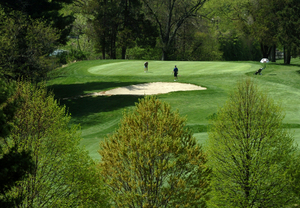
SCIOTO_TMD3_-_04_10_2008_-.jpg_04-29-08_C1_PDA29PO.jpgBob Baptist in the Columbus Dispatch lets Michael Hurdzan tell the story of Scioto Country Club's renovation where he had a little help from Jack Nicklaus.
The eighth hole at Scioto Country Club is the club's "postcard hole," a 500-yard par-5 on which a stream crosses the fairway, feeds into a lake left of the green and then feeds back out through a stone moat encircling the other three sides of the green.

"It's been a picturesque hole for us for many years," course superintendent Mark Yoder said.

Its beauty, though, was not in the eye of the beholder one day last spring as Jack Nicklaus walked toward a members committee on No. 8 and said, "Well, what do you guys think of this green?"

"The members said, 'We love it,' " said Mike Hurdzan, a local golf course architect who also was there that day. "They said, 'This is our favorite green. It doesn't get any better than this. This is our signature hole.'

"And Jack said, 'Well, I think it's just awful,' " Hurdzan said with a smile, "and I'm saying to myself, 'Oh, my God, this is really going to get fun.'

"Jack said, 'What makes you think this is such a good hole?' Now, all of a sudden, he's (challenging) these members to try to explain to Mr. Jack Nicklaus, winner of 18 majors, why this is such a good golf green? And all of a sudden people are looking at it and saying, 'Well, maybe it isn't so good.' "

The Boo Files: "If you ain't ever done it, you need to try."

They lured Boo Weekley into the Wachovia press tent to talk about his test driving a NASCAR, one of the player perks this week.

Q. What did you do this morning?
BOO WEEKLEY: I went and drove them NASCARs, them speed cars over there at the Motor Speedway here in Charlotte. It was awesome. If you ain't ever done it, you need to try.

Q. How fast did you get?

BOO WEEKLEY: The first session I went, I went like 138, 134, something like that, and then the second session I think I got it up around close to 150. It is very exciting and very tense. I've got a new perspective of how them guys go about the driving.

Q. Is it just the speed or the bend?

BOO WEEKLEY: It's the whole thing. You get a vehicle that's probably more expensive than what I own at the house, everything (laughter), you know, if you pile that thing up in the wall, you can't just say, hey, I'm sorry (laughter). It was kind of nerve-wracking, you know?

And later on, talking about the cars... 
Q. Can what you did this morning in any way help you out on the golf course?

BOO WEEKLEY: I don't think so. I don't know (laughing). It might help -- I think some of the guys need to go out there that are slower players; maybe they'd learn to speed up a little bit (laughter).

It wasn't all comedy and cars...

Q. Did you play with Trevor the first two days at Augusta?

BOO WEEKLEY: I did indeed, sir. I talked to his caddie Neil a while ago, and it was kind of amazing. I saw a little bit of it as we were playing because very rarely -- when you get into a zone or when you get into where you're actually feeling comfortable over what you're doing, but Trevor, the first two days I played with him, he looked so just focused, confident, the whole nine yards, and it's amazing that you very rarely see that as a player. But when you look at it and you see another player doing that, you're like, man, I wish I could get where he's at, in that comfort zone. I think a lot of it had to do with what happened for me the following week at Hilton Head is because I actually was focusing on a lot of the stuff I saw him doing. I kind of tried to get myself in that position, and it was neat.

"I don't have a comment about that."

amd_holy-name-golf.jpgThanks to Scott for Dennis Hamill's New York Daily News column on a case of greed from Goldman Sachs-owned American Golf. They are running off a New York charity group with excessive pricing...at a city owned course.

Last year, Houlie organized 600 neighborhood people to board an ocean cruise, kicking in $60 each toward Holy Name and Bishop Ford.

"And every year for the past 13 years on the first Thursday of June we've held a golf outing at Dyker in honor of Eddie Farrell, who used to own Farrell's," says Houlie. "The Boy Scouts volunteer to cook and clean up at a barbecue in the schoolyard after the golf outing. The proceeds, around $15,000, go to Holy Name. This year, the Dyker Golf people priced us right off the course. For the first time, we're forced to leave Brooklyn and go to Breezy Point pitch and putt because Dyker got greedy with our little religious charity."

Mike Coyne, a hospital administrator, handled the Holy Name negotiation with Dyker. "Every year, we get about 160 guys who participate," he says. "In 2006, Dyker charged us $57 per golfer. In '07 they charged us $68. This year, they wanted $89. That's a 31% jump over last year."

On weekdays, Dyker Beach Golf Course charges $54.67 for greens fees and a cart for a city resident. "But they wanted to charge us $89 a head," says Coyne. "When we did the cruise, the cruise line gave us a big discount for having a large number of people. In this case, Dyker Beach Golf wants to charge us $89 a head because there are a lot of us. It's crazy."

And...


"This isn't a corporate event," says Coyne. "This is cops, firemen, sanitation workers who want to help keep their neighborhood school open. We can't ask a working guy for $180 for a day of golf. I tried to explain that to the people at Dyker Beach but they didn't want to hear it. I asked them if we could get a better price at Marine Park, which most golfers feel is an inferior course, and they said, 'no.' They run that one, too. You can't negotiate with a monopoly. So we went to Breezy Point to a pitch and putt and we're charging $100 a head."

This didn't sound right. Especially when American Golf boasts on its Web site about, "... our commitment to improve the quality of life for those who live and work in the communities we serve. That's why we support local grass roots charitable efforts. ..."

So I called Jeff DeFranco, manager of Dyker Beach Golf, and asked about all of this. He said, "I don't have a comment about that."

And hung up.

Callaway Supports Bifurcation

1508WB0.jpgVery nice spot by reader Mark reading an Economist piece on Callaway CEO George Fellows, who apparently endorsed bifurcating the sport to save it.

Another obvious strategy, though a more controversial one, is to make golf more “consumer-friendly”—meaning easier. Golf's rulemakers have tended to focus on maintaining the integrity of the game for the best players, which has made life tough for the rest. Callaway has to conform to a welter of arcane specifications: there are regulations about how far from the centre of the club a ball can be hit and still go straight, for example. These are intended to stop Tiger Woods shooting 30 under par, but also make the game less fun for less gifted players. Golf needs to “bifurcate” into a professional sport and a game for the masses, says Mr Fellows. One opportunity is to think outside the old 18-hole, four-hour box. Callaway has recently invested in TopGolf, a business that turns a driving range into a sort of dart board, where players aim at targets and scores are calculated with the help of radio transmitters in the balls.

It's amazing that it took a major company this long to endorse the concept. But at this point, other than grooves, is there really much that could be done to make equipment so much more user friendly that it would encourage growth?

Perhaps if Mr. Fellows had noted bifurcation could lead to less expensive equipment thanks to less emphasis on spending ridiculous marketing millions to convince people that they can get the same benefits from technology as the PGA Tour's best, then he'd be onto something.

Protecting Par at Quail Hollow? Follow The Money!

Scott Hamilton of Golfweek reports that finally we have justification for a tournament protecting par:
Lots of birdies at this week’s PGA Tour stop – the Wachovia Championship in Charlotte, N.C. – could produce dividends for the title sponsor’s select customers.

Adding a new wrinkle to its sponsorship, Wachovia, the nation’s fourth-largest bank, has debuted its “Save Like A Champion” initiative. It will reward customers enrolled in the bank’s Way2Save savings program with an interest rate in June, July and August equal to the tournament’s winning score in relation to par. In the past five years at Quail Hollow Club in Charlotte, that number has ranged from 10 to 13 under.

"I'm delighted with the way things have worked out and believe we have a good test there. It's narrower, longer and tougher."

Take a guess which course R&A secretary Peter Dawson is talking about? Only that lowly Turnberry, which hosted all of those exciting Open Championships but has become outdated thanks to all that heavy lifting the boys have been doing.

Mike Aitken reports:

"The Open hasn't been back to Turnberry since 1994 and in that time the links, which is a resort course that caters for visitors, was in need of attention for a major championship," he explained.

"Work needed to be done and we're very pleased that the people at Turnberry were willing to allow us to undertake these improvements. I'm delighted with the way things have worked out and believe we have a good test there. It's narrower, longer and tougher."

Isn't it great, one of the governing bodies touting the narrowing of a course. That's good for the game.

"Perhaps the most noticeable change is at the 16th which is now a dog-leg left-to-right. It's an alteration which (changes the angle] and makes the second shot to the green over the burn much harder. That change has also allowed us to take the tee back on the par-5 17th quite significantly.

And why did you need to do that? Oh right, the working out.

"Another difference is a new tee on the third which is much further back on the top of the hill. There's also a tee which is 20 yards back of the one we used last time on the 18th. Perhaps the most spectacular alteration, though, is the new tee at the tenth where the players are going to have to hit their drives over more of the water. One of the great advantages of having an Amateur before an Open is that you can see if what you've planned works. So, some late tweaks could be possible, but I don't anticipate much changing now.

Who knew the R&A provides architectural services?

Let's see now, making course changes but not addressing changes in equipment. Good thing they know how best to attack the problem.

R&A Delays Open Championship Drug Testing

Lawrence Donegan reports on the latest example of procrastination, joining grooves, the ball, etc. In this instance, they are blaming the Asian and South African Tours. The difference here is that this is something Peter Dawson has been adamant about, which may give us some insight into why they are dragging their feet on issues they aren't so passionate about (grooves, the ball, etc.).


John Daly...There Are No Words

As reader Chuck noted, words fail to describe the video report of John Daly talking about his design work at, well, I don't know even know the name of the course. I was too distracted by the sight of him shirtless and shoeless for a photo op. Which prompted reader Gregory to wonder if John has set the new standard for staged architect photo ops? I think he may be onto something.

A flavor of what the video shows...

JohnDalynoshirt2.pngJohnDalynoshirt.png 


"Listen to the commentators? No, never."

From Larry Stewart in today's L.A. Times Morning Briefing:

Fox Sports Radio's Steve Czaban last week asked Woods: "Do you TiVo tournaments you're in, then go back and look at them afterward, maybe take notes, notice something, listen to what the announcers are saying?"

Said Woods: "I usually have my secretary get a copy of the telecasts from the PGA Tour and I'll take a look at it just from the swing standpoint, yeah."

Czaban: "Just the swing, though. You really won't sit down and . . . "

Woods: "Listen to the commentators? No, never."


"Or do we just like losing golf balls and shooting high scores?"

28golf.3.190.jpgThere should be a rule at the New York Times: don't let anyone besides Larry Dorman write about golf.

Exhibit A? Check out Bill Pennington's links golf lede. It sounds more like it came from a story assignment email:

What is it about links-style courses that has made them so popular with American golfers and golf designers? Is it because they remind us of golf’s Scottish seaside roots? Is it the blind shots? The pot bunkers?

Or do we just like losing golf balls and shooting high scores?

Golfers in the United States are drawn to the many links-style courses that have sprouted nationwide. We pay from $75 to $400 a round for the right to get battered across 18 distinctive holes.

Who would have thought that tall fescue, which you can grow in your backyard without trying, would have such cachet?

Pennington's piece was embellished by the video of him sporting one of Bill Murray's AT&T Pro-Am outfits. It's not Matty G Ambush video bad, but it's close.

Sunday Dramatics: Andy North Wins; Vows To Keep Lulling Us To Sleep With His Commentary

pga_g_clarke_300.jpgAnd I missed all of it attending the LA Times Festival of Books (yes, we read here in southern California).

This NY Times wire service compilation covers the basics, including Adam Scott's win at the Nelson and the team of Tom Watson/Andy North winning the Legeds.

This AP story explains how there's life in the old Swede yet. Annika even had Paula Creamer shaking. Literally.

And there's and ESPN.com report summing up the most exciting win of the day, Darren Clarke's Asian Open win.

For those of you who watched, anything we should know about? 

"Cobbs Creek was once a "must-play" course for visitors to Philadelphia."

20080427_inq_cobbs27-d.JPGJoe Logan profiles the GolfClubAtlas gents working to research and restore Philadelphia's Cobbs Creek, which has an amazing history.

The driving force behind building Cobbs Creek was not the city or the park commission but rather Robert Lesley, then president of the Golf Association of Philadelphia and a member of Merion, who preached the need for a quality course open to all golfers.

To goad the city into building a municipal course, Lesley appointed a committee to find a suitable plot in Fairmount Park that included Wilson; George Crump, designer of Pine Valley; and A.H. Smith, a member of Huntingdon Valley and the first Philadelphia Amateur champion. To further pressure city officials, Lesley appointed another committee made up of movers and shakers, namely the presidents of several local country clubs.

Although Wilson spent six months designing Cobbs, it's evident that he had help from Crump, Smith, George Klauder of Aronimink and J. Franklin Meehan of North Hills, all accomplished players. George Thomas, who designed White Marsh Valley, Riveria and Los Angeles Country Club, also spent time on the Cobbs site "learning."
20080427_inq_cobbs27-a.JPGCobbs Creek was once a "must-play" course for visitors to Philadelphia. Ty Cobb and Connie Mack were among the regulars.

Donald Trump played Cobbs Creek often during his time at the Wharton School of Business in the late '60s.

Maybe he'll write a check and then not say a word? I know, I can dream.


If you want to help or get involved, you can email the group at friendsofcobbscreek@gmail.com

65 Hitting 2 of 14 Fairways?

Fairways hit has become an overrated stat with the landing strips so hard to hit these days. Not to mention the fact that any decently designed course likely rewards side angles of approach that are now covered in rough, but I still did a double take at some of Alex Turnbull's ShotLink highlights following third round play at the Nelson: 

Sergio Garcia – 4 under par
• Sergio shot the low round of the day (5 under 65) despite hitting the fewest fairways in the field in the 3rd round (2 of 14).  He ranks 2nd to last in the field for driving accuracy (38.1%) for the week yet ranks T3rd in the field for greens in regulation (70.3%).
   

Our friends in Far Hills may want to copy and paste that for the ban U-grooves presentation. That is, whenever you get around to that. Then again, maybe Sergio's finally putting better thanks to Stan Utley:

• Of the 16 greens Garcia has missed thus far, he’s successfully salvaged par 14 times ranking 1st in the field for scrambling percentage.  Entering the week, Garcia ranked T107th on TOUR for scrambling from around the green (58%).

• Sergio Garcia’s 128 ft of putts made in the 3rd round was more than both his 1st and 2nd round distance of putts made combined.


"I hear the club might be making some changes next year to give us a break."

Thanks to reader Chris for noting Tiger Woods' newsletter comments where he reiterates what he said to a D.C. radio station about his belief that Augusta National will be undoing some of the course changes:

The course was very difficult. I didn't hear as many roars as I usually hear, especially on the weekend. It did play like a U.S. Open course, which is fine. But I think the galleries are used to seeing birdies and eagles. On Sunday, the way the wind was blowing, it was tough to make pars. I hear the club might be making some changes next year to give us a break. We'll see what happens.