The Boo Files: Confesses To Reading; Watching Golf To Induce Sleep

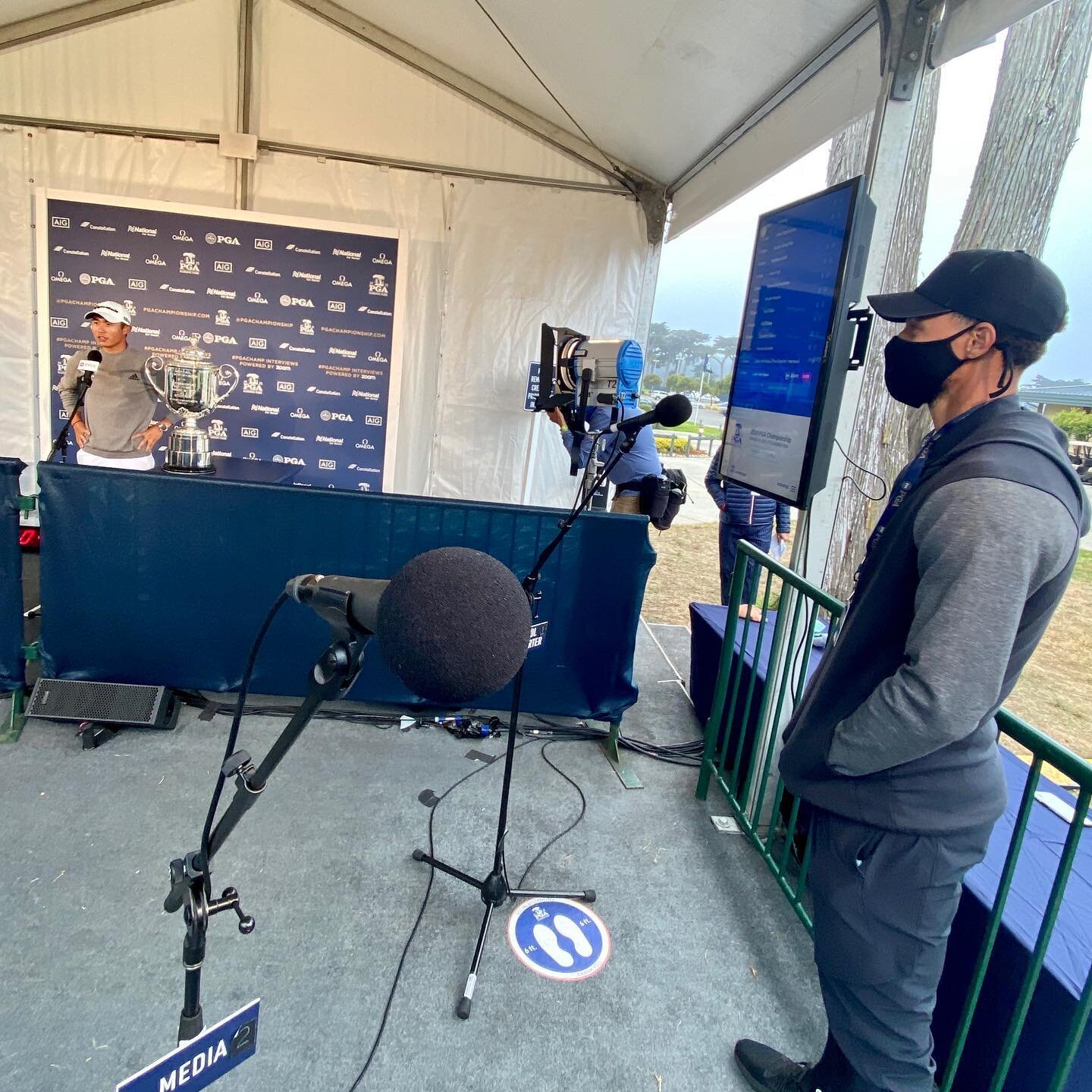
After round 2 of The Players:

Q. There was a story a couple of weeks ago SI wrote and they quoted your dad as saying you know a lot more about golf than you let on; that you watched golf more as a kid. Just talk about that.

BOO WEEKLEY: Daddy's full of it. (Laughter) Daddy wasn't never there. I mean, he was there, but like he said, I read a bunch of Hogan books; I read two Hogan books, and they were my neighbor's; he said I probably read every Hogan book there was, I think somebody quoted him saying.

And you know, and now I do watch a little more golf but I mean, that ain't nothing -- if I'm laying around the house at night getting ready to fall asleep I'll flip over and see what is golf, what is on, but I ain't going to sit there and just watch it.


"When Tiger Stays Home, So Do The Fans"

Steve Elling addresses what was painfully obvious Thursday, but much less so during Friday's telecast of The Players.
Because demand has fallen so quickly, the walkup room rate is far lower than the price many of us had reserved six months earlier. By checking back in later today, the rate will be $50 cheaper per night. Hotels are slashing rates, a sure sign that supply exceeds demand.

Tournaments that have never had Woods in the field haven't felt the impact of his absence in such stark and contrasting terms, because they don't truly know what they have been missing. The merchants in tiny, tony Ponte Vedra Beach, a sliver of a town located on a barrier island outside Jacksonville, now fully understand his financial importance.

Concrete evidence that attendance is lacking is tougher to come by. The tour does not release an actual turnstile count. A St. Johns County sheriff deputy said Friday that the number of cars in the off-site parking lot is actually greater than last year, but sensed that there were fewer people in attendance. Yet, on the course, even if the gallery figures have remained equal to past years, the vibe, minus Woods, predictably hasn't.

You can always feel the difference with your ears. Now the locals are feeling it in their wallets. It begs the question: If you paid a steep $75 for a single-day ticket and Woods couldn't play, would you still make the trip?

The body count in other quarters has signaled a resounding no. The numbers for national media in attendance speak for themselves. None of the papers from Los Angeles or Chicago are covering the so-called fifth major. Even the Miami Herald, located just six hours down Interstate 95, took a pass, as did St. Petersburg, the state's biggest newspaper. Sports strongholds like Charlotte, Dallas, Houston and Philadelphia also took a pass. Amazingly, San Diego, set to host a U.S. Open in a month, isn't here either.

GigaPan Of No. 17

They're excited over at golf.com about Fred Vuich's round 1 GigaPan image with Phil Mickelson putting on both the 16th and 17th greens, but what I found more amazing was the view of No. 17's putting surface from this angle.

If you zoom in, note how much of the green slope you can see, and how much it moves from left to right (as the players view it from the tee). This probably explains why guys have so much trouble from the drop area.

Nicklaus Admits He Used To Design For His Own Game; Has No Regrets

Jeff Shain in the Miami Herald examines the design operations of Arnold Palmer and Jack Nicklaus. Thanks to reader Nick for the link, which includes quotes from Brad Klein about the nature of the mass produced player-architect model.

First, a Palmer anecdote:

'This is certainly an ideal situation for me to stay in the business of golf,'' Palmer said during his visit to Deering Bay. ``We'd like to hope that [golfers] appreciate what we're trying to do.''
There's always hope.
Not that Palmer and Nicklaus have the capability to get intimately engaged in each design -- though it's available for developers willing to pay higher prices.

Both, though, leave a mark on nearly every blueprint that crosses their desk.
Well, better there than in the field where they could do real damage.
''He's real careful with not pushing his thoughts on us,'' said Erik Larson, Palmer Design's vice president and one of his lead designers. ``But there are certain design philosophical items that he embraces that he wants to make sure we incorporate.''

Hazards and greens should be visible. Subtly rolling greens, rather than severe humps and bumps. Make the round visually pleasing.

''Give the golfer something to look at,'' Palmer said, standing on the 13th tee of PGA National's Palmer course. The par-3 green slopes off to a collection area behind, but it all runs together.

Palmer suggests two bunkers instead.

''One on the left and one on the right,'' he said. ``That'll make a better target.''

Hey, how about a big highway stripe down the center of the fairway too?

As the caravan gets ready to move on, he adds: ``This is potentially the best hole on the course.''
He has a stronger suggestion for No. 18, where a fairway bunker melds into a larger waste area bordering water.

''We have a beautiful hazard here and it's not showcased,'' he said, all but ordering up sod and vegetation.

Palmer's suggestions will be incorporated this summer.

All in a hard day's work.

As for Nicklaus, he did reluctantly admit in his book that he favored the left-to-right approach shot in his green designs. Still, it's nice to read it in a newspaper. 

'[Nicklaus has] evolved dramatically,'' Klein said, ``both as a function of the market as well as changes in Jack's own game.''

Early Nicklaus creations frequently caught criticism for favoring a left-to-right ball flight -- matching Nicklaus' playing style. As time has evolved, though, so have the patterns.

''Pretty soon I found out,'' Nicklaus acknowledged. ``I learned from that and adjusted what I did.''

I think his work was more interesting when he was designing for himself. 

Romo Blames Football For Local Qualifier 75; Now He Can Focus On Important Stuff: USGA Reality Show

The Cowboys QB will still get to play Torrey Pines thanks to his exemption into the June 6 whatever-it's-called-contest.

Romo shot a 5-over 75 Wednesday in a local qualifying event for the Open, finishing four shots out of a playoff for the eighth and final spot for a chance to compete in a sectional qualifying event.

"I found a good rhythm on the backside, but it just took too long to get started," said Romo, who had five video cameras and 25 people following him.

 How nice for his playing partners. I take it those were cameras developing the reality show backstory? If so, nice touch.

"I just haven't been able to practice or prepare. I've got a lot of football stuff. That's part of it."

The U.S. Open is June 9-12. The Cowboys have organized team activities June 10-12, then their lone minicamp June 17-19.

However, Romo will be at the Open as a celebrity guest for an event June 6.

Nice that AP didn't bother to, uh, brand it. 

Lorena, Annika and Suzann

kingsmill.jpgThere were a pair of interesting takes on the World Nos. 1-2-3 pairing of Ochoa, Sorenstam and Pettersen at Kingsmill. Golfweek's Beth Ann Baldry posted this breakdown of a day where Annika posted a ho-hum 64 to Lorena's 65.

Dave Fairbank files this entertaining take on the round and also the need for less niceness between the three top players.
Pity that the buzz and the galleries didn't match the golf. Sorenstam fired a 7-under 64, her best round of the year and by far her best round in five appearances at Kingsmill. She is just one shot off the lead.

Ochoa, three times a runner-up here, was one shot back at 65 following a birdie binge on the back nine. Unable to find a rhythm, Pettersen managed only level par.

They toiled in front of a traveling party of approximately 300. The crowds, or lack thereof, likely were a reflection of the Thursday workday, intermittent rain and, alas, the niche appeal of women's golf.

"It's too &*%$#+ hard"

Steve Elling posts a blog item about Stephen Ames not caring for the firmness of the TPC Sawgrass greens after his opening 74.

"I have said all along, with the changes, this course was going to be borderline," he said of its fairness factor after the 2007 revisions. "And that's exactly what it is. The balls don’t even make pitchmarks on the green, they're so hard."

A handful of other players saw shots on the 17th carom off the green and into the water, including Matt Kuchar, whose ball bounced twice on the green, and still plopped into the lake.

Ames said his approach shot on the 18th landed 50 feet short of the pin, yet rolled all the way off the back of the green. As he stomped away from the scoring area, Ames spotted a tour employee and let loose some steam.

"It's too &*%$#+ hard," Ames said, within earshot of several reporters. "Go ahead, keep building courses like this."


"It was like the Hope Classic in that way."

From T.J. Simers of the L.A. Times:

Played in George Lopez's National Kidney Foundation Celebrity Golf Classic and when I mentioned Andruw Jones' name, Lopez said, "A Dodger uniform just doesn't look good with a cummerbund."

In 2005 Lopez received a kidney from his wife, Ann, who tripped while coming onto the stage after the tournament dinner. "Don't fall," he told her, "I might need the other one."

For the last two years Lopez had tried to breathe some life into the Bob Hope Classic, which no longer featured an interesting field of golfers and celebrities.

Lopez was apparently too edgy for the folks who don't know a dying tournament when they have one, and so Lopez will no longer be affiliated with the Hope.

As a result, the Kidney Classic has a new host, the first tournament drawing such incredible stars as Frank Pace, R.J. Jarimillo, NinoCuccinello and Bryan Callen.

I know one of them was a star, because the tournament assigned a celebrity to every fivesome, part of the fun of the whole day guessing which one of our guys used to be somebody. It was like the Hope Classic in that way.

"That's for me and him"

During Wednesday's contest to see which caddies could hit No. 17 green, it also served as a fundraiser for the Bruce Edwards Foundation for ALS Research.

Peter Morrice at GolfDigest.com offers up some insights on the day, including what some players did and did not drop cash into the collection jar.

The following players gave $100, the biggest number we know of: Ernie Els, Camilo Villegas, Tom Pernice, Ryuji Imada, Nathan Green and Kevin Stadler. At the other end, some players didn't put anything in the jar, including Fred Couples, Mark Calcavecchia, Retief Goosen, Charles Howell III and Zach Johnson ("I don't have my wallet"). To be fair, we're only naming players we saw donate (or not donate) or heard about from a reliable source, and only during part of the day; some caddies made donations, which they could have been doing for their players; some pros might be giving in other ways or at other times. Whatever the case, it was great tour-player watching.

Teacher Butch Harmon donated a hundred bucks and promised another hundred to any caddie in the group he was walking with who hit (and held) the green. None did. Bart Bryant was light on cash when he got to 17, so he slipped $10 in the pot but in a classy move sent someone back with 100 more. Sergio Garcia was playing with Villegas, and when Camilo produced a Ben Franklin, Sergio said, "That's for me and him" and left it at that. Here's a few more donations we're pretty sure about, although these players could've slipped an extra twenty by us: Vijay Singh ($40), Angel Cabrera ($25), Trevor Immelman ($20) and Stewart Cink ($20).

One player (hint: He almost won a major last year) said he didn't have any money on him, so he hit up one of his playing partners for $100. Then put $20 of it in the jar. We can only assume he later made good on the loan--or else cleared a smooth 80 bucks.

"They don’t ever assess (stroke) penalties and the fining thing, it takes four or five months before you get one 20 grand fine."

Andrew Both on slow play:
As anyone who has attended a tournament lately will attest, it is almost painful watching a professional tournament on site.
Ouch. Nice to see this theme picking up steam rapidly, eh?

Both also shares this from Matthew Goggin:
“It’s brutal,” Goggin said. “Slow players can affect fast players but fast players don’t affect slow players. Fast players just have to deal with it.

“Slow players can torture everyone in the group by not letting anyone get into a rhythm, either their playing partners or the three or four groups behind them. We’re all sick of slow players, we all know who they are.”

There have been several suggestions as to how to speed up play, including smaller fields and easier hole locations, but the biggest problem may be that the penalty for slow play on tour is so small.

“They don’t ever assess (stroke) penalties and the fining thing, it takes four or five months before you get one 20 grand fine,” Goggin said.

"5 Tips From Tim Finchem For Managing Well"

Wall Street Journal online readers were deprived of five tips accompanying the "Boss Talk" interview with the PGA Tour Commissioner. However, because advice like this just can't be withheld from the online reading public, I share with you Tim Finchem's 5 Tips For Managing Well.

1. Do it now.

Succinct, highly original and said with such warmth. Do it now Senior Vice President No. 32 or you'll be a Vice President faster than you can say product incentivization!

2. Communicate, communicate, communicate.

Take that John Wooden!  Only two communicates would have been less, uh, impactful.

3. Seek consensus, but recognize when to sacrifice unanimity for decisiveness.

Well, we know Tim came up with that convoluted way of saying, $#@% the Policy Board, we'll do what I want to do! 

4. Remember that, as a leader of a team, you are also a member of that team.

Remember that, just because I am paid, $5.2 million, don't act like it.  

5. Take what you do seriously, but not yourself. 

There is no punchline for No. 5. It is a punchline. 

“The world’s most dangerous golf course.”

AP's Bradley Brooks writes about the actual Green Zone golf course (as opposed to the proposed one). Thanks to reader Jim for the story of Crossed Swords Golf Course, which Brooks writes "is closed in by 15-foot concrete blast walls and watched over by humorless Gurkha guards from Nepal."

Our tee time was 5 p.m. The day had cooled to about 109 degrees.

The first challenge was getting by the Gurkha guards. Despite gaining access a few times before, on this particular day our security badges were deemed insufficient. After 45 minutes of explaining, pleading and miming a golf swing— the guards had little command of English—a British officer took pity and got us to the first tee at what must be one of the quirkiest courses in the world.

It has competition, though. Several years after the fall of the Taliban in Afghanistan in 2001, the Kabul Golf Club was cleared of landmines and reopened. Near the DMZ separating the Korean peninsula, the single, 192-yard hole at U.S. Camp Bonifas playfully billed itself as “the world’s most dangerous golf course.”

In the Green Zone, there is so little grass on the course golfers must carry their own: swatches of artificial turf for all shots except putts.

“I guess we’ll always hit the fairway, right?” Petr quipped as we made our way to the first tee, fake grass in hand.

"I got amped after watching Cirbie Sheppard, a competitor on Golf Channel's 'Big Break Kaanapali'"

Golf World's Jaime Diaz notes the "mini-spike" in slow play outrage and summarizes in succinct fashion the many issues the golf world faces if it hopes to confront the issue. More disturbing than the slow play is what got Jaime fired up:

David Toms, Boo Weekley and even Tiger Woods all have sounded off. So did R&A chief executive Peter Dawson. Personally, I got amped after watching Cirbie Sheppard, a competitor on Golf Channel's "Big Break Kaanapali," haplessly indulge in a reported seven minutes (the ordeal was shown in fast motion) of pacing, club changing and general dithering before getting herself to hit a simple chip shot.

One of, if not the most esteemed writer in the game today watching the Big Break Kaanapali?

It's one thing to watch it Jaime, but to admit it in print is a cause for concern!