The Torrey Story, Continued
/ I've added posts on Tiger and Phil's press conferences (including Phil blasting the USGA's 13th tee) and a look at the Torrey Pines practice area. Check it out.
It’s back!
Twenty years later Tatra Press has kindly allowed me to bring back Grounds For Golf now that golf architecture is of more interest to the masses. A new Introduction looks at what’s driven the interest growth and two new chapters I had a blast adding (plus a few edits to keep things up-to-date).
The Amazon purchase page for the book arriving June 15, 2026.
 I've added posts on Tiger and Phil's press conferences (including Phil blasting the USGA's 13th tee) and a look at the Torrey Pines practice area. Check it out.
A man devoted to his craft. See if you can count the number of cameras.


I broke down the golf course portion Tiger's sitdown with the scribes for GolfDigest.com, but there were a few other highlights worth noting, starting with this from Rich Lerner:
Q. A question about your website, what's the benefit to you in terms of being able to control the information that flows from your camp and control the message a little bit as opposed to the rest of us speculating?
TIGER WOODS: Well, it's a way for me to basically say exactly what's on my mind. I can say it to a few of you guys, but not all of you.
Ouch.
And this on the winning score possibilities:
Q. I don't think anyone's expecting anybody to go to 19-under par here. What would you imagine you'd have to shoot to win this tournament this week or anyone would have to shoot?
TIGER WOODS: Well, 18 would be good, then. (Laughter).
Q. What would you guess they might shoot?
TIGER WOODS: Oh, might? We've been trying to figure that out the last few days. As Loren asked about the uncertainty of the set up, we don't know. How many days are they going to play it up on 13? How many days are they going to play it up on 14? Same on 3. Are they going to keep us all the way to the back on 6. We just don't know.
If they play it all the way up, I'm sure it will be under par, without any doubt. If they play it all the way back and move some of the pins around, like on 16, get the left tee box and left pins, well then it makes it a whole lot harder.
It's really hard to answer because I don't know how they're going to play it. If they play it up all days then you'll say under par, for sure. Play it back every day, then you'll probably say over par. But since it's a mixture you don't know what it's going to be.
And it's a little bit frustrating as a player, because you always have an idea what the score is going to be going into the event. But this year it's a little bit different.
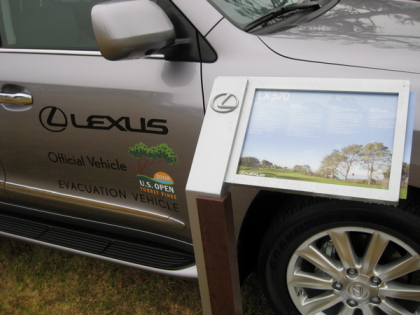
Why do the evacuation vehicles need a sign telling us the car specs?
The U.S. Golf Association is expected to generate up to $50 million in profits during this week’s U.S. Open hosted by Torrey Pines Golf Course, making it one of the most successful Opens of all time.
Total revenue for the tournament should be close to $100 million, including estimates of $20 million in ticket sales, $15 million in corporate hospitality, $15 million in merchandise and $5 million in food and beverage.
That also includes approximately $40 million from domestic and international television revenue. Many of those arrangements include rights to air parts of other USGA tournaments, such as the Women’s and Senior Opens, but media industry sources estimated 95 percent of the value of those deals is attributable to the U.S. Open.
Expenses should be about $50 million based on Opens held at comparable courses.

More posts are up at GolfDigest.com, including a look at the kikuyu rough and player reaction to the new 13th tee.
 Steve Elling tells you more than you ever wanted to know about Black's Beach, the nudist spot below the 13th tee that is actually a much shorter walk to the golf course than the media center.
A long overdue honor, reports Brad Klein.
In Brent Schrotenboer's look at the perception of a USGA-East Coast bias, he offers this interesting quote from USGA Executive Committee member Jay Rains:
Torrey Pines needed a $3.5 million renovation and redesign before it was deemed worthy by the USGA. A new course that opened in 2007, Chambers Bay in Washington state, will host the Open in 2015. Rains hopes these events will whet Western appetites for more.Ah remember the good ole days when you didn't have to add 500 yards to make a course Open ready?
"Because there haven't been as many championships out here, you don't stir the imagination of people to think, `Gosh, if we added 500 yards to our course, or if we did this or did that, we could host the Open, too,'" Rains said.

Come test drive a Lexus (click to enlarge and cringe)Brent Schrotenboer of the San Diego Union Tribune looks at the USGA's corporate shift and some of the quotes are worth noting as well as a sidebar on just how little money the City of San Diego will see from the U.S. Open revenues.
Why would this “purist” nonprofit suddenly be signing high-profile corporate partnerships with American Express, Lexus, IBM and the Royal Bank of Scotland?Pete Bevacqua of the USGA says they are absolutely drawing the line, until the line needs to be redrawn.
“It's bull-(expletive),” said Frank Hannigan, who worked at the USGA from 1961-89. “They don't need the money. I'm telling you as somebody who was intimately involved with USGA financial affairs for a long, long time. They do not need the money.”
“I would tell you we are absolutely drawing a line” on partnerships, said Pete Bevacqua, the USGA's chief business officer. “We have no intentions of going beyond four at this time. We didn't want to dive into anything recklessly. These are very measured steps we're taking.”
Purists such as Hannigan don't completely buy in, though. Told the USGA needs to diversify its revenue streams, Hannigan scoffed. “I said that in 1970,” he said.
And this was interesting...
A lion's share of the USGA's revenue stems from the Open, though it's hard to quantify exactly how much. Besides TV rights, there are ticket sales and merchandise. Last year, the USGA netted $6.8 million from U.S Open souvenir sales of $12.4 million. This year, the USGA will try to exceed that at the largest commercial symbol of the Open: its 39,000-square-foot merchandise tent.
“It looks like Wal-Mart,” Tatum said. “And I think Wal-Mart probably wonders why it can't be as effective in marketing and selling its products. I guess I have mixed reactions to that. When it involves a strictly commercial activity, I think it detracts from the scene and the emphasis of the game played at its ultimate level. But I do understand the economics and how useful that money can be.”
“It’s sad that they pick and choose the pairings like that,” said Watson following Monday morning’s practice round at Torrey Pines. “There’s no crowd that’s going to be following us. Not that they would, anyway.”
 Another post is up at GolfDigest.com, this one looking at my day with Geoff Ogilvy walking around Torrey Pines last week.
You can check all two of the posts here.
It's take the trash out day at PGA Tour HQ...releasing this on Monday of U.S. Open week is, well, wise I suppose. Still, hard to believe people won't notice.
 So much to read, so little time. I'm off to Torrey Pines, so here's just some of the stuff that caught my eye to get you ready for the week. I'll leave it up to you to find the Anthony Kim-is-the-next great-player stories.
Oh and this will likely be my last clippings post this week, as my duties for GolfDigest.com will be the focus, with plenty of posts here as well.
Anyway, here goes:
Tod Leonard covers the lore and essence of the national championship with several entertaining anecdotes.
As always, SI's anonymous pro is entertaining in breaking down the favorites.
Larry Dorman considers the impact Torrey Pines will have and offers this from Mike Davis:
“I’m really pleased with how it has turned out,” he said. “A couple years ago I was thinking, ‘Gosh are we going to be anywhere close?’ Now I’m thinking, ‘What’s out there that we could do any better?’ I’ve done a lot of talking with some of the pros that have been out there, and I have yet to hear anything from anyone that wasn’t right.”
Fred Vuich's Gigapans are back, offering the chance to study that lifeless bunker and crappy catch basin at Torrey's third hole.
Ron Whitten on six things you don't know about Torrey, and the story includes a shot of an old Torrey Pines related old racetrack program
Ron Balicki looks at the strange journey of Rickie Fowler, with a great story about how he learned he was in the field.
Brett Avery and bestapproach.com produce the best map of theirs I've ever seen, capturing the property scale and grandeur of the clips. I mean, they made Torrey Pines look dramatic! In all seriousness, I think the map does capture the feel of the place that we will see this week, with the canyons and ocean more prominent thanks to tree removal (and NBC's production work).
Whitten profiles Rees Jones and says he has the worst come-over comb-over in golf. And you think I'm tough!
Bill Center in the San Diego Union Tribune captures the essence of why Torrey Pines is a great place (and not just because of the golf).
Alan Shipnuck considers the role the Junior World has played in golf.
It shocks him to admit it, but Peter Kostis says the USGA is now the standard bearer for golf course setup and that the PGA Tour is stinking it up with dreadful consequences for the future of the game. Now if we could just get you to say that on the air...
And finally, it's not Torrey Pines related, and yet it is: Sam Weinman looks at the amazing notion that Westchester County is without a golf tournament this year, and the future looks bleak due to any number of reasons, including the emergence of places like Torrey Pines. He also offers a blog post of his own take and a sidebar piece about possible future venues in the Westchester area.
Geoff Shackelford is a Senior Writer for Golfweek magazine, a weekly contributor to Golf Channel's Morning






Copyright © 2022, Geoff Shackelford. All rights reserved.