"There is a new level of excitement at Golf House that has evolved as the USGA has moved from a 'no' culture to a 'let's consider it' culture."

Sports Business Journal offers a "What I Like" interview with USGA CMO Barry Hyde. This caught my eye:

"There is a new level of excitement at Golf House that has evolved as the USGA has moved from a "no" culture to a "let's consider it" culture. The best example may be the Golf Digest U.S. Open Challenge which we launched with the publication and NBC this year and has already generated significant member growth, handicap awareness and a medium for us to discuss practical rules situations. This would never have had a chance in 2005."

Hey, I have a let's consider it item: doing something about grooves, distance gains and hey, while I'm throwing stuff out, the long putter too!

Oh, and the photo of Hyde? Standing in front of the Rolex clock outside Golf House. Pure coincidence!

(Yes, for those of you who haven't heard, they have a Rolex clock in Far Hills now.)
USGA Going "Soft"

Steve McClellan in AdWeek reports on where all the USGA's money going: a new $10 million ad campaign (could this mean the hole-in-one ad has been laid to rest?).

The campaign was developed by Omnicom's Fathom Communications, New York, which won the account in April after a review that included Kirshenbaum Bond + Partners. Incumbent BBDO did not defend.
Did not defend?
In addition to the new commercials, directed by Academy Award-winning director Errol Morris (Fog of War), the campaign will utilize online, direct mail and experiential components.

The spots (with voiceovers by actor Ed Burns) are designed to soften the game's elitist image and demonstrate that anyone can play. In one ad, kids are shown playing.

 Oh, highly original!

 In another a couple is playing a round and it's the woman who has the handicap, not her male partner.

 You go girl!

But while everyday folks are featured instead of the celebrity-laden spots featured previously, the "For the good of the game" tagline, developed by BBDO, remains.

Thank God! What would we do without it.
Peter Groome, president of Fathom Communications, said. "Our focus for the USGA is to develop a complete communications plan that will create a stronger connection between golfers and the USGA at all points of contact and well beyond their most visible medium, television."

 Is this web site a point of contact?

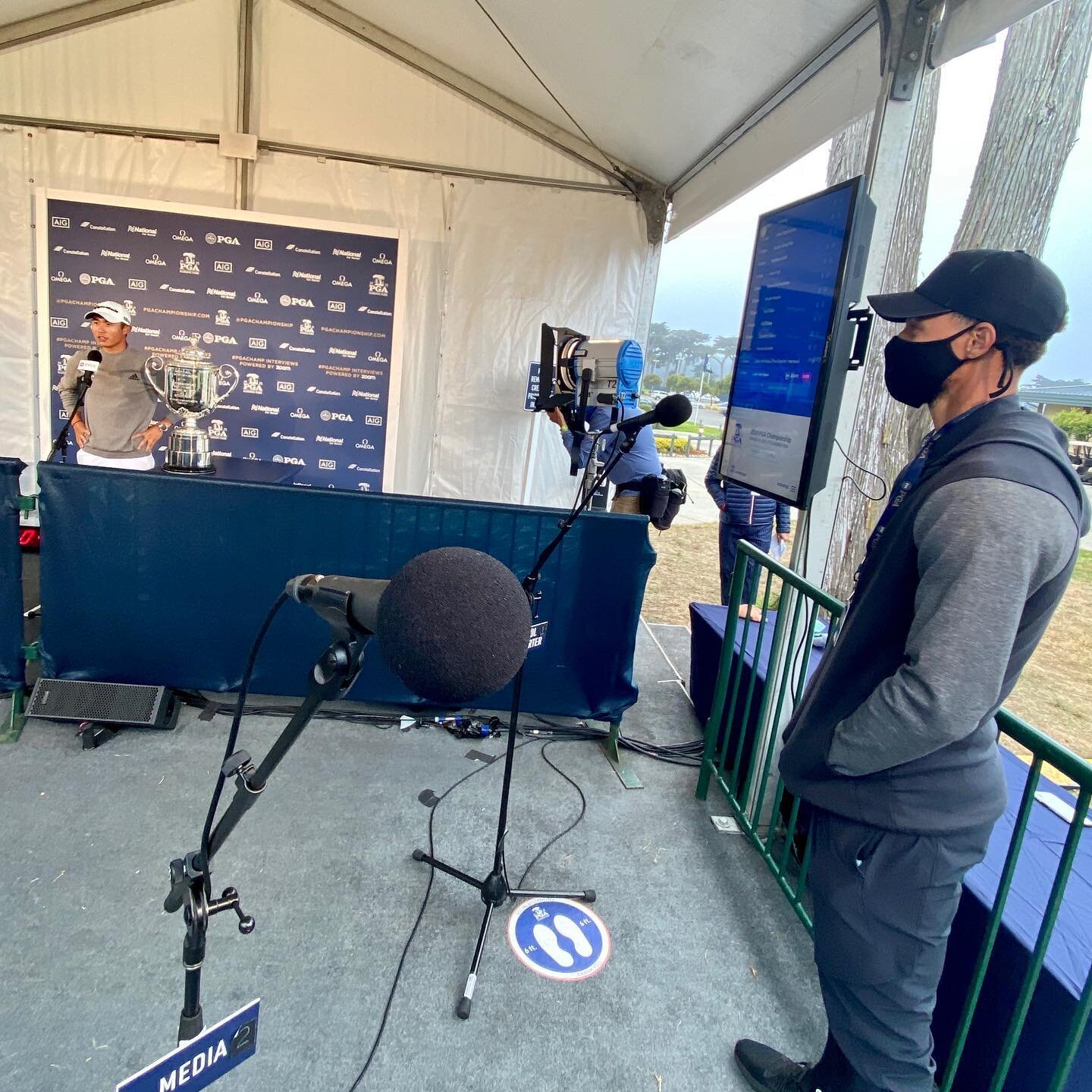
Tiger's Press Conference From Torrey

I broke down the golf course portion Tiger's sitdown with the scribes for GolfDigest.com, but there were a few other highlights worth noting, starting with this from Rich Lerner:

Q. A question about your website, what's the benefit to you in terms of being able to control the information that flows from your camp and control the message a little bit as opposed to the rest of us speculating?

TIGER WOODS: Well, it's a way for me to basically say exactly what's on my mind. I can say it to a few of you guys, but not all of you.

Ouch.

And this on the winning score possibilities:

Q. I don't think anyone's expecting anybody to go to 19-under par here. What would you imagine you'd have to shoot to win this tournament this week or anyone would have to shoot?

TIGER WOODS: Well, 18 would be good, then. (Laughter).

Q. What would you guess they might shoot?

TIGER WOODS: Oh, might? We've been trying to figure that out the last few days. As Loren asked about the uncertainty of the set up, we don't know. How many days are they going to play it up on 13? How many days are they going to play it up on 14? Same on 3. Are they going to keep us all the way to the back on 6. We just don't know.

If they play it all the way up, I'm sure it will be under par, without any doubt. If they play it all the way back and move some of the pins around, like on 16, get the left tee box and left pins, well then it makes it a whole lot harder.

It's really hard to answer because I don't know how they're going to play it. If they play it up all days then you'll say under par, for sure. Play it back every day, then you'll probably say over par. But since it's a mixture you don't know what it's going to be.

And it's a little bit frustrating as a player, because you always have an idea what the score is going to be going into the event. But this year it's a little bit different.

50 Million Reasons We'll Be Back!

Jon Show reports that the USGA's profits this week should help offset David Fay's bloated salary, and more importantly you would hope the financial windfall ensures a return to Torrey Pines (with architectural, uh, tweaks a must, as is a media center within range of the course).
The U.S. Golf Association is expected to generate up to $50 million in profits during this week’s U.S. Open hosted by Torrey Pines Golf Course, making it one of the most successful Opens of all time.

Total revenue for the tournament should be close to $100 million, including estimates of $20 million in ticket sales, $15 million in corporate hospitality, $15 million in merchandise and $5 million in food and beverage.

That also includes approximately $40 million from domestic and international television revenue. Many of those arrangements include rights to air parts of other USGA tournaments, such as the Women’s and Senior Opens, but media industry sources estimated 95 percent of the value of those deals is attributable to the U.S. Open.

Expenses should be about $50 million based on Opens held at comparable courses.

"`Gosh, if we added 500 yards to our course, or if we did this or did that, we could host the Open, too.'"

In Brent Schrotenboer's look at the perception of a USGA-East Coast bias, he offers this interesting quote from USGA Executive Committee member Jay Rains:

Torrey Pines needed a $3.5 million renovation and redesign before it was deemed worthy by the USGA. A new course that opened in 2007, Chambers Bay in Washington state, will host the Open in 2015. Rains hopes these events will whet Western appetites for more.

"Because there haven't been as many championships out here, you don't stir the imagination of people to think, `Gosh, if we added 500 yards to our course, or if we did this or did that, we could host the Open, too,'" Rains said.
Ah remember the good ole days when you didn't have to add 500 yards to make a course Open ready?


“It's bull-(expletive)"

230136-1634678-thumbnail.jpg
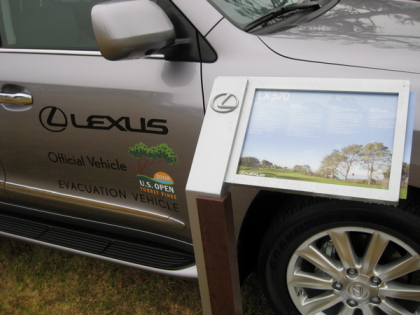
Come test drive a Lexus (click to enlarge and cringe)
Brent Schrotenboer
of the San Diego Union Tribune looks at the USGA's corporate shift and some of the quotes are worth noting as well as a sidebar on just how little money the City of San Diego will see from the U.S. Open revenues.

Why would this “purist” nonprofit suddenly be signing high-profile corporate partnerships with American Express, Lexus, IBM and the Royal Bank of Scotland?

“It's bull-(expletive),” said Frank Hannigan, who worked at the USGA from 1961-89. “They don't need the money. I'm telling you as somebody who was intimately involved with USGA financial affairs for a long, long time. They do not need the money.
Pete Bevacqua of the USGA says they are absolutely drawing the line, until the line needs to be redrawn.

 “I would tell you we are absolutely drawing a line” on partnerships, said Pete Bevacqua, the USGA's chief business officer. “We have no intentions of going beyond four at this time. We didn't want to dive into anything recklessly. These are very measured steps we're taking.”

Purists such as Hannigan don't completely buy in, though. Told the USGA needs to diversify its revenue streams, Hannigan scoffed. “I said that in 1970,” he said.

And this was interesting...

A lion's share of the USGA's revenue stems from the Open, though it's hard to quantify exactly how much. Besides TV rights, there are ticket sales and merchandise. Last year, the USGA netted $6.8 million from U.S Open souvenir sales of $12.4 million. This year, the USGA will try to exceed that at the largest commercial symbol of the Open: its 39,000-square-foot merchandise tent.

“It looks like Wal-Mart,” Tatum said. “And I think Wal-Mart probably wonders why it can't be as effective in marketing and selling its products. I guess I have mixed reactions to that. When it involves a strictly commercial activity, I think it detracts from the scene and the emphasis of the game played at its ultimate level. But I do understand the economics and how useful that money can be.”


“There’s no crowd that’s going to be following us. Not that they would, anyway.”

Kirk Kenney of the San Diego Union Tribune talks to Bubba Watson about The Pairing and offers this Yogiesque perspective:
“It’s sad that they pick and choose the pairings like that,” said Watson following Monday morning’s practice round at Torrey Pines. “There’s no crowd that’s going to be following us. Not that they would, anyway.”