"You need to come up with something else"

AP's Larry Lage follows Rocco Mediate around Warwick Hills and shares some fun anecdotes about his return to the tour following the U.S. Open showdown with Tiger.

Mediate's approach from 115 yards at No. 6 sailed to the right and landed in rough thick enough it almost hid the ball, an errant shot just 46 fans standing along the ropes saw at the sparsely attended event.

Instead of cursing at himself, Mediate conversed with fans and joked about how many of them say "That's a gimme,'' any time a ball is remotely close to the cup.

"You need to come up with something else,'' Mediate joked.

"The fact that you've not heard anything should not be construed as meaning there's a problem."

Several interesting items in the USGA press conference at Interlachen where David Fay, Roberta Bolduc and Mike Davis faced the inkslingers who miraculously asked some great questions (offsetting the point missers lobbing stuff about a U.S. Senior Women's Open). After Davis talked at length about Interlachen's design attributes and Brian Silva's restoration work there, he shared this about the bunkers at Torrey Pines:

The bunkers like we have been doing the last few years, we did stir up the bottoms to try to make the bunkers a little bit softer so that the player can't get as much spin. And I was telling somebody the other day, one of the best things I heard at Torrey Pines, it just -- I almost wanted to do a cartwheel is when a player actually said, we were trying to avoid bunkers at Torrey Pines. Because we haven't heard that in who knows how long.

Davis, on driveable par-4s this week at Interlachen and in future USGA course setups:

 You have to have enough risk but you've got to have the reward with it. They have to match. And in fact David and I talked about it before Sunday of Torrey Pines, that I thought it was going to work well for the reasons I kept going through in my mind, but you don't really know. And if only ten players out of the 80 went for it I would call it a failure but I think there was 57 or 56 or whatever that went for it. And it's, you know, there was a blend of scoring.

But when we did it at Oakmont it worked. Because those holes were architecturally set up for it. We did it the one hole at Winged Foot. But, no, we will not force it. So it won't necessarily be a trademark. But I think when you get that opportunity, it's really neat because you do make the players think. And we want -- we don't want this to be gimmicky, but at the same time we want it to be the hardest championship of the year, whether it's the U.S. Girls Junior, the Women's Open, the U.S. Open or the Senior Men's Amateur, but at the same time there's nothing wrong with introducing more risk, reward and making the players think, giving them opportunities, and taking a hole and really saying if you play it great you can make birdie, eagle, but if you don't play it so great, if you try something and don't pull it off you're going to pay the price.

And look at this troublemaker with the killer follow up about those R&A lollygaggers.

Q. David, could we get an update on the groove situation? Wasn't that due for some sort of roll out in January, I think, in theory? Has there been any developments on that front or are we going to have to all change irons?

DAVID FAY: The latest update is there's no update. We are still on track, we hope. There are a number of components that we have to get everything resolved. A number of -- and we're moving ahead on that. But to give you a timetable at this time, it would be premature.

Q. R & A still a part of the equation in getting them signed up for the same time?

DAVID FAY: Well the R & A, it's a change in equipment, a change in any rule will not happen unless both sides support it. Fully. The fact that you've not heard anything should not be construed as meaning there's a problem. It's just that we -- anything dealing with equipment, particularly these days, is complex. You deal with the specifications, manufacturing tolerances, I think that one thing I would say that we have never, at least in my experience at the USGA, researched and done the lab testing and the player testing to the degree that we have with this subject of grooves.

Just not enough for the R&A!

"Think of wacky bowls where the sculptor takes the wet clay mold and stretches it in different directions."

The first review is on the Castle Course at St. Andrews, making its debut this week.

Alistair Tait doesn't sound like he'll be invited back after this.

With the Castle Course, I felt as if I’d need a few rounds to get the lay of the land.

I’d certainly need more than a few rounds to get used to the greens. Kidd must have been in a funky mood when he designed these, for they might be the most undulating greens I’ve ever played.

The note I jotted on my course guide regarding the fifth green consists of  one word: “stupid.” The course guide describes this as a “bowl.” I’d agree if it read, “bowl that’s bent out of shape.” Think of wacky bowls where the sculptor takes the wet clay mold and stretches it in different directions.


Lost Balls, Double Digit Scores And Unreachable Fairway Add Up To Declaration Of Success By Dawson

The R&A frontman and in house architect, Peter Dawson, declares his redo work at Turnberry a success. And boy doesn't it sound like great work based on this reporting. First, Douglas Lowe writes:

The 17th hole particularly, where Nick Price had an eagle 3 on his way to Open triumph in 1994, was considered too soft for a modern championship, but having lengthened the hole and added three new bunkers there were lost balls galore in the qualifying rounds.

Scores in excess of 10 were recorded as players, into winds in excess of 30mph, failed to make the 230-yard carry to the fairway and so tough was the course altogether that the competition scratch score on day two was up at a mind-boggling nine-over-par 79.

Asked about the severity of the 17th, Dawson, who has been under fire in recent years for allowing distances the ball is hit to increase, quipped: "The players will just have to learn to hit the ball further."

Brilliant answer!

Mike Aitken can't wait for the Open Championship next year after witnessing the same success as Lowe:

Although the Ailsa has been something of a soft touch at past Opens – both Tom Watson and Nick Price won at Turnberry with 72 hole totals of 268, the lowest winning scores for an Open in Scotland – the revised links, albeit in severe weather, produced a standard scratch of 79 during the first round of qualifying for the Amateur last week. Moreover, a number of players from the new tee at the stretched par-5 17th couldn't reach the fairway when the hole played into a strong headwind.

One of the most heartening aspects of the changes was the success of the 16th, where the re-modelled par 4 has become a 458-yard dogleg which brings the burn in front of the green into play and approaches the green from a far trickier angle. "I never thought I'd see the day when people couldn't get up in two at the 16th," admitted Dawson.
Yes that sounds heartening!
Although offering a spectacular view, the new tenth tee, built beyond the halfway house to create a dramatic drive over a rocky promontory, received more mixed reviews. "If we had our time again we might have raised (the tee] a little," said the chief executive. "It's not too late to change, and we'll think about it."

 Print up that change order Peter!

Shocker: Doctors Declare Tiger Surgery A Success

Your basic pre-fab press release from IMG, with a quote from Tiger written by someone else...

Tiger Woods underwent successful reconstructive surgery on the Anterior Cruciate Ligament (ACL) in his left knee on Tuesday in Park City, Utah.

The surgery was performed by Dr. Thomas D. Rosenberg and Dr. Vernon J. Cooley who did arthroscopic surgery on Woods’ same knee in April of this year.

“We were confident going in to this surgery and I am pleased with the results,” said Dr. Rosenberg.  “There were no surprises during the procedure, and as we have said, with the proper rehabilitation and training, it is highly unlikely that Mr. Woods will have any long-term effects as it relates to his career.”

A rehabilitation schedule and projected timetable for Woods’ return to competitive golf has yet to be determined, but will be announced at the appropriate time.

“It was important to me to have the surgery as soon as possible so that I could begin the rehabilitation process,” said Woods. “I am very appreciative of Dr. Rosenberg and Dr. Cooley and his staff’s guidance and look forward to working with them through the necessary rehabilitation and training.  I also wanted to thank everyone for their well wishes over the past week.  I look forward to working hard at my rehabilitation over the coming months and returning to the PGA TOUR healthy next year.”

Reflecting On The 2008 U.S. Open: The Setup

2008OpenLogo.gifThere's not too much more I can say about the details of the Torrey Pines setup that were not covered in the GolfDigest.com blog or in the Golf World story on No. 14.

However I would ask you to consider the potential impact of what Mike Davis and friends accomplished at Torrey Pines.

They took a golf course virtually devoid of strategic questions and made it a thinking man's championship that will be remembered for ages. The simple act of moving tees around actually caused players to pause and think. Players could not plan out their club selections in advance (sorry Phil).

The fact that this kind of spontaneity and surprise only happens in links golf speaks to just how far the game has drifted from rewarding thought as much as physical skill. 2008USOpenSetupGear.jpg

Though Davis made it look easy it can be to inject interest, there was a great deal of planning and vision that went into the setup. This doesn't mean anyone should be discouraged from more of this variety in future majors, tour events or local amateur tournaments, just a reminder that a lot of work went into this.

230136-1661189-thumbnail.jpg
Tiger On No. 14 Sunday, Photo courtesy of Rob Matre (click to enlarge)
I'm still fascinated that a few observers are making a fuss about the notion that players had to pause and contemplate options at No. 14. That shortening a "solid" hole like the 14th was a terrible sacrifice. Yes, the current 14th is solid. Solidly dull. You hit the fairway, you hit the green and you putt. There are not questions to answer, no decisions to make. Just an obedience examination.

Ponder this: I saw only one player the entire day come to No. 14 tee and pull a club before he arrived at the tee markers. Everyone else had a discussion with their caddy or at least took in information before selecting a club. That is the kind of "test" that golf needs more of. Not every hole because they'll never finish, just more often during a round.230136-1661192-thumbnail.jpg
Heath Slocum drives the 14th green, courtesy of Rob Matre (click to enlarge)

It also cannot be underestimated how difficult a shot the 267-yard 14th posed and how impressive Rocco's two plays were Sunday and in the playoff.

Now that we have evidence of an exciting event owing much of its success to the setup elements--particularly the vulnerability and scoring differential on the par-5s--Mike Davis has proven that options, variety and strategic thinking can offer difficulty that is far more interesting and revealing than tiny landing areas and high rough.

Lettter From Saugerties: The U.S. Open and Tiger

Our friend Frank Hannigan, the former USGA Executive Director, wrote after the thrilling U.S. Open to put matters in his unique perspective.

Dear Geoff:

Golf was not invented at Torrey Pines. Nor did it die on Tuesday when Tiger Woods revealed he is badly damaged and can't play for the balance of 2008.

Ben Hogan, hit straight on by a fast moving bus, in the winter of 1948, after winning the US Open,  had to sit our all of 1949.   Golf survived. The four major winners in 1949 were Sam Snead (twice),  Bobby Locke and Cary Middlecoff.   Moreover,  I'm sick of hearing of the huge money game being defined as "golf."  As in "Golf is in dreadful shape with Tiger out.  The British Open might just as well be Quad Cities.

By the way, golf has been stagnant during the era of Tiger Woods in terms of rounds played or golf balls sold. In Hogan's best days,  golf boomed.

I'm not ready to acknowledge that Tiger is the best player ever.   America has produced four incredible golfers: Bobby Jones,  Hogan and Jack Nicklaus. Jones was such an anomaly it's impossible to compare him with anyone.  He was an amateur who stopped playing competitive golf at age 28.   While he was the best player in world  -  way in front of Sarazen and Hagen - he picked up degrees from Georgia Tech (engineering),  Harvard (English Lit) and Emory (Law).  

Hogan's total of nine majors  was lessened by away time.  After returning from his bus accident,  Hogan won the 1950, 1951 and 1953 US Opens.  Your readers will recognize the most famous photograph in golf ever taken was of Hogan from behind by Life Magazine 's brilliant Hy Peskin.  He was hitting a 1 iron into the 18th green at Merion.  As was his wont,  Hogan did not miss the fairway or the green and went on to win a 3 man playoff

Two years later, with no special enthusiasm,  Hogan went on to his lone British Open and won at Carnoustie.

(A typical Hogan story:  As he rested in what passed for a locker room at Carnoustie he was approached by a dignified man bearing a card.  The man said he was representing Paul, king of Belgium.  His majesty had read Mr. and Mrs.Hogan were coming to the continent for a week.  Would they like to stay in his castle and perhaps play a round of golf.  Hogan looked and said "I don't play golf when I'm on vacation.")

He took nearly a week to reach Great Britain by ship.  Few Americans played. But let's pose a counter factual: suppose there were jets so that Hogan could play in every British Open from 1946 through 1960. (He had missed 1942 through 1945 because of World War II. )  I do believe he would have won some.

As for Nicklaus, with his 18 majors and 19 runner-ups in majors, I resort to another hypothetical.  It is that Tiger Woods comes along in 1970 rather than in the late 90s.     Nicklaus just might have revved up his game a little.  He was the most competitive man I ever met.  He thought he should win everything.  In his later years, he played with Greg Norman as his partner in one those silly season events.  They were way behind after 3 rounds. Nicklaus peered at the scoreboard in our ABC booth and allowed as how they could get right back in it by shooting about 51 in the last round in a scramble format.  Norman looked at Jack as if he was crazy.

Jack had an approach based on his belief  that only 5 or 6 other players could stand the heat in the final round of  a major whereas "I can always play my game".  In my opinion, that's why he was runner-up so often.   He would be a touch cautious,  get behind after 3 rounds and then come roaring back   Too late.

In a technical sense, Nicklaus was in relative terms  and considering the change in equipment, about the same length as Tiger but infinitely  straighter.   Jack was an astonishing fairway wood player.  Alas, there are no fairway wood (or metal) shots today.  Their iron play was equally terrific.  It is accepted that Tiger is the world's best putter. Nicklaus was not bad.   The late David Marr and others regarded Jack as the best putter in his glory days.

Tiger is miles ahead when it comes to playing from 120  yards on in.  Lee Trevino said "God gave Jack everything except a wedge."  Though I continue to think Jack would have improved his short game if it had been necessary to play against Tiger.

We hope for a complete recovery for Tiger.   When he returns it will be said on ESPN that he has reinvented the game.

What actually happened last week was a young man on the USGA staff,  Mike Davis, just about turned water into wine in preparing Torrrey Pines.  It is a golf course that is not and never will be exceptional.  What I learned is that, given a few million dollars and enough property to expand the course to 7,400 yards,  Mike Davis could make any of hundreds of courses pass as US Open courses.

Considering the justifiable  praise  Mike Davis earned last week, it could be that he will be  tempted other entities with even more money than the USGA has.  I would caution him:  be careful.  It's not so easy out in the real world.

Frank Hannigan

Reflecting On The 2008 U.S. Open: The Media Center

2008OpenLogo.gifBecause I know how much you love to hear writers complain about getting free food, a free pass (sometimes inside the ropes), free merchandise (they bribed us with a pair of Maui Jims!), free internet access and a cushy shuttle drive to the course...I'll just stick with one gripe.

Well, two.

- The USGA put the media tent on the second fairway of the North Course and trapped it with a row of corporate tents lining the first fairway. This meant it would take 10-12 minutes of walking just to see any action on the golf course unless you cut through one of the tents like I did most of the week (by the time they realized I was intruding, I was out the front door...).
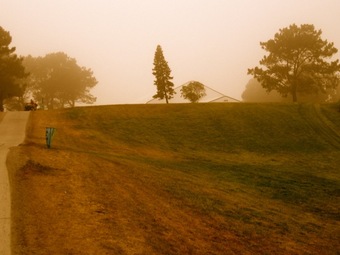
230136-1654195-thumbnail.jpg
The Media Center lurking like the view from Bates Motel up to mom's house (click to enlarge)
When I mentioned to David Fay that it was a great week except for the location of the media center, he said that as he was walking up the steep hill the tent reminded him of the view from the Bates Motel looking up to mom's haunted house. He was right about that (see photo).

When the Open returns in 2017 or 18, let's put the media center to the right of the range next to the player locker room and leave the cool ocean view (that we never got to see) for the overpaying patrons. 230136-1654222-thumbnail.jpg

Inside the media tent (click to enlarge)

- IBM scoring. Various Open vets declared it a disaster. The round one scores did not make most national newspapers east of the Mississippi and by all accounts, the Unysis system of the past was faster and more efficient. Also, based on the comments in threads here, the website was a step back in terms of function and reliability.

Alright, off I go in my Maui Jims.


"Scooped it up in a empty beer cup, as not to disrupt the DNA, Ive got lots of witness'...all moneys go to my daughters college fund"

cb8f_2.JPGSome people go to the merchandise tent and buy a hat, others pick up Tiger Woods-discarded apple cores and put them on ebay. And you wonder why he has a boat called Privacy?

The text, in case it disappears...

I was at the US Open this Friday, following Tiger Woods down the 12 th Fairway, after his tee shot, he was eating an apple, 30 yards from his ball he discarded his apple core in the rough, I asked a photothe to kick it over my way, and he did, I never touched the core, Scooped it up in a empty beer cup, as not to disrupt the DNA, Ive got lots of witness'...all moneys go to my daughters college fund 

"He would hit four or five balls, then limp to the cart for a rest."

John Huggan gets Hank Haney to talk about the weeks leading up to the Open and Tiger's knee prognosis.
"Three weeks before the US Open he couldn't walk. It was about then he started hitting balls and trying to play a little bit. I watched him practise. He would hit four or five balls, then limp to the cart for a rest. He'd sit down for a few minutes, then limp back to the balls and hit four or five more. That was all he could do.

"At that time he was insistent that he was going to play in Jack Nicklaus' Memorial Tournament at Muirfield Village. I just shook my head. 'Bud,' I said, 'how are you going to do that? You can't even walk.'

"His feeling was that he had to play in the Memorial because he was so rusty. But he couldn't walk from the kitchen to the dining room table without bending over, he was in so much pain. So there was no way he could play."

With the Memorial proving a tournament too soon, Woods' mind then shifted to the possibility of making it to the US Open.

"He started playing a little bit, but never more than a few holes at a time and always in a cart," recalls Haney. "In fact, he didn't play more than 72 holes total between the Masters and the US Open. When we went to Torrey Pines the weekend before the tournament I told him he had to try and walk at least nine holes. Just to see if he could do it.

"So I drove the cart and he walked nine holes. He made it, but only just. I was asking him if he could bend down to read putts. He said, as he always does, 'I'll be all right.' But I made him do it. So he tried. He could get down okay, but he had to lean on his putter to get back up again. Even then he was still saying he'd be all right!

"Anyway, he walked nine holes on the Sunday, then nine more on the Monday. And he couldn't hit more than 50 balls on either day. Whether he was going to play was in doubt right up to the last minute."

“I would hope it would be teed up pretty good"

2008OpenLogo.gifTim Sullivan in the San Diego Union Tribune talks to David Fay about the prospects for a return to Torrey Pines and it seems it has to get in line behind Oakmont and Erin Hills. (Now, I'm no accountant, but if I'm looking at the numbers from last week I'm making a case for Erin Hills waiting a few more years...like, after Tiger has retired.)

The USGA will consider those courses at its October championships and executive committee meetings in New Jersey. Based on the commercial and theatrical success of the 108th Open, however, Torrey Pines could also be considered for fast-track approval.

“It's unusual, but not unheard of, to select three U.S. Open sites at one meeting,” Fay said yesterday via e-mail.

Site selection, Fay cautioned, is only a first step. The USGA customarily withholds announcing its decisions until a formal agreement can be negotiated with prospective tournament hosts.

Given the additional complexities involved in haggling with city government as well as the various private enterprises that operate at Torrey Pines, those negotiations could turn tricky. Still, the success of this year's tournament was so great that the USGA may want to ponder pushing another site back a year in order to accelerate its Torrey Pines timetable.

After all, a PGA Championship in San Diego in August has a nice ring to it, doesn't it?
Whether auditors will conclude that the city broke even on the 2008 Open will depend on the size of their imagination. The city stands to collect only $500,000 in cash for an event that could be worth up to $50 million in profits to the USGA, according to Street & Smith's Sports Business Journal.

Though Fay says that estimate is a distortion – “the guy who parsed the numbers together for Sports Business should receive an advanced degree for making accounting a creative art!” he wrote – the USGA typically books enough profit to pay millions to the Open site.

And this is nice to read since despite his great intentions and hard work, the appearance of a conflict has not been a positive...

The Friends of Torrey Pines, the donors who made the Open possible by funding the renovations that raised Torrey Pines' South Course to USGA standards, should have no role in the next round of negotiations. Eliminating these middlemen – well-intentioned though they were – means the city should be able to deal directly with the USGA and therefore reap a larger piece of the proceeds.

“I would hope it would be teed up pretty good,” said Jay Rains, who spearheaded San Diego's Open initiative before becoming a USGA vice president. “I'm not personally aware of why the city wouldn't directly contract (with the USGA).”