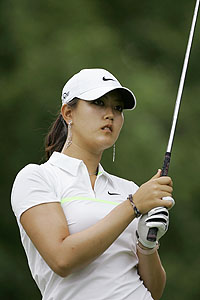
"I should be looking nice for the media.”

img10879970.jpgCraig Dolch (here) and Steve Elling (here) celebrate new media (that's lower case, as opposed to...) darling Minea Blomqvist who is currently tied for second place in the U.S. Women's Open.

Elling:

 Have you driven a fjord lately? Putted on tundra bentgrass? Blomqvist has. For whatever reason, the Finnish development in the game has lagged behind the other Scandinavian countries, especially Sweden, which has produced two different U.S. Women's Open winners, while another Swede, veteran Helen Alfredsson, is among the leaders this week.

Blomqvist offered a theory on that front.

"I always tell a story about why the Swedes are so good in golf," she said, laughing. "Because in golf, you need an empty mind, and there's nothing going on in their heads, so that's why they play good."
 And...
That Blomqvist is among the leaders comes as a middling surprise, since she has never won an LPGA event and hasn't finished better than third this year. She wasn't expecting such scrutiny, either.
"I'm upset because I didn't put my makeup on today," she cracked as a phalanx of TV cameras zoomed tight. "I didn't think I was going to play that well. I should be looking nice for the media."
Her entire interview can be viewed here.


"What she missed while looking at her toes..."

lpga_a_wie_200.jpgRon Sirak takes an interesting look at Michelle Wie's first round 9 and ESPN.com dresses it up with video.

Wie made a series of mistakes on No. 9, the first being that she elected to hit driver off the elevated tee instead of 3-wood. Wie has struggled with the driver for nearly two years now -- missing shots low and left as well as high and right -- and she blocked this one into the right rough.

She compounded the mistake off the tee by being too aggressive with her second shot, trying to advance it too close to the green instead of opting to pitch out sideways. The second shot ran through the fairway and into the rough at the base of the steep hill leading up to the ninth green.

Playing from the rough, she hit a shot that came out low, skidded across the green and ended up in the rough about two yards over the green. That's not a good place to be. It's virtually impossible to keep the ball on the green from there, without some luck or trickiness.

Trying to barely nudge the ball onto the fringe, Wie moved it only about 30 inches and left it still in the rough right on the edge of the fringe, now laying 4. At this point it was Julieta Granada's turn to play from the rough also behind the green. It was also at this point that Wie's brain shut down and she stared at her feet waiting for her turn to hit again.

What she missed while looking at her toes was that Granada played her shot sideways and it trickled down onto the safe shelf. Wie then took her putter and played her fifth shot straight down the sliding board, across the shelf and off the false front.

Her first chip from below the false front was not hit hard enough and rolled back to her feet. Her second pitch ended five feet from the hole, from where she two-putted for a 9.


"There's so many different strategies."

I missed Annika's round today in the U.S. Women's Open but caught her post round interview where she explained an apparently not-so-hot decision to use driver on No. 17 despite a tee being moved up. After the round, look what she had to say about the setup of Interlachen:

It's just, it's very, very fair, but you have to hit the ball well and there are a lot of tees out there where it's, there's so many different strategies. I mean, I've hit 4-irons off the tee, I hit 5-irons, I hit 5-woods, 4-wood, driver. I mean that's five different clubs off the tee other than par-3s. I can't think of any other golf course like that. And it's just strategy and it's just there's not a right way to play it, it's just depending how feel and how you want to approach the greens and with which clubs.


"The officials can only do so much"

Gerry Dulac files a slow play rant after watching some high level amateur slugs play in the West Penn Amateur. Thanks to reader Kevin for this.
This is what happened to me Friday afternoon at a public course in Western Pennsylvania I won't mention. Was the glacial pace acceptable? Absolutely not. Was it understandable? Of course, because too many players don't understand the first thing about etiquette and pace of play.

But, someone needs to explain to me how a threesome of talented young golfers, none older than 29, can take nearly three hours to play nine holes and five hours to play 18 holes on a perfectly sunny day? And in a tournament staged by an organization whose purpose, among other things, is to enforce the rules?

That, though, is what happened Tuesday in the final round of the West Penn Amateur, the oldest tournament in Western Pennsylvania that was celebrating its 108th year. But, after the final group started at 9:13 a.m. and finished at 2:15 p.m. at the wonderfully restored Bedford Springs Resort, the tournament felt as though it had morphed into year No. 109.

"The officials can only do so much," said Jeff Rivard, executive director of the Western Pennsylvania Golf Association. "The players need to say, hey, we need to pick it up."

"I want to think about it"

Tim Rosaforte recaps Tiger's knee prospects and slips this in at the end of his Golf World story:
So while many hope Woods returns for next year's Buick Invitational, or even the 2009 Masters, he may not be back until daughter Sam is close to her second birthday -- or just in time to defend his U.S. Open title at Bethpage Black. What will it be like for him to miss that much time? "Anybody who's a warrior is going to have trouble taking a [sustained] break from competition," says sport psychologist Bob Rotella. "It is not only the winning they miss, it's the way they feel starting out Thursday, or being in contention on Sunday."

Woods already is restless. After filming a Buick commercial last week, he called Haney requesting a list of areas that he could improve upon during his time away from competition. The instructor tried to tell Woods that he hadn't even had surgery yet, but Tiger pressed. "I want to think about it," he said.

The Spririt Of The Hamptons: Scantily Clad Women For Charity!

hampton_hills_final.jpgMatty G spares us an "ambush" video in his write-up on a Make-A-Wish fundraiser, but instead shares with us in spellbinding detail an event that should never be documented: a Monday charity outing.
We didn't play by all the rules, at times we weren't complete gentlemen, and we didn't always hit great shots, but this group had a blast. It never ceases to amaze me how the game of golf can be the common denominator. Regardless of the fact that we didn't know each other and came from different backgrounds, professions and generations, for a little more than six hours, with an assortment of alcohol, hot dogs and a $100-per-man side-bet between two foursomes, we had the game of golf.
Really Darwinesque, don't you think?
It seemed like on every tee box we were greeted by a new form of alcohol, served by a young, scantily clad representative of the liquor company. The Hawaiian Tropic Zone Girls attended this function, also scantily clad, and we had an occasional visit on the course by a rogue cart full of marinated members of the gallery. Was THIS what they meant by "the spirit of the Hamptons?" Other than that, we had razor-sharp focus on the side-bet.

I'll condense the day of competitive golf down to the fact that my team won. I use "competitive" loosely here, and it's always a relative term. Each group and each player had good shots, clutch putts, lucky breaks and cold-tops that made you want to bury your head in the bottom of your bag. We had an above-average amount of smack-talk, change-shaking, chest-bumping and fist-pumping, but a portion of that has to be attributed to the "swing-oil" and an unusual number of pit stops.
And for those of you counting at home, that's 3 "scantily clad" mentions in 1200 words.

"You need to come up with something else"

AP's Larry Lage follows Rocco Mediate around Warwick Hills and shares some fun anecdotes about his return to the tour following the U.S. Open showdown with Tiger.

Mediate's approach from 115 yards at No. 6 sailed to the right and landed in rough thick enough it almost hid the ball, an errant shot just 46 fans standing along the ropes saw at the sparsely attended event.

Instead of cursing at himself, Mediate conversed with fans and joked about how many of them say "That's a gimme,'' any time a ball is remotely close to the cup.

"You need to come up with something else,'' Mediate joked.

"The fact that you've not heard anything should not be construed as meaning there's a problem."

Several interesting items in the USGA press conference at Interlachen where David Fay, Roberta Bolduc and Mike Davis faced the inkslingers who miraculously asked some great questions (offsetting the point missers lobbing stuff about a U.S. Senior Women's Open). After Davis talked at length about Interlachen's design attributes and Brian Silva's restoration work there, he shared this about the bunkers at Torrey Pines:

The bunkers like we have been doing the last few years, we did stir up the bottoms to try to make the bunkers a little bit softer so that the player can't get as much spin. And I was telling somebody the other day, one of the best things I heard at Torrey Pines, it just -- I almost wanted to do a cartwheel is when a player actually said, we were trying to avoid bunkers at Torrey Pines. Because we haven't heard that in who knows how long.

Davis, on driveable par-4s this week at Interlachen and in future USGA course setups:

 You have to have enough risk but you've got to have the reward with it. They have to match. And in fact David and I talked about it before Sunday of Torrey Pines, that I thought it was going to work well for the reasons I kept going through in my mind, but you don't really know. And if only ten players out of the 80 went for it I would call it a failure but I think there was 57 or 56 or whatever that went for it. And it's, you know, there was a blend of scoring.

But when we did it at Oakmont it worked. Because those holes were architecturally set up for it. We did it the one hole at Winged Foot. But, no, we will not force it. So it won't necessarily be a trademark. But I think when you get that opportunity, it's really neat because you do make the players think. And we want -- we don't want this to be gimmicky, but at the same time we want it to be the hardest championship of the year, whether it's the U.S. Girls Junior, the Women's Open, the U.S. Open or the Senior Men's Amateur, but at the same time there's nothing wrong with introducing more risk, reward and making the players think, giving them opportunities, and taking a hole and really saying if you play it great you can make birdie, eagle, but if you don't play it so great, if you try something and don't pull it off you're going to pay the price.

And look at this troublemaker with the killer follow up about those R&A lollygaggers.

Q. David, could we get an update on the groove situation? Wasn't that due for some sort of roll out in January, I think, in theory? Has there been any developments on that front or are we going to have to all change irons?

DAVID FAY: The latest update is there's no update. We are still on track, we hope. There are a number of components that we have to get everything resolved. A number of -- and we're moving ahead on that. But to give you a timetable at this time, it would be premature.

Q. R & A still a part of the equation in getting them signed up for the same time?

DAVID FAY: Well the R & A, it's a change in equipment, a change in any rule will not happen unless both sides support it. Fully. The fact that you've not heard anything should not be construed as meaning there's a problem. It's just that we -- anything dealing with equipment, particularly these days, is complex. You deal with the specifications, manufacturing tolerances, I think that one thing I would say that we have never, at least in my experience at the USGA, researched and done the lab testing and the player testing to the degree that we have with this subject of grooves.

Just not enough for the R&A!

"Think of wacky bowls where the sculptor takes the wet clay mold and stretches it in different directions."

The first review is on the Castle Course at St. Andrews, making its debut this week.

Alistair Tait doesn't sound like he'll be invited back after this.

With the Castle Course, I felt as if I’d need a few rounds to get the lay of the land.

I’d certainly need more than a few rounds to get used to the greens. Kidd must have been in a funky mood when he designed these, for they might be the most undulating greens I’ve ever played.

The note I jotted on my course guide regarding the fifth green consists of  one word: “stupid.” The course guide describes this as a “bowl.” I’d agree if it read, “bowl that’s bent out of shape.” Think of wacky bowls where the sculptor takes the wet clay mold and stretches it in different directions.


Lost Balls, Double Digit Scores And Unreachable Fairway Add Up To Declaration Of Success By Dawson

The R&A frontman and in house architect, Peter Dawson, declares his redo work at Turnberry a success. And boy doesn't it sound like great work based on this reporting. First, Douglas Lowe writes:

The 17th hole particularly, where Nick Price had an eagle 3 on his way to Open triumph in 1994, was considered too soft for a modern championship, but having lengthened the hole and added three new bunkers there were lost balls galore in the qualifying rounds.

Scores in excess of 10 were recorded as players, into winds in excess of 30mph, failed to make the 230-yard carry to the fairway and so tough was the course altogether that the competition scratch score on day two was up at a mind-boggling nine-over-par 79.

Asked about the severity of the 17th, Dawson, who has been under fire in recent years for allowing distances the ball is hit to increase, quipped: "The players will just have to learn to hit the ball further."

Brilliant answer!

Mike Aitken can't wait for the Open Championship next year after witnessing the same success as Lowe:

Although the Ailsa has been something of a soft touch at past Opens – both Tom Watson and Nick Price won at Turnberry with 72 hole totals of 268, the lowest winning scores for an Open in Scotland – the revised links, albeit in severe weather, produced a standard scratch of 79 during the first round of qualifying for the Amateur last week. Moreover, a number of players from the new tee at the stretched par-5 17th couldn't reach the fairway when the hole played into a strong headwind.

One of the most heartening aspects of the changes was the success of the 16th, where the re-modelled par 4 has become a 458-yard dogleg which brings the burn in front of the green into play and approaches the green from a far trickier angle. "I never thought I'd see the day when people couldn't get up in two at the 16th," admitted Dawson.
Yes that sounds heartening!
Although offering a spectacular view, the new tenth tee, built beyond the halfway house to create a dramatic drive over a rocky promontory, received more mixed reviews. "If we had our time again we might have raised (the tee] a little," said the chief executive. "It's not too late to change, and we'll think about it."

 Print up that change order Peter!