"But I'm on the good side now and I can start sleeping more than an hour at times..."

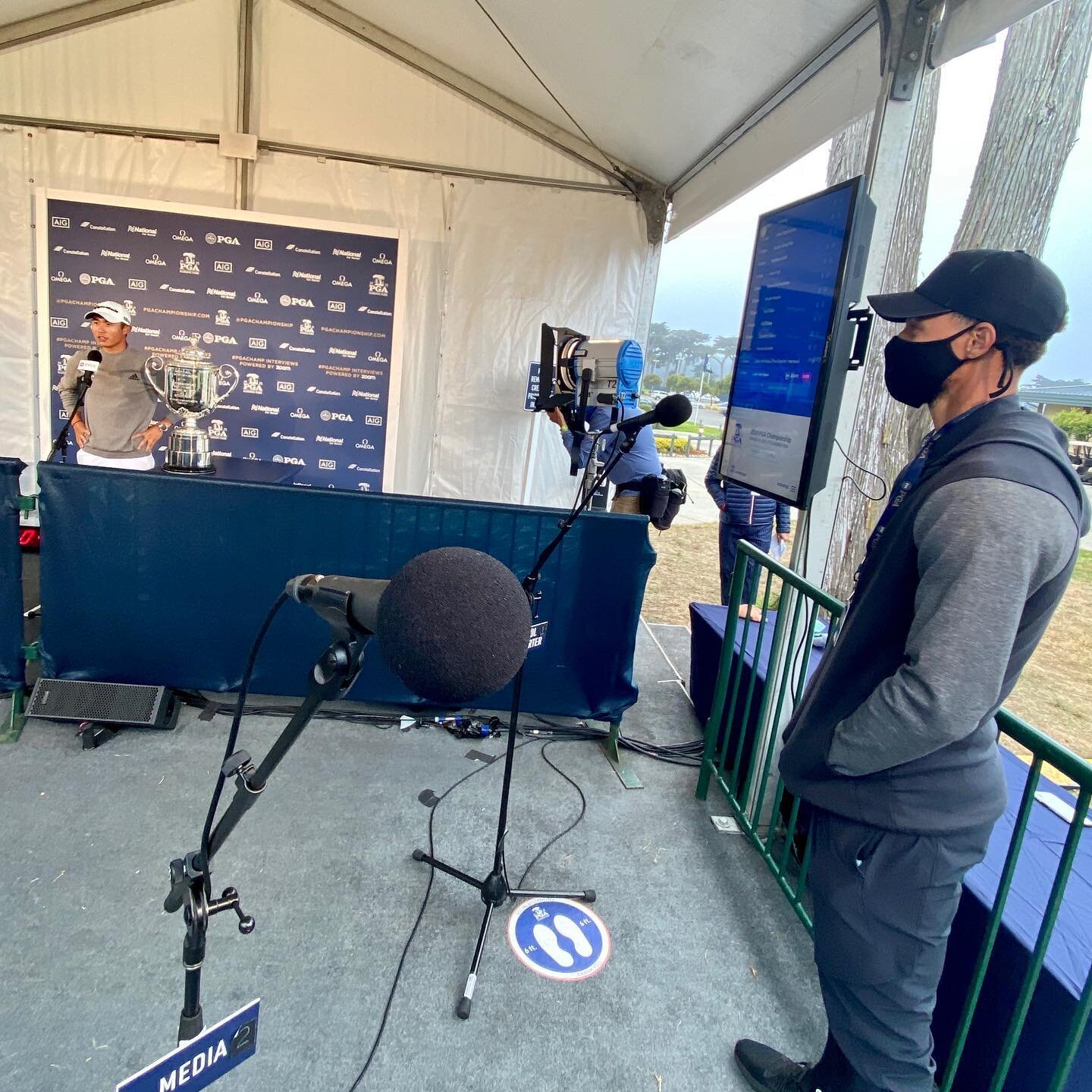
One of the real highlights of today's AT&T National final round was a captivating 5-minute chat with Tiger Woods via satellite (transcript here). 

First, we learned that Tiger's been only sleeping an hour at a time (ugh!) and believe me, he looked the part.

More importantly, we learned that he actually keeps the FedEx Cup trophy in his home, not locked up in that storage facility where they stashed the Ark of the Covenant. I thought it was wonderful that he has the trophy there available for satellite interviews such as today. Special thanks to Verne Lundquist for pointing that out and eliminating all Cialis usage in the greater Ponte Vedra area tonight.

"If you think about some of the shots Lee Trevino hit in his lifetime it breaks your heart to see what goes on today."

John Huggan catches up with instructor Bob Torrance who joins the list announcing that shotmaking is almost gone from the game.

"As someone who has spent a lifetime in and around golf, it is a great sadness to me that the game at the highest level is so much less interesting than it used to be," he sighs. "It is that way because of the modern equipment and the ball, of course. I rarely see anyone shaping shots any more. Instead of hitting high shots, low shots, fades and draws, most players now hit the same shot time after time.

"I don't blame the players for that necessarily. Varying your shape of shot is just too hard with the modern ball. It goes straight almost no matter how you hit it.

"If you think about some of the shots Lee Trevino hit in his lifetime it breaks your heart to see what goes on today. He had all the shots, the modern player has only one.

"The whole thing is pretty depressing, if I'm honest. But it hasn't affected what I teach. What I teach today is exactly what I taught years ago. Maybe I'm just stubborn."
I'm surprised more hasn't been written about this, then again...

"The European Tour is getting more and more like America, where conditions are all but identical every week. They hit the same shots from the same lies all the time.

"I have to admit, I hanker for an era that is long gone and doesn't look as if it is coming back. I think of players like Christy O'Connor senior. He could hit any shot with almost any club in the bag. Sadly, we will never see his like again."

"The Ryder Cup is a little more than two months away and there is no buzz."

Gary Van Sickle breaks down the 8 Americans most likely to qualify for the Ryder Cup team and speculates on possible Captain's picks. After looking at the uh, elite eight, you have to wonder if Azinger is going to regret giving himself so many picks.

And while Van Sickle detects no buzz, Steve Elling sees Kenny Perry's decision to skip the British as setting up a fun showdown between the British press and Perry come September.

"Why isn't the PGA Tour and Tim Finchem stepping to the plate and using our own rules?"

Tom Pernice livens up the lagging groove change discussion just in time for the best of British golf writing to give Peter Dawson a free pass when they lob Nerfballs at the Open Championship's R&A press conference!

Doug Ferguson reports on this and other Pernice venting:

"Why isn't the PGA Tour and Tim Finchem stepping to the plate and using our own rules?" Pernice said. "Tim's been against it all the time. We should have our own rules, and this way we could use V-grooves and everybody can have the same set, and driving the ball in the fairway might make a difference."

Or, make firm greens mean something? Well, we'll quibble over that later. You go Tom!

“It’s a one-dimensional hole"

Thanks to reader Chris for this AP note on Fred Funk and Congressional's 6th hole.

When a par 5 become a par 4, the result can be, in the words of Fred Funk, “downright stupid.”
 
No. 6 at Congressional Country Club is this week’s prime example. It is listed as 518 yards for the AT&T National—the third longest par 4 on the PGA TOUR so far this year—and the large water hazard around the right front of the green makes it even more daunting.
 
“I don’t like their mentality with that hole,” said Funk, who double-bogeyed the hole to mar his even-par round of 70. “I think it’s downright stupid, actually.”
 
The hole produced one adventure after another during Thursday’s first round. Defending champion K.J. Choi and Jim Furyk both landed in the front bunker yet saved par. Bo Van Pelt’s 40-foot putt provided one of only two birdies among the morning rounds. Corey Pavin, one of the shortest drivers on the tour, had no chance at all: He laid up despite hitting a tee shot that landed in the middle of the fairway.
 
“That green’s designed for a par 5,” said Rich Beem, who parred the hole after missing a 15-foot putt for birdie. “That’s the problem with par 5s turning into par 4s.”
 
“It’s difficult,” added Furyk. “You’ve got to get the ball in the fairway, or you’re going to be struggling.”
 
Choi said he was so concerned about the hole that on Wednesday he practiced the very bunker shot he ended up hitting on Thursday.
 
“It’s a one-dimensional hole,” Funk said. “If you hit the fairway and you’re a long hitter, you can get your shot to fit in there. The shorter hitters are going to have a long, long, long shot in there with a green that’s really designed for a wedge.”

What an interesting contrast in course setup approach we're seeing between the PGA Tour and USGA. (I'm guessing based on what we saw at Torrey Pines that the 2011 U.S. Open tees would be moved up a bit to prevent the situation described above, or perhaps even see the hole played as a par 5.)

"Social media and technology are being leveraged to make the game of golf more accessible..."

According to this press released turned CNN news item, IBM is offering a series of podcasts contemplating how technology will change everyday life (not their technology, mind you, since it doesn't work that well).

Check out this recent issue you can get on itunes (link at the bottom of the release/story):

Future of Golf: Social media and technology are being leveraged to make the game of golf more accessible to new groups of players and new audiences, including in emerging markets like China and India. Hosted by Tim Washer, with Peter Bevacqua, USGA Chief Business Officer and Rick Singer, Director, Worldwide Sponsorship Marketing, IBM.

Please, someone spare me the pain of listening to this thing and report back with the single most obnoxious use of MBAspeak.

"In recent weeks, everyone except for Dr. Seuss, it seems, has been quoted in stories regarding Woods's knee"

Jim McCabe on the peanut gallery commenting on Tiger's knee:
Instead of keeping to themselves and their patients, they're reaching out through hospital PR machines to offer free consultations and observations of Woods's condition to any reporter willing to call. And guess what? The reporters have been taking the easy way out and lining up to get quotes from doctors who offer "expert" opinions, analysis, and a prognosis - though, of course, it's always accompanied by the disclaimer that the person being quoted isn't close to the case, has never met the patient, and is merely "speculating," but, hey, it's a good way to get their names in the paper, right?

In recent weeks, everyone except for Dr. Seuss, it seems, has been quoted in stories regarding Woods's knee, as if we were dealing with something rare. But it occurs to me that the knee injury has been a part of the sports landscape since David stunned Goliath, 3 and 1, using a putter and 5-iron - or maybe it was a sling and five stones; it's so hard to keep track.

"You want things to slow you down.”

I thought Rex Hoggard was trying to be funny with this column, but he's definitely serious in saying that no one will test positive in the next five years and all this drug testing is an enormous waste of time.

The Tour’s not doing it wrong. Instead, maybe a sports world bent on bending or breaking the rules prompted the Tour to do the wrong thing.
Or maybe it's the fault of a tour that said players who were hitting the ball longer enjoyed gains thanks to their improved athleticism?

This bit backing up the argument was strange...
“People assume every sport is the same and that steroids will make you better. But it’s not the same,” said Greg Rose, a co-founder of the Titleist Performance Institute, the sport’s leading center for golf fitness.

“There are so many components to golf. This isn’t the long-drive Tour where all that matters is how far you hit it. The short game is more important, and things like steroids can affect your flexibility, your attitude and your personality. Bad things. You want things to slow you down.”
Right, and last I heard they're testing for those things that slow you down, too.


Finchem Takes One For The Team: Undergoes Drug Test, Results Not Pending

finchem.jpgHelen Ross provides the overview of the big day, while you can read the spellbinding Finchem transcript here.

Let's go to the script...

Q. Is it important for you to go first?

COMMISSIONER TIM FINCHEM: No, I don't think it's important to go first. I think it's important for me and certain of our executives who are involved with the program to understand exactly what the procedure is, because by doing that, you can kind of see what player reaction will be, what players questions will be, and it's just a good, healthy learning experience. I don't view it as anything meaningful from a symbolism standpoint, but just I think it's important that we understand it in the detail of it.

Q. Did it go as efficiently as you thought it would?

COMMISSIONER TIM FINCHEM: It did. I was very pleased with the way it went, and I think that we have every reason to be optimistic that we're not going to have logistical problems; that it's not going to be a big disruption and it's not going to take much time.

The people that are doing it are quite professional, well organized, buttoned up, and that also conveys a sense of integrity to the process; because as we all know in this area, the integrity of the process is very, very important.
I'm glad they're buttoned up. That could cause problems if they weren't.
Q. Do you know how long it took you?

COMMISSIONER TIM FINCHEM: Nine and a half minutes. And I asked some questions.

Questions? You mean like, "Have you ever seen..." oh I better stop.

Q. Yesterday or today?

COMMISSIONER TIM FINCHEM: Let's just say I've been through it. I don't know that it's necessary to get really specific.

Yeah, TMI could get ugly here, especially if you had asparagus for lunch.

Q. Secondly on drug testing, do you think that when this is up and running for a year, that if there are no positive tests, as it relates to performance-enhancing that this will take care of any naysayers?
COMMISSIONER TIM FINCHEM: Any naysayers? That's impossible. I think the thing in the whole world of drug testing and anti-doping is that if you're not getting positive tests, somebody is going to write a blog that says your testing is screwed up: How can that be?

Write a blog? Such hostility to the blogosphere Commish. We're hurt. It's also possible someone will write a column, or an essay, or even a Haiku wondering why everyone is so clean and yet, throwing so many more clubs than they did prior to July 1.

You have a testing program; you must have had a problem to begin with or you wouldn't have done it. There's going to be naysayers regardless of what happens.
But on balance, among people who follow the sport and know these athletes, I think a rigorous testing program will add credibility to the general notion, which I think we all recognize, there are not that many people who believe that there is any significant issue here prior to this rule going into effect. Credibility requires that we have the program.

Thatta boy, that's a better answer! And hey, how about a comment that you're doing this testing stuff for the kids? Big family values Q rating points in that.

“We could even name the first hole after you"

I've been part of and seen some awkward group site visits, but this one at Trump's site in Scotland described by Emma Christie takes the prize.

The group stopped to listen to the Trump Organisation’s project director, Neil Hobday, who said the spectacular view towards the sea from the green would remain “unchanged” if the course was built.

Pausing to admire the dunes, Mr Trump’s right-hand man George Sorial shared a light moment with Martin Ford, the councillor whose casting vote scuppered the US tycoon’s plans.

Mr Sorial asked Mr Ford if he played golf – he does not – before saying he could be made an honorary member of the club, should it get the go-ahead.

“We could even name the first hole after you,” joked Mr Sorial, a suggestion Mr Ford said would make him feel uncomfortable.

The 13th hole, a par three, crosses the vast swathe of mobile sand dune known as a ‘sand sheet’ or ‘the dome’.

The vast majority of the sand sheet would be planted with marram grass in order to stabilise it. Golf course architect Martin Hawtree pointed to some existing grass growth on the dome, which he said had appeared naturally over the past year.

“This dome wants to be green,” said Mr Sorial, in reference to the same site.

But Mr Ford disagreed, and said the beauty of the sand sheet reconfirmed why the decision of the infrastructure services committee was the right one.

He said: “This has simply reminded me that this is a magical wild place with a real sense of wilderness. That’s something we don’t want to lose.”

There goes the honorary membership.

"The only thing that could have helped me was to win"

Doug Ferguson addresses and explains the odd rule that prevented Stacy Lewis' U.S. Open winnings from counting toward  LPGA Tour earnings.
In a policy that no longer makes sense, Lewis will not get credit for her tie for third in the U.S. Women's Open as she tries to earn enough money to get her LPGA Tour card without going to Q-school.

"The only thing that could have helped me was to win," Lewis said at Interlachen, where she had a one-shot lead going into the final round and closed with a 78 to finish five shots behind Inbee Park.

Lewis earned $162,487, which would have been enough to finish the year equal to 80th on the LPGA Tour money list. She is playing in the Northwest Arkansas Championship this week, one of a maximum six events she can play to earn enough money.

She also will play the Jamie Farr Classic next week, and on Tuesday received a sponsor's exemption to the LPGA Kapalua Classic on Maui. Her agent, Jeff Chilcoat of Sterling Sports Management, said he is working on three other tournaments.

"I think it should be revisited," he said of the policy. "And frankly, I'd love to have it revisited retroactively. But I don't anticipate it being changed for her."

Starting in 2003, the LPGA expanded the maximum number of sponsor exemptions for non-members from four to six tournaments, and counted only domestic tournaments with at least 75 players in the field toward the money list. The U.S. Women's Open didn't count, because it is not co-sponsored by the LPGA.
Come on Commish B, you like to change platform-damaging rules. Why not go after this one?

"I want our golf tournament to be there for perpetuity"

I don't! And I suspect a number of players with more discerning taste would agree. From Doug Ferguson's weekly notes:

The board of directors at Congressional Country Club has recommended a three-year contract to host the AT&T National starting in 2012, with an option for three more years that will take it to 2017, The Washington Post reported.

It still requires approval from the full membership, but tournament host Tiger Woods liked the development.

"I want our golf tournament to be there for perpetuity," Woods said. "It is an unbelievable golf course, and in our nation's capitol, on our nation's birthday. The stars couldn't get aligned even more than what it is. Hopefully, we can keep it there."

"It took DeBock five tries; the reporter finally found it on his 15th."

Not to dwell excessively on the U.S. Open with THE Open lurking, but several moments keep flashing before my eyes and none sticks out more than Tiger's putt on 18 Sunday. I remember looking at downhill putts here after learning that front right would be the likely location, and it just never looked like an easy putt to read with the slope coming off the bunker.

Well, Ed Zieralski reports that others have had that putt in mind and tried it out.

 A student of U.S. Open history with a terrific collection of memorabilia from past events, Torrey Pines head pro Joe DeBock was prodded by a reporter to return to the South's 18th green on June 18, two days after Woods beat Rocco Mediate in a thrilling 19-hole playoff.

Of all the putts Woods made during the Open, the reporter told DeBock he was most impressed with a 15-footer that had about eight inches of right-to-left break, which Woods gingerly jarred for birdie to tie Mediate after 72 holes of regulation. DeBock found the hole placement used for Sunday's final round, and he and the reporter took turns trying to make it.

It took DeBock five tries; the reporter finally found it on his 15th.