FedEx Cup Playoffs Arrive, Several People Take Notice
/It's hard to describe how excited I am at the prospect

It’s back!
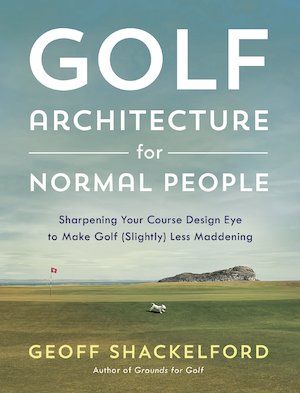
Twenty years later Tatra Press has kindly allowed me to bring back Grounds For Golf now that golf architecture is of more interest to the masses. A new Introduction looks at what’s driven the interest growth and two new chapters I had a blast adding (plus a few edits to keep things up-to-date).
The Amazon purchase page for the book arriving June 15, 2026.
It's hard to describe how excited I am at the prospect
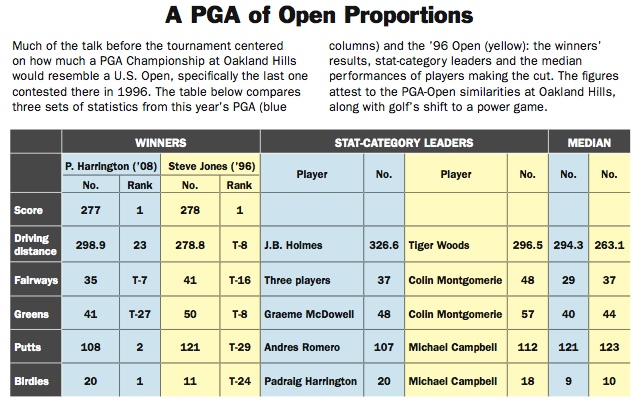
In the post PGA coverage, Brett Avery offers a rather astounding chart in the Golf World stat package (PDF).
Now I'm in favor of the groove rule change because it has the potential to restore the importance of firm greens, but will only be meaningful if an increase in fairway width comes with it.
However, the USGA and R&A continue to contend that armed with V-grooves, the world's best will be forced to respect rough and therefore they will have to throttle back in an attempt to hit more fairways. In other words, it's a backdoor way of rolling back distance increases. I still believe it's pure fantasy, but hey, if it makes them happy and leads to other positives, so be it.
Yet no study has determined how much fairway narrowing has played a role in the driving accuracy decreases so regularly cited as the cause for regulating grooves.
So here we have Oakland Hills, host to the 1996 U.S. Open and on the cusp of the distance explosion, and again host to the 2008 PGA where a remodel narrowed fairways and rough was farmed and coifed.
The 2008 field median was 30 yards longer off the tee than in 1996 while the fairway's hit median dropped 8 fairways.
The governing bodies would like us to believe that these dramatic increases in distance and decreases in accuracy are a result of players finding themselves armed with U-grooves that persuades them to flog drives with reckless disregard for the awful fairway contours crafted to take driver out of their bag.
Seems in the case of Oakland Hills that the radically improved driver/ball combination (oh and of course, the increased athleticism!) along with a further reduction in width since 1996 was likely much more significant than the grooves in fostering such radical differences in distance and accuracy.
 What can I say but, wow, what a canvas!
Steve Ellling posts his annual analysis of players making all four major cuts, with Padraig Harrington easily taking the low medalist honors. And Elling shares this from Robert Allenby:
And...Last weekend, the veteran Australian was grousing about the difficult playing conditions at the 90th PGA Championship at Oakland Hills, comparing the unusually harsh and critically panned setup to another major championship once known for its punitive traditions.
"Everybody is trying to be like the U.S. Open, except for the U.S. Open, which was the best major setup we had all year," Allenby observed.
So, then, are major setups getting harder? Allenby might have a point about their general difficulty, though there were some dire weather issues at times in 2008. The number of players who finished under par after playing in all 16 major-championship rounds has fallen from six to one to zero over the past three years.
I'm not sure if this is an appeal to the putter collectors and a way to get attention, but PGATour.com's Mike McCallister talks to Scotty Cameron about his putters and gets these two interesting quotes:
"I think I get red-flagged by the the USGA because I'm always trying to walk that fine line. I think if you're to buy my products, you want me to be on the edge, you want me to be barely legal. But if I'm well within the zone, then it's like we're not stretching the limits enough."And...
"People say there's no arc in the putter stroke. Well, is there an arc in a golf swing? Of course there is. ... There is an arc in the putter stroke. I wish there wasn't. But there is -- it comes from the lie angle of the shaft. The USGA says its must be at least 10 percent, not straight up and down. With that angle, there must be an arc. ... I wish we could putt between our legs, 90 degrees, square to square. But the USGA says we can't putt between our legs, so I design putters to fit those arcs so that it becomes almost effortless for the putter."
Great to see the positive early reviews on Sedgefield, new host of the Greensboro event and a Donald Ross design restored by Kris Spence.
Even more remarkable was Robert Bell getting Lee Janzen to talk.
In their Golf World recap of the USGA and R&A groove announcement,
In considering how the setup impacted the PGA Championship, we get a couple of different perspectives.
Geoff Shackelford is a Senior Writer for Golfweek magazine, a weekly contributor to Golf Channel's Morning







Copyright © 2022, Geoff Shackelford. All rights reserved.