Pebble's 17th, Another Look At The Evolution

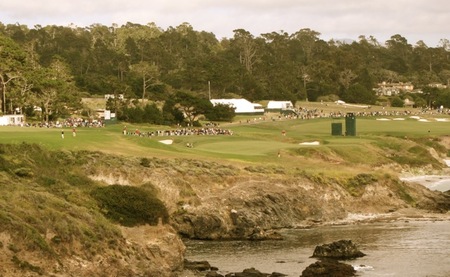
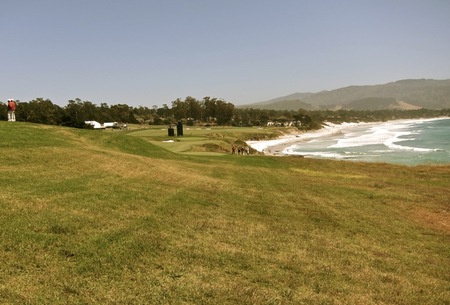
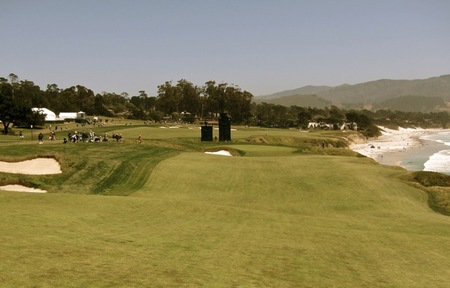
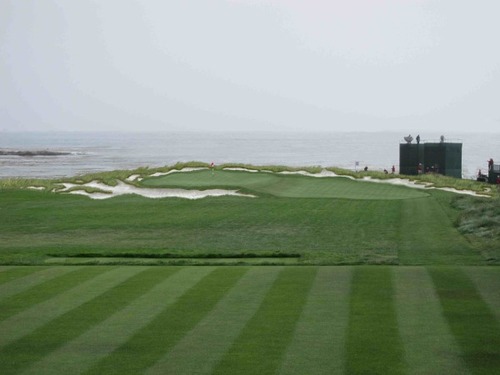
Not to beat a dead golf hole, but I just loved this effort by the art department (a.k.a. Tom Naccarato) to show us how much the fronting bunker at Pebble Beach's controversial 17th has eaten into the green. You may recall I detailed the issues here in this story and video.

First, the historic image (click on images if you wish to enlarge them):
 

And now, mid-Photoshop layering, the old bunker and the evolved together:
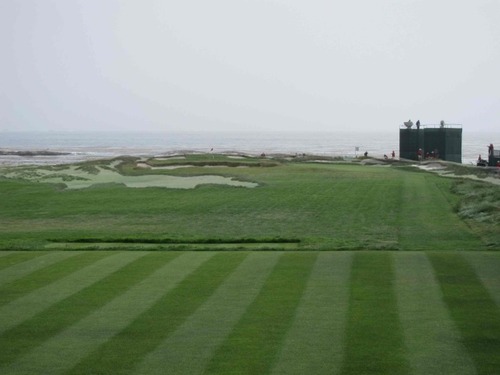
 

The view today:
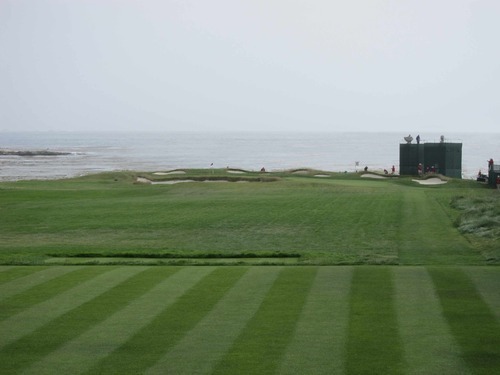
And a restored look:
 

"Beauty In Eye Of Beholder"

A week after the U.S. Open, there is still quite a bit of conjecture about the greens at Pebble Beach.

The USGA's Pat Gross writes this defense at USGA.org.

The U.S. Open is not about cosmetics; it’s about providing a challenging and rigorous test to identify the best player.  Producing a cosmetically attractive golf course would have been the easy task: a little more water, a touch of fertilizer, and we would have had green, pretty putting greens and soft conditions, but that was not the goal.

The question I keep hearing relates to firmness and why they couldn't have softened the greens just a bit. And while I certainly can see that response, there is another large audience that would howl with horror at the notion of artificially softening the greens. But when the greens have shrunken so much and are in a sense dysfunctional architecturally when combined with major championshp conditions, maybe that is the answer. But either way, the USGA can't win.

"For the visitors who play golf in Hainan, it takes them seven hours to play a round of golf. That is a real shortage of supply."

The WSJ's Emily Veach interviews Ken Chu of the Mission Hills Group about golf in China. And you thought play was slow in America...

WSJ: As many as 200,000 people attended the 2009 Omega Mission Hills World Cup. Analysts have said the number of golfers in China is about 300,000, other reports are as high as 3 million. What are your estimates and how can you turn those spectators into golfers?

Mr. Chu: There are close to 3 million golfers in China already, and that is increasing. Golf is perceived as a luxurious sport only because the demand is much greater than the supply, and it is still very young in the country. Every tournament we have hosted is free for the public to come and understand the game. Centuries ago, golf in Europe and also in the United States was considered a very prestigious, very expensive sport as well. Look what it has turned into today. It's very common overseas. In China, it's not today because there's only 24 years of history. The supply of golf is under the demand that's required. It will grow, definitely.

A normal round of golf takes about four hours. For the visitors who play golf in Hainan, it takes them seven hours to play a round of golf. That is a real shortage of supply. In the coming years, maybe around 50 courses will be built (in Hainan). We are building for the demand.

"I couldn't get the 'yes' or the 'I do' out on my wedding day. And the pastor said, you gotta say it. You can't just nod."

Lorne Rubenstein celebrates the beauty of how little golf sense golf makes sometimes, particularly after a Bubba Watson playoff against super short knockers Corey Pavin and Scott Verplank.

Bubba's post round interview is a must read. Besides the outpouring of emotion and explanation of the above quote, he clarifies what happened with the the playoff drive on 18 that might have been missed by the select few who opted not to watch the event. Well, it was more than a select few.

Q. Talk about the drive there. I think that went 396.

BUBBA WATSON: Boy, that cart path helped out a lot. You know, I hit it really well. It was more downwind in the playoff. Matt Jones, he hit it past the cart path. We saw it going past the cart path from the tee. Then I hit a good one. We thought it was going to be a short iron, 100 yards or so just give or take, and then Matt saw it hit the cart path. I didn't even look. I picked my tee up and started walking, just put my head down trying to grind out another birdie, and Matt said it hit the cart path and bounced straight up in the air. So we knew it had to be pretty far down there. So I was just inside 50 yards, and I was like, my best chance for birdie on this hole is right now. Somehow I walked away with a birdie.

Q. Bubba, talk about how nervous you were when you thought you had a chance to win.

BUBBA WATSON: I was nervous.

“That’s almost too good."

What an astonishing 12-shot win by Cristie Kerr in Sunday's LPGA Championship.

“That’s almost too good,” Miyazato said, figuring 8 under would be good enough to win the tournament. “She’s just amazing. I played really good, too, but she is just better than me.”

Kerr’s rise comes with women’s golf going through a changing of the guard. In April, Lorena Ochoa followed Annika Sorenstam into retirement, leaving a vacuum at the top.

Kerr will become the third player at No. 1 in the past three weeks. Miyazato supplanted Shin last week by winning the ShopRite LPGA Classic, her fourth victory of the year.

Americans have won only four of the past 14 majors, with Kerr winning two of them. Americans also have won only six of the past 34 LPGA events, with Kerr winning three times.

Randall Mell wonders if we're seeing an transformative moment for the new world No. 1.

Kerr was a chubby, prickly teen who didn’t make friends easily when she first hit the tour, but she’s evolved. There’s evidence of that in the foundation she established to help fight breast cancer after her mother was diagnosed with the disease. There’s her well documented physical transformation that’s landed her on the cover of women’s magazines, and there’s the social transformation. She counts Natalie Gulbis and Morgan Pressel as close friends. She credits her husband, Erik Stevens, for helping her evolve since they married in ‘06.

“I’ve won one tournament without my husband,” Kerr said. “I’ve won all the others with him. He’s been one of the biggest influences on me becoming a better person, changing and evolving and giving back.”

Unfortunately, for Kerr’s fellow competitors, the evolution hasn’t softened the little warrior within who wants to kick their butts.

"The two reasons golf courses fail is that almost no one does basic demographic research, and developers and lenders get starry-eyed by the name of the designer."

Kurt Badenhausen's Forbes.com story on the state of Tiger's design business gets interesting on page two. He's writing about how Jim Anthony put together new financing for the Woods-designed course that we've been told is under construction.

Hungry for capital, Anthony turned to homeowners at Cliffs' eight properties. He scared up $64 million from 525 of them in the form of a mortgage note paying 12% annually. So far it's the only debt on the course. Creative fundraising on Anthony's part. Because it was a private placement, he didn't have to register the deal with the Securities & Exchange Commission. "Banks are not lending to any developer," he laments.

Maybe that's because bankers are concerned about repayment. Over the past decade the number of golf courses in the U.S. has crept up 3% to 16,000, but the number of rounds played has declined 6%. In 2000, 30 golf courses closed while 399 new courses opened, according to the National Golf Foundation. Last year 140 closed and only 50 opened. Over the past five years 607 courses have closed.

Now this is fun:

"The two reasons golf courses fail is that almost no one does basic demographic research, and developers and lenders get starry-eyed by the name of the designer," says Jerry P. Sager, a managing director at First National of America, a privately owned financial holding company whose main asset is loans to golf course owners. Sager says that a name architect helps sell real estate during the first year of a project. After that sales look like those at any other development. Bad news for Cliffs, which has sold only 44 lots surrounding the future Woods course.

Wait, you mean to tell me that someone has just now figured out that the quality of the course ultimately outweighs the value of the name brand designer. At least it's finally common knowledge!

Pebble's Double Fairway 9th Could Be Restored!

I understand if you have Pebble Beach fatigue by now, but come on, it beats talking about the Traveler's Championship, no?

Anyway, for years I've been told by Pebble Beach Company folks that the old alternate fairway on the 9th fairway, created by Chandler Egan in the 1928 redo along with a shift of the 9th green toward the cliffs, was not possible because of cliff erosion.

Last week I wandered over to the now abandoned fairway and of course, there is plenty of space for the fairway and it provides the optimum angle to attack hole locations cut behind the gaping left bunker.

So for starters, here is a drawing of the hole that appeared in the 1929 National Greenkeeper:

And here is a view of the righthand fairway from the 8th hole:


And the view as you first walk down this now-abandoned stretch of pricey real estate:

And the view of the second shot from the right, a great angle to approach from:

 Finally, the fairway view: