Golf architect Scott Macpherson worked previously for architect Denis Griffiths and the Australian firm of Thomson, Wolveridge and Perrett, where he was the on-site architect for two designs at St. Andrews Bay (now the Fairmont at St. Andrews). Now working with touring professional Greg Turner, the duo have undertaken several renovations and are completing a new UK design.
Macpherson kindly answered questions via email about his thoroughly researched book on the evolution of the Old Course, which can be purchased via the web. In Part I will get to know Scott and what motivated his research and in Part II, we'll get into the specifics of the course and his new Colt-inspired design.

GS: How did a New Zealander become so obsessed with the Old Course?
SM: The OC is important because it is a foundation stone for the design industry. What happens in St Andrews and on the OC trickles out to the corners of the golfing globe. I happen to think the OC is a tremendously fun course, but its greatest virtue is perhaps that it remains a viable championship test of golf 137 years after it held its first Open. Can another other course make such a claim?
On a professional level, I know that I needed to complete this study of the OC, and the history surrounding it and the industry to become a better architect.
GS: When do you think the Old Course was at its architectural peak in terms of the look, strategy, and sheer fun to play? Or is it better than ever?
SM: It is an interesting question to try and determine when the course was providing the best test (that was one of the goals of the book)– partly because this leaves one wondering if the changes since then, whatever period one decides is their holy grail, have been to the detriment of the course. The research shows that the test for the best players on the Old course was in the late 1920's-1930's (see graph page 158) when the length of the course and the equipment available to them was in balance and the winning scores were just under par, but the field were just over par. But to get to that point the course, prior to then, under undergone some rather radical changes – e.g for the 1905 Open 200 yards were added and 13 bunkers. No changes since then have been to the detriment of the course, but if the Par standard is how you measure the course, then that was arguably when the OC provided the best test of golf.
As for fun, I think you can shoot 130 and have fun. And they did – but mainly in match play. Those who play golf competitively often measure the fun they have on the course but the level of success they have. For the rest of us, it is the adventure that provides the fun – and the scoring is almost irrelevant. In other words, the success and fun are by-products of overcoming adversity. A good shot here, sinking a rolling put there etc provide those memorable moments. The course was a lot more difficult in years gone by, as were the golf clubs and balls , so I imagine that when one overcame the hurdles then, the satisfaction gained was higher that it can be today. But this is just my speculation. It is still a fun course today.
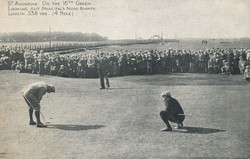 Tournament play on the Corner Of The Dyke (Geoff Shackelford Collection, click to enlarge)GS: Tell us about researching the book?
SM: I have never considered myself an author at all, nor harboured aspirations to write a book. This book was the culmination of a private research project and then being cajoled (by Greg Turner and John Huggan) into 'adding a few photos' and publishing it. I had trained at a GCA, and been in St Andrews waiting for the planning permissions to come through for the building of the two courses then known at St Andrews Bay (now Fairmont St Andrews). This became an extended period (about 12 months), and so a friend ( another kiwi guy who was doing a Phd at St Andrews Uni and also caddying at St Andrews) suggested I join him and caddy on the OC for the summer. I had done quite a bit of caddying on the Australasian Tour, so expected no problems. What I did discover was how little people thought the Old Course had changed. The caddy's perpetuated this myth '"No Sir, this hole has never changed". The Truth was unknown. So I started the spreadsheet which appears at the rear of the book. I wanted to find the lengths of all the holes for all the Opens held at St Andrews. It took me almost 4 years. In looking for this info, I found lots of others things out about the OC like the bunkers, the out of Bounds, the Teeing grounds moving. This was fascinating to me.
The objective of the books was to find out al the changes to the OC, Determine when the OC provided the best test for golf (and this needed to be defined) and I also wanted the book to be the first book to bring together all the great and important plans of the OC. e.g. the 1821 plan, the MacKenzie plan, and the most recent ones. Along the way, I though some readers might like to see the scorecards from the various Opens, and kindly Peter Dawson gave me permission to include them.
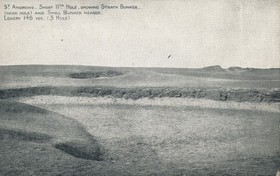 The High Hole, date unknown (Geoff Shackelford Collection, click to enlarge)GS: The theme of your book is this constant evolution of the course, but even as much as it has evolved, the tees on other courses for the Open seems to be extreme even for the St. Andrews, no?
SM: There have been some ground breaking (excuse the pun) decisions made at St Andrews through the years. Most recently, perhaps you might consider the new tees built outside the accepted boundaries of the course for the 2005 Open (e.g. on holes 2, 13, 14). What came out of the scoring stats after that Open was that length alone will not provide more interest, make the course harder, or reduce the effects of the new equipment on scoring. On page 157, the graph shows scoring coming down in spite of added length, and on p150 the table shows the stroke average on those holes lengthened. I think it is apparent that the added length made the course easier for the long hitters and harder for the average guys – making me would wonder if a shorter hitting shot maker (e.g. a Corey Pavin) will ever win at St Andrews in the future? (It would be sad if this type of golfer was pushed out of contention due to equipment but that is another topic). The only hole playing easier for the field was the one where longer hitter had to lay-up due to a landform (hill) and the fairway running out. This is on the 13th hole.

 Oliver Brown files a heartwrenching must read story on his visit with Seve Ballesteros.