Common Sense Scare: World Golf Hall of Fame Induction Ceremony Moves to Players Week
/I thought for sure they'd find a way not to do this. It just makes too much sense.
Read More
It’s back!
Twenty years later Tatra Press has kindly allowed me to bring back Grounds For Golf now that golf architecture is of more interest to the masses. A new Introduction looks at what’s driven the interest growth and two new chapters I had a blast adding (plus a few edits to keep things up-to-date).
The Amazon purchase page for the book arriving June 15, 2026.

Okay the Open coverage will be winding down, but another question that's been on my mind involves the topic of course setup.
In my piece for Golf World summing up the Old Course's week, I get into the unnecessary rough throughout the course that eliminates key areas needed to attack certain hole locations. It appears to be a product of three things:
-Someone intentionally narrowing the place down
-Overall overwatering, leading to overspray unintentionally hitting native roughs
-Subtle mowing pattern changes over time
Because of space considerations, I also just mention but not detail the combination of some really edgy hole locations with redundancy of placements over the four days on some holes. The R&A theory on keeping holes bunched in small areas is due to the double greens and the desire to keep players moving. However, even with this situation carried out as planned, players still wait for their peers on the neighboring green.
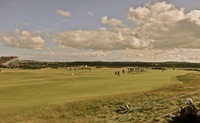 The 7th (left) and (11th). Imagine swapping the hole locations one day to give players a fresh look? (Click to enlarge)So with that in mind, I'm wondering if the R&A is really getting the most out of the Old Course with their setup? This year things were not helped by a consistent wind direction over four days, but why not throw so major twists into the setup? Say, play the seventh hole to the eleventh green area and move eleven down nearer the seventh (this would require moving the scoreboard).
Or perhaps play the second hole to the sixteenth green one day and the sixteenth to the second? In other words, maximize the looks that players get over four days? After all, if there's any place you should be doing varied day-to-day setup, isn't the Old Course the one?
I did see one stellar mixing up move, when the 5th was played up front all three days, usually 12 to 15 paces from the front. Sunday, the hole was cut 85 paces deep into the green!
So should the R&A do more of that or would players and media howl when they fail to use the "traditional" hole locations?
Darren Carroll's Gigapan shot of the Home hole is up and while it's spectacular, I can't help but wonder how fun it would be to put one of these cameras up on a crane and shoot down on the Old Course's key holes so that we could zoom in and study the features.
Golf.com offers an alternative in the form of time-elapsed video. As great as it is, I think it'd be more fun to have one of these in the media lunch room to watch us scribes work the free buffet provided by the R&A (and it was quite good too).
It's a week after the Open contestants were arriving in St. Andrews, but it's fun to read Steve Elling's extensive account of first timer Jeff Overton's adventure to get there and his efforts to figure the place out.
The highlight of the day was when Overton walked along the gravel path and a rock wall situated down the right side of the 14th hole and blurted out, "Is this the Road Hole?"
Yep, he's truly an impressionable, wide-eyed first-timer. The most famous par-4 in the world, the Road Hole is actually the 17th. Before we arrive, some of the oddly named bunkers along the way were pointed out, like the Hell Bunker on the 14th and Principal's Nose, a cluster of three pot bunkers on the 16th.
After a T-11, sounds like Overton got to know the place pretty well. And the $20,000 in plane tickets was worth it!
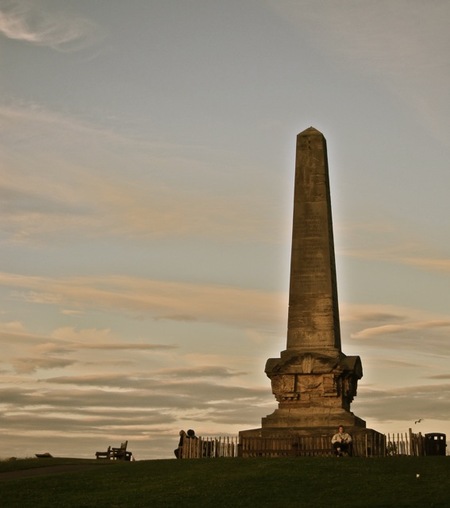
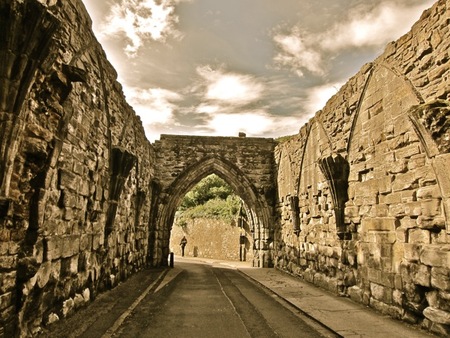
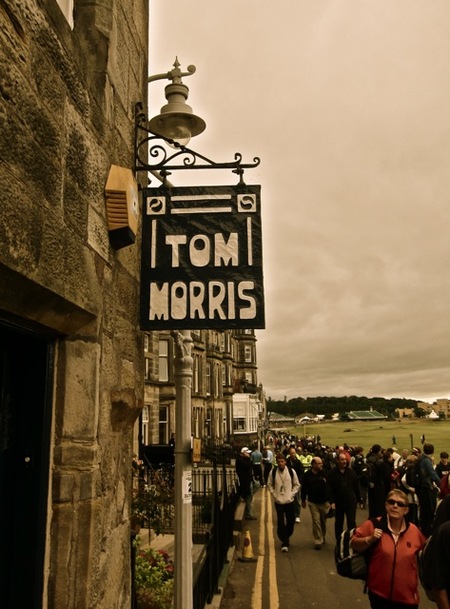
And a few more scenes from the town and Home of Golf. I hope you enjoy them. I sure enjoyed being there.


 After all the will he or won't he talk, Monty didn't include Jose Maria Olazabal in his assistant captain's club but does have Darren Clarke on board, even though Clarke could be a candidate for the team if he continues his excellent play.
Either way, they are the reddest group I've ever seen.
Neither was there a place for Jose Maria Olazabal, the single vice-captain to Sir Nick Faldo during the defeat two years ago at Valhalla, Kentucky and the likely European captain for the 2012 match at Medinah, Illinois. The Spaniard suffers from a rheumatic ailment and as a result his schedule has been limited this year.
That does not fit with captain Montgomerie’s policy of appointing current players who play week-in, week-out and are known well to the ones likely to make the team that will be finalised on August 29 at the end of the Johnnie Walker Championship at Gleneagles.
A display at the British Golf Museum, just across from the Royal and Ancient clubhouse. A must visit next time you are at St. Andrews.
This is what you call a lifelike exhibit.

Put me for every five years. After seeing that it lives up to the perfect place for a tournament, more often would be great. But I understand the need to move it around.
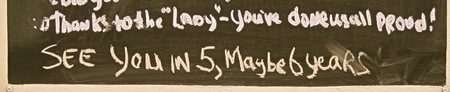
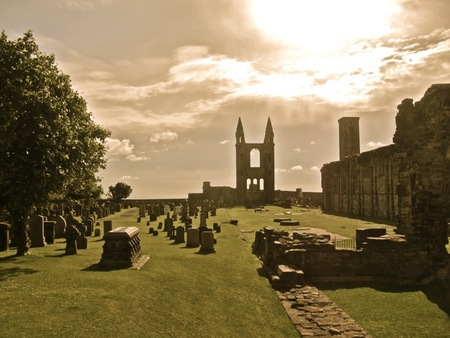
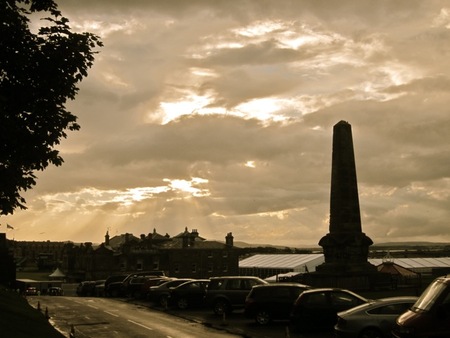
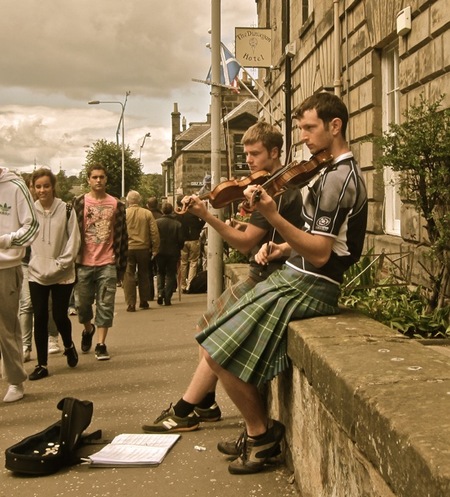
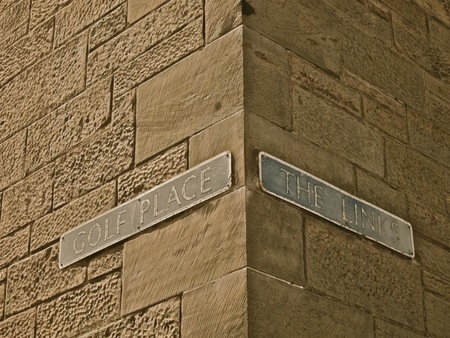
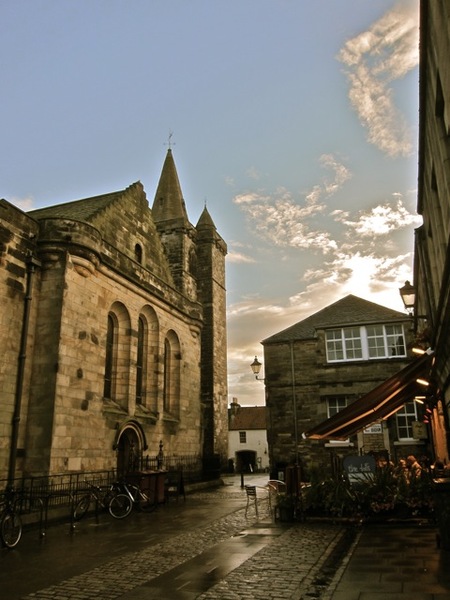
Posting will be intermittent the next few days so there'll be lots of images to look at. Here are just a few shots from the town during Open Championship week. Click on the image to enlarge.

Joe Posnanski files a different take on the state of Tiger's game.
And frankly… there’s good reason to write him off. This may sound cruel but I actually mean it as the opposite of cruel: More people SHOULD be writing off Tiger Woods.
First, he will turn 35 at the end of the year. There has been talk that this means Woods will still be in his golfing prime for the next few years, but history tells a different story. Since 1970, the average age of major championship winners is 32, and things tumble off for golfers after age 35. Fewer than a quarter of the major championship winners have been 36 or older. The only players since 1970 to win multiple majors after 35 are: Jack Nicklaus (4), Gary Player (4), Ray Floyd (2), Nick Price (2), Vijay Singh (2), Mark O’Meara (2), Angel Cabrera (2), Padraig Harrington (2).
More to the point, Woods has been dominant for a dozen years — which is a long time to dominate in golf. The greatest golfers have had a fairly short window of time when they dominate, and when that window closes, they stop winning major championships.
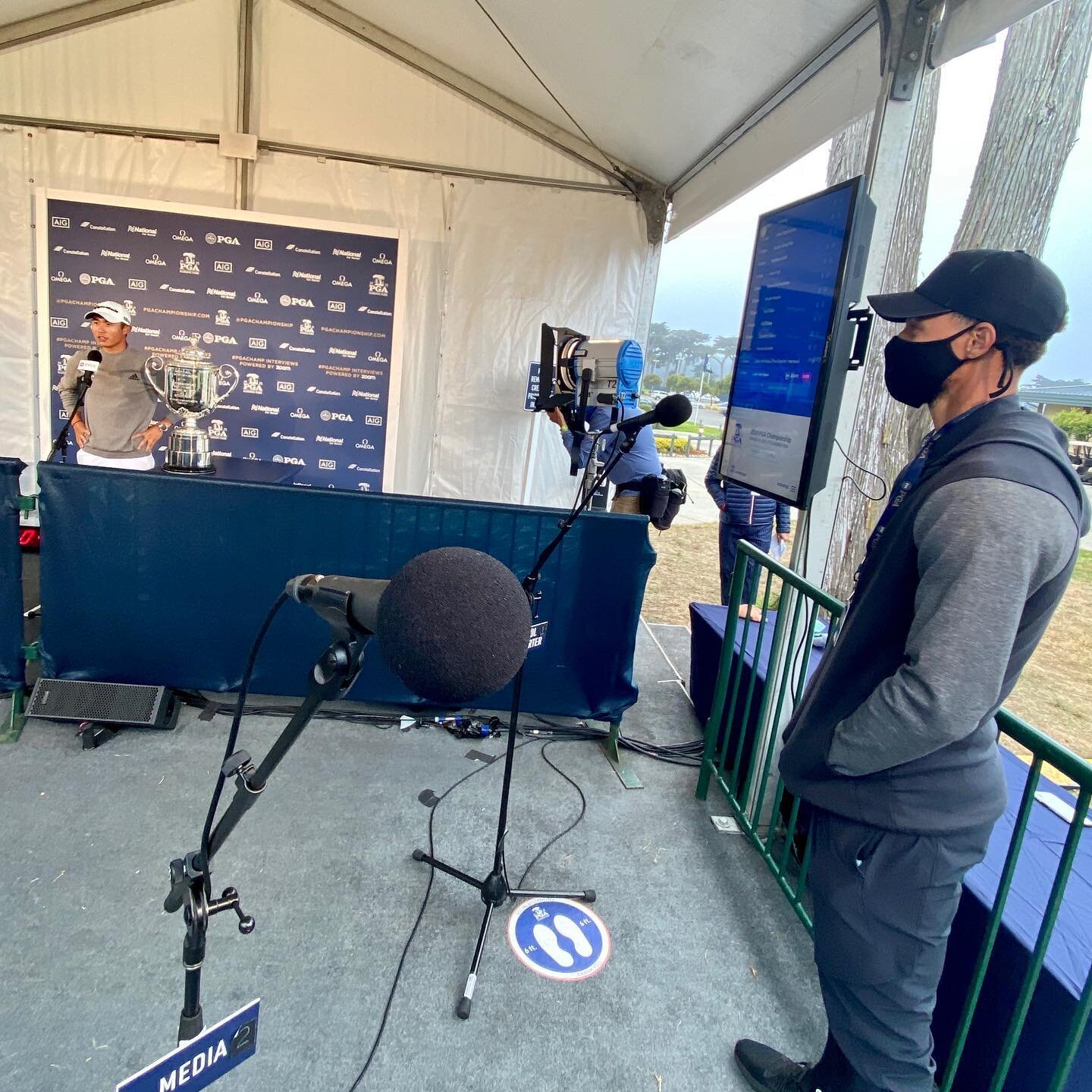
 The Champion poses at the Swilken Bridge Monday after a press conference (click to enlarge)Or a little of both?
I'm pretty sure if Tiger, Phil, Lee, Ernie, even Paul, Rory or Martin posted the winning margins Louis Oosthuizen did, they'd call it one of the great performances in the history of the game.
There's little question he ended up having a great draw, but remember back to Thursday it was thought to be the wrong end of the draw!
Thoughts?
Thanks to read Amol for spotting this Jason Dufner post about Friday's wind and the suspension of play:
just a note about the delay on friday, so everyone has a clear idea of what happened. not that it matters much now 2 days latter, but it clears my name a little bit
had a 10ft putt on the 7th hole, as i placed the ball down it rolled away aprox 2ft. At that point i called a official over to make sure on the rule. was told to play it where it was, remarked the ball. Went to put the ball down again, rolled away another half a foot. The official saw it this time and got on his radio to report to whoever in the rules department about what was happening. Told to wait for another official to come over. Tell the next official what had just happened, he then gets on his radio to report what has happened to who i assumed was the central rules office. He then tells me to wait while they figure out what they want to do. 3-5 mins pass, the 2nd rules official then tells me to putt. i take 30 secs to putt, and miss. Then i have a 6 inch putt to tap in, as i go to stroke the ball, it is rocking back and forth, i turn and ask if that is considered a moving ball??? He tells me to mark and then proceeds to blow the horn 20 secs later to suspend play. At no point did i tell anyone i was not playing or that i refuse to play in these conditions. just wanted to clear the air with the real version of what had happened, instead of what tv or everyone else may have assumed to happen. i would never quit or tell a rules department when we should play or not play. and i did tell a reporter that the conditions were ridiculous , bc that is what they were. hope that clears a little up to all that have followed or commented on this topic. all the best to golfwrx followers. jason dufner
Peter Dawson today on the 17th hole's setup and performance:
Q. Just going back to the golf course for a moment, the 17th hole we spoke about before the championship began, and you said, Peter, that players have been very complimentary about the changes that have been made. They were all quite critical of the amount of rough up the left‑hand side and felt it was out of character with what was on the rest of the golf course. What are your thoughts on that? And also, why did you change the boundaries of the golf course so late in the week? What was the thinking there?
PETER DAWSON: Well, I do agree with Graeme that the rough left of 17 ought to have been somewhat thinner, but it grew away very rapidly amazingly in the two or three weeks running up to the championship, having been pretty much how we wanted it two to three weeks ago.
I think the 17th tee has been a great success in terms of stiffening the test of that hole. I said that at the beginning of the week, we were hoping that the road might come more back into play, and by gosh, it did. We had far more people on the road this year through the back of the hole than I've seen at previous Opens in recent times. To that degree we are very pleased with the hole, and the player comments by and large have been very positive.
I heard about Graeme's comments. I was out with Graeme when he was here practising and didn't receive any such comments, so I'm not sure if he's been misquoted or not, but the player reaction by and large has been extremely good.
He definitely was not misquoted, as it appears in the transcript of McDowell's presser:
Q. Can I ask you about the changes made to the Road Hole and what level of influence it will have on determining the outcome of this championship?
GRAEME McDOWELL: Yeah, I mean, the Road Hole has obviously been steeped in drama over the years here at the British Open at St. Andrews, and it's a difficult hole, and they've made it more difficult. I think architecturally the tee box fits in beautifully, just like it's been there forever. It really looks like part of the golf course. It looks really good.
You know, if anything, it's probably going to make me play the hole a little bit more conservatively because you're going in with 4- or 5-iron into a green, which was really difficult to hit with an 8-iron. The wind today was in out of the left, so I hit a really good drive and I had 170 to the front edge. So I had like a 6-iron onto the front edge of the green, and that's going to be my target to probably three out of the four pins.
The left rough there is probably some of the thickest on the golf course. You know, they've taken a hard hole and made it really, really hard. Yeah, there's going to be a lot of drama there. Like I say, I think guys are going to play it more conservative than they have. I don't think they're going to be taking pins on. When you have a 7- or 8-iron in your hand, it's pretty tough to ignore a pin. When you have a 4- or 5-iron you can ignore a pin. I see that as the only change. I see less bunkers because of it and I see less balls in the road because of it. So from that point of view, perhaps it might take the drama out of it. We'll see.
The other press conference highlight, showing a new level of attention to detail to bunker design by architect Dawson:
Q. What's an inclinometer? Obviously it says what it does. But is that a proper name? Secondly, what was the angle of the face in 2005? And who decided and what was the thinking behind it not being the same this year as then? And fourthly, was the face of the bunker reverted three weeks ago? I read something about that before. Are they all connected?
PETER DAWSON: What happened three or four weeks ago was just a tidying‑up exercise. The fundamental construction of the bunker was earlier than that.
An inclinometer is a proper name.
I don't know the answer to 2005; I can't remember, but I think it was three or four degrees steeper. And the reasoning behind it was that we wanted to give the players some kind of chance of getting out rather than no chance.
Geoff Shackelford is a Senior Writer for Golfweek magazine, a weekly contributor to Golf Channel's Morning




Copyright © 2022, Geoff Shackelford. All rights reserved.