Portrush Remains (Sort Of) On R&A Radar Screen
/Bob Harig on the question of Portrush's prospects raised during Wednesday's R&A press conference. Peter Dawson:
When you come to think of it that is the secret of most of the great holes all over the world. They all have some kind of a twist. C.B. MACDONALD

Bob Harig on the question of Portrush's prospects raised during Wednesday's R&A press conference. Peter Dawson:
Other tours and governing bodies now just throw up their hands, shrug their shoulders and give the "it's always been that way" answer to slow play questions.
Not for the R&A's Championship Committee head Jim McArthur, with a nice assist from Peter Dawson!
 Lauren at Parenting.com (really!) says McDain's Restaurant & Golf Center outside of Pittsburgh, "may have just won the award for America's least kid-friendly restaurant" after owner Mike Vuick banned kids under the age of six from dining there.
I hadn't looked very closely at the story on 6-year-old Reagan Kennedy who made a hole in one this week.
Are you kidding me with the name?
The Links at Ireland Grove? ;)
It can be a little tricky figuring out broadcast times, but things are getting simpler with ESPN going live on all, gulp, platforms. If you want simple, golf.com posts a basic viewing guide.
 Gambling on The Open is part of the tournament's essence, so even though this family values website does not condone such heathenness, as a full service blogger I'm obligated to steer you to helpful information from your fellow mongrels.
BetRepublic looks at some of the more intriguing "matchup" bets.
Jim McCabe makes this key point about the weather and the potential for an unlucky draw.
While dry and partly sunny weather is predicted for Rounds 1 and 2, the wind is expected to pick up as things go along, to the point where by Friday afternoon, it could be ripping at perhaps 25 mph.
Studying such news, none other than Harry “The Hat” Emanuel suggests we could have a situation similar to last year at St. Andrews, where those who had benign weather Thursday morning had fierce conditions Friday afternoon and saw their chances blown away – most notably Rory McIlroy (63-80) and Ernie Els (69-79).
Ian Chadband talks to host pro Andrew Brooks, who has some interesting insights into what kind of attributes the Royal St. George's favors, with a shock pick for the win.
Steven Rawlings gives one punter's perspective at the Betfair blog, seizing on the lack of rough to advocate some of the longer hitters.
Golfweek posts 20 players to watch.
Jeff Rude bats arounds some names and seems to like Jason Day along with talent over experience.
PGATour.com's expert picks includes one Ben Curtis selection.
Golfobserver's Sal Johnson has crunched the numbers and offers his selections.
**Alex Myers with his Fantasy Fix column at GolfDigest.com, highlights some obvious and not-so-obvious names.
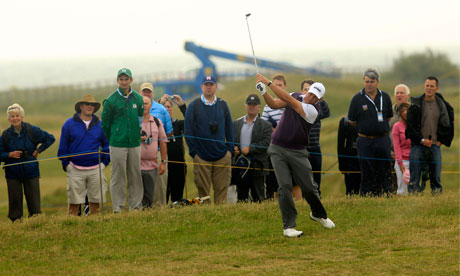 I've noticed a recurring theme in a few stories about the course: the R&A addressed complaints by widening fairways and keeping the rough tame. Uh, let's give credit where credit is due: the Golf Gods have kept Sandwich dry and therefore, at least based on the player comments I could find, the course is going to present itself well thanks to the lack of tall grass lining the fairways that has become an R&A staple to slow down swelling driving distances.
 Brian Keough reports that Bubba has become known in Europe as "Blubba Watson" after his French Open complaining, and that Bubba denies snubbing a fellow player needing a ride. And you might want to note this if you were contemplating putting Bubba on your fantasy team this week.
 Thanks to reader Tim for this cool BBC helicopter-shot video of Royal St. George's and the surrounding area, including a great look at the place Viagra was discovered, Royal Cinque Ports and Ian Fleming's house.
The higher the ball flight, the worse the landing on a fairway hillock, goes Peter Dawson's theory revealed yesterday in a story by John Huggan.
Now Mike Stachura has tracked down a professor who confirms. Fasten your seat belts!
But here's the bit that justifies Dawson's explanation of projectile motion. Basically, a projectile like a golf ball has two velocity components, a horizontal one and a vertical one, as Martin Brouillette, professor of mechanical engineering at the University of Sherbrooke and a member of the Golf Digest Technical Panel explains: "Assuming two cases with the same landing velocity but with different landing angles, the case with the steeper landing angle has a smaller horizontal velocity component, therefore a greater vertical velocity component. This greater vertical velocity component, upon interacting with a tilted landing surface, is more likely to produce a greater sideways velocity component."
Therefore, play the stinger...less sideways velocity component. Oh wait.
***** Stachura writes:
Of course, a ball that's rolling over those awkward angles is going to be dramatically affected; one that's flying by those humps and bumps won't be bothered by them at all.
Maybe we could read more about this theory in the USGA/R&A ball study? After all, we're 8 years in, I assume this theory is covered?
Geoff Shackelford is a Senior Writer for Golfweek magazine, a weekly contributor to Golf Channel's Morning






Copyright © 2022, Geoff Shackelford. All rights reserved.